

Here's something you might be interested in.
Ask a Hipster — Advice you didn't know you needed
Big Screen — Movie commentary
Blurt — Music's inside track
Booze News — San Diego spirits
Classical Music — Immortal beauty
Classifieds — Free and easy
Close to Home — What it’s like on the street where you live
Cover Stories — Front-page features
Drinks All Around — Bartenders' drink recipes
Excerpts — Literary and spiritual excerpts
Feast! — Food & drink reviews
Feature Stories — Local news & stories
Fishing Report — What’s getting hooked from ship and shore
From the Archives — Spotlight on the past
Golden Dreams — Talk of the town
The Gonzo Report — Making the musical scene, or at least reporting from it
Letters — Our inbox
Movies@Home — Local movie buffs share favorites
Movie Reviews — Our critics' picks and pans
Musician Interviews — Up close with local artists
Neighborhood News from Stringers — Hyperlocal news
News Ticker — News & politics
Obermeyer — San Diego politics illustrated
Outdoors — Weekly changes in flora and fauna
Overheard in San Diego — Eavesdropping illustrated
Poetry — The old and the new
Reader Travel — Travel section built by travelers
Reading — The hunt for intellectuals
Roam-O-Rama — SoCal's best hiking/biking trails
San Diego Beer — Inside San Diego suds
SD on the QT — Almost factual news
Sheep and Goats — Places of worship
Special Issues — The best of
Street Style — San Diego streets have style
Surf Diego — Real stories from those braving the waves
Theater — On stage in San Diego this week
Tin Fork — Silver spoon alternative
Under the Radar — Matt Potter's undercover work
Unforgettable — Long-ago San Diego
Unreal Estate — San Diego's priciest pads
Your Week — Daily event picks
Theater Review: Jaja's African Hair Braiding at La Jolla Playhouse
Mostly winsome, mostly winning, always assured
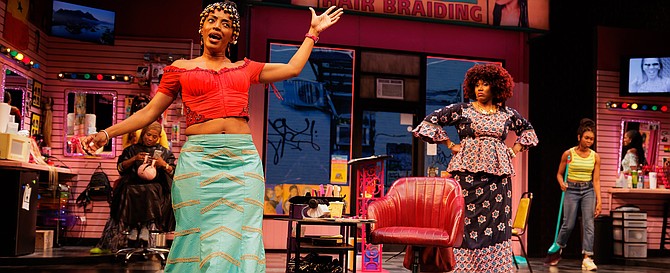
Near the end of Jocelyn Bioh’s mostly winsome, mostly winning play set in a Harlem hair braiding salon, a woman who came in near the beginning and ordered microbraids says to the staff, “Thank you for this; I feel like I moved in for the day.” Comes the quick reply, “You did.” And just as a house is not the same as a home, simply being in a place is not the same as moving in. Ms. Microbraid may have annoyed the crew when she ordered up the most finger-taxing option, but that didn’t stop them from letting her in on the life of the place.
Her main involvement comes through her braider Miriam, who tells the story of the daughter and the disastrous marriage she left back in Sierra Leone. (Men don’t show too well here: besides the lazy, no-fun, impotent, violent jerk who accuses Miriam of being a witch after she runs around on him — but before she runs out on him — one is a slick playboy who causes the whole place to flinch when he says “May God strike me down if I’m lying,” one is a sweet but pitiful peddler, and one is a white dude who is marrying owner Jaja under inauspicious circumstances. She’ll get her papers, but her employees don’t think she’ll get much else. Phew!) It’s a testament to both Bioh’s writing and Bisserat Tseggai’s acting that this extended bit of tell-don’t-show is as engaging as it is. The word that came to mind, here and almost everywhere else, was “assured.” Which was impressive, given the territory the cast had to navigate; at several points, these ladies walked up to the borderline of comedic caricature — imperious Bea gets laughs by sniffing at a doctor “telling me my blood pressure is high. How do he know?” (Well, presumably, by the cuff he’s just strapped onto your arm, which he told you would measure your blood pressure?) But Claudia Logan’s blessed assurance was powerful enough to pull the moment back into the realm of character.
Mostly, however, Ms. Microbraid moves in by listening in — just like the audience — and oh boy, is there a lot to listen in about. The drama is thicker than the 100-degree air outside, starting with whether or not the air conditioner will last the day. (Ditto the hair supply.) It’s there between two stylists over the question of stolen customers, between one of those stylists and one of those customers, between that same stylist and the owner who “stole my idea for this place,” between the owner and her daughter over whether the girl will be a doctor or a writer and whether or not she will attend an Ivy League school...you get the idea. It’s more than can possibly be resolved, and Bioh knows it — so she doesn’t resolve it. The real drama here is off-stage, where Jaja is preparing for her wedding, the wedding that will mean her daughter can stop using her cousin’s identity…
I have to grant, the diablo ex machina that serves as the play’s climax makes sense. You’ve got all these day-to-day dreams and day-to-day problems, but they don’t mean anything when disaster strikes. And it’s not like we weren’t warned. And the ending, after a bit of clunky speechifying — “This country is fine with taking, they’re even fine with our giving, but the minute you ask...” — is both sweet and smart. But it’s what happened inside the salon that made us love these people and this play, and I found myself wishing that we could have stayed inside its cheerful confines. Maybe that’s the point.
Here's something you might be interested in.
Theater Review: Jaja's African Hair Braiding at La Jolla Playhouse
Mostly winsome, mostly winning, always assured

Theater Review: Jaja's African Hair Braiding at La Jolla Playhouse
Mostly winsome, mostly winning, always assured
Near the end of Jocelyn Bioh’s mostly winsome, mostly winning play set in a Harlem hair braiding salon, a woman who came in near the beginning and ordered microbraids says to the staff, “Thank you for this; I feel like I moved in for the day.” Comes the quick reply, “You did.” And just as a house is not the same as a home, simply being in a place is not the same as moving in. Ms. Microbraid may have annoyed the crew when she ordered up the most finger-taxing option, but that didn’t stop them from letting her in on the life of the place.
Her main involvement comes through her braider Miriam, who tells the story of the daughter and the disastrous marriage she left back in Sierra Leone. (Men don’t show too well here: besides the lazy, no-fun, impotent, violent jerk who accuses Miriam of being a witch after she runs around on him — but before she runs out on him — one is a slick playboy who causes the whole place to flinch when he says “May God strike me down if I’m lying,” one is a sweet but pitiful peddler, and one is a white dude who is marrying owner Jaja under inauspicious circumstances. She’ll get her papers, but her employees don’t think she’ll get much else. Phew!) It’s a testament to both Bioh’s writing and Bisserat Tseggai’s acting that this extended bit of tell-don’t-show is as engaging as it is. The word that came to mind, here and almost everywhere else, was “assured.” Which was impressive, given the territory the cast had to navigate; at several points, these ladies walked up to the borderline of comedic caricature — imperious Bea gets laughs by sniffing at a doctor “telling me my blood pressure is high. How do he know?” (Well, presumably, by the cuff he’s just strapped onto your arm, which he told you would measure your blood pressure?) But Claudia Logan’s blessed assurance was powerful enough to pull the moment back into the realm of character.
Mostly, however, Ms. Microbraid moves in by listening in — just like the audience — and oh boy, is there a lot to listen in about. The drama is thicker than the 100-degree air outside, starting with whether or not the air conditioner will last the day. (Ditto the hair supply.) It’s there between two stylists over the question of stolen customers, between one of those stylists and one of those customers, between that same stylist and the owner who “stole my idea for this place,” between the owner and her daughter over whether the girl will be a doctor or a writer and whether or not she will attend an Ivy League school...you get the idea. It’s more than can possibly be resolved, and Bioh knows it — so she doesn’t resolve it. The real drama here is off-stage, where Jaja is preparing for her wedding, the wedding that will mean her daughter can stop using her cousin’s identity…
I have to grant, the diablo ex machina that serves as the play’s climax makes sense. You’ve got all these day-to-day dreams and day-to-day problems, but they don’t mean anything when disaster strikes. And it’s not like we weren’t warned. And the ending, after a bit of clunky speechifying — “This country is fine with taking, they’re even fine with our giving, but the minute you ask...” — is both sweet and smart. But it’s what happened inside the salon that made us love these people and this play, and I found myself wishing that we could have stayed inside its cheerful confines. Maybe that’s the point.
Comments