

Here's something you might be interested in.
Ask a Hipster — Advice you didn't know you needed
Big Screen — Movie commentary
Blurt — Music's inside track
Booze News — San Diego spirits
Classical Music — Immortal beauty
Classifieds — Free and easy
Close to Home — What it’s like on the street where you live
Cover Stories — Front-page features
Drinks All Around — Bartenders' drink recipes
Excerpts — Literary and spiritual excerpts
Feast! — Food & drink reviews
Feature Stories — Local news & stories
Fishing Report — What’s getting hooked from ship and shore
From the Archives — Spotlight on the past
Golden Dreams — Talk of the town
The Gonzo Report — Making the musical scene, or at least reporting from it
Letters — Our inbox
Movies@Home — Local movie buffs share favorites
Movie Reviews — Our critics' picks and pans
Musician Interviews — Up close with local artists
Neighborhood News from Stringers — Hyperlocal news
News Ticker — News & politics
Obermeyer — San Diego politics illustrated
Outdoors — Weekly changes in flora and fauna
Overheard in San Diego — Eavesdropping illustrated
Poetry — The old and the new
Reader Travel — Travel section built by travelers
Reading — The hunt for intellectuals
Roam-O-Rama — SoCal's best hiking/biking trails
San Diego Beer — Inside San Diego suds
SD on the QT — Almost factual news
Sheep and Goats — Places of worship
Special Issues — The best of
Street Style — San Diego streets have style
Surf Diego — Real stories from those braving the waves
Theater — On stage in San Diego this week
Tin Fork — Silver spoon alternative
Under the Radar — Matt Potter's undercover work
Unforgettable — Long-ago San Diego
Unreal Estate — San Diego's priciest pads
Your Week — Daily event picks
Fish Report: Hot fishing before it gets hot in Gonzaga
Plus: Kayaked yellowtail off La Jolla, getting your ducks in a row before going to Mexico
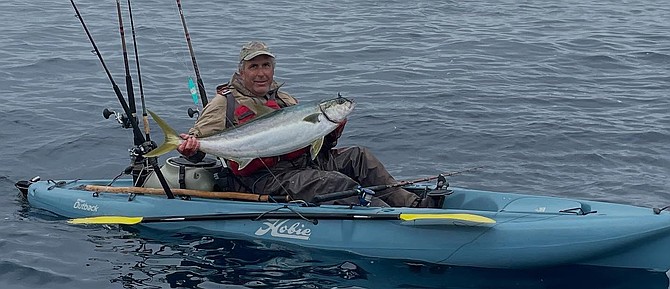
Matt Rabasco with a nice chunky yellowtail caught outside the reserve off La Jolla by kayak.
Dock Totals 5/18 – 5/24: 1751 anglers aboard 75 half-day to 3-day trips out of San Diego landings over the past week caught 17 barracuda, 367 bluefin tuna (to 180 pounds), 559 bonito, 1 cabezon, 729 calico bass, 4 halibut, 13 lingcod, 3610 rockfish, 17 sand bass, 30 sanddab, 84 sculpin, 23 sheephead, 189 whitefish, 4 white seabass, and 87 yellowtail.
Saltwater: With the first day of summer less than a month away, more anglers are making their way to the landings and getting out on the water. And while bluefin are still holding in the same offshore areas where they have been for the past couple of months, yellowtail fishing has been heating up along the coast. And because the offshore bluefin tuna have been biting best at night, the Tribute, for one, has been running reverse 1.5-day trips to allow more nighttime fishing outside, while at the same time snagging a little coastal or paddy action on yellowtail in daylight before heading back to the dock.
These 1.5-day trips have proved a success, though it should be noted that if conditions are too rough offshore, they may cancel, as most of the anglers who booked trips were anticipating bluefin action and not a coastal trip. I admire the fleet's dedication to its anglers here: cancelling a trip with 30 booked spots costs the operation a lot of money. But as these trips were specifically timed to target the nighttime bite for bluefin, it just wouldn’t be right to take the anglers down to fish along the beach. Happily, as we move into summer, these occasional spring blows should taper off substantially and offshore counts should improve as a result.
White seabass are still biting well at Catalina Island, especially if live squid are around, and yellowtail have been showing along the beach as the water warms. San Diego angler Matt Rabasco landed a nice one while kayak fishing off La Jolla this week. A brief word on kayaks: it was well over a quarter century ago that anglers started modifying rotomolded plastic sit-on-top kayaks for fishing out of La Jolla, a fad that grew into a multi-billion-dollar industry, thanks to their ability to access fisheries on a small budget. My first kayak was a Scupper Pro TW that cost me $400, slightly used. I put a fish finder and bait tank on it for under $200. I have fished from that kayak ever since, and have put tons of fish on it over the decades.
In those early days in La Jolla, we had to make our own accessories and mounts. But now, kayak fishing has bloomed into a worldwide sport with tournaments in both fresh and saltwater venues, and you can spend $5000 on a fully-fitted pedal kayak specifically made for fishing. These days, I spend more time south of the border, but it is nice to see that Matt and others are still paddling out through the break at La Jolla Shores and getting them.
Fishing down south has been epic in the upper/mid Sea of Cortez, with yellowtail, cabrilla, and snapper topping the catches. Amigo Captain Juan Cook has been slaying them for his clients on a steady basis while fishing along the coast and at the Golden Reef on his comfy Grady White. This is a great time of year to head south as fishing heats up before the daytime temps get high enough to drive you into the shade or air conditioning by noon or so by July.
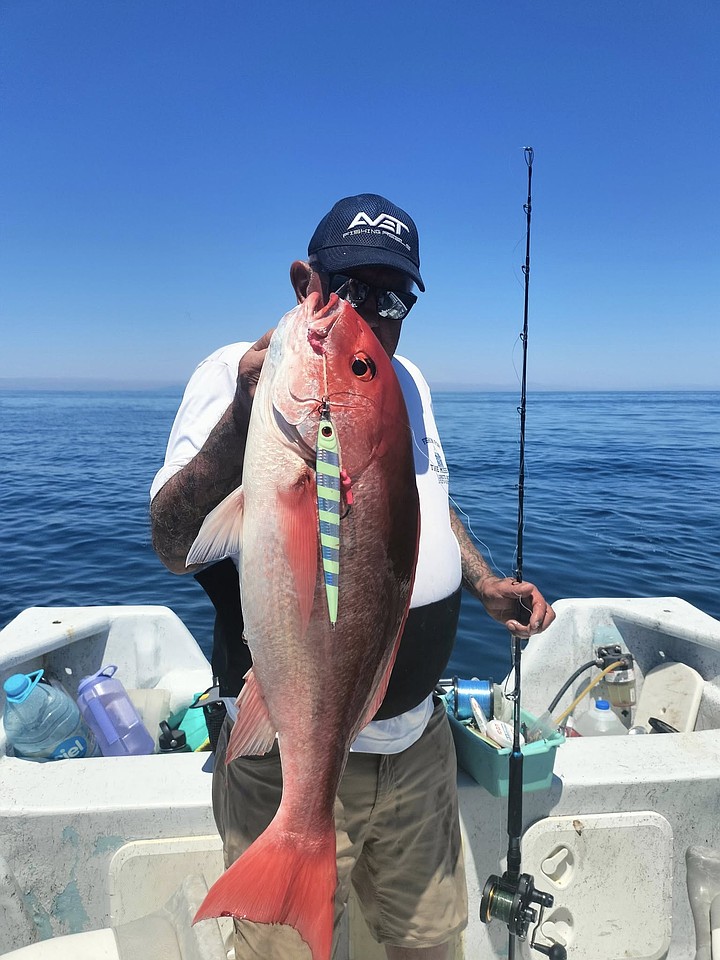
Juan Cook with a nice huachinango, aka red snapper, caught from the Golden Reef near Bahia de San Luis Gonzaga.
Bahia de San Luis Gonzaga is an easy day’s drive from the border if you cross at first light, whether going through Tijuana and along the Pacific route then across at Laguna Chapala, or over to Mexicali and down through San Felipe. Just be sure to have all your ducks in a row: Mexican car insurance and Forma Migration Multiple (FMM) being two necessities to be legally in country in your car. The registered owner of the car need be in the car, as well. A Mexican fishing license is required when fishing from any platform (boat, kayak, float tube), but if you're fishing from shore,there is no license required.
Though many folks travel to Baja to fish without getting their FMMs and insist it is no big deal to not have one, it has been legally required for over a decade in its current form, and there is no "free zone." All who enter Mexico needs to stop and get their FMM at the INM office at the border. You can get them online, but you still must stop and get them stamped at the port of entry. (The process usually takes me no more than ten minutes at the border, so I have not bothered with doing it online.) The FMM is free for up to 7 days, and 861 pesos (about $45) for 8 to 180 days. Also, if you like traveling with your dog as I do, you should check to make sure you meet the CDC requirements for bringing dogs into the U.S. Those requirements apply to all dogs, even your pets that traveled down with you.
Heads up: San Diego Fish Processing is holding an Open House/ Vendor Day at their facility at 1842 McKinley Avenue, National City, from noon until 5 pm on Saturday, May 31. There will be live music, facility tours, food, and vendors set up as well as raffles for gear and swag. This will be a great opportunity to check out just how fish are processed and packaged properly to get the best quality and longevity for your self-caught table fare. Whether the beach, bay, lake, or offshore, they’re out there so go out and get ‘em!
Here's something you might be interested in.
Fish Report: Hot fishing before it gets hot in Gonzaga
Plus: Kayaked yellowtail off La Jolla, getting your ducks in a row before going to Mexico

Fish Report: Hot fishing before it gets hot in Gonzaga
Plus: Kayaked yellowtail off La Jolla, getting your ducks in a row before going to Mexico
Matt Rabasco with a nice chunky yellowtail caught outside the reserve off La Jolla by kayak.
Dock Totals 5/18 – 5/24: 1751 anglers aboard 75 half-day to 3-day trips out of San Diego landings over the past week caught 17 barracuda, 367 bluefin tuna (to 180 pounds), 559 bonito, 1 cabezon, 729 calico bass, 4 halibut, 13 lingcod, 3610 rockfish, 17 sand bass, 30 sanddab, 84 sculpin, 23 sheephead, 189 whitefish, 4 white seabass, and 87 yellowtail.
Saltwater: With the first day of summer less than a month away, more anglers are making their way to the landings and getting out on the water. And while bluefin are still holding in the same offshore areas where they have been for the past couple of months, yellowtail fishing has been heating up along the coast. And because the offshore bluefin tuna have been biting best at night, the Tribute, for one, has been running reverse 1.5-day trips to allow more nighttime fishing outside, while at the same time snagging a little coastal or paddy action on yellowtail in daylight before heading back to the dock.
These 1.5-day trips have proved a success, though it should be noted that if conditions are too rough offshore, they may cancel, as most of the anglers who booked trips were anticipating bluefin action and not a coastal trip. I admire the fleet's dedication to its anglers here: cancelling a trip with 30 booked spots costs the operation a lot of money. But as these trips were specifically timed to target the nighttime bite for bluefin, it just wouldn’t be right to take the anglers down to fish along the beach. Happily, as we move into summer, these occasional spring blows should taper off substantially and offshore counts should improve as a result.
White seabass are still biting well at Catalina Island, especially if live squid are around, and yellowtail have been showing along the beach as the water warms. San Diego angler Matt Rabasco landed a nice one while kayak fishing off La Jolla this week. A brief word on kayaks: it was well over a quarter century ago that anglers started modifying rotomolded plastic sit-on-top kayaks for fishing out of La Jolla, a fad that grew into a multi-billion-dollar industry, thanks to their ability to access fisheries on a small budget. My first kayak was a Scupper Pro TW that cost me $400, slightly used. I put a fish finder and bait tank on it for under $200. I have fished from that kayak ever since, and have put tons of fish on it over the decades.
In those early days in La Jolla, we had to make our own accessories and mounts. But now, kayak fishing has bloomed into a worldwide sport with tournaments in both fresh and saltwater venues, and you can spend $5000 on a fully-fitted pedal kayak specifically made for fishing. These days, I spend more time south of the border, but it is nice to see that Matt and others are still paddling out through the break at La Jolla Shores and getting them.
Fishing down south has been epic in the upper/mid Sea of Cortez, with yellowtail, cabrilla, and snapper topping the catches. Amigo Captain Juan Cook has been slaying them for his clients on a steady basis while fishing along the coast and at the Golden Reef on his comfy Grady White. This is a great time of year to head south as fishing heats up before the daytime temps get high enough to drive you into the shade or air conditioning by noon or so by July.
Juan Cook with a nice huachinango, aka red snapper, caught from the Golden Reef near Bahia de San Luis Gonzaga.
Bahia de San Luis Gonzaga is an easy day’s drive from the border if you cross at first light, whether going through Tijuana and along the Pacific route then across at Laguna Chapala, or over to Mexicali and down through San Felipe. Just be sure to have all your ducks in a row: Mexican car insurance and Forma Migration Multiple (FMM) being two necessities to be legally in country in your car. The registered owner of the car need be in the car, as well. A Mexican fishing license is required when fishing from any platform (boat, kayak, float tube), but if you're fishing from shore,there is no license required.
Though many folks travel to Baja to fish without getting their FMMs and insist it is no big deal to not have one, it has been legally required for over a decade in its current form, and there is no "free zone." All who enter Mexico needs to stop and get their FMM at the INM office at the border. You can get them online, but you still must stop and get them stamped at the port of entry. (The process usually takes me no more than ten minutes at the border, so I have not bothered with doing it online.) The FMM is free for up to 7 days, and 861 pesos (about $45) for 8 to 180 days. Also, if you like traveling with your dog as I do, you should check to make sure you meet the CDC requirements for bringing dogs into the U.S. Those requirements apply to all dogs, even your pets that traveled down with you.
Heads up: San Diego Fish Processing is holding an Open House/ Vendor Day at their facility at 1842 McKinley Avenue, National City, from noon until 5 pm on Saturday, May 31. There will be live music, facility tours, food, and vendors set up as well as raffles for gear and swag. This will be a great opportunity to check out just how fish are processed and packaged properly to get the best quality and longevity for your self-caught table fare. Whether the beach, bay, lake, or offshore, they’re out there so go out and get ‘em!
Comments