

Here's something you might be interested in.
Ask a Hipster — Advice you didn't know you needed
Big Screen — Movie commentary
Blurt — Music's inside track
Booze News — San Diego spirits
Classical Music — Immortal beauty
Classifieds — Free and easy
Close to Home — What it’s like on the street where you live
Cover Stories — Front-page features
Drinks All Around — Bartenders' drink recipes
Excerpts — Literary and spiritual excerpts
Feast! — Food & drink reviews
Feature Stories — Local news & stories
Fishing Report — What’s getting hooked from ship and shore
From the Archives — Spotlight on the past
Golden Dreams — Talk of the town
The Gonzo Report — Making the musical scene, or at least reporting from it
Letters — Our inbox
Movies@Home — Local movie buffs share favorites
Movie Reviews — Our critics' picks and pans
Musician Interviews — Up close with local artists
Neighborhood News from Stringers — Hyperlocal news
News Ticker — News & politics
Obermeyer — San Diego politics illustrated
Outdoors — Weekly changes in flora and fauna
Overheard in San Diego — Eavesdropping illustrated
Poetry — The old and the new
Reader Travel — Travel section built by travelers
Reading — The hunt for intellectuals
Roam-O-Rama — SoCal's best hiking/biking trails
San Diego Beer — Inside San Diego suds
SD on the QT — Almost factual news
Sheep and Goats — Places of worship
Special Issues — The best of
Street Style — San Diego streets have style
Surf Diego — Real stories from those braving the waves
Theater — On stage in San Diego this week
Tin Fork — Silver spoon alternative
Under the Radar — Matt Potter's undercover work
Unforgettable — Long-ago San Diego
Unreal Estate — San Diego's priciest pads
Your Week — Daily event picks
Coastal Jacarandas are finally blooming, New moon brings high tides, June gloom is here
Mars is in the constellation of Leo
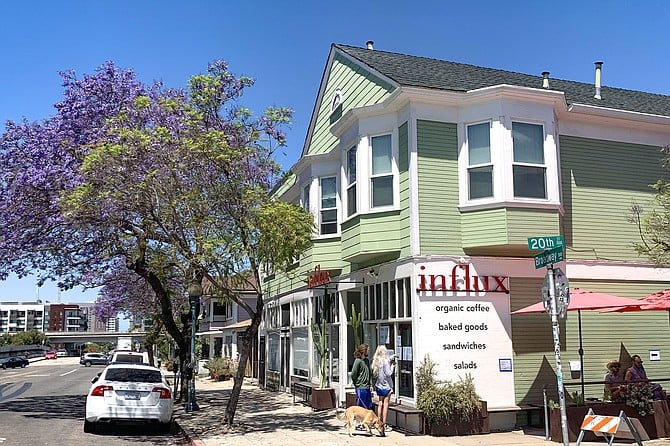
The springtime return of Influx Cafe to Golden Hill
Jacaranda Trees Started Blooming inland a couple of weeks ago, but those planted in coastal San Diego began showing their bluish-purple color just this past week. That's not unusual, as the blooms typically are triggered not only by increased light, but also by warmer days. Larger jacarandas — which are nearly leafless when in full bloom — display a myriad of delicate, trumpet-shaped blossoms. Seen from a distance, they look like clouds of lavender haze. Jacarandas commonly are used as landscaping in parks and on most college campuses. Long rows of them grace many of the streets Downtown; they can also be seen lining Rosecrans Boulevard in Point Loma, 25th Street in Golden Hill, and Mission Village Drive above Snapdragon Stadium.
Look Up In The Night Sky On May 26 and you’ll notice that the Moon is missing. That’s because the New Moon has arrived. It’s also a good day to start your summer garden. While the moon’s gravitational pull famously affects the ocean’s tides, the cycles of the moon also affect moisture levels in the soil and so assist in plant growth.
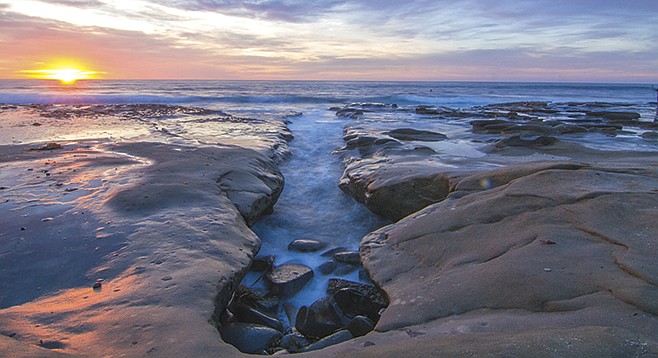
La Jolla tidepools
Some Extremely High Tides Are Occurring Monday, Tuesday and Wednesday this week. Highs measuring 7.45 feet on Monday at 9:17 pm, 7.38 feet on Tuesday at 10 pm, and 7.09 feet on Wednesday at 10:46 pm. Lows will reach -1.84 feet on Monday at 3:44 am, -2.03 feet on Tuesday at 4:33 am, and -1.97 feet on Wednesday at 5:23 am. These high tides can lead to coastal flooding in low-lying beach areas, but allow for great early-morning exploration of some normally inaccessible coastal areas — such as the La Jolla Caves — if you don't mind getting up a bit early.

Looking from Camp Pendleton(center) and down the southern California coastline, the phenomena known as May Gray or June Gloom hugs the coast.
“June Gloom,” The Generally Dreary, Overcast, Late-Spring Weather along San Diego’s coastline, has already arrived and could intensify next month. Occasionally, the low clouds will stick around for several days. The effect is usually triggered by a “Catalina eddy,” in which moist marine air drawn inland from the area around Santa Catalina Island forms low clouds over a wide area. In the absence of Catalina eddy conditions, San Diego’s inland areas, at least, experience plenty of midday and afternoon sunshine.
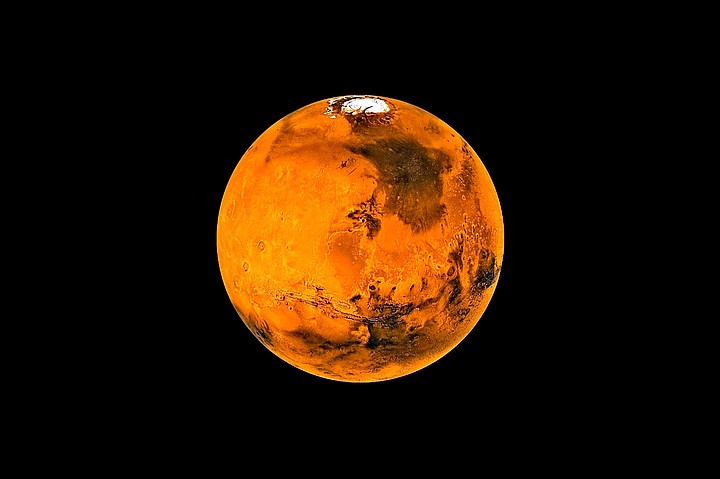
The red planet Mars, named for the Roman god of war, has long been an omen in the night sky.
May 31 Will Offer Another View Of Mars. Check the western sky about 30 minute after sunset, Mars is in the constellation of Leo, fading to a magnitude of 1.8. You can see them both just above the crescent moon.
Here's something you might be interested in.
Coastal Jacarandas are finally blooming, New moon brings high tides, June gloom is here
Mars is in the constellation of Leo

Coastal Jacarandas are finally blooming, New moon brings high tides, June gloom is here
Mars is in the constellation of Leo
The springtime return of Influx Cafe to Golden Hill
Jacaranda Trees Started Blooming inland a couple of weeks ago, but those planted in coastal San Diego began showing their bluish-purple color just this past week. That's not unusual, as the blooms typically are triggered not only by increased light, but also by warmer days. Larger jacarandas — which are nearly leafless when in full bloom — display a myriad of delicate, trumpet-shaped blossoms. Seen from a distance, they look like clouds of lavender haze. Jacarandas commonly are used as landscaping in parks and on most college campuses. Long rows of them grace many of the streets Downtown; they can also be seen lining Rosecrans Boulevard in Point Loma, 25th Street in Golden Hill, and Mission Village Drive above Snapdragon Stadium.
Look Up In The Night Sky On May 26 and you’ll notice that the Moon is missing. That’s because the New Moon has arrived. It’s also a good day to start your summer garden. While the moon’s gravitational pull famously affects the ocean’s tides, the cycles of the moon also affect moisture levels in the soil and so assist in plant growth.
La Jolla tidepools
Some Extremely High Tides Are Occurring Monday, Tuesday and Wednesday this week. Highs measuring 7.45 feet on Monday at 9:17 pm, 7.38 feet on Tuesday at 10 pm, and 7.09 feet on Wednesday at 10:46 pm. Lows will reach -1.84 feet on Monday at 3:44 am, -2.03 feet on Tuesday at 4:33 am, and -1.97 feet on Wednesday at 5:23 am. These high tides can lead to coastal flooding in low-lying beach areas, but allow for great early-morning exploration of some normally inaccessible coastal areas — such as the La Jolla Caves — if you don't mind getting up a bit early.
Looking from Camp Pendleton(center) and down the southern California coastline, the phenomena known as May Gray or June Gloom hugs the coast.
“June Gloom,” The Generally Dreary, Overcast, Late-Spring Weather along San Diego’s coastline, has already arrived and could intensify next month. Occasionally, the low clouds will stick around for several days. The effect is usually triggered by a “Catalina eddy,” in which moist marine air drawn inland from the area around Santa Catalina Island forms low clouds over a wide area. In the absence of Catalina eddy conditions, San Diego’s inland areas, at least, experience plenty of midday and afternoon sunshine.
The red planet Mars, named for the Roman god of war, has long been an omen in the night sky.
May 31 Will Offer Another View Of Mars. Check the western sky about 30 minute after sunset, Mars is in the constellation of Leo, fading to a magnitude of 1.8. You can see them both just above the crescent moon.
Comments