

Here's something you might be interested in.
Ask a Hipster — Advice you didn't know you needed
Big Screen — Movie commentary
Blurt — Music's inside track
Booze News — San Diego spirits
Classical Music — Immortal beauty
Classifieds — Free and easy
Close to Home — What it’s like on the street where you live
Cover Stories — Front-page features
Drinks All Around — Bartenders' drink recipes
Excerpts — Literary and spiritual excerpts
Feast! — Food & drink reviews
Feature Stories — Local news & stories
Fishing Report — What’s getting hooked from ship and shore
From the Archives — Spotlight on the past
Golden Dreams — Talk of the town
The Gonzo Report — Making the musical scene, or at least reporting from it
Letters — Our inbox
Movies@Home — Local movie buffs share favorites
Movie Reviews — Our critics' picks and pans
Musician Interviews — Up close with local artists
Neighborhood News from Stringers — Hyperlocal news
News Ticker — News & politics
Obermeyer — San Diego politics illustrated
Outdoors — Weekly changes in flora and fauna
Overheard in San Diego — Eavesdropping illustrated
Poetry — The old and the new
Reader Travel — Travel section built by travelers
Reading — The hunt for intellectuals
Roam-O-Rama — SoCal's best hiking/biking trails
San Diego Beer — Inside San Diego suds
SD on the QT — Almost factual news
Sheep and Goats — Places of worship
Special Issues — The best of
Street Style — San Diego streets have style
Surf Diego — Real stories from those braving the waves
Theater — On stage in San Diego this week
Tin Fork — Silver spoon alternative
Under the Radar — Matt Potter's undercover work
Unforgettable — Long-ago San Diego
Unreal Estate — San Diego's priciest pads
Your Week — Daily event picks
Now Playing: ON THE TOWN (1949)
We're going On the Town! Can I get a WOO WOO?
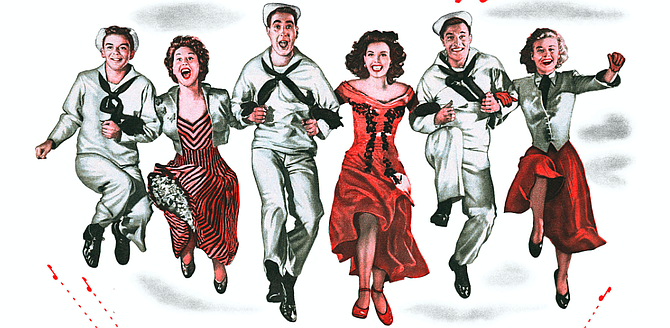
Frank Sinatra, Betty Garrett, Jules Munshin, Ann Miller, Gene Kelly, and Vera-Ellen invite you to join them for 24 hours!
Here we have a pair of groundbreaking firsts: On the Town was the first film to assign co-director credit to Gene Kelly and Stanley Donen. It was also the first musical to feature numbers filmed on location, in the streets of New York, as opposed to the Metro backlot. (It Happened in Brooklyn, shot two years earlier, doesn’t count; Frank Sinatra spent a couple of minutes alone singing on and to The Brooklyn Bridge — without once setting foot on pavement). Were it up to Donen and Kelly, the entire film would have been shot on location, but producer Arthur Freed was only able to squeeze a week out of the budget.
To this day, the viewer can still share in the gooseflesh an opening night audience must have experienced when Gabey (Gene Kelly), Chip (Frank Sinatra) and Ozzie (Jules Munshin) came shooting down the gangplank, each sailor clutching a 24-hour pass in his eager mitts and singing the praises of New York, New York — a “wonderful” town. The censors wouldn’t tolerate “helluva,” the profane lyric from Leonard Bernstein’s original Broadway score, and downgraded it to a more innocuous “wonderful.” That wasn’t all that was missing from the theatrical version: only 4 of Bernstein’s original numbers survived the leap from stage to screen. Roger Edens, a major player in the studio’s estimable “Freed Unit,” contributed six new compositions and shared the honors with Musical Director Lennie Hayton the night Oscars were handed out. Bernstein got the gate. (The composer’s sole bid for an Oscar was a nomination for his score to On the Waterfront.)
Video:
Trailer: ON THE TOWN

Our hoofing sailors are paired opposite a trio of Hollywood’s top tap-dancing tootsies: Gabey melts at the sight of "Miss Turnstile of the Month” (Vera-Ellen, pert and perky), Chip is left black-and-blue at the hands of aggressive taxi driver Brunhilde Esterhazy (Betty Garrett), and, lucky for Ozzie, his Neanderthal features bring out the beast in comely anthropologist Claire Huddesen (Ann Miller). The latter are the impetus for the film’s most memorable number, Prehistoric Man.
Donen and Kelly signed three pictures together. As with many great artistic collaborations, their efforts got progressively better. Singin’ in the Rain is, for many, the pinnacle of the American studio musical (and a letter-perfect history lesson of how the movies got their voice). Their final team-up, It’s Always Fair Weather, was intended as a sequel to On the Town. Rather than following three sailors through a 24-hour furlough, the time frame expands to a decade. The war is over, and our trio of soldiers vow to reconvene at their favorite watering hole, 10 years to the day, only to discover they wish they hadn’t. Sinatra and Munshin were unavailable, so Kelly was pitted against top shelf song-and-dance men Dan Dailey and Michael Kidd in the greatest downer musical this side of The Band Wagon.
No matter which end of San Diego County you live on, there's a showing in a theater near you:, On The Town screens Monday, May 25 at 7 pm at both the Angelika Film Center and Reading Grossmont.
Trailer:
Here's something you might be interested in.
Now Playing: ON THE TOWN (1949)
We're going On the Town! Can I get a WOO WOO?

Now Playing: ON THE TOWN (1949)
We're going On the Town! Can I get a WOO WOO?
Frank Sinatra, Betty Garrett, Jules Munshin, Ann Miller, Gene Kelly, and Vera-Ellen invite you to join them for 24 hours!
Here we have a pair of groundbreaking firsts: On the Town was the first film to assign co-director credit to Gene Kelly and Stanley Donen. It was also the first musical to feature numbers filmed on location, in the streets of New York, as opposed to the Metro backlot. (It Happened in Brooklyn, shot two years earlier, doesn’t count; Frank Sinatra spent a couple of minutes alone singing on and to The Brooklyn Bridge — without once setting foot on pavement). Were it up to Donen and Kelly, the entire film would have been shot on location, but producer Arthur Freed was only able to squeeze a week out of the budget.
To this day, the viewer can still share in the gooseflesh an opening night audience must have experienced when Gabey (Gene Kelly), Chip (Frank Sinatra) and Ozzie (Jules Munshin) came shooting down the gangplank, each sailor clutching a 24-hour pass in his eager mitts and singing the praises of New York, New York — a “wonderful” town. The censors wouldn’t tolerate “helluva,” the profane lyric from Leonard Bernstein’s original Broadway score, and downgraded it to a more innocuous “wonderful.” That wasn’t all that was missing from the theatrical version: only 4 of Bernstein’s original numbers survived the leap from stage to screen. Roger Edens, a major player in the studio’s estimable “Freed Unit,” contributed six new compositions and shared the honors with Musical Director Lennie Hayton the night Oscars were handed out. Bernstein got the gate. (The composer’s sole bid for an Oscar was a nomination for his score to On the Waterfront.)
Video:
Trailer: ON THE TOWN
Our hoofing sailors are paired opposite a trio of Hollywood’s top tap-dancing tootsies: Gabey melts at the sight of "Miss Turnstile of the Month” (Vera-Ellen, pert and perky), Chip is left black-and-blue at the hands of aggressive taxi driver Brunhilde Esterhazy (Betty Garrett), and, lucky for Ozzie, his Neanderthal features bring out the beast in comely anthropologist Claire Huddesen (Ann Miller). The latter are the impetus for the film’s most memorable number, Prehistoric Man.
Donen and Kelly signed three pictures together. As with many great artistic collaborations, their efforts got progressively better. Singin’ in the Rain is, for many, the pinnacle of the American studio musical (and a letter-perfect history lesson of how the movies got their voice). Their final team-up, It’s Always Fair Weather, was intended as a sequel to On the Town. Rather than following three sailors through a 24-hour furlough, the time frame expands to a decade. The war is over, and our trio of soldiers vow to reconvene at their favorite watering hole, 10 years to the day, only to discover they wish they hadn’t. Sinatra and Munshin were unavailable, so Kelly was pitted against top shelf song-and-dance men Dan Dailey and Michael Kidd in the greatest downer musical this side of The Band Wagon.
No matter which end of San Diego County you live on, there's a showing in a theater near you:, On The Town screens Monday, May 25 at 7 pm at both the Angelika Film Center and Reading Grossmont.
Trailer: