

Here's something you might be interested in.
Ask a Hipster — Advice you didn't know you needed
Big Screen — Movie commentary
Blurt — Music's inside track
Booze News — San Diego spirits
Classical Music — Immortal beauty
Classifieds — Free and easy
Close to Home — What it’s like on the street where you live
Cover Stories — Front-page features
Drinks All Around — Bartenders' drink recipes
Excerpts — Literary and spiritual excerpts
Feast! — Food & drink reviews
Feature Stories — Local news & stories
Fishing Report — What’s getting hooked from ship and shore
From the Archives — Spotlight on the past
Golden Dreams — Talk of the town
The Gonzo Report — Making the musical scene, or at least reporting from it
Letters — Our inbox
Movies@Home — Local movie buffs share favorites
Movie Reviews — Our critics' picks and pans
Musician Interviews — Up close with local artists
Neighborhood News from Stringers — Hyperlocal news
News Ticker — News & politics
Obermeyer — San Diego politics illustrated
Outdoors — Weekly changes in flora and fauna
Overheard in San Diego — Eavesdropping illustrated
Poetry — The old and the new
Reader Travel — Travel section built by travelers
Reading — The hunt for intellectuals
Roam-O-Rama — SoCal's best hiking/biking trails
San Diego Beer — Inside San Diego suds
SD on the QT — Almost factual news
Sheep and Goats — Places of worship
Special Issues — The best of
Street Style — San Diego streets have style
Surf Diego — Real stories from those braving the waves
Theater — On stage in San Diego this week
Tin Fork — Silver spoon alternative
Under the Radar — Matt Potter's undercover work
Unforgettable — Long-ago San Diego
Unreal Estate — San Diego's priciest pads
Your Week — Daily event picks
San Diego squid boom lasts three weeks
La Jolla Shores, La Jolla Submarine Canyon, and just north of V Point

Fishermen target spawning squid because they die soon after they reproduce.
It was not the average “big bang” squid run off La Jolla last fall, as scientists sometimes call it when the normally large spawning groups turn up in extra large numbers. And while breeding typically lasts only a few days, this run lasted three weeks.
Squid runs don't happen every year. One likely reason for the surge was the shift from El Nino to La Nina weather patterns that brought cooler, nutrient-rich waters to the West Coast.
All of which made 2024 a boom year for California squid, already the most valuable squid fishery in the U.S. Fishermen landed more than 126 million pounds of squid, valued at over 67 million dollars, making it the top fishery in both volume and value, according to the California Department of Fish and Wildlife.
San Diego supports a major part of California's commercial market, mainly from April to October. Most fishing takes place at night using 60-foot size purse seine boats and specialized lighting systems to attract and catch squid, often on spawning grounds near shore.
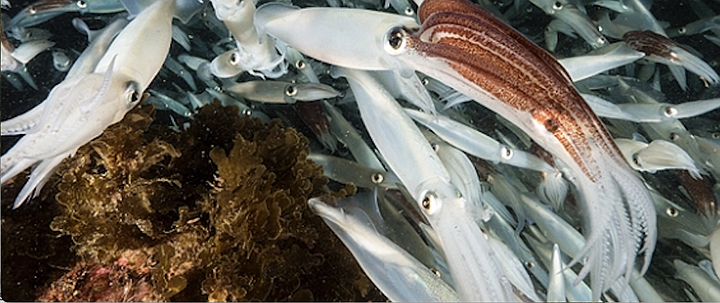
Market squid are known as opalescent squids for their mutable, iridescent white and purple colors. They are small invertebrates, around 12 inches long.
Market squid, also known as opalescent squids for their mutable, iridescent white and purple colors, are small invertebrates, around 12 inches long, related to snails. Divers describe a ghostly adventure among moving white walls during spawning events.
In San Diego, the migratory species — found from Baja to Alaska — occurs around La Jolla Shores, the La Jolla Submarine Canyon, and an area off the main wall just north of V Point (Point Loma). The foraging creatures are a food source for marine animals such as sharks, dolphins and sea lions.
Fishermen target spawning squid because they die soon after they reproduce; they live only six to nine months. Scientists say that even without fishing, the entire population replaces itself annually, making the live fast-die young molluscs resilient to a high amount of fishing pressure.
Recreational fishers use squid as live or dead bait, while much of the harvest gets exported to China and Japan for processing. It may then be re-exported back to the U.S., in a long chain of travel and emissions. But officials say the fishery itself is managed in a way that supports a healthy population, which began with the adoption of the Market Squid Fishery Management Plan in 2004. To reduce overfishing, there are weekend fishery closures and regulations regarding the lights used to attract squid.
Still, there are no reliable estimates of the population size, and the overfished and overfishing status are unknown.
To ensure long-term conservation, environmental groups are seeking changes to the plan, which is scheduled for potential adoption by the the California Fish and Game Commission in August. For one, requiring updated net parts that reduce contact with the ocean floor, to avoid disturbing egg beds.
It will be the first amendment to a California fishery management plan ever considered.
Here's something you might be interested in.
San Diego squid boom lasts three weeks
La Jolla Shores, La Jolla Submarine Canyon, and just north of V Point

San Diego squid boom lasts three weeks
La Jolla Shores, La Jolla Submarine Canyon, and just north of V Point
Fishermen target spawning squid because they die soon after they reproduce.
It was not the average “big bang” squid run off La Jolla last fall, as scientists sometimes call it when the normally large spawning groups turn up in extra large numbers. And while breeding typically lasts only a few days, this run lasted three weeks.
Squid runs don't happen every year. One likely reason for the surge was the shift from El Nino to La Nina weather patterns that brought cooler, nutrient-rich waters to the West Coast.
All of which made 2024 a boom year for California squid, already the most valuable squid fishery in the U.S. Fishermen landed more than 126 million pounds of squid, valued at over 67 million dollars, making it the top fishery in both volume and value, according to the California Department of Fish and Wildlife.
San Diego supports a major part of California's commercial market, mainly from April to October. Most fishing takes place at night using 60-foot size purse seine boats and specialized lighting systems to attract and catch squid, often on spawning grounds near shore.
Market squid are known as opalescent squids for their mutable, iridescent white and purple colors. They are small invertebrates, around 12 inches long.
Market squid, also known as opalescent squids for their mutable, iridescent white and purple colors, are small invertebrates, around 12 inches long, related to snails. Divers describe a ghostly adventure among moving white walls during spawning events.
In San Diego, the migratory species — found from Baja to Alaska — occurs around La Jolla Shores, the La Jolla Submarine Canyon, and an area off the main wall just north of V Point (Point Loma). The foraging creatures are a food source for marine animals such as sharks, dolphins and sea lions.
Fishermen target spawning squid because they die soon after they reproduce; they live only six to nine months. Scientists say that even without fishing, the entire population replaces itself annually, making the live fast-die young molluscs resilient to a high amount of fishing pressure.
Recreational fishers use squid as live or dead bait, while much of the harvest gets exported to China and Japan for processing. It may then be re-exported back to the U.S., in a long chain of travel and emissions. But officials say the fishery itself is managed in a way that supports a healthy population, which began with the adoption of the Market Squid Fishery Management Plan in 2004. To reduce overfishing, there are weekend fishery closures and regulations regarding the lights used to attract squid.
Still, there are no reliable estimates of the population size, and the overfished and overfishing status are unknown.
To ensure long-term conservation, environmental groups are seeking changes to the plan, which is scheduled for potential adoption by the the California Fish and Game Commission in August. For one, requiring updated net parts that reduce contact with the ocean floor, to avoid disturbing egg beds.
It will be the first amendment to a California fishery management plan ever considered.