

Here's something you might be interested in.
Ask a Hipster — Advice you didn't know you needed
Big Screen — Movie commentary
Blurt — Music's inside track
Booze News — San Diego spirits
Classical Music — Immortal beauty
Classifieds — Free and easy
Close to Home — What it’s like on the street where you live
Cover Stories — Front-page features
Drinks All Around — Bartenders' drink recipes
Excerpts — Literary and spiritual excerpts
Feast! — Food & drink reviews
Feature Stories — Local news & stories
Fishing Report — What’s getting hooked from ship and shore
From the Archives — Spotlight on the past
Golden Dreams — Talk of the town
The Gonzo Report — Making the musical scene, or at least reporting from it
Letters — Our inbox
Movies@Home — Local movie buffs share favorites
Movie Reviews — Our critics' picks and pans
Musician Interviews — Up close with local artists
Neighborhood News from Stringers — Hyperlocal news
News Ticker — News & politics
Obermeyer — San Diego politics illustrated
Outdoors — Weekly changes in flora and fauna
Overheard in San Diego — Eavesdropping illustrated
Poetry — The old and the new
Reader Travel — Travel section built by travelers
Reading — The hunt for intellectuals
Roam-O-Rama — SoCal's best hiking/biking trails
San Diego Beer — Inside San Diego suds
SD on the QT — Almost factual news
Sheep and Goats — Places of worship
Special Issues — The best of
Street Style — San Diego streets have style
Surf Diego — Real stories from those braving the waves
Theater — On stage in San Diego this week
Tin Fork — Silver spoon alternative
Under the Radar — Matt Potter's undercover work
Unforgettable — Long-ago San Diego
Unreal Estate — San Diego's priciest pads
Your Week — Daily event picks
Fish Report: Book now as bluefin begin biting
Plus: Cedros Island season opener, surfperch finally on the chew in San Q
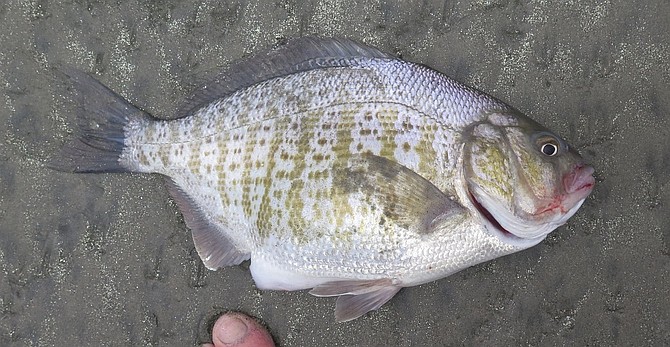
Big pregnant female barred surfperch caught from the beach near Cielito Lindo just south of San Quintin, Baja California, Mexico.
Dock Totals 5/11 – 5/17: 1491 anglers aboard 68 half-day to 3-day trips out of San Diego landings over the past week caught 2 barracuda, 82 bluefin tuna (to 180 pounds), 812 bonito, 160 calico bass, 11 lingcod, 4181 rockfish, 5 sand bass, 90 sanddab, 127 sculpin, 31 sheephead, 1 Spanish jack, 255 whitefish, and 31 yellowtail.
Saltwater: Those finicky bluefin did finally start to bite toward the end of the week, just as a bit of weather blew up and made conditions in the area a little rough. The 82 tuna in the count for the past week through Saturday don't quite represent the bite, as boats on 2- and 3-day trips are still fishing. With calm conditions beginning early this coming week, I expect to see the numbers climb substantially by the end of next week.
As it is, many of those trips are selling out as anglers see the positive reports about the number of fish, and gear up while booking last-minute trips. Finding a ride might get tough as the bite progresses, though there are always cancellations and added trips as the fishing picks up. Some folks book a year in advance, and as life is life, spots do occasionally open up.
As Captain Drew Card of the Pacific Queen reported during their 3-day trip: “…35 fish from 100-180 pounds so far, to go along with some 30-60 pounders as well. Our next 3 trips have some openings, but after that, we are pretty much booked till fall. This is the best sign of big fish we’ve seen so far this year!” With signs pointing to another excellent season for bluefin and yellowtail, I expect to see angler numbers rise by June to their summertime averages of 4000-5000 anglers per week.
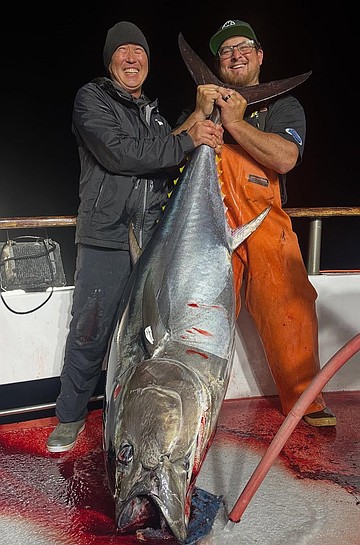
Solid bluefin caught aboard the Pacific Queen as the moon phase wanes, conditions calm, and the bite picks up.
May is normally a transitional month along Southern California and the Baja Peninsula — especially from San Diego to Guererro Negro. South from Guererro along the Pacific side of Baja to La Bocana or so, the season actually begins later, and fishing for pelagics gets much better by the end of July. This is due to the cool water trend below the point of the Vizcaino Peninsula. The eddies keep conditions cool until the northern push of warmer water heats it up during hurricane season. It will also stay warm longer, and fishing for yellowtail and other pelagics will continue until late March or so.
Cedros Island is right on the northern edge of that cool water zone, yet experiences a season more akin to ours in Southern California. Last weekend officially kicked off their season for the operations at the island, with great yellowtail, halibut, white seabass and calico fishing expected for their clients. Cedros Sportfishing, Toro’s, and Cedros Outdoor Adventures are three of the main operators there that can put you on the fish.
The history of Cedros goes back centuries, and probably even more than a millennia, given the pre-Columbian population of natives found when, in 1539, a Spanish expedition led by Francisco de Ulloa came upon indigenous villages on the island with populations in the hundreds. Cedros’ population of indigenous people was moved to the peninsula and mainland missions in 1732 by missionaries. Seal and otter harvesting by the Europeans followed in the 1800s, and miners dug gold out of Punta Norte in the late 1800s and early 1900s.
A fishing village and cannery were established in 1920 at Puerto Cedros, and in 1943, the fishing cooperative was established. A deepwater salt dock was built in 1966 for the salt-transshipment facility that facilitates transit of salt from the Guerrero Negro salt works, the largest such operation in the world. Boats running out of San Diego used to fish the island often, but since 2016 and the biosphere designation, the only way to fish the inshore fishery at Cedros is through a local operator, even if you get there by boat.
Because it is a very protected fishery, populations of endemic species like broomtail grouper, black seabass, calico bass, and sheephead are healthy. Halibut fishing there on the lee side can be off the hook. Premium fishing packages to Cedros Island from the border crossing at Otay include travel to the Tijuana airport, airfare, lodging, meals, and daily panga rides for fishing run about $650 per day with a four-day minimum. The per-day price drops with longer trips.
Surf fishing is finally picking up in my neck of the woods down here in San Quintin, though it has been better up north. San Quintin is in its own little cool water trend that runs from south of Punta Banda to El Rosario, and fishing here can be sluggish until it warms up. That said, yellowtail have been pretty good offshore, and one local pangero landed a 200-pound bluefin back in February. It’s just that it is also the windiest time of year here, with few opportunities to get out. This coming week looks excellent for offshore fishing as well as on the beach.
So far this year, it has been hard to coax a decent perch bite in the surf by my place at Cielito Lindo, but about two weeks ago, sand crabs showed up thick on the beach and the bite picked up a little. I caught a few smallish fish, including some early-spawn females last week. This week, I finally caught a fat, very pregnant fish close to 15 inches long and over two pounds, along with a handful of smaller perch. I released her and the others, but soon I will enjoy some fresh-caught fried perch prepared at the restaurant. C’mon down, the fishing and weather are getting good. Whether the beach, bay, lake, or offshore, they’re out there so go out and get ‘em!
Here's something you might be interested in.
Fish Report: Book now as bluefin begin biting
Plus: Cedros Island season opener, surfperch finally on the chew in San Q

Fish Report: Book now as bluefin begin biting
Plus: Cedros Island season opener, surfperch finally on the chew in San Q
Big pregnant female barred surfperch caught from the beach near Cielito Lindo just south of San Quintin, Baja California, Mexico.
Dock Totals 5/11 – 5/17: 1491 anglers aboard 68 half-day to 3-day trips out of San Diego landings over the past week caught 2 barracuda, 82 bluefin tuna (to 180 pounds), 812 bonito, 160 calico bass, 11 lingcod, 4181 rockfish, 5 sand bass, 90 sanddab, 127 sculpin, 31 sheephead, 1 Spanish jack, 255 whitefish, and 31 yellowtail.
Saltwater: Those finicky bluefin did finally start to bite toward the end of the week, just as a bit of weather blew up and made conditions in the area a little rough. The 82 tuna in the count for the past week through Saturday don't quite represent the bite, as boats on 2- and 3-day trips are still fishing. With calm conditions beginning early this coming week, I expect to see the numbers climb substantially by the end of next week.
As it is, many of those trips are selling out as anglers see the positive reports about the number of fish, and gear up while booking last-minute trips. Finding a ride might get tough as the bite progresses, though there are always cancellations and added trips as the fishing picks up. Some folks book a year in advance, and as life is life, spots do occasionally open up.
As Captain Drew Card of the Pacific Queen reported during their 3-day trip: “…35 fish from 100-180 pounds so far, to go along with some 30-60 pounders as well. Our next 3 trips have some openings, but after that, we are pretty much booked till fall. This is the best sign of big fish we’ve seen so far this year!” With signs pointing to another excellent season for bluefin and yellowtail, I expect to see angler numbers rise by June to their summertime averages of 4000-5000 anglers per week.
Solid bluefin caught aboard the Pacific Queen as the moon phase wanes, conditions calm, and the bite picks up.
May is normally a transitional month along Southern California and the Baja Peninsula — especially from San Diego to Guererro Negro. South from Guererro along the Pacific side of Baja to La Bocana or so, the season actually begins later, and fishing for pelagics gets much better by the end of July. This is due to the cool water trend below the point of the Vizcaino Peninsula. The eddies keep conditions cool until the northern push of warmer water heats it up during hurricane season. It will also stay warm longer, and fishing for yellowtail and other pelagics will continue until late March or so.
Cedros Island is right on the northern edge of that cool water zone, yet experiences a season more akin to ours in Southern California. Last weekend officially kicked off their season for the operations at the island, with great yellowtail, halibut, white seabass and calico fishing expected for their clients. Cedros Sportfishing, Toro’s, and Cedros Outdoor Adventures are three of the main operators there that can put you on the fish.
The history of Cedros goes back centuries, and probably even more than a millennia, given the pre-Columbian population of natives found when, in 1539, a Spanish expedition led by Francisco de Ulloa came upon indigenous villages on the island with populations in the hundreds. Cedros’ population of indigenous people was moved to the peninsula and mainland missions in 1732 by missionaries. Seal and otter harvesting by the Europeans followed in the 1800s, and miners dug gold out of Punta Norte in the late 1800s and early 1900s.
A fishing village and cannery were established in 1920 at Puerto Cedros, and in 1943, the fishing cooperative was established. A deepwater salt dock was built in 1966 for the salt-transshipment facility that facilitates transit of salt from the Guerrero Negro salt works, the largest such operation in the world. Boats running out of San Diego used to fish the island often, but since 2016 and the biosphere designation, the only way to fish the inshore fishery at Cedros is through a local operator, even if you get there by boat.
Because it is a very protected fishery, populations of endemic species like broomtail grouper, black seabass, calico bass, and sheephead are healthy. Halibut fishing there on the lee side can be off the hook. Premium fishing packages to Cedros Island from the border crossing at Otay include travel to the Tijuana airport, airfare, lodging, meals, and daily panga rides for fishing run about $650 per day with a four-day minimum. The per-day price drops with longer trips.
Surf fishing is finally picking up in my neck of the woods down here in San Quintin, though it has been better up north. San Quintin is in its own little cool water trend that runs from south of Punta Banda to El Rosario, and fishing here can be sluggish until it warms up. That said, yellowtail have been pretty good offshore, and one local pangero landed a 200-pound bluefin back in February. It’s just that it is also the windiest time of year here, with few opportunities to get out. This coming week looks excellent for offshore fishing as well as on the beach.
So far this year, it has been hard to coax a decent perch bite in the surf by my place at Cielito Lindo, but about two weeks ago, sand crabs showed up thick on the beach and the bite picked up a little. I caught a few smallish fish, including some early-spawn females last week. This week, I finally caught a fat, very pregnant fish close to 15 inches long and over two pounds, along with a handful of smaller perch. I released her and the others, but soon I will enjoy some fresh-caught fried perch prepared at the restaurant. C’mon down, the fishing and weather are getting good. Whether the beach, bay, lake, or offshore, they’re out there so go out and get ‘em!
Comments