

Here's something you might be interested in.
Ask a Hipster — Advice you didn't know you needed
Big Screen — Movie commentary
Blurt — Music's inside track
Booze News — San Diego spirits
Classical Music — Immortal beauty
Classifieds — Free and easy
Close to Home — What it’s like on the street where you live
Cover Stories — Front-page features
Drinks All Around — Bartenders' drink recipes
Excerpts — Literary and spiritual excerpts
Feast! — Food & drink reviews
Feature Stories — Local news & stories
Fishing Report — What’s getting hooked from ship and shore
From the Archives — Spotlight on the past
Golden Dreams — Talk of the town
The Gonzo Report — Making the musical scene, or at least reporting from it
Letters — Our inbox
Movies@Home — Local movie buffs share favorites
Movie Reviews — Our critics' picks and pans
Musician Interviews — Up close with local artists
Neighborhood News from Stringers — Hyperlocal news
News Ticker — News & politics
Obermeyer — San Diego politics illustrated
Outdoors — Weekly changes in flora and fauna
Overheard in San Diego — Eavesdropping illustrated
Poetry — The old and the new
Reader Travel — Travel section built by travelers
Reading — The hunt for intellectuals
Roam-O-Rama — SoCal's best hiking/biking trails
San Diego Beer — Inside San Diego suds
SD on the QT — Almost factual news
Sheep and Goats — Places of worship
Special Issues — The best of
Street Style — San Diego streets have style
Surf Diego — Real stories from those braving the waves
Theater — On stage in San Diego this week
Tin Fork — Silver spoon alternative
Under the Radar — Matt Potter's undercover work
Unforgettable — Long-ago San Diego
Unreal Estate — San Diego's priciest pads
Your Week — Daily event picks
Fish Report: Striped Marlin caught and released on overnight trip
Wahoo biting well at Alijos Rocks
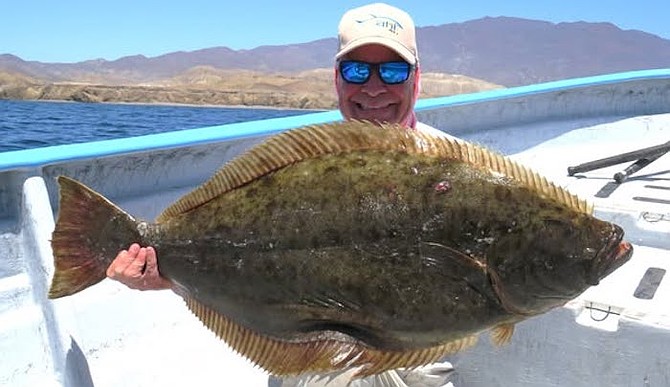
Noted fishing author Bill Varney with his 34-pound halibut at Cedros Island that, per Varney, “ate a 2lb mackerel in 80' of water...came to the boat like pulling in a giant frisbee!”
Dock Totals 7/27 – 8/2: 5176 anglers aboard 202 half-day to 3-day trips out of San Diego landings over the past week caught 371 barracuda, 1879 bluefin tuna (to 270 pounds), 250 bonito, 7 cabezon, 570 calico bass, 1 dorado, 8 halibut, 26 lingcod, 1 mako shark, 3734 rockfish, 1 rock sole, 1389 sand bass, 868 sculpin, 73 sheephead, 1 striped marlin (released), 524 whitefish, 4 white seabass, 1 yellowfin tuna, and 2394 yellowtail.
Saltwater: Well, it was just another summer week for the half-day to three-day fleet, featuring the first dorado and first week with over 5000 anglers in 2025. Bluefin numbers dropped from the previous week, but they are still out there thick, and yellowtail are eating the paint off the jigs from the Coronado Islands to outside of San Quintin. Yellowfin tuna are still further south but expected to move up the line as the water warms, which should also bring more dorado within three-day range.
Locally, sand bass are on the feed and rockfish numbers have been fluctuating — mostly depending on to what degree they are the target species. Barracuda seem to be getting bigger, with many more kept than in the weeks previous — though they have been getting a lot of shorts under 28 inches since mid-July. The kelp edges are holding some yellowtail, though most of that action has been down the line. Calico bass have been biting best when the current is lined up right, and bonito are foaming in spots on bait shoals. Sheephead have been biting well on shrimp on a dropper loop on the kelp beds and reefs, while a few decent halibut have been caught from the sand flats between.
Outside, most of the bluefin action has been around San Clemente Island, while there are still good numbers down south outside of Rosarito to Ensenada. Overnight trips are finding some bluefin action within range, plus an occasional exotic — like the striped marlin caught by an angler aboard the Producer on last Monday’s overnight trip and the opah last week.
Further down the Baja coast, yellowtail, halibut, and white seabass are biting well off Cedros Island and along the Vizcaino coast from Cedros to La Bocana. South of there, the fishing turns more to wahoo and yellowfin tuna for the long-range boats running five days or longer. Alijos Rocks has been on fire for larger yellowtail, decent dorado, and speedster wahoo, as witnessed by anglers aboard the Searcher on their 8-day Turner's Outdoorsman and Izorline Fishing Products sponsored trip.
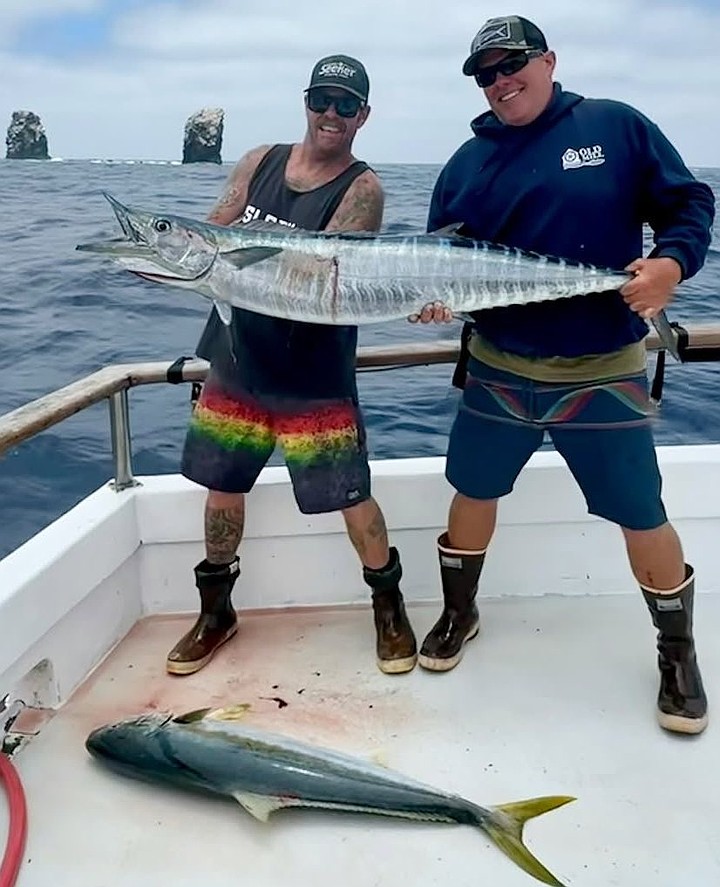
A solid wahoo in hand and a chunky yellowtail on the deck of the Searcher with Alijos Rocks in the background.
If I had to choose one, wahoo is the species I’d like to see more closer to San Diego. They are both speedy and some of the best table fare I have ever caught. When I was living outside of La Paz, wahoo would come through our area in late summer and fall, and we’d mostly catch them six miles from the beach launch near Agua Amarga. Wahoo are a toothy species, and given their speed and razor sharp teeth, landing one out of every two hooked was a worthwhile goal. Most boats trolled Marauder lures on a wire leader at about ten to twelve knots, though we found we could get them to bite much cheaper Rapalas on 30-pound mono.
The problem for us was, at that speed, the older Rapalas, the ones with the metal lip, would get "out of tune," so we would have to bend the lip back into shape. Newer Rapalas have a molded plastic lip and won’t bend out of tune. Our best results back then were on purple CD 18s and 22s, and to prevent them being chewed off on the light mono, we would remove the forward hook. This way, we could avoid the wahoo's teeth as much as possible, with the long lure and rear hook keeping most fish from being able get their teeth on the line.
When bit on the troll, the reels would scream as the fish — running up to 60 miles an hour — peeled out line. But with a little patience, and by using 30-pound mono and rear-only hook on the long lure, we could catch more fish than most folks who were running wire and the chubbier Marauder lures on the troll. Wahoo are one of the fastest fish in the ocean; only sailfish reach higher speeds. Now and then, we do see them within 3-day range from Point Loma, but usually only when there is exceptionally warm water, or during an El Niño year.
For preparation, I usually just put a little rub of garlic and pepper on my wahoo and grill until it's cooked through but not overdone. Steaks, lightly seasoned to taste and fried in olive oil, were also excellent. If you’d like to try wahoo but don’t have the time or the ducats for an 8-day run south to catch them, you can often find wahoo fresh off the boat at the Tuna Harbor Dockside Market on Saturdays. It was listed this week at $14 per pound for filets. Yum! Whether the beach, bay, lake, or offshore, they’re out there so go out and get ‘em!
Here's something you might be interested in.
Fish Report: Striped Marlin caught and released on overnight trip
Wahoo biting well at Alijos Rocks

Fish Report: Striped Marlin caught and released on overnight trip
Wahoo biting well at Alijos Rocks
Noted fishing author Bill Varney with his 34-pound halibut at Cedros Island that, per Varney, “ate a 2lb mackerel in 80' of water...came to the boat like pulling in a giant frisbee!”
Dock Totals 7/27 – 8/2: 5176 anglers aboard 202 half-day to 3-day trips out of San Diego landings over the past week caught 371 barracuda, 1879 bluefin tuna (to 270 pounds), 250 bonito, 7 cabezon, 570 calico bass, 1 dorado, 8 halibut, 26 lingcod, 1 mako shark, 3734 rockfish, 1 rock sole, 1389 sand bass, 868 sculpin, 73 sheephead, 1 striped marlin (released), 524 whitefish, 4 white seabass, 1 yellowfin tuna, and 2394 yellowtail.
Saltwater: Well, it was just another summer week for the half-day to three-day fleet, featuring the first dorado and first week with over 5000 anglers in 2025. Bluefin numbers dropped from the previous week, but they are still out there thick, and yellowtail are eating the paint off the jigs from the Coronado Islands to outside of San Quintin. Yellowfin tuna are still further south but expected to move up the line as the water warms, which should also bring more dorado within three-day range.
Locally, sand bass are on the feed and rockfish numbers have been fluctuating — mostly depending on to what degree they are the target species. Barracuda seem to be getting bigger, with many more kept than in the weeks previous — though they have been getting a lot of shorts under 28 inches since mid-July. The kelp edges are holding some yellowtail, though most of that action has been down the line. Calico bass have been biting best when the current is lined up right, and bonito are foaming in spots on bait shoals. Sheephead have been biting well on shrimp on a dropper loop on the kelp beds and reefs, while a few decent halibut have been caught from the sand flats between.
Outside, most of the bluefin action has been around San Clemente Island, while there are still good numbers down south outside of Rosarito to Ensenada. Overnight trips are finding some bluefin action within range, plus an occasional exotic — like the striped marlin caught by an angler aboard the Producer on last Monday’s overnight trip and the opah last week.
Further down the Baja coast, yellowtail, halibut, and white seabass are biting well off Cedros Island and along the Vizcaino coast from Cedros to La Bocana. South of there, the fishing turns more to wahoo and yellowfin tuna for the long-range boats running five days or longer. Alijos Rocks has been on fire for larger yellowtail, decent dorado, and speedster wahoo, as witnessed by anglers aboard the Searcher on their 8-day Turner's Outdoorsman and Izorline Fishing Products sponsored trip.
A solid wahoo in hand and a chunky yellowtail on the deck of the Searcher with Alijos Rocks in the background.
If I had to choose one, wahoo is the species I’d like to see more closer to San Diego. They are both speedy and some of the best table fare I have ever caught. When I was living outside of La Paz, wahoo would come through our area in late summer and fall, and we’d mostly catch them six miles from the beach launch near Agua Amarga. Wahoo are a toothy species, and given their speed and razor sharp teeth, landing one out of every two hooked was a worthwhile goal. Most boats trolled Marauder lures on a wire leader at about ten to twelve knots, though we found we could get them to bite much cheaper Rapalas on 30-pound mono.
The problem for us was, at that speed, the older Rapalas, the ones with the metal lip, would get "out of tune," so we would have to bend the lip back into shape. Newer Rapalas have a molded plastic lip and won’t bend out of tune. Our best results back then were on purple CD 18s and 22s, and to prevent them being chewed off on the light mono, we would remove the forward hook. This way, we could avoid the wahoo's teeth as much as possible, with the long lure and rear hook keeping most fish from being able get their teeth on the line.
When bit on the troll, the reels would scream as the fish — running up to 60 miles an hour — peeled out line. But with a little patience, and by using 30-pound mono and rear-only hook on the long lure, we could catch more fish than most folks who were running wire and the chubbier Marauder lures on the troll. Wahoo are one of the fastest fish in the ocean; only sailfish reach higher speeds. Now and then, we do see them within 3-day range from Point Loma, but usually only when there is exceptionally warm water, or during an El Niño year.
For preparation, I usually just put a little rub of garlic and pepper on my wahoo and grill until it's cooked through but not overdone. Steaks, lightly seasoned to taste and fried in olive oil, were also excellent. If you’d like to try wahoo but don’t have the time or the ducats for an 8-day run south to catch them, you can often find wahoo fresh off the boat at the Tuna Harbor Dockside Market on Saturdays. It was listed this week at $14 per pound for filets. Yum! Whether the beach, bay, lake, or offshore, they’re out there so go out and get ‘em!
Comments