

Here's something you might be interested in.
Ask a Hipster — Advice you didn't know you needed
Big Screen — Movie commentary
Blurt — Music's inside track
Booze News — San Diego spirits
Classical Music — Immortal beauty
Classifieds — Free and easy
Close to Home — What it’s like on the street where you live
Cover Stories — Front-page features
Drinks All Around — Bartenders' drink recipes
Excerpts — Literary and spiritual excerpts
Feast! — Food & drink reviews
Feature Stories — Local news & stories
Fishing Report — What’s getting hooked from ship and shore
From the Archives — Spotlight on the past
Golden Dreams — Talk of the town
The Gonzo Report — Making the musical scene, or at least reporting from it
Letters — Our inbox
Movies@Home — Local movie buffs share favorites
Movie Reviews — Our critics' picks and pans
Musician Interviews — Up close with local artists
Neighborhood News from Stringers — Hyperlocal news
News Ticker — News & politics
Obermeyer — San Diego politics illustrated
Outdoors — Weekly changes in flora and fauna
Overheard in San Diego — Eavesdropping illustrated
Poetry — The old and the new
Reader Travel — Travel section built by travelers
Reading — The hunt for intellectuals
Roam-O-Rama — SoCal's best hiking/biking trails
San Diego Beer — Inside San Diego suds
SD on the QT — Almost factual news
Sheep and Goats — Places of worship
Special Issues — The best of
Street Style — San Diego streets have style
Surf Diego — Real stories from those braving the waves
Theater — On stage in San Diego this week
Tin Fork — Silver spoon alternative
Under the Radar — Matt Potter's undercover work
Unforgettable — Long-ago San Diego
Unreal Estate — San Diego's priciest pads
Your Week — Daily event picks
Now Playing: CAUGHT BY THE TIDES (2024)
This one is worth getting off your couch for

Tao Zhao goes from catwalk to Covid in Jia Zhang-ke's towering film.
CAUGHT BY THE TIDES (2024) Jia Zhangke / Writers: Jiahuan Wan & Jia Zhangke / Cinematographers: Eric Gautier & Nelson Lik-wai Yu / Editors: Yang Chao, Matthieu Laclau & Xudong Lin / Composer: Giong Lim / Acted by: Zhao Tao, Li Zhubin, Zhou Lan, & Jianlin Pan / Distributor: Sideshow / Made in China / Not rated / Length: 111 min.
I was 10 the day dad introduced me to the concept of television as bedroom furniture. It was on that 12-inch black-and-white Muntz, equipped with tin-foil-tipped rabbit ears for superior reception, that I was first introduced to foreign language films: The Blue Angel and The Rules of the Game. Prior to that day, the only films from other shores that had caught my attention starred giant rubber Japanese monsters and were dubbed (badly) in English.
Thanks to the Muntz, I first encountered the magic of subtitles the hard way. The medium obscured the message: so ancient was the tube, it blew up the image, and in doing so, effectively guillotined both the tops of heads and the bottom row of text. But in spite of the language barrier, there was something about those movies that stayed with me for days. I was far too young to even begin to understand the complexities of either picture, yet something inside me knew that we were destined to grow old together.
Video:
Trailer: CAUGHT BY THE TIDES
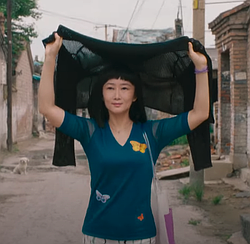
I approach every new film by Jia Zhangke with that same singular sensation of awe and discovery I felt lying on the floor, chin in hands, before the altar of my Muntz. And none have intrigued more than his latest, Caught by the Tides. We open in 2001, just after the dawn of the new millennium, and finish towards the end of the Covid quarantine, with mask mandates still in place. It would be silly to analyze the plot of a film that goes out of its way to renounce the need for such an arcane notion. What Jia has done is unlike anything we’ve seen before — with perhaps the exception of the director’s earlier films. Still Life and 24 City make for superb companion viewing. And while you’re at it, a viewing of Yung Chang’s Up the Yangtze would prove equally beneficial.
Unlike Richard Linklater’s Boyhood, Michael Apted’s “Up” documentaries, and Francois Truffaut’s Antoine Doinel series, Jia didn’t intentionally commit to following the same actors playing the same characters over the course of two-plus decades. But by using outtakes and recycled footage, Jia is able to hew together a romance between Qiaoqiao (Zhao Tao) — in close-up, a mask covers half her face, but her eyes can still out-perform anyone in the room — and Bin (Li Zhubin). (Li is a regular player in the director’s stock company, while Zhao is his leading lady both on and off screen.)
Zhao, who spends much of the running time searching for lost love, is a feisty cuss. Her trademark way of walking, with a sweater held high over her head to block the sun, attracts the attention of a gang of toughs on motorbikes. Before things get out of hand, she picks up a brick and chucks it in their general direction. Later, an absent-minded thug accidentally leaves a stack of bills on a barroom table. When she's caught after deciding that no one will notice if $500 goes missing, when caught, the brick of yesteryear gets replaced by a room-emptying taser gun.
Mystery is her middle name. During a boat ride lunch along the Yangtze, Qiaoqiao indicates her dining choice by using chopsticks to point to the menu. A bell in my head went off: we’ve yet to hear her speak a word. She gives no reason for this, and there's no indication that speech is impossible for her; she just chooses not to. But that's not to say she's silent. A robot greeter positioned at the front of a supermarket achieves the near-impossible: after she lowers her mask so the machine can read her face, it remarks how sad she looks before hitting her with a double-dose of PMA quotes from Mother Teresa and Mark Twain. Just when you think a smile might be the only thing harder to get out of her than a word, she breaks out laughing.
Qiaoqiao’s criminal leanings can be chalked up to guilt by association. Bin, a two-bit gunsel who dreams of being a criminal mastermind when he grows up, is under investigation because his boss absconded with big money. (He must have had his TV turned off the day Qiaoqiao posted a missing persons notice on the television.) Business took a hit during Covid, so he moved to the Great Bay area, and that's where the two lovers finally connect — with Bin now walking with a pronounced limp.
It’s movies like this that make my life a joy. I’m not the one to turn to for insight into China’s cultural, economic, and anthropological growth (or lack thereof) over the past two decades. And the fact that a film so well-versed in all three talking points can hold and transfix the duffer in the crowd makes me love it all the more. Admittedly, this is one of those movies where an audio commentary track would go a long way, so I developed one of my own over the course of three viewings, the first early last Saturday morning. That was followed by a matinee at the Angelika, plus an additional Sunday morning viewing. It’s doubtful that we’ll encounter a better film in the six months that lie ahead. This one is worth getting off your couch for. Who knows? Maybe we’ll run into each other when I go for #4. *****
Here's something you might be interested in.
Now Playing: CAUGHT BY THE TIDES (2024)
This one is worth getting off your couch for

Now Playing: CAUGHT BY THE TIDES (2024)
This one is worth getting off your couch for
Tao Zhao goes from catwalk to Covid in Jia Zhang-ke's towering film.
CAUGHT BY THE TIDES (2024) Jia Zhangke / Writers: Jiahuan Wan & Jia Zhangke / Cinematographers: Eric Gautier & Nelson Lik-wai Yu / Editors: Yang Chao, Matthieu Laclau & Xudong Lin / Composer: Giong Lim / Acted by: Zhao Tao, Li Zhubin, Zhou Lan, & Jianlin Pan / Distributor: Sideshow / Made in China / Not rated / Length: 111 min.
I was 10 the day dad introduced me to the concept of television as bedroom furniture. It was on that 12-inch black-and-white Muntz, equipped with tin-foil-tipped rabbit ears for superior reception, that I was first introduced to foreign language films: The Blue Angel and The Rules of the Game. Prior to that day, the only films from other shores that had caught my attention starred giant rubber Japanese monsters and were dubbed (badly) in English.
Thanks to the Muntz, I first encountered the magic of subtitles the hard way. The medium obscured the message: so ancient was the tube, it blew up the image, and in doing so, effectively guillotined both the tops of heads and the bottom row of text. But in spite of the language barrier, there was something about those movies that stayed with me for days. I was far too young to even begin to understand the complexities of either picture, yet something inside me knew that we were destined to grow old together.
Video:
Trailer: CAUGHT BY THE TIDES
I approach every new film by Jia Zhangke with that same singular sensation of awe and discovery I felt lying on the floor, chin in hands, before the altar of my Muntz. And none have intrigued more than his latest, Caught by the Tides. We open in 2001, just after the dawn of the new millennium, and finish towards the end of the Covid quarantine, with mask mandates still in place. It would be silly to analyze the plot of a film that goes out of its way to renounce the need for such an arcane notion. What Jia has done is unlike anything we’ve seen before — with perhaps the exception of the director’s earlier films. Still Life and 24 City make for superb companion viewing. And while you’re at it, a viewing of Yung Chang’s Up the Yangtze would prove equally beneficial.
Unlike Richard Linklater’s Boyhood, Michael Apted’s “Up” documentaries, and Francois Truffaut’s Antoine Doinel series, Jia didn’t intentionally commit to following the same actors playing the same characters over the course of two-plus decades. But by using outtakes and recycled footage, Jia is able to hew together a romance between Qiaoqiao (Zhao Tao) — in close-up, a mask covers half her face, but her eyes can still out-perform anyone in the room — and Bin (Li Zhubin). (Li is a regular player in the director’s stock company, while Zhao is his leading lady both on and off screen.)
Zhao, who spends much of the running time searching for lost love, is a feisty cuss. Her trademark way of walking, with a sweater held high over her head to block the sun, attracts the attention of a gang of toughs on motorbikes. Before things get out of hand, she picks up a brick and chucks it in their general direction. Later, an absent-minded thug accidentally leaves a stack of bills on a barroom table. When she's caught after deciding that no one will notice if $500 goes missing, when caught, the brick of yesteryear gets replaced by a room-emptying taser gun.
Mystery is her middle name. During a boat ride lunch along the Yangtze, Qiaoqiao indicates her dining choice by using chopsticks to point to the menu. A bell in my head went off: we’ve yet to hear her speak a word. She gives no reason for this, and there's no indication that speech is impossible for her; she just chooses not to. But that's not to say she's silent. A robot greeter positioned at the front of a supermarket achieves the near-impossible: after she lowers her mask so the machine can read her face, it remarks how sad she looks before hitting her with a double-dose of PMA quotes from Mother Teresa and Mark Twain. Just when you think a smile might be the only thing harder to get out of her than a word, she breaks out laughing.
Qiaoqiao’s criminal leanings can be chalked up to guilt by association. Bin, a two-bit gunsel who dreams of being a criminal mastermind when he grows up, is under investigation because his boss absconded with big money. (He must have had his TV turned off the day Qiaoqiao posted a missing persons notice on the television.) Business took a hit during Covid, so he moved to the Great Bay area, and that's where the two lovers finally connect — with Bin now walking with a pronounced limp.
It’s movies like this that make my life a joy. I’m not the one to turn to for insight into China’s cultural, economic, and anthropological growth (or lack thereof) over the past two decades. And the fact that a film so well-versed in all three talking points can hold and transfix the duffer in the crowd makes me love it all the more. Admittedly, this is one of those movies where an audio commentary track would go a long way, so I developed one of my own over the course of three viewings, the first early last Saturday morning. That was followed by a matinee at the Angelika, plus an additional Sunday morning viewing. It’s doubtful that we’ll encounter a better film in the six months that lie ahead. This one is worth getting off your couch for. Who knows? Maybe we’ll run into each other when I go for #4. *****