

Here's something you might be interested in.
Ask a Hipster — Advice you didn't know you needed
Big Screen — Movie commentary
Blurt — Music's inside track
Booze News — San Diego spirits
Classical Music — Immortal beauty
Classifieds — Free and easy
Close to Home — What it’s like on the street where you live
Cover Stories — Front-page features
Drinks All Around — Bartenders' drink recipes
Excerpts — Literary and spiritual excerpts
Feast! — Food & drink reviews
Feature Stories — Local news & stories
Fishing Report — What’s getting hooked from ship and shore
From the Archives — Spotlight on the past
Golden Dreams — Talk of the town
The Gonzo Report — Making the musical scene, or at least reporting from it
Letters — Our inbox
Movies@Home — Local movie buffs share favorites
Movie Reviews — Our critics' picks and pans
Musician Interviews — Up close with local artists
Neighborhood News from Stringers — Hyperlocal news
News Ticker — News & politics
Obermeyer — San Diego politics illustrated
Outdoors — Weekly changes in flora and fauna
Overheard in San Diego — Eavesdropping illustrated
Poetry — The old and the new
Reader Travel — Travel section built by travelers
Reading — The hunt for intellectuals
Roam-O-Rama — SoCal's best hiking/biking trails
San Diego Beer — Inside San Diego suds
SD on the QT — Almost factual news
Sheep and Goats — Places of worship
Special Issues — The best of
Street Style — San Diego streets have style
Surf Diego — Real stories from those braving the waves
Theater — On stage in San Diego this week
Tin Fork — Silver spoon alternative
Under the Radar — Matt Potter's undercover work
Unforgettable — Long-ago San Diego
Unreal Estate — San Diego's priciest pads
Your Week — Daily event picks
Escondido extends ban on new battery sites
Blow to clean energy interests
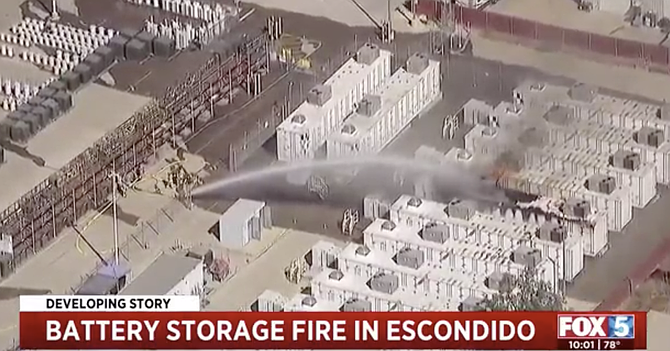
Fox 5 coverage of battery fire on Enterprise St.
Escondido’s moratorium on new battery storage sites will stay in place. What began as a temporary pause after a fire last October was extended in November for up to 10 months and 15 days.
At a meeting last week, the city council could have ended the urgency ordinance but instead voted 5-0 to maintain the ban on new sites while continuing to study land-use and safety regulations, including a citywide cap on the number of commercial battery energy storage sites.
“Until we have some clear guidelines in place,” said Mayor Dane White.

Mayor White: "It doesn’t make sense for Escondido to have 20 battery storage facilities.”
Battery energy storage systems draw on renewable energy like wind and solar and are a key part of the city’s climate action plan. The facilities collect and store energy from the grid for use during periods of high demand.
In some cases, they are fire-prone due to the potential of a fire in a single battery cell to quickly spread to other cells and modules. The moratorium was prompted by a fire at a San Diego Gas & Electric battery facility on Enterprise Street, which caused evacuations and an uproar over the safety of the sites.
In 2024 the county of San Diego Fire Protection District developed a “best practices” report in response to community concerns. While the county approved stricter interim guidelines for future energy storage sites in unincorporated areas, it did not impose a moratorium on new ones.
Now city officials say they are waiting for the county to set a cap on the total number of projects and will incorporate the county's current guidelines.
Several speakers urged the city to drop the moratorium.
Greg Wade, CEO of Clean Energy Alliance, the renewable energy provider for Escondido and other North County cities, said they currently have solar energy well beyond what can be stored and used.
Safety keeps improving, he said. Given advanced fire standards and 24-7 monitoring, some asked why the city couldn’t just allow projects to move forward, while working on future regulations.
There is currently one project under review that is affected by the moratorium, but they have not come back in a few months, “so we’re still waiting to hear back from them,” says city planner Veronica Morones.
Cori Schumacher from IBEW Local 569 asked that in addition to rescinding the moratorium, both the city and county revise their guidelines to establish minimum safety standards for all stages of the battery energy lifecycle.
Morones says updated safety regulations for battery energy storage facilities are expected by the Fire Department at the start of 2026. Staff recommended incorporating the county’s guidelines as part of the required fire code update.
Another concern was where the facilities would be placed. According to city fire marshal, LaVona Koretke, the county has setback guidelines on things like density, facility size, and wildland fire areas.
Once the projects are in, what areas they will serve is an open question.
“There isn’t a way to guarantee a facility located within a city boundary is providing energy to the finite city boundary. It all goes into the grid and supports grid efficacy,” said Morones.
Mayor White said that’s why they should consider a cap on the total number in the city. “If we’re not guaranteed any of the power, it doesn’t make sense for Escondido to have 20 battery storage facilities.”
The city’s long effort to sort out the issues means a permanent regulatory framework could take 1-2 years or longer to finalize.
“When introduced, the moratorium was described as a temporary pause to explore reasonable safety standards,” said Lauren Cazares, policy advisor at the San Diego Regional Chamber of Commerce.
“The timeline far exceeds the original intent and places Escondido at risk of falling behind on its own climate and energy action goals.”
Here's something you might be interested in.
Escondido extends ban on new battery sites
Blow to clean energy interests

Escondido extends ban on new battery sites
Blow to clean energy interests
Fox 5 coverage of battery fire on Enterprise St.
Escondido’s moratorium on new battery storage sites will stay in place. What began as a temporary pause after a fire last October was extended in November for up to 10 months and 15 days.
At a meeting last week, the city council could have ended the urgency ordinance but instead voted 5-0 to maintain the ban on new sites while continuing to study land-use and safety regulations, including a citywide cap on the number of commercial battery energy storage sites.
“Until we have some clear guidelines in place,” said Mayor Dane White.
Mayor White: "It doesn’t make sense for Escondido to have 20 battery storage facilities.”
Battery energy storage systems draw on renewable energy like wind and solar and are a key part of the city’s climate action plan. The facilities collect and store energy from the grid for use during periods of high demand.
In some cases, they are fire-prone due to the potential of a fire in a single battery cell to quickly spread to other cells and modules. The moratorium was prompted by a fire at a San Diego Gas & Electric battery facility on Enterprise Street, which caused evacuations and an uproar over the safety of the sites.
In 2024 the county of San Diego Fire Protection District developed a “best practices” report in response to community concerns. While the county approved stricter interim guidelines for future energy storage sites in unincorporated areas, it did not impose a moratorium on new ones.
Now city officials say they are waiting for the county to set a cap on the total number of projects and will incorporate the county's current guidelines.
Several speakers urged the city to drop the moratorium.
Greg Wade, CEO of Clean Energy Alliance, the renewable energy provider for Escondido and other North County cities, said they currently have solar energy well beyond what can be stored and used.
Safety keeps improving, he said. Given advanced fire standards and 24-7 monitoring, some asked why the city couldn’t just allow projects to move forward, while working on future regulations.
There is currently one project under review that is affected by the moratorium, but they have not come back in a few months, “so we’re still waiting to hear back from them,” says city planner Veronica Morones.
Cori Schumacher from IBEW Local 569 asked that in addition to rescinding the moratorium, both the city and county revise their guidelines to establish minimum safety standards for all stages of the battery energy lifecycle.
Morones says updated safety regulations for battery energy storage facilities are expected by the Fire Department at the start of 2026. Staff recommended incorporating the county’s guidelines as part of the required fire code update.
Another concern was where the facilities would be placed. According to city fire marshal, LaVona Koretke, the county has setback guidelines on things like density, facility size, and wildland fire areas.
Once the projects are in, what areas they will serve is an open question.
“There isn’t a way to guarantee a facility located within a city boundary is providing energy to the finite city boundary. It all goes into the grid and supports grid efficacy,” said Morones.
Mayor White said that’s why they should consider a cap on the total number in the city. “If we’re not guaranteed any of the power, it doesn’t make sense for Escondido to have 20 battery storage facilities.”
The city’s long effort to sort out the issues means a permanent regulatory framework could take 1-2 years or longer to finalize.
“When introduced, the moratorium was described as a temporary pause to explore reasonable safety standards,” said Lauren Cazares, policy advisor at the San Diego Regional Chamber of Commerce.
“The timeline far exceeds the original intent and places Escondido at risk of falling behind on its own climate and energy action goals.”
Comments