

Here's something you might be interested in.
Ask a Hipster — Advice you didn't know you needed
Big Screen — Movie commentary
Blurt — Music's inside track
Booze News — San Diego spirits
Classical Music — Immortal beauty
Classifieds — Free and easy
Close to Home — What it’s like on the street where you live
Cover Stories — Front-page features
Drinks All Around — Bartenders' drink recipes
Excerpts — Literary and spiritual excerpts
Feast! — Food & drink reviews
Feature Stories — Local news & stories
Fishing Report — What’s getting hooked from ship and shore
From the Archives — Spotlight on the past
Golden Dreams — Talk of the town
The Gonzo Report — Making the musical scene, or at least reporting from it
Letters — Our inbox
Movies@Home — Local movie buffs share favorites
Movie Reviews — Our critics' picks and pans
Musician Interviews — Up close with local artists
Neighborhood News from Stringers — Hyperlocal news
News Ticker — News & politics
Obermeyer — San Diego politics illustrated
Outdoors — Weekly changes in flora and fauna
Overheard in San Diego — Eavesdropping illustrated
Poetry — The old and the new
Reader Travel — Travel section built by travelers
Reading — The hunt for intellectuals
Roam-O-Rama — SoCal's best hiking/biking trails
San Diego Beer — Inside San Diego suds
SD on the QT — Almost factual news
Sheep and Goats — Places of worship
Special Issues — The best of
Street Style — San Diego streets have style
Surf Diego — Real stories from those braving the waves
Theater — On stage in San Diego this week
Tin Fork — Silver spoon alternative
Under the Radar — Matt Potter's undercover work
Unforgettable — Long-ago San Diego
Unreal Estate — San Diego's priciest pads
Your Week — Daily event picks
Fish Report: Big bones biting
Yellowtail slow during Moon phase - White Seabass comeback
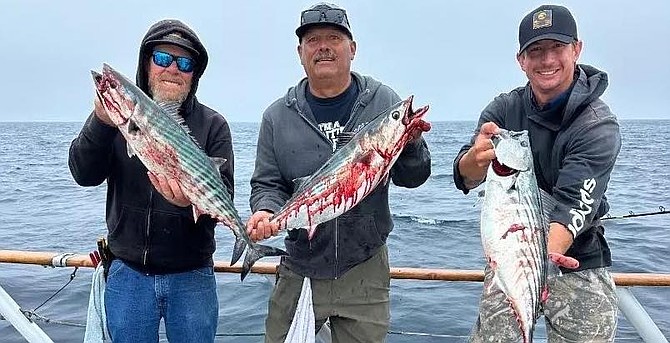
Happy anglers with some very big bonito for anglers aboard the Dolphin half-day run.
Dock Totals 5/4 – 5/10: 889 anglers aboard 42 half-day to 3-day trips out of San Diego landings over the past week caught 1 barracuda (30 released), 33 bluefin tuna (to 100 pounds), 555 bonito, 112 calico bass, 1 halibut, 12 lingcod, 2498 rockfish, 12 sand bass, 60 sanddab, 165 sculpin, 55 sheephead, 2 Spanish jack, 609 whitefish, and 28 yellowtail.
Saltwater: Angler numbers dropped to about half that of the week before, due mostly to weather. Last Sunday was a very slow day, when normally it is the busiest day of the week for the fleet. It could be that some people were holding off because of the Moon phase. As we approached the full Moon, the bluefin bite dropped off dramatically, even though most boats in the area metered gobs of fish. Rockfish numbers were about equal per angler, though surface and mid- to upper-water column species got a bit tight lipped. The exception was big bonito to ten or twelve pounds, with the bite beginning close enough for the half-day runs to get in on the action and continuing on down into Mexican waters.
Big bonito are fun, unless they are taking bait before it gets to a more desirable species, like yellowtail or tuna. If those fish don’t want to play, catching big bones is fine. I like to eat them, but only when they're properly bled and kept fresh. If they're really fresh, I will eat bonito as sashimi and even fried fillets with a little rub on them. We would eat fresh caught bonito ceviche often when fishing with the co-op commercial guys in Mexico. Having lived where I can catch one and get to my kitchen within a couple few minutes, bonito are definitely on my menu. They can be great on the smoker or even fried up in some olive oil and made into "tuna salad."
I have found that this latter approach kind of works for any fish; like ceviche, the added ingredients leave the fish "neutral" in flavor. Just make your favorite tuna salad and instead of opening a can, trim the blood meat and any remaining pin bones from a filet of any species, fry it up, and shred it into your mayo-based salad.
While we're on the subject of eating fish: the domoic acid event that has been plaguing marine mammals and birds proved to be the cause of death in necropsies of two out of the four whales that stranded on Orange and LA County beaches in April. Gray whales are usually not affected by domoic acid, and their strandings are usually mostly due to starvation as their normal summer feeding grounds are depleted. We tend to see them feeding en route during migrations — moreso in recent decades — and we see more whales with dimples behind their blow holes along the spine, which is one indication of malnourishment.
The whales found to have succumbed to domoic acid were a humpback and a minke, which would make more sense as they often prey on baitfish. That is also why sea lions, dolphins, and birds have been dying along the coast. The good news is that domoic acid is lessening, with very little present in the water. The bad news is that levels in sardines, specifically, are so high that the California Department of Fish and Wildlife issued a Take Restriction for sardines, allowing them to be taken only for bait, as consuming them poses a threat to health. The good news for anglers chasing fish that feed on sardines is that in the species we target, domoic acid builds up in the intestines and livers, and not so much in muscle. As a result, no gamefish are off the table due to the recent blooms resulting in domoic acid. But I would be very careful about shellfish.
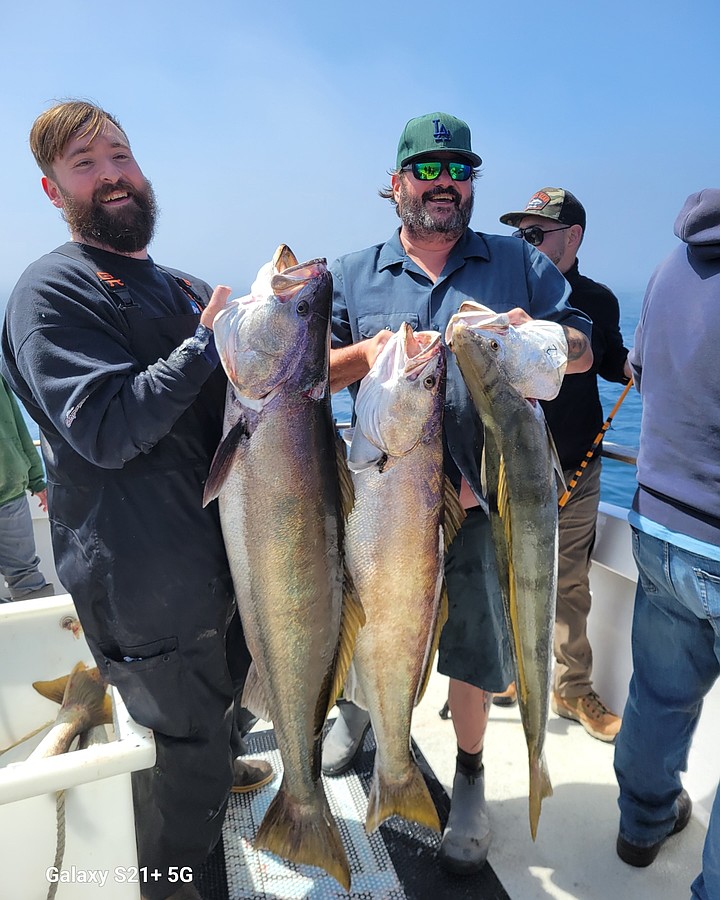
Anglers aboard Amigo Sportfishing this April with some solid white seabass, some of which are most likely a result of restocking efforts since the 1980s
The full Moon might have slowed the pelagic species in our neck of the woods, but white seabass and halibut have been biting very well for boats like Amigo Sportfishing, Ghost Sportfishing, and Pride Sportfishing running out of 22nd Street Landing in San Pedro. The boats are running 1.5-day trips to the islands, mostly to San Clemente and Catalina. Seabass have been eating bait just outside the kelp line and the size has been pretty good. It wasn’t that long ago that white seabass were nearly gone, having been fished hard from the early years of sportfishing in California before World War II and through the 1970s.
So, how did white seabass come back so strong, even as fishing pressure grew? Well, the Hubbs-SeaWorld Research Institute white seabass program tagged and released their first pen-raised white seabass in 1986. Since then, the hatchery/pen program has expanded to thirteen sites in Southern California, including an installation at Catalina Island. In recent studies, they found that nearly 50% of the fish caught had genetic markers confirming they were either released or the offspring of released fish. The Hubbs-SeaWorld Research Institute’s Ocean Resources Enhancement and Hatchery Program (OREHP), to date, has released 2.7 million white seabass into the ocean, with release goals currently set at 350,000 fish per year. That’s good stuff. I’d much rather eat white seabass than bonito. Whether the beach, bay, lake, or offshore, they’re out there so go out and get ‘em!
Here's something you might be interested in.
Fish Report: Big bones biting
Yellowtail slow during Moon phase - White Seabass comeback

Fish Report: Big bones biting
Yellowtail slow during Moon phase - White Seabass comeback
Happy anglers with some very big bonito for anglers aboard the Dolphin half-day run.
Dock Totals 5/4 – 5/10: 889 anglers aboard 42 half-day to 3-day trips out of San Diego landings over the past week caught 1 barracuda (30 released), 33 bluefin tuna (to 100 pounds), 555 bonito, 112 calico bass, 1 halibut, 12 lingcod, 2498 rockfish, 12 sand bass, 60 sanddab, 165 sculpin, 55 sheephead, 2 Spanish jack, 609 whitefish, and 28 yellowtail.
Saltwater: Angler numbers dropped to about half that of the week before, due mostly to weather. Last Sunday was a very slow day, when normally it is the busiest day of the week for the fleet. It could be that some people were holding off because of the Moon phase. As we approached the full Moon, the bluefin bite dropped off dramatically, even though most boats in the area metered gobs of fish. Rockfish numbers were about equal per angler, though surface and mid- to upper-water column species got a bit tight lipped. The exception was big bonito to ten or twelve pounds, with the bite beginning close enough for the half-day runs to get in on the action and continuing on down into Mexican waters.
Big bonito are fun, unless they are taking bait before it gets to a more desirable species, like yellowtail or tuna. If those fish don’t want to play, catching big bones is fine. I like to eat them, but only when they're properly bled and kept fresh. If they're really fresh, I will eat bonito as sashimi and even fried fillets with a little rub on them. We would eat fresh caught bonito ceviche often when fishing with the co-op commercial guys in Mexico. Having lived where I can catch one and get to my kitchen within a couple few minutes, bonito are definitely on my menu. They can be great on the smoker or even fried up in some olive oil and made into "tuna salad."
I have found that this latter approach kind of works for any fish; like ceviche, the added ingredients leave the fish "neutral" in flavor. Just make your favorite tuna salad and instead of opening a can, trim the blood meat and any remaining pin bones from a filet of any species, fry it up, and shred it into your mayo-based salad.
While we're on the subject of eating fish: the domoic acid event that has been plaguing marine mammals and birds proved to be the cause of death in necropsies of two out of the four whales that stranded on Orange and LA County beaches in April. Gray whales are usually not affected by domoic acid, and their strandings are usually mostly due to starvation as their normal summer feeding grounds are depleted. We tend to see them feeding en route during migrations — moreso in recent decades — and we see more whales with dimples behind their blow holes along the spine, which is one indication of malnourishment.
The whales found to have succumbed to domoic acid were a humpback and a minke, which would make more sense as they often prey on baitfish. That is also why sea lions, dolphins, and birds have been dying along the coast. The good news is that domoic acid is lessening, with very little present in the water. The bad news is that levels in sardines, specifically, are so high that the California Department of Fish and Wildlife issued a Take Restriction for sardines, allowing them to be taken only for bait, as consuming them poses a threat to health. The good news for anglers chasing fish that feed on sardines is that in the species we target, domoic acid builds up in the intestines and livers, and not so much in muscle. As a result, no gamefish are off the table due to the recent blooms resulting in domoic acid. But I would be very careful about shellfish.
Anglers aboard Amigo Sportfishing this April with some solid white seabass, some of which are most likely a result of restocking efforts since the 1980s
The full Moon might have slowed the pelagic species in our neck of the woods, but white seabass and halibut have been biting very well for boats like Amigo Sportfishing, Ghost Sportfishing, and Pride Sportfishing running out of 22nd Street Landing in San Pedro. The boats are running 1.5-day trips to the islands, mostly to San Clemente and Catalina. Seabass have been eating bait just outside the kelp line and the size has been pretty good. It wasn’t that long ago that white seabass were nearly gone, having been fished hard from the early years of sportfishing in California before World War II and through the 1970s.
So, how did white seabass come back so strong, even as fishing pressure grew? Well, the Hubbs-SeaWorld Research Institute white seabass program tagged and released their first pen-raised white seabass in 1986. Since then, the hatchery/pen program has expanded to thirteen sites in Southern California, including an installation at Catalina Island. In recent studies, they found that nearly 50% of the fish caught had genetic markers confirming they were either released or the offspring of released fish. The Hubbs-SeaWorld Research Institute’s Ocean Resources Enhancement and Hatchery Program (OREHP), to date, has released 2.7 million white seabass into the ocean, with release goals currently set at 350,000 fish per year. That’s good stuff. I’d much rather eat white seabass than bonito. Whether the beach, bay, lake, or offshore, they’re out there so go out and get ‘em!