

Here's something you might be interested in.
Ask a Hipster — Advice you didn't know you needed
Big Screen — Movie commentary
Blurt — Music's inside track
Booze News — San Diego spirits
Classical Music — Immortal beauty
Classifieds — Free and easy
Close to Home — What it’s like on the street where you live
Cover Stories — Front-page features
Drinks All Around — Bartenders' drink recipes
Excerpts — Literary and spiritual excerpts
Feast! — Food & drink reviews
Feature Stories — Local news & stories
Fishing Report — What’s getting hooked from ship and shore
From the Archives — Spotlight on the past
Golden Dreams — Talk of the town
The Gonzo Report — Making the musical scene, or at least reporting from it
Letters — Our inbox
Movies@Home — Local movie buffs share favorites
Movie Reviews — Our critics' picks and pans
Musician Interviews — Up close with local artists
Neighborhood News from Stringers — Hyperlocal news
News Ticker — News & politics
Obermeyer — San Diego politics illustrated
Outdoors — Weekly changes in flora and fauna
Overheard in San Diego — Eavesdropping illustrated
Poetry — The old and the new
Reader Travel — Travel section built by travelers
Reading — The hunt for intellectuals
Roam-O-Rama — SoCal's best hiking/biking trails
San Diego Beer — Inside San Diego suds
SD on the QT — Almost factual news
Sheep and Goats — Places of worship
Special Issues — The best of
Street Style — San Diego streets have style
Surf Diego — Real stories from those braving the waves
Theater — On stage in San Diego this week
Tin Fork — Silver spoon alternative
Under the Radar — Matt Potter's undercover work
Unforgettable — Long-ago San Diego
Unreal Estate — San Diego's priciest pads
Your Week — Daily event picks
Japanese Pittosporum mocks orange blossoms, rodent populations boom
Weak rainfall leads to lesser wildflower bloom
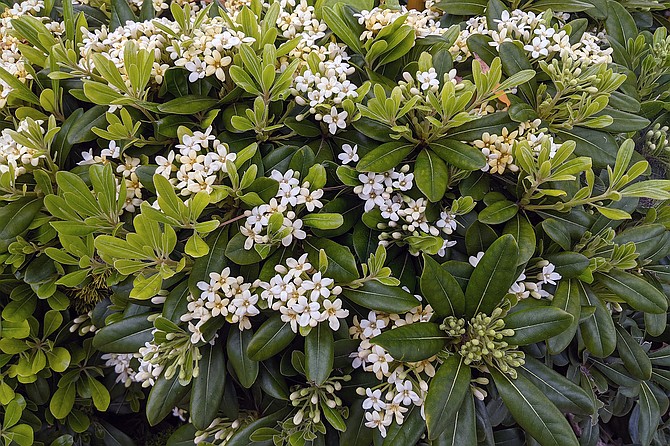
Japanese Pittosporum has flowers that smell like orange blossoms giving it the name "Mock Orange."
As the fragrance of orange blossoms stops its welcome wafting on the San Diego breeze, it is being replaced by the sweet scent of Mock Orange, also known as Japanese Pittosporum or Australian Laurel. Mock Orange is an evergreen shrub that is native to parts of Eastern Asia; it can be found in Japan, South Korea, northern Taiwan, and coastal parts of China. In North America, it can be found in coastal statues with mild climates — zones 8-10 — such as California, North Carolina, Georgia, and Florida. It thrives in full sun to heavy shade, grows in a wide range of soil pH, and is drought, heat and salt spray tolerant — but can’t survive in cold temperatures. It is typically seen as a bush or shrub, but can grow as tall as 13 feet if left unpruned. It blooms in April and May, and the flowers smell like orange blossoms — hence the name Mock Orange. However, the fruit it produces in the fall is not edible.
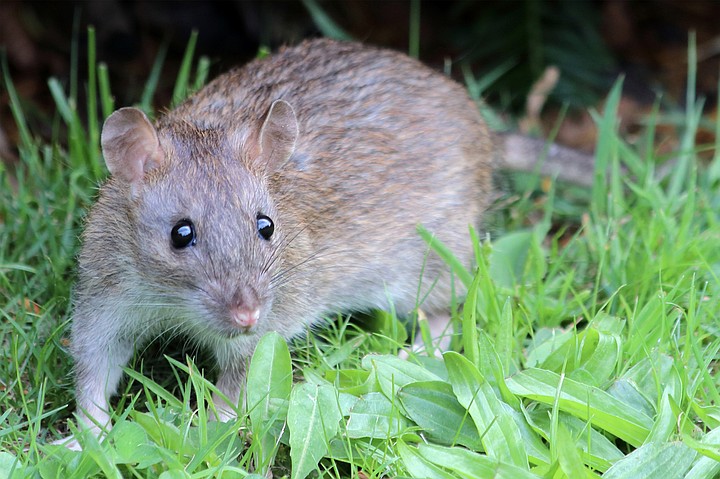
A Norway or brown rat (Rattus norvegicus) scurries across a backyard lawn to grab a morsel before it heads back to cover.
The populations of rabbits and rodents are peaking in the canyons and hillsides of coastal San Diego County just now. In many neighborhoods, car headlights are illuminating the bright white rear ends of scampering cottontail rabbits as they stage raids on succulent garden vegetation. Out on the fringes of suburbia, sleek coyotes are sometimes spotted slinking about in pursuit of rodents, rabbits, or easier-to-catch fare such as house cats. Rodent populations in Southern California have been booming the last couple years: a 2024 study by pest control company Orkin named Los Angeles the second "rattiest" city in America last year, beating out New York city. Only Chicago was more infested. Local San Diego neighborhoods have seen and increase in rodent populations in recent years as well. An old backyard shed and an unattended citrus tree are enough to support an entire colony of rodents, which are known to climb trees to source food.
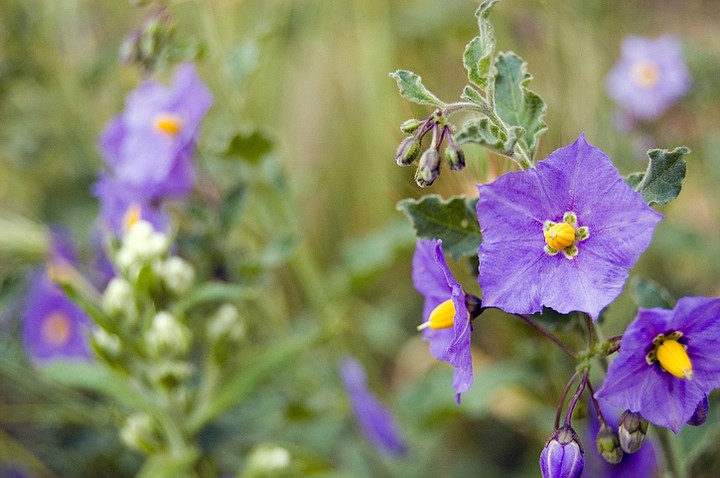
Spring wildflowers like purple nightshade can still be found in cooler coastal enclaves.
San Diego’s coastal wildflower bloom — almost a bust this year because we had so little winter rain — is not entirely over. Meticulous searches on slopes facing north (away from the sun) or in shady canyon bottoms (where runoff may have lingered) may reveal native red monkeyflower, blue-eyed grass, wild hyacinth, and nonnatives such as chrysanthemum and mustard. Irrigated freeway embankments, with their showy African daisies, blooming iceplant, and other forms of groomed landscaping, look muted but decent this spring.
Here's something you might be interested in.
Japanese Pittosporum mocks orange blossoms, rodent populations boom
Weak rainfall leads to lesser wildflower bloom

Japanese Pittosporum mocks orange blossoms, rodent populations boom
Weak rainfall leads to lesser wildflower bloom
Japanese Pittosporum has flowers that smell like orange blossoms giving it the name "Mock Orange."
As the fragrance of orange blossoms stops its welcome wafting on the San Diego breeze, it is being replaced by the sweet scent of Mock Orange, also known as Japanese Pittosporum or Australian Laurel. Mock Orange is an evergreen shrub that is native to parts of Eastern Asia; it can be found in Japan, South Korea, northern Taiwan, and coastal parts of China. In North America, it can be found in coastal statues with mild climates — zones 8-10 — such as California, North Carolina, Georgia, and Florida. It thrives in full sun to heavy shade, grows in a wide range of soil pH, and is drought, heat and salt spray tolerant — but can’t survive in cold temperatures. It is typically seen as a bush or shrub, but can grow as tall as 13 feet if left unpruned. It blooms in April and May, and the flowers smell like orange blossoms — hence the name Mock Orange. However, the fruit it produces in the fall is not edible.
A Norway or brown rat (Rattus norvegicus) scurries across a backyard lawn to grab a morsel before it heads back to cover.
The populations of rabbits and rodents are peaking in the canyons and hillsides of coastal San Diego County just now. In many neighborhoods, car headlights are illuminating the bright white rear ends of scampering cottontail rabbits as they stage raids on succulent garden vegetation. Out on the fringes of suburbia, sleek coyotes are sometimes spotted slinking about in pursuit of rodents, rabbits, or easier-to-catch fare such as house cats. Rodent populations in Southern California have been booming the last couple years: a 2024 study by pest control company Orkin named Los Angeles the second "rattiest" city in America last year, beating out New York city. Only Chicago was more infested. Local San Diego neighborhoods have seen and increase in rodent populations in recent years as well. An old backyard shed and an unattended citrus tree are enough to support an entire colony of rodents, which are known to climb trees to source food.
Spring wildflowers like purple nightshade can still be found in cooler coastal enclaves.
San Diego’s coastal wildflower bloom — almost a bust this year because we had so little winter rain — is not entirely over. Meticulous searches on slopes facing north (away from the sun) or in shady canyon bottoms (where runoff may have lingered) may reveal native red monkeyflower, blue-eyed grass, wild hyacinth, and nonnatives such as chrysanthemum and mustard. Irrigated freeway embankments, with their showy African daisies, blooming iceplant, and other forms of groomed landscaping, look muted but decent this spring.
Comments