

Here's something you might be interested in.
Ask a Hipster — Advice you didn't know you needed
Big Screen — Movie commentary
Blurt — Music's inside track
Booze News — San Diego spirits
Classical Music — Immortal beauty
Classifieds — Free and easy
Close to Home — What it’s like on the street where you live
Cover Stories — Front-page features
Drinks All Around — Bartenders' drink recipes
Excerpts — Literary and spiritual excerpts
Feast! — Food & drink reviews
Feature Stories — Local news & stories
Fishing Report — What’s getting hooked from ship and shore
From the Archives — Spotlight on the past
Golden Dreams — Talk of the town
The Gonzo Report — Making the musical scene, or at least reporting from it
Letters — Our inbox
Movies@Home — Local movie buffs share favorites
Movie Reviews — Our critics' picks and pans
Musician Interviews — Up close with local artists
Neighborhood News from Stringers — Hyperlocal news
News Ticker — News & politics
Obermeyer — San Diego politics illustrated
Outdoors — Weekly changes in flora and fauna
Overheard in San Diego — Eavesdropping illustrated
Poetry — The old and the new
Reader Travel — Travel section built by travelers
Reading — The hunt for intellectuals
Roam-O-Rama — SoCal's best hiking/biking trails
San Diego Beer — Inside San Diego suds
SD on the QT — Almost factual news
Sheep and Goats — Places of worship
Special Issues — The best of
Street Style — San Diego streets have style
Surf Diego — Real stories from those braving the waves
Theater — On stage in San Diego this week
Tin Fork — Silver spoon alternative
Under the Radar — Matt Potter's undercover work
Unforgettable — Long-ago San Diego
Unreal Estate — San Diego's priciest pads
Your Week — Daily event picks
Movie review: THE SURFER (2024)
Every day in this beach town plays out like an alpha-male hazing on crank

Paranoia, anyone?
THE SURFER (2024) Lorcan Finnegan / Writer: Thomas Martin / Cinematographer: Radek Ladczuk (2.35:1) / Designer: Emma Fletcher / Editor: Tony Cranstoun / Composer: François Tétaz / Cast: Nicolas Cage, Julian McMahon, Nic Cassim, Miranda Tapsell, Alexander Bertrand, Nic Cassim, and Justin Rosniak / Distributor: Lionsgate / Rated R / 100 mins.
At the story's beginning, Nicolas Cage’s big-time operator — known only as “The Surfer” — has every intention of making it a memorable day spent with his son — known only as “The Kid” (Finn Little). Given the choice, how many high schoolers would choose slogging through another day cracking the books over a furlough spent shooting the curl with their Zen surfing dad? Some fathers drill their otherwise preoccupied kids with, “Study hard and stay in school,” but this particular Kid lives by that rule all by himself, afraid that a day off might affect his grades.
They don’t call him The Surfer without reason. Before he went square, Dad rode the waves to fame. Most teenagers would resent a father who prioritized fielding a business call on a shared holiday before they even got their hair wet. But what Kid doesn’t know is that his old man is just a few thousand dollars away from purchasing the house Surfer was born in.
It’s a dream from the past that Surfer has spent a lifetime working hard to reclaim. Why anyone would want to relive those childhood memories is known only to Surfer, but this time, nothing is going to stop him — except maybe a gang of half-baked, sun-kissed wave jockeys who claim exclusive rights to the beach.
Video:
Trailer: THE SURFER
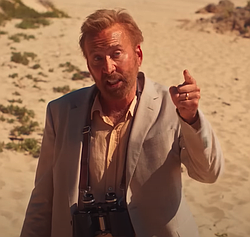
“Don't live here, don't surf here” seems to be the motto of the community. Surfer was born in Australia and spent time in America (somehow managing to lose his accent in transit). Not one to back down, particularly when he's just been humiliated in front of his son by the head instigator, Surfer has no choice but to take on Scally (Julian McMahon, turning up the terror) and his band of unskilled deplorables.
Every day in this beach town plays out like an alpha-male hazing on crank; when it comes Surfer’s turn to walk barefoot on broken glass, he seems to get off on every crunched sliver. Why else would he keep coming back for more? At around the 3/4 mark, full-blown madness comes to the fore, as it must for all Cage protagonists. Once that happens, there’s little more to do than put your feet up and watch the star superbly earn his paycheck.
Lorcan Finnegan's knowledge of '70s genre films is compounded by an ingrained know-how when it comes to using the Panavision frame for dramatic effect. Strapped atop the car’s roof, the pointy end of the surfboard casts a pie-wedge shadow on the windshield that fits The Surfer like a yoke.
The movie is billed as a psychological drama, but if that's the case, why did I find myself frequently laughing out loud during this tale of what happens when your worst enemies become your best friends?
SPOILERS BELOW!
Who leaves a pizza — one that he just paid the delivery man $100 for, mind you — on the roof of his car while he goes to relieve himself?
Why does The Kid vanish for the entire middle of the picture?
When Surfer found the gun hidden in the bathroom, there were 4 bullets in the chamber (and one in his pocket). Outnumbered as he was, why waste a bullet on a test fire?
Once the the gun in his possession, only a fool, or a screenwriter in a corner, would have Surfer return it to whence it came, rather than carry it in his pocket.
If everyone in town was in on the gag, what happened to the coffee cart operator?
We have so much dirt on Scally that by the time we learn late in the third act that he is sleeping with a 16-year-old, the accusation sounds like one of his better traits. ***
Here's something you might be interested in.
Movie review: THE SURFER (2024)
Every day in this beach town plays out like an alpha-male hazing on crank

Movie review: THE SURFER (2024)
Every day in this beach town plays out like an alpha-male hazing on crank
Paranoia, anyone?
THE SURFER (2024) Lorcan Finnegan / Writer: Thomas Martin / Cinematographer: Radek Ladczuk (2.35:1) / Designer: Emma Fletcher / Editor: Tony Cranstoun / Composer: François Tétaz / Cast: Nicolas Cage, Julian McMahon, Nic Cassim, Miranda Tapsell, Alexander Bertrand, Nic Cassim, and Justin Rosniak / Distributor: Lionsgate / Rated R / 100 mins.
At the story's beginning, Nicolas Cage’s big-time operator — known only as “The Surfer” — has every intention of making it a memorable day spent with his son — known only as “The Kid” (Finn Little). Given the choice, how many high schoolers would choose slogging through another day cracking the books over a furlough spent shooting the curl with their Zen surfing dad? Some fathers drill their otherwise preoccupied kids with, “Study hard and stay in school,” but this particular Kid lives by that rule all by himself, afraid that a day off might affect his grades.
They don’t call him The Surfer without reason. Before he went square, Dad rode the waves to fame. Most teenagers would resent a father who prioritized fielding a business call on a shared holiday before they even got their hair wet. But what Kid doesn’t know is that his old man is just a few thousand dollars away from purchasing the house Surfer was born in.
It’s a dream from the past that Surfer has spent a lifetime working hard to reclaim. Why anyone would want to relive those childhood memories is known only to Surfer, but this time, nothing is going to stop him — except maybe a gang of half-baked, sun-kissed wave jockeys who claim exclusive rights to the beach.
Video:
Trailer: THE SURFER
“Don't live here, don't surf here” seems to be the motto of the community. Surfer was born in Australia and spent time in America (somehow managing to lose his accent in transit). Not one to back down, particularly when he's just been humiliated in front of his son by the head instigator, Surfer has no choice but to take on Scally (Julian McMahon, turning up the terror) and his band of unskilled deplorables.
Every day in this beach town plays out like an alpha-male hazing on crank; when it comes Surfer’s turn to walk barefoot on broken glass, he seems to get off on every crunched sliver. Why else would he keep coming back for more? At around the 3/4 mark, full-blown madness comes to the fore, as it must for all Cage protagonists. Once that happens, there’s little more to do than put your feet up and watch the star superbly earn his paycheck.
Lorcan Finnegan's knowledge of '70s genre films is compounded by an ingrained know-how when it comes to using the Panavision frame for dramatic effect. Strapped atop the car’s roof, the pointy end of the surfboard casts a pie-wedge shadow on the windshield that fits The Surfer like a yoke.
The movie is billed as a psychological drama, but if that's the case, why did I find myself frequently laughing out loud during this tale of what happens when your worst enemies become your best friends?
SPOILERS BELOW!
Who leaves a pizza — one that he just paid the delivery man $100 for, mind you — on the roof of his car while he goes to relieve himself?
Why does The Kid vanish for the entire middle of the picture?
When Surfer found the gun hidden in the bathroom, there were 4 bullets in the chamber (and one in his pocket). Outnumbered as he was, why waste a bullet on a test fire?
Once the the gun in his possession, only a fool, or a screenwriter in a corner, would have Surfer return it to whence it came, rather than carry it in his pocket.
If everyone in town was in on the gag, what happened to the coffee cart operator?
We have so much dirt on Scally that by the time we learn late in the third act that he is sleeping with a 16-year-old, the accusation sounds like one of his better traits. ***