

Here's something you might be interested in.
Ask a Hipster — Advice you didn't know you needed
Big Screen — Movie commentary
Blurt — Music's inside track
Booze News — San Diego spirits
Classical Music — Immortal beauty
Classifieds — Free and easy
Close to Home — What it’s like on the street where you live
Cover Stories — Front-page features
Drinks All Around — Bartenders' drink recipes
Excerpts — Literary and spiritual excerpts
Feast! — Food & drink reviews
Feature Stories — Local news & stories
Fishing Report — What’s getting hooked from ship and shore
From the Archives — Spotlight on the past
Golden Dreams — Talk of the town
The Gonzo Report — Making the musical scene, or at least reporting from it
Letters — Our inbox
Movies@Home — Local movie buffs share favorites
Movie Reviews — Our critics' picks and pans
Musician Interviews — Up close with local artists
Neighborhood News from Stringers — Hyperlocal news
News Ticker — News & politics
Obermeyer — San Diego politics illustrated
Outdoors — Weekly changes in flora and fauna
Overheard in San Diego — Eavesdropping illustrated
Poetry — The old and the new
Reader Travel — Travel section built by travelers
Reading — The hunt for intellectuals
Roam-O-Rama — SoCal's best hiking/biking trails
San Diego Beer — Inside San Diego suds
SD on the QT — Almost factual news
Sheep and Goats — Places of worship
Special Issues — The best of
Street Style — San Diego streets have style
Surf Diego — Real stories from those braving the waves
Theater — On stage in San Diego this week
Tin Fork — Silver spoon alternative
Under the Radar — Matt Potter's undercover work
Unforgettable — Long-ago San Diego
Unreal Estate — San Diego's priciest pads
Your Week — Daily event picks
Paging Doctor Dog
Signal Healthware's Laika spotted at the Del

The original rated a stamp!
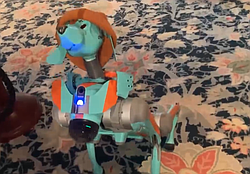
Laika clacks up to me. He doesn’t actually lick my hand, but he wants to be friendly.
Laika is a dog. Laika is also a robot.
Tommy Sharkey, the guy with the controls, says Laika was named after the first dog in space, which the Soviets sent up in 1957. “Our Laika here was manufactured by a Chinese company named Unitree. We sent Laika to Hollywood for redecoration, to make him more friendly.”
What does Laika do? He visits patients. He also treats them — or at least helps them to treat themselves. “I have never worked out why medicine should be centralized,” says Eli Spencer, who’s the force behind the Laika project for Signal Healthware, based out of UCSD. “For my whole career, I have been trying to get medicine to people for them to own. I’m a doctor and a researcher. This is my passion project. [With medicine] you want to go towards the joy spectrum, instead of the ‘OMG this is scary’ sort of thing.”
Video:
Meet Laika!
“In the U.S. at least,” adds Sharkey, “you have this ‘patient as helpless individual’ idea when you have a medical problem. The solution is to give up. You have to go towards a doctor — and they will solve the problem. And [so we’re] rethinking this idea of giving people agency, more control over their lives. You can actually do a lot to help yourself. You don’t need to be this helpless little thing. So that’s why when we’re designing these things: we’re trying to make [medicine] approachable, not intimidating.”
Laika, the “doc-dog” who’s going to empower us, is still very much in the testing phase. “We sent Laika up to the Arctic for a NASA mission,” says Sharkey. “They have like a Mars analogue training base up there. NASA asked us to do some tests. It was a search and rescue experiment. We were using Laika for triage, to go out to patients to talk to them, using AI that can run locally. It can be like, ‘OK, what’s going on?’ Then go back and retrieve medical equipment if needed.”

There is precedent for this sort of thing.
"Yes," says Dr. Spencer. "The first thing is to realize that we have the resources. I don't need a doctor. They call it 'deprofessionalizing.' It's taking away the profession's control of it. People can have control of this. That's what's exciting. It's all the pieces that we can put together. Universal health care! I didn't imagine it this way. I'm just seeing it now. It doesn't do everything. There are gaps. But if this [talking, AI-powered] first-aid kit takes care of most of your stuff, it's nice. Every person in America could get close to affording it, or a community or family. But it's tricky to merge the wisdom of what medicine knows with the human factor with AI. We need 1000, 10,000 people trying it, because it's not going to be perfect, but [it's time to] move to that edge."
“Think of the recent LA fires,” says Sharkey. “Medical services were overwhelmed, people were in these isolated communities. You can totally send out a drone. It drives out, shows up, pops open, and there’s an AI assistant in there. And that AI assistant knows everything that’s in the pod. It can do a lot of diagnostic stuff, figure out a treatment plan. It’ll say, ‘What’s going on?’ And if you’re panicked, saying confusing things, it’s particularly trained to work with you, step by step, elicit what’s going on very carefully. Then that translates into our algorithm that does all of this ‘What’s the diagnosis?’ ‘What questions should you ask?’ The AI’s having this very natural conversation with the person. So let’s say it’s seeing something similar to a diabetic emergency. And it might ask them if they have a known history of diabetes. There’s a glucometer on board. It can say things like, ‘Hey! This is a glucometer.’ It can give them step-by-step instructions. It’s super hand-holdy. They’ll hear, ‘Here’s the device. And here’s a light to guide you…’ And then they can diagnose a person. It’s like, ‘OK. Your blood glucose level is this. This is very abnormal. You need more sugars…’ And if you have the diabetes module, you have insulin on board. You have continuous monitoring on board. It’s like, ‘Hey, we can solve this right here, right now. You don’t need an ambulance. You can do this yourself.’”
Or say the user or a family member just got injured. "They’re panicking, they’re freaked out, they don’t have a medical background. And we’re trying to make this process so simple that even a person in that situation could use the equipment."
Are we talking the end of doctors? “No,” says Sharkey. “Of course, I would always prefer to see a real doctor. But if it’s difficult to get access to the doctor — like if medical services are overwhelmed, or it’s going to be two weeks before I can get a scheduled appointment — then I’m like, ‘This is good enough.’”
Here's something you might be interested in.
Paging Doctor Dog
Signal Healthware's Laika spotted at the Del

Paging Doctor Dog
Signal Healthware's Laika spotted at the Del
The original rated a stamp!
Laika clacks up to me. He doesn’t actually lick my hand, but he wants to be friendly.
Laika is a dog. Laika is also a robot.
Tommy Sharkey, the guy with the controls, says Laika was named after the first dog in space, which the Soviets sent up in 1957. “Our Laika here was manufactured by a Chinese company named Unitree. We sent Laika to Hollywood for redecoration, to make him more friendly.”
What does Laika do? He visits patients. He also treats them — or at least helps them to treat themselves. “I have never worked out why medicine should be centralized,” says Eli Spencer, who’s the force behind the Laika project for Signal Healthware, based out of UCSD. “For my whole career, I have been trying to get medicine to people for them to own. I’m a doctor and a researcher. This is my passion project. [With medicine] you want to go towards the joy spectrum, instead of the ‘OMG this is scary’ sort of thing.”
Video:
Meet Laika!
“In the U.S. at least,” adds Sharkey, “you have this ‘patient as helpless individual’ idea when you have a medical problem. The solution is to give up. You have to go towards a doctor — and they will solve the problem. And [so we’re] rethinking this idea of giving people agency, more control over their lives. You can actually do a lot to help yourself. You don’t need to be this helpless little thing. So that’s why when we’re designing these things: we’re trying to make [medicine] approachable, not intimidating.”
Laika, the “doc-dog” who’s going to empower us, is still very much in the testing phase. “We sent Laika up to the Arctic for a NASA mission,” says Sharkey. “They have like a Mars analogue training base up there. NASA asked us to do some tests. It was a search and rescue experiment. We were using Laika for triage, to go out to patients to talk to them, using AI that can run locally. It can be like, ‘OK, what’s going on?’ Then go back and retrieve medical equipment if needed.”
There is precedent for this sort of thing.
"Yes," says Dr. Spencer. "The first thing is to realize that we have the resources. I don't need a doctor. They call it 'deprofessionalizing.' It's taking away the profession's control of it. People can have control of this. That's what's exciting. It's all the pieces that we can put together. Universal health care! I didn't imagine it this way. I'm just seeing it now. It doesn't do everything. There are gaps. But if this [talking, AI-powered] first-aid kit takes care of most of your stuff, it's nice. Every person in America could get close to affording it, or a community or family. But it's tricky to merge the wisdom of what medicine knows with the human factor with AI. We need 1000, 10,000 people trying it, because it's not going to be perfect, but [it's time to] move to that edge."
“Think of the recent LA fires,” says Sharkey. “Medical services were overwhelmed, people were in these isolated communities. You can totally send out a drone. It drives out, shows up, pops open, and there’s an AI assistant in there. And that AI assistant knows everything that’s in the pod. It can do a lot of diagnostic stuff, figure out a treatment plan. It’ll say, ‘What’s going on?’ And if you’re panicked, saying confusing things, it’s particularly trained to work with you, step by step, elicit what’s going on very carefully. Then that translates into our algorithm that does all of this ‘What’s the diagnosis?’ ‘What questions should you ask?’ The AI’s having this very natural conversation with the person. So let’s say it’s seeing something similar to a diabetic emergency. And it might ask them if they have a known history of diabetes. There’s a glucometer on board. It can say things like, ‘Hey! This is a glucometer.’ It can give them step-by-step instructions. It’s super hand-holdy. They’ll hear, ‘Here’s the device. And here’s a light to guide you…’ And then they can diagnose a person. It’s like, ‘OK. Your blood glucose level is this. This is very abnormal. You need more sugars…’ And if you have the diabetes module, you have insulin on board. You have continuous monitoring on board. It’s like, ‘Hey, we can solve this right here, right now. You don’t need an ambulance. You can do this yourself.’”
Or say the user or a family member just got injured. "They’re panicking, they’re freaked out, they don’t have a medical background. And we’re trying to make this process so simple that even a person in that situation could use the equipment."
Are we talking the end of doctors? “No,” says Sharkey. “Of course, I would always prefer to see a real doctor. But if it’s difficult to get access to the doctor — like if medical services are overwhelmed, or it’s going to be two weeks before I can get a scheduled appointment — then I’m like, ‘This is good enough.’”
Comments