

Here's something you might be interested in.
Ask a Hipster — Advice you didn't know you needed
Big Screen — Movie commentary
Blurt — Music's inside track
Booze News — San Diego spirits
Classical Music — Immortal beauty
Classifieds — Free and easy
Close to Home — What it’s like on the street where you live
Cover Stories — Front-page features
Drinks All Around — Bartenders' drink recipes
Excerpts — Literary and spiritual excerpts
Feast! — Food & drink reviews
Feature Stories — Local news & stories
Fishing Report — What’s getting hooked from ship and shore
From the Archives — Spotlight on the past
Golden Dreams — Talk of the town
The Gonzo Report — Making the musical scene, or at least reporting from it
Letters — Our inbox
Movies@Home — Local movie buffs share favorites
Movie Reviews — Our critics' picks and pans
Musician Interviews — Up close with local artists
Neighborhood News from Stringers — Hyperlocal news
News Ticker — News & politics
Obermeyer — San Diego politics illustrated
Outdoors — Weekly changes in flora and fauna
Overheard in San Diego — Eavesdropping illustrated
Poetry — The old and the new
Reader Travel — Travel section built by travelers
Reading — The hunt for intellectuals
Roam-O-Rama — SoCal's best hiking/biking trails
San Diego Beer — Inside San Diego suds
SD on the QT — Almost factual news
Sheep and Goats — Places of worship
Special Issues — The best of
Street Style — San Diego streets have style
Surf Diego — Real stories from those braving the waves
Theater — On stage in San Diego this week
Tin Fork — Silver spoon alternative
Under the Radar — Matt Potter's undercover work
Unforgettable — Long-ago San Diego
Unreal Estate — San Diego's priciest pads
Your Week — Daily event picks
Fish Report: Bluefin still biting better at night
Squid off La Jolla brings white seabass; also: Peregrine 1, seagull 0
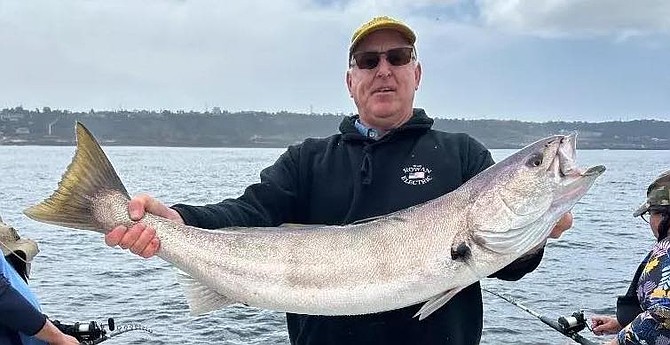
Solid coastal white seabass caught by this happy angler while fishing aboard the Daily Double.
Dock Totals 6/15 – 6/21: 3359 anglers aboard 120 half-day to 3-day trips out of San Diego landings over the past week caught 23 barracuda, 754 bluefin tuna (to 200 pounds), 51 bonito, 20 cabezon, 3880 calico bass, 12 halibut, 10 lingcod, 2853 rockfish, 581 sand bass, 5 sargo, 130 sculpin, 98 sheephead, 1189 whitefish, 7 white seabass, and 129 yellowtail.
Saltwater: ‘Tis the season for transitional tuna fishing. By that, I mean bluefin to yellowfin as the water warms coming up the Baja Peninsula against the predominant south push of the California Current. The line right now seems to be around Punta Eugenia at the tip of the Vizcaino Peninsula that juts westward, pointing at Cedros Island about midway down Baja’s Pacific coast. South of there and to the Ridge outside of Bahia Magdalena, yellowfin tuna fishing is beginning to take off, along with excellent yellowtail along the coast, outside, and around islands from Cedros to Asuncion.
North of that line, yellowtail and bluefin are the predominant catches of pelagic species outside, while inside, calico bass, sheephead, and more than a smattering of white seabass have been reported. Bluefin are thickest from the banks off Ensenada, and north to the Channel Islands. Boats targeting them are reporting mixed success, with fish biting strong for a couple days then tight lipped for a couple days, and most catches coming at night on deep-drop jigs and tuna bombs. Daytime bites have mostly been on bait on a dropper loop with a few kite fish and fly-line bites on the surface. Most of the fish have been over the 100-pound mark at night, while the daytime bite has been more mixed from 40 pounds up.
For those reasons, trips targeting bluefin are suggesting the following tackle: at least one 80 to 100-pound outfit with 300-gram to 400-gram knife jigs and number 2 to 2/0 circle hooks for bait. On the lighter side, a 25- to 35-pound outfit with 8 to 12-ounce torpedo sinkers, and the same sized hooks for dropper loop bait, flyline or kite fishing during the day.
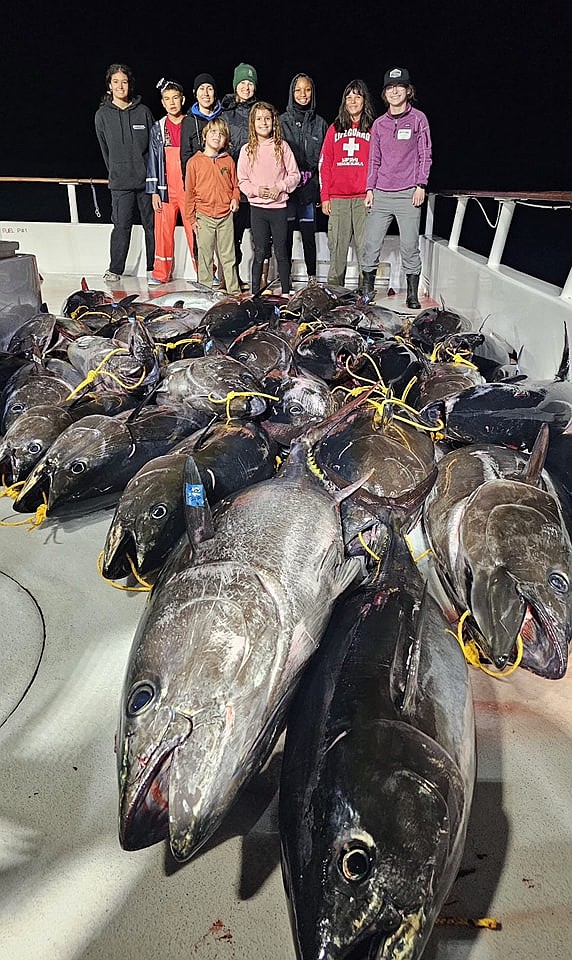
Bluefin haul for youngsters aboard the Excel: “We are out on our Family Adventure #1 trip with lots of young talent aboard. These kids put a whoopin on these local bluefin. 50 of these beauties hitting the deck and everyone is pumped. These kids are the future of our industry and the future is lookin' bright! Great Job.”
The local short run boats have been doing very well on calico bass and rockfish, with occasional catches of yellowtail, white seabass, and halibut in the mix. There has been some market squid off La Jolla and white seabass fishing has picked up, with a few good fish boated on morning or evening half-day runs fishing off Point Loma and outside the reserve in La Jolla. Longer trips have focused on rockfish off the 9-Mile Bank and south to the Coronado Islands where yellowtail have begun to bite, albeit slowly, even though there have been good marks on schools. That action should pick up substantially in coming weeks as conditions improve.
A little further south, calico bass, white seabass, barracuda, and yellowtail are feeding off coastal kelp beds and high spots from Ensenada and to the south, with good yellowtail fishing reported at San Martin Island more so than the offshore at the 240, 15 and 6 high spots. That, too can change quickly, as yellowtail tend to get thick out at those banks by July, with white seabass, calicos, and some decent halibut being the fish more targeted in close to the island. Bluefin also haunt those numbered banks for the pangeros running out of San Quintin, and in warmer years, yellowfin and some dorado will show up. Jaime of Jaime’s Pangas caught a 200-pound bluefin out there early this year in February, but other than that,it has been hit and miss, as the fish tend to show up outside on the deep side of those spots, and we’re still in the windy season which can be prohibitive for pangas. On the good days, yellowtail have been on and off, with the on days featuring wide open surface iron action.
One thing I look forward to every year as late spring eases into summer is the plethora of pelicans that show up with the baitfish as the water warms and triggers mass spawning of the anchovies, sardines, and other silversides that are a base building block for our fishery. My favorite dinosaurs, California brown pelicans can look like aerial acrobats one minute and seem oafishly bumbling the next. They will often fly along the crest of a wave, almost touching it with splayed wingtip feathers that resemble fingers, then dodge up and over the wave as it breaks and gracefully slide alongside the next rising lip.
Brown pelicans are the only one of the seven species of pelicans that dive from heights when feeding. I tend to see them inside working bait more than outside, moreso when I am on the kayak or surf fishing than when out on a boat. My fishing jones always starts acting up when I see birds working, and especially so when pelicans form their dive-bombing squadrons just off the beach. Alas, my nearest beach, the 12-mile stretch from Punta Azufre on the east side of Bahia San Quintin down to the bluffs at Socorro, has yet to see any birds working as of the first day of summer. Usually, the bait is inside and the birds are here by April or so, but even though fishing is at the island and the banks, there have been no pelicans.
What we have seen are gulls, terns as they nest here in the sloughs during mating season, some cormorants feeding alone, and shorebirds picking at sand crabs. During low tides, gulls can be seen tussling over clams that have been washed out by the surf. They will take pismos that are not too large to carry, but still heavy enough to break when dropped from 30 feet or so onto the hard-pack sand below the previous high tide line. The gull that drops the clam has to learn to follow it down so that other gulls don’t steal the dropped delicacy. It's fun to watch, but still not as fun as seeing pelicans diving en masse.
I also saw a peregrine falcon take out a juvenile seagull down by the bluffs, falling from the sky like a rock then leveling off and hitting the unsuspecting gull. Poor critter was concentrating on trying to steal a clam that another gull had dropped. Karma, I reckon. Natural, mostly unspoiled beaches can be amazing, beautiful, and often brutal. And on that note, whether the beach, bay, lake, or offshore, they’re out there so go out and get ‘em!
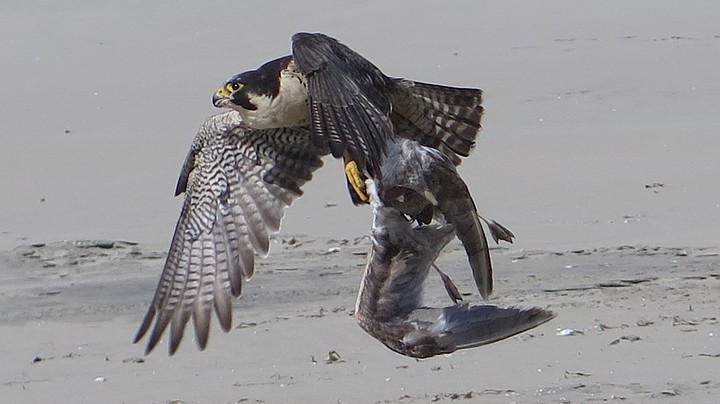
As the sea birds await the usual late spring shoals of bait that are a foundation of the marine biosphere, life can be precarious at most levels of the food chain. This peregrine took out a clam-snatching seagull.
Here's something you might be interested in.
Fish Report: Bluefin still biting better at night
Squid off La Jolla brings white seabass; also: Peregrine 1, seagull 0

Fish Report: Bluefin still biting better at night
Squid off La Jolla brings white seabass; also: Peregrine 1, seagull 0
Solid coastal white seabass caught by this happy angler while fishing aboard the Daily Double.
Dock Totals 6/15 – 6/21: 3359 anglers aboard 120 half-day to 3-day trips out of San Diego landings over the past week caught 23 barracuda, 754 bluefin tuna (to 200 pounds), 51 bonito, 20 cabezon, 3880 calico bass, 12 halibut, 10 lingcod, 2853 rockfish, 581 sand bass, 5 sargo, 130 sculpin, 98 sheephead, 1189 whitefish, 7 white seabass, and 129 yellowtail.
Saltwater: ‘Tis the season for transitional tuna fishing. By that, I mean bluefin to yellowfin as the water warms coming up the Baja Peninsula against the predominant south push of the California Current. The line right now seems to be around Punta Eugenia at the tip of the Vizcaino Peninsula that juts westward, pointing at Cedros Island about midway down Baja’s Pacific coast. South of there and to the Ridge outside of Bahia Magdalena, yellowfin tuna fishing is beginning to take off, along with excellent yellowtail along the coast, outside, and around islands from Cedros to Asuncion.
North of that line, yellowtail and bluefin are the predominant catches of pelagic species outside, while inside, calico bass, sheephead, and more than a smattering of white seabass have been reported. Bluefin are thickest from the banks off Ensenada, and north to the Channel Islands. Boats targeting them are reporting mixed success, with fish biting strong for a couple days then tight lipped for a couple days, and most catches coming at night on deep-drop jigs and tuna bombs. Daytime bites have mostly been on bait on a dropper loop with a few kite fish and fly-line bites on the surface. Most of the fish have been over the 100-pound mark at night, while the daytime bite has been more mixed from 40 pounds up.
For those reasons, trips targeting bluefin are suggesting the following tackle: at least one 80 to 100-pound outfit with 300-gram to 400-gram knife jigs and number 2 to 2/0 circle hooks for bait. On the lighter side, a 25- to 35-pound outfit with 8 to 12-ounce torpedo sinkers, and the same sized hooks for dropper loop bait, flyline or kite fishing during the day.
Bluefin haul for youngsters aboard the Excel: “We are out on our Family Adventure #1 trip with lots of young talent aboard. These kids put a whoopin on these local bluefin. 50 of these beauties hitting the deck and everyone is pumped. These kids are the future of our industry and the future is lookin' bright! Great Job.”
The local short run boats have been doing very well on calico bass and rockfish, with occasional catches of yellowtail, white seabass, and halibut in the mix. There has been some market squid off La Jolla and white seabass fishing has picked up, with a few good fish boated on morning or evening half-day runs fishing off Point Loma and outside the reserve in La Jolla. Longer trips have focused on rockfish off the 9-Mile Bank and south to the Coronado Islands where yellowtail have begun to bite, albeit slowly, even though there have been good marks on schools. That action should pick up substantially in coming weeks as conditions improve.
A little further south, calico bass, white seabass, barracuda, and yellowtail are feeding off coastal kelp beds and high spots from Ensenada and to the south, with good yellowtail fishing reported at San Martin Island more so than the offshore at the 240, 15 and 6 high spots. That, too can change quickly, as yellowtail tend to get thick out at those banks by July, with white seabass, calicos, and some decent halibut being the fish more targeted in close to the island. Bluefin also haunt those numbered banks for the pangeros running out of San Quintin, and in warmer years, yellowfin and some dorado will show up. Jaime of Jaime’s Pangas caught a 200-pound bluefin out there early this year in February, but other than that,it has been hit and miss, as the fish tend to show up outside on the deep side of those spots, and we’re still in the windy season which can be prohibitive for pangas. On the good days, yellowtail have been on and off, with the on days featuring wide open surface iron action.
One thing I look forward to every year as late spring eases into summer is the plethora of pelicans that show up with the baitfish as the water warms and triggers mass spawning of the anchovies, sardines, and other silversides that are a base building block for our fishery. My favorite dinosaurs, California brown pelicans can look like aerial acrobats one minute and seem oafishly bumbling the next. They will often fly along the crest of a wave, almost touching it with splayed wingtip feathers that resemble fingers, then dodge up and over the wave as it breaks and gracefully slide alongside the next rising lip.
Brown pelicans are the only one of the seven species of pelicans that dive from heights when feeding. I tend to see them inside working bait more than outside, moreso when I am on the kayak or surf fishing than when out on a boat. My fishing jones always starts acting up when I see birds working, and especially so when pelicans form their dive-bombing squadrons just off the beach. Alas, my nearest beach, the 12-mile stretch from Punta Azufre on the east side of Bahia San Quintin down to the bluffs at Socorro, has yet to see any birds working as of the first day of summer. Usually, the bait is inside and the birds are here by April or so, but even though fishing is at the island and the banks, there have been no pelicans.
What we have seen are gulls, terns as they nest here in the sloughs during mating season, some cormorants feeding alone, and shorebirds picking at sand crabs. During low tides, gulls can be seen tussling over clams that have been washed out by the surf. They will take pismos that are not too large to carry, but still heavy enough to break when dropped from 30 feet or so onto the hard-pack sand below the previous high tide line. The gull that drops the clam has to learn to follow it down so that other gulls don’t steal the dropped delicacy. It's fun to watch, but still not as fun as seeing pelicans diving en masse.
I also saw a peregrine falcon take out a juvenile seagull down by the bluffs, falling from the sky like a rock then leveling off and hitting the unsuspecting gull. Poor critter was concentrating on trying to steal a clam that another gull had dropped. Karma, I reckon. Natural, mostly unspoiled beaches can be amazing, beautiful, and often brutal. And on that note, whether the beach, bay, lake, or offshore, they’re out there so go out and get ‘em!
As the sea birds await the usual late spring shoals of bait that are a foundation of the marine biosphere, life can be precarious at most levels of the food chain. This peregrine took out a clam-snatching seagull.