

Here's something you might be interested in.
Ask a Hipster — Advice you didn't know you needed
Big Screen — Movie commentary
Blurt — Music's inside track
Booze News — San Diego spirits
Classical Music — Immortal beauty
Classifieds — Free and easy
Close to Home — What it’s like on the street where you live
Cover Stories — Front-page features
Drinks All Around — Bartenders' drink recipes
Excerpts — Literary and spiritual excerpts
Feast! — Food & drink reviews
Feature Stories — Local news & stories
Fishing Report — What’s getting hooked from ship and shore
From the Archives — Spotlight on the past
Golden Dreams — Talk of the town
The Gonzo Report — Making the musical scene, or at least reporting from it
Letters — Our inbox
Movies@Home — Local movie buffs share favorites
Movie Reviews — Our critics' picks and pans
Musician Interviews — Up close with local artists
Neighborhood News from Stringers — Hyperlocal news
News Ticker — News & politics
Obermeyer — San Diego politics illustrated
Outdoors — Weekly changes in flora and fauna
Overheard in San Diego — Eavesdropping illustrated
Poetry — The old and the new
Reader Travel — Travel section built by travelers
Reading — The hunt for intellectuals
Roam-O-Rama — SoCal's best hiking/biking trails
San Diego Beer — Inside San Diego suds
SD on the QT — Almost factual news
Sheep and Goats — Places of worship
Special Issues — The best of
Street Style — San Diego streets have style
Surf Diego — Real stories from those braving the waves
Theater — On stage in San Diego this week
Tin Fork — Silver spoon alternative
Under the Radar — Matt Potter's undercover work
Unforgettable — Long-ago San Diego
Unreal Estate — San Diego's priciest pads
Your Week — Daily event picks
Fish Report: Big Bluefin moving north
Also: Calico Bass Bite is on, big surfperch on a big spiny mole crab

A small spiny mole crab (L) compared to a large sand crab — though the spiny mole crab worked better, they are both good baits for surf perch.
Dock Totals 5/25 – 5/31: 2452 anglers aboard 93 half-day to 3-day trips out of San Diego landings over the past week caught 18 barracuda, 723 bluefin tuna (to 210 pounds), 289 bonito, 6 cabezon, 1881 calico bass, 2 halibut, 9 lingcod, 2930 rockfish, 58 sand bass, 30 sanddab, 88 sculpin, 58 sheephead, 1 triggerfish, 182 whitefish, 1 white seabass, and 67 yellowtail.
Saltwater: As Tropical Storm Alvin dissipated off of southern Baja, low pressure in far northern Baja pulled moisture from that first named Eastern Pacific storm of the season northward, bringing thunderstorms with voluminous rain and lightning to northern Baja. We received more rain in San Quintin over 12 hours late Saturday night into Sunday morning than we have over the previous 12 months. Ahead of the inclement weather, fishing off the coast was wide open for bluefin tuna for the San Diego fleet. Most boats reported great fishing, including the Polaris Supreme, with limits of 124 bluefin for their 24 anglers during their last 3-day outing.
The average size of the tuna caught was on the large side of 60 pounds up to 210 pounds, and though the count went up from the week previous, more than half of the fish hooked prevailed and either chewed through the line or wore out knots and escaped capture. As the area southwest of Point Loma outside the Butterfly Bank was going off, bluefin were also caught as far north as off Santa Barbara Island. This new development bodes well for operations on up to Orange county going forward, and we should see them soon off San Clemente and in the channel between there and Catalina.
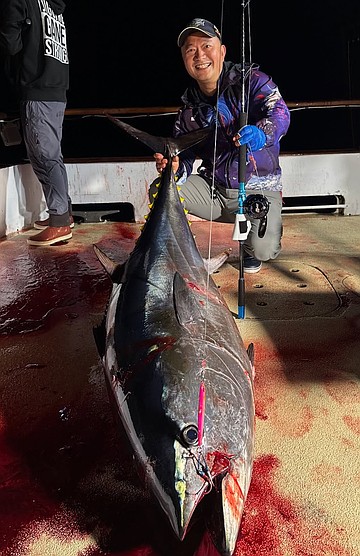
Hefty bluefin tuna caught on the last night of May aboard the Polaris Supreme 3-day trip.
Still, the better odds for boats this week will more than likely be 70-ish miles to the south/southwest for the San Diego fleet. San Clemente Island, Tanner, and the Cortez banks are a bit longer haul at this point, though as the season moves forward into summer, that may be the better option, as bluefin have historically moved north as the sea surface temperatures warm. With the tuna going off, most of the boats running 1.5-day trips stayed on them and didn’t spend a lot of time looking for the yellowtail that have been holding on kelp paddies floating offshore. More boats are running "reverse" 1.5-day trips to take advantage of the night bite, which also explains the low count of yellowtail this week.
The inshore scene for half-day boats did feature a few yellowtail, but mostly, calico bass were the target species — with a few halibut, sculpin, and sheephead tossed in. Further offshore, rockfish bit well for those trips targeting the groundfish fishery to 600 feet deep, as should be the case until the end of June. Starting July 1, rockfish will be limited to inside the 50-fathom (300 feet) depth line until September 30.
Here in San Quintin 180 miles south of San Diego, the water is cooler and typically warms later than it does off Southern California, but in just 24 hours before the stormy weather arrived, sea surface temperatures off San Quintin and Isla San Martin rose 4 degrees, from 57 to 61, due mostly to the first hot day of the year with little wind. Though rockfish, lingcod, and yellowtail fishing has been great around the banks 15 to 20 miles outside Bahia San Quintin, I haven’t been able to get out since last year. That's because I took due on a street dog rescue that had lost her eyes in an accident. Still, I do hit the beach, where she loves to run and chase waves while I try to get a little fishing in.
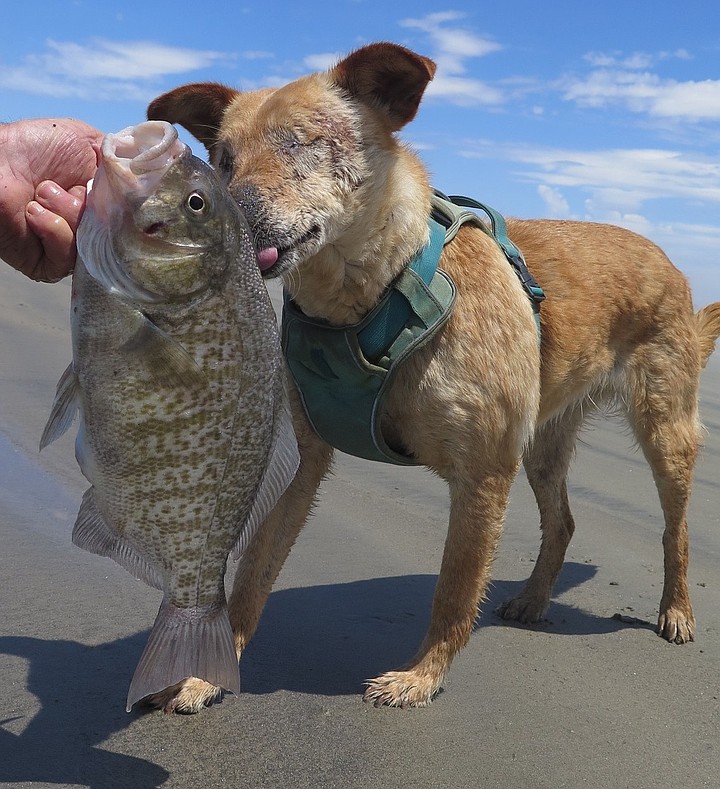
Large barred surfperch that even a blind dog could appreciate. Rona just had to get her licks in.
I decided to go surf fishing in the "calm before the storm" as conditions and the tide looked good for a shot at some decent surf perch action. I was not disappointed. Though not wide open, I caught fish on spoons, stick baits, and sand crabs presented on a Carolina rig. While digging for crabs with my toes as I was tossing lures, I kicked out a quarter-sized spiny mole crab. Spiny mole crabs are the larger cousins of the sand crabs we normally use for bait. Their body is rounder and spinier than a normal sand crab's, and they have impressive claws that help them eat the carcasses of other sand crabs. Adult spiny mole crabs tend to show the same gray on the carapace as their smaller cousins, but the small spiny mole crabs are pearlescent white.
Anyhow, I pinned this white spiny mole crab on a number 4 baitholder hook that was tied to an 18-inch leader to a swivel and a half-ounce egg sinker, cast it out into a trough, and within fifteen seconds, a huge 17-inch surf perch pushing three pounds took it. That was the second largest barred surf perch I have caught in my life! Even my blind rescue dog Rona was impressed. Spiny mole crabs, if you can find them, make excellent bait and I feel they are a notch above their cousins. They are loaded with meat, and I usually break them down into leg sections, smashing the shell so as to be able to thread the hook through. The only problem I have with spiny mole crabs is that I usually find them with my bare toes and their sharp spines are pokey and often draw a little blood. Asi es, no pain, no gain. Whether the beach, bay, lake, or offshore, they’re out there so go out and get ‘em!
Here's something you might be interested in.
Fish Report: Big Bluefin moving north
Also: Calico Bass Bite is on, big surfperch on a big spiny mole crab

Fish Report: Big Bluefin moving north
Also: Calico Bass Bite is on, big surfperch on a big spiny mole crab
A small spiny mole crab (L) compared to a large sand crab — though the spiny mole crab worked better, they are both good baits for surf perch.
Dock Totals 5/25 – 5/31: 2452 anglers aboard 93 half-day to 3-day trips out of San Diego landings over the past week caught 18 barracuda, 723 bluefin tuna (to 210 pounds), 289 bonito, 6 cabezon, 1881 calico bass, 2 halibut, 9 lingcod, 2930 rockfish, 58 sand bass, 30 sanddab, 88 sculpin, 58 sheephead, 1 triggerfish, 182 whitefish, 1 white seabass, and 67 yellowtail.
Saltwater: As Tropical Storm Alvin dissipated off of southern Baja, low pressure in far northern Baja pulled moisture from that first named Eastern Pacific storm of the season northward, bringing thunderstorms with voluminous rain and lightning to northern Baja. We received more rain in San Quintin over 12 hours late Saturday night into Sunday morning than we have over the previous 12 months. Ahead of the inclement weather, fishing off the coast was wide open for bluefin tuna for the San Diego fleet. Most boats reported great fishing, including the Polaris Supreme, with limits of 124 bluefin for their 24 anglers during their last 3-day outing.
The average size of the tuna caught was on the large side of 60 pounds up to 210 pounds, and though the count went up from the week previous, more than half of the fish hooked prevailed and either chewed through the line or wore out knots and escaped capture. As the area southwest of Point Loma outside the Butterfly Bank was going off, bluefin were also caught as far north as off Santa Barbara Island. This new development bodes well for operations on up to Orange county going forward, and we should see them soon off San Clemente and in the channel between there and Catalina.
Hefty bluefin tuna caught on the last night of May aboard the Polaris Supreme 3-day trip.
Still, the better odds for boats this week will more than likely be 70-ish miles to the south/southwest for the San Diego fleet. San Clemente Island, Tanner, and the Cortez banks are a bit longer haul at this point, though as the season moves forward into summer, that may be the better option, as bluefin have historically moved north as the sea surface temperatures warm. With the tuna going off, most of the boats running 1.5-day trips stayed on them and didn’t spend a lot of time looking for the yellowtail that have been holding on kelp paddies floating offshore. More boats are running "reverse" 1.5-day trips to take advantage of the night bite, which also explains the low count of yellowtail this week.
The inshore scene for half-day boats did feature a few yellowtail, but mostly, calico bass were the target species — with a few halibut, sculpin, and sheephead tossed in. Further offshore, rockfish bit well for those trips targeting the groundfish fishery to 600 feet deep, as should be the case until the end of June. Starting July 1, rockfish will be limited to inside the 50-fathom (300 feet) depth line until September 30.
Here in San Quintin 180 miles south of San Diego, the water is cooler and typically warms later than it does off Southern California, but in just 24 hours before the stormy weather arrived, sea surface temperatures off San Quintin and Isla San Martin rose 4 degrees, from 57 to 61, due mostly to the first hot day of the year with little wind. Though rockfish, lingcod, and yellowtail fishing has been great around the banks 15 to 20 miles outside Bahia San Quintin, I haven’t been able to get out since last year. That's because I took due on a street dog rescue that had lost her eyes in an accident. Still, I do hit the beach, where she loves to run and chase waves while I try to get a little fishing in.
Large barred surfperch that even a blind dog could appreciate. Rona just had to get her licks in.
I decided to go surf fishing in the "calm before the storm" as conditions and the tide looked good for a shot at some decent surf perch action. I was not disappointed. Though not wide open, I caught fish on spoons, stick baits, and sand crabs presented on a Carolina rig. While digging for crabs with my toes as I was tossing lures, I kicked out a quarter-sized spiny mole crab. Spiny mole crabs are the larger cousins of the sand crabs we normally use for bait. Their body is rounder and spinier than a normal sand crab's, and they have impressive claws that help them eat the carcasses of other sand crabs. Adult spiny mole crabs tend to show the same gray on the carapace as their smaller cousins, but the small spiny mole crabs are pearlescent white.
Anyhow, I pinned this white spiny mole crab on a number 4 baitholder hook that was tied to an 18-inch leader to a swivel and a half-ounce egg sinker, cast it out into a trough, and within fifteen seconds, a huge 17-inch surf perch pushing three pounds took it. That was the second largest barred surf perch I have caught in my life! Even my blind rescue dog Rona was impressed. Spiny mole crabs, if you can find them, make excellent bait and I feel they are a notch above their cousins. They are loaded with meat, and I usually break them down into leg sections, smashing the shell so as to be able to thread the hook through. The only problem I have with spiny mole crabs is that I usually find them with my bare toes and their sharp spines are pokey and often draw a little blood. Asi es, no pain, no gain. Whether the beach, bay, lake, or offshore, they’re out there so go out and get ‘em!