

Here's something you might be interested in.
Ask a Hipster — Advice you didn't know you needed
Big Screen — Movie commentary
Blurt — Music's inside track
Booze News — San Diego spirits
Classical Music — Immortal beauty
Classifieds — Free and easy
Close to Home — What it’s like on the street where you live
Cover Stories — Front-page features
Drinks All Around — Bartenders' drink recipes
Excerpts — Literary and spiritual excerpts
Feast! — Food & drink reviews
Feature Stories — Local news & stories
Fishing Report — What’s getting hooked from ship and shore
From the Archives — Spotlight on the past
Golden Dreams — Talk of the town
The Gonzo Report — Making the musical scene, or at least reporting from it
Letters — Our inbox
Movies@Home — Local movie buffs share favorites
Movie Reviews — Our critics' picks and pans
Musician Interviews — Up close with local artists
Neighborhood News from Stringers — Hyperlocal news
News Ticker — News & politics
Obermeyer — San Diego politics illustrated
Outdoors — Weekly changes in flora and fauna
Overheard in San Diego — Eavesdropping illustrated
Poetry — The old and the new
Reader Travel — Travel section built by travelers
Reading — The hunt for intellectuals
Roam-O-Rama — SoCal's best hiking/biking trails
San Diego Beer — Inside San Diego suds
SD on the QT — Almost factual news
Sheep and Goats — Places of worship
Special Issues — The best of
Street Style — San Diego streets have style
Surf Diego — Real stories from those braving the waves
Theater — On stage in San Diego this week
Tin Fork — Silver spoon alternative
Under the Radar — Matt Potter's undercover work
Unforgettable — Long-ago San Diego
Unreal Estate — San Diego's priciest pads
Your Week — Daily event picks
Could El Cajon vote for fourth time on cooperation with ICE?
Huntington Beach only other CA city with similar policy

Mayor Bill Wells revised resolution to clarify that El Cajon is not a sanctuary city.
Nine protesters showed up at the El Cajon city council meeting last week to demand the city roll back a resolution that allows police to cooperate with federal immigration officials.
While that is a much smaller number than the 100 speakers — on both sides of the issue — who signed up to speak before the February vote on the resolution, the protesters say they aren’t going away.
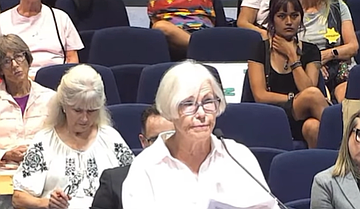
Connie Elder: “The city of El Cajon must look deeply into its soul...."
“The city of El Cajon and its citizens must look deeply into their soul and stop working with ICE,” said Connie Elder, a retired dean from Cuyamaca College who holds biweekly protests on Fletcher Parkway. A June gathering coordinated by Union de Barrio, which included groups such as Fuerza Hispania de El Cajon and Latinos En Acción, drew hundreds

Immigration march in El Cajon
Other protestors came to urge the recall of councilmember Phil Ortiz, who changed his vote in favor of the twice-failed resolution.
“This is kind of what I predicted would happen if we passed this,” said council member Gary Kendrick, who voted against it all three times.
The resolution, favored by Mayor Bill Wells, was passed at a time when dozens of other California cities have leaned the opposite way on the question of handing over to ICE undocumented immigrants who have been convicted or accused of a violent crime. Councilmember Kenrdrick noted that out of 482 California cities, only two have passed this kind of resolution: Huntington Beach and El Cajon. “We're the outliers.”
In January, the council voted 3-2 to defeat the resolution. The mayor then revised it to clarify that El Cajon is not a sanctuary city and will not interfere with federal immigration enforcement, and also requested that the U.S. Attorney General protect officers who cooperate against any actions taken by the state. (State law prohibits cities from turning people over to federal immigration authorities unless they have been convicted in court of certain felony crimes.)
But according to city manager Graham Mitchell, the police aren’t working with ICE. This led Councilmember Kendrick to ask, “So, why do we even need this resolution? We could just rescind it. And everybody would be happy. It has done nothing except create a lot of fear.”
City attorney Morgan Foley explained that to repeal the resolution, two councilmembers should request it be placed on the agenda for a vote. Ideally, the request would be made by a councilmember who had approved it and then changed their mind, in order to ensure passage of the repeal. If the effort failed and the resolution remained effective, “you’re not going to get a reconsideration unless one of the persons who voted to keep it is joined in that request.”
Kendrick suggested he would be pressing on. For his part, Councilmember Ortiz responded that the whole matter “is being blown up into something that is outside my control and outside the city’s control.”
Here's something you might be interested in.
Could El Cajon vote for fourth time on cooperation with ICE?
Huntington Beach only other CA city with similar policy

Could El Cajon vote for fourth time on cooperation with ICE?
Huntington Beach only other CA city with similar policy
Mayor Bill Wells revised resolution to clarify that El Cajon is not a sanctuary city.
Nine protesters showed up at the El Cajon city council meeting last week to demand the city roll back a resolution that allows police to cooperate with federal immigration officials.
While that is a much smaller number than the 100 speakers — on both sides of the issue — who signed up to speak before the February vote on the resolution, the protesters say they aren’t going away.
Connie Elder: “The city of El Cajon must look deeply into its soul...."
“The city of El Cajon and its citizens must look deeply into their soul and stop working with ICE,” said Connie Elder, a retired dean from Cuyamaca College who holds biweekly protests on Fletcher Parkway. A June gathering coordinated by Union de Barrio, which included groups such as Fuerza Hispania de El Cajon and Latinos En Acción, drew hundreds
Immigration march in El Cajon
Other protestors came to urge the recall of councilmember Phil Ortiz, who changed his vote in favor of the twice-failed resolution.
“This is kind of what I predicted would happen if we passed this,” said council member Gary Kendrick, who voted against it all three times.
The resolution, favored by Mayor Bill Wells, was passed at a time when dozens of other California cities have leaned the opposite way on the question of handing over to ICE undocumented immigrants who have been convicted or accused of a violent crime. Councilmember Kenrdrick noted that out of 482 California cities, only two have passed this kind of resolution: Huntington Beach and El Cajon. “We're the outliers.”
In January, the council voted 3-2 to defeat the resolution. The mayor then revised it to clarify that El Cajon is not a sanctuary city and will not interfere with federal immigration enforcement, and also requested that the U.S. Attorney General protect officers who cooperate against any actions taken by the state. (State law prohibits cities from turning people over to federal immigration authorities unless they have been convicted in court of certain felony crimes.)
But according to city manager Graham Mitchell, the police aren’t working with ICE. This led Councilmember Kendrick to ask, “So, why do we even need this resolution? We could just rescind it. And everybody would be happy. It has done nothing except create a lot of fear.”
City attorney Morgan Foley explained that to repeal the resolution, two councilmembers should request it be placed on the agenda for a vote. Ideally, the request would be made by a councilmember who had approved it and then changed their mind, in order to ensure passage of the repeal. If the effort failed and the resolution remained effective, “you’re not going to get a reconsideration unless one of the persons who voted to keep it is joined in that request.”
Kendrick suggested he would be pressing on. For his part, Councilmember Ortiz responded that the whole matter “is being blown up into something that is outside my control and outside the city’s control.”
Comments