

Here's something you might be interested in.
Ask a Hipster — Advice you didn't know you needed
Big Screen — Movie commentary
Blurt — Music's inside track
Booze News — San Diego spirits
Classical Music — Immortal beauty
Classifieds — Free and easy
Close to Home — What it’s like on the street where you live
Cover Stories — Front-page features
Drinks All Around — Bartenders' drink recipes
Excerpts — Literary and spiritual excerpts
Feast! — Food & drink reviews
Feature Stories — Local news & stories
Fishing Report — What’s getting hooked from ship and shore
From the Archives — Spotlight on the past
Golden Dreams — Talk of the town
The Gonzo Report — Making the musical scene, or at least reporting from it
Letters — Our inbox
Movies@Home — Local movie buffs share favorites
Movie Reviews — Our critics' picks and pans
Musician Interviews — Up close with local artists
Neighborhood News from Stringers — Hyperlocal news
News Ticker — News & politics
Obermeyer — San Diego politics illustrated
Outdoors — Weekly changes in flora and fauna
Overheard in San Diego — Eavesdropping illustrated
Poetry — The old and the new
Reader Travel — Travel section built by travelers
Reading — The hunt for intellectuals
Roam-O-Rama — SoCal's best hiking/biking trails
San Diego Beer — Inside San Diego suds
SD on the QT — Almost factual news
Sheep and Goats — Places of worship
Special Issues — The best of
Street Style — San Diego streets have style
Surf Diego — Real stories from those braving the waves
Theater — On stage in San Diego this week
Tin Fork — Silver spoon alternative
Under the Radar — Matt Potter's undercover work
Unforgettable — Long-ago San Diego
Unreal Estate — San Diego's priciest pads
Your Week — Daily event picks
Alex Nye takes monkey business seriously
American Ninja Warrior regular welcomes you to the Jungle
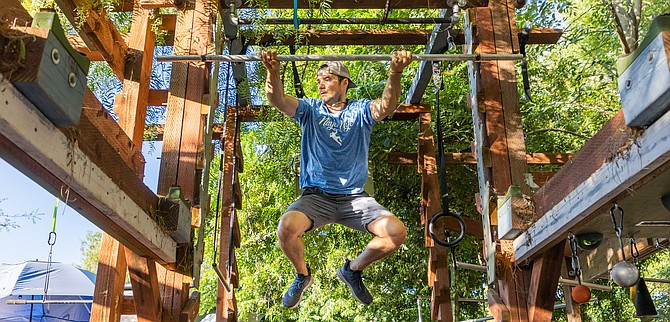
Growing up in upstate New York, American Ninja Warrior competitor Alex Nye and his brother were “naturally monkeys,” he says. Accordingly, the boys' father built them a treehouse, plus ramps for skateboarding and snowboarding. And of course, there was a trampoline, which eventually bounced him into the New Jersey "ninja" training center Movement Lab. “It was my very first taste of it, and I loved it right away,” Nye recalls.
When he moved to California, he found there weren’t many ninja gyms on the west coast, so he took up other activities that would help his skills. "I got really into rock climbing. I did gymnastics, parkour, calisthenics, and went to a CrossFit gym. I would train on playgrounds, creating my own upper body challenges.”
But eventually, he returned to the the thing he had known in his youth: the homemade backyard adventure course. “It’s a pretty advanced course,” Nye says, “that I’m always obsessively adding to. It’s called The Jungle.” From a construction standpoint, “It’s practical, because any other gym or ninja rig would require a lot of digging and concrete, whereas at The Jungle, I never really had to do any of that, because everything is intermingled with the trees, making the whole thing as stable and strong as an interconnected unit.”
Part of what keeps American Ninja Warrior entertaining is that it’s always evolving: every season brings an array of new obstacles. Nye is able to tweak his course to help meet the challenge, and to work on his weak spots. “I can see these new ideas in the community, and I can replicate them using found objects and simple household material. After my first couple seasons on the show, I identified some of my weaknesses. One specifically was called Flying Bar, which was one of the first things I built in my backyard so I could figure out that skill and overcome that weakness. Then it slowly became one of my biggest strengths.”

Besides adding new obstacles, the show also shifts its format. Flying bars were so four years ago. This season, instead of the usual endurance challenge, this year’s competition prioritizes speed, with competitors racing side-by-side. Previously, competitors were able to be more tactical, patient, and precise. “That’s something that not a lot of ninjas necessarily train for,” Nye says. “This new format really encouraged — or forced — everybody to embrace their speed and efficiency. That’s when really interesting things happen. I understand why they do it because it makes for good TV. It’s high energy and more exciting.”
I notice the way Nye says "ninjas" — almost as if there's a ninja community out there. Turns out there is: to assist with his training back at The Jungle, Nye brings together a group ranging from fellow pros to aspiring kids. “There’s not a ton of us,” he says, "but the people who are doing it are really into it. It’s very niche, but we’re very passionate about it. We run courses. They come over on the weekends. We design a brand-new course in the backyard and challenge ourselves to run it as fast as we can. We stay competitive and try to hyper-analyze, maximize efficiencies, where we can trim off a few seconds from our time. That’s where the sport is headed, this more speed focused competition.”
About the future: at 34 years old and with five seasons of American Ninja Warrior under his belt, Nye is considered a veteran ninja. These days, the sport is being dominated by ambitious teenagers. Despite his experience and his achievements — the finals last season, the semi-finals this season — the pressure remains. “No matter how many times you’ve done it, you still get the jitters, the butterflies, the nerves. You’ve got bright lights and cameras in your face. It’s something that you’ve looked forward to and trained for an entire year or more, and you only get one shot. It comes down to this very brief moment where you kind of black out and let your ninja instincts take over.”
Video:
Ninja Nye's semi-finals run, 2025
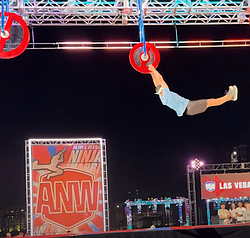
Nye says he will continue applying for the show beyond its 17th season. His spot isn’t guaranteed, but so long as his own course stands, he'll keep his monkey-man status. If you think you might like to join him sometime, pay attention to his Instagram: periodically, he announces public "open jungle gyms" on his account.
Here's something you might be interested in.
Alex Nye takes monkey business seriously
American Ninja Warrior regular welcomes you to the Jungle

Alex Nye takes monkey business seriously
American Ninja Warrior regular welcomes you to the Jungle
Growing up in upstate New York, American Ninja Warrior competitor Alex Nye and his brother were “naturally monkeys,” he says. Accordingly, the boys' father built them a treehouse, plus ramps for skateboarding and snowboarding. And of course, there was a trampoline, which eventually bounced him into the New Jersey "ninja" training center Movement Lab. “It was my very first taste of it, and I loved it right away,” Nye recalls.
When he moved to California, he found there weren’t many ninja gyms on the west coast, so he took up other activities that would help his skills. "I got really into rock climbing. I did gymnastics, parkour, calisthenics, and went to a CrossFit gym. I would train on playgrounds, creating my own upper body challenges.”
But eventually, he returned to the the thing he had known in his youth: the homemade backyard adventure course. “It’s a pretty advanced course,” Nye says, “that I’m always obsessively adding to. It’s called The Jungle.” From a construction standpoint, “It’s practical, because any other gym or ninja rig would require a lot of digging and concrete, whereas at The Jungle, I never really had to do any of that, because everything is intermingled with the trees, making the whole thing as stable and strong as an interconnected unit.”
Part of what keeps American Ninja Warrior entertaining is that it’s always evolving: every season brings an array of new obstacles. Nye is able to tweak his course to help meet the challenge, and to work on his weak spots. “I can see these new ideas in the community, and I can replicate them using found objects and simple household material. After my first couple seasons on the show, I identified some of my weaknesses. One specifically was called Flying Bar, which was one of the first things I built in my backyard so I could figure out that skill and overcome that weakness. Then it slowly became one of my biggest strengths.”
Besides adding new obstacles, the show also shifts its format. Flying bars were so four years ago. This season, instead of the usual endurance challenge, this year’s competition prioritizes speed, with competitors racing side-by-side. Previously, competitors were able to be more tactical, patient, and precise. “That’s something that not a lot of ninjas necessarily train for,” Nye says. “This new format really encouraged — or forced — everybody to embrace their speed and efficiency. That’s when really interesting things happen. I understand why they do it because it makes for good TV. It’s high energy and more exciting.”
I notice the way Nye says "ninjas" — almost as if there's a ninja community out there. Turns out there is: to assist with his training back at The Jungle, Nye brings together a group ranging from fellow pros to aspiring kids. “There’s not a ton of us,” he says, "but the people who are doing it are really into it. It’s very niche, but we’re very passionate about it. We run courses. They come over on the weekends. We design a brand-new course in the backyard and challenge ourselves to run it as fast as we can. We stay competitive and try to hyper-analyze, maximize efficiencies, where we can trim off a few seconds from our time. That’s where the sport is headed, this more speed focused competition.”
About the future: at 34 years old and with five seasons of American Ninja Warrior under his belt, Nye is considered a veteran ninja. These days, the sport is being dominated by ambitious teenagers. Despite his experience and his achievements — the finals last season, the semi-finals this season — the pressure remains. “No matter how many times you’ve done it, you still get the jitters, the butterflies, the nerves. You’ve got bright lights and cameras in your face. It’s something that you’ve looked forward to and trained for an entire year or more, and you only get one shot. It comes down to this very brief moment where you kind of black out and let your ninja instincts take over.”
Video:
Ninja Nye's semi-finals run, 2025
Nye says he will continue applying for the show beyond its 17th season. His spot isn’t guaranteed, but so long as his own course stands, he'll keep his monkey-man status. If you think you might like to join him sometime, pay attention to his Instagram: periodically, he announces public "open jungle gyms" on his account.
Comments