

Here's something you might be interested in.
Ask a Hipster — Advice you didn't know you needed
Big Screen — Movie commentary
Blurt — Music's inside track
Booze News — San Diego spirits
Classical Music — Immortal beauty
Classifieds — Free and easy
Close to Home — What it’s like on the street where you live
Cover Stories — Front-page features
Drinks All Around — Bartenders' drink recipes
Excerpts — Literary and spiritual excerpts
Feast! — Food & drink reviews
Feature Stories — Local news & stories
Fishing Report — What’s getting hooked from ship and shore
From the Archives — Spotlight on the past
Golden Dreams — Talk of the town
The Gonzo Report — Making the musical scene, or at least reporting from it
Letters — Our inbox
Movies@Home — Local movie buffs share favorites
Movie Reviews — Our critics' picks and pans
Musician Interviews — Up close with local artists
Neighborhood News from Stringers — Hyperlocal news
News Ticker — News & politics
Obermeyer — San Diego politics illustrated
Outdoors — Weekly changes in flora and fauna
Overheard in San Diego — Eavesdropping illustrated
Poetry — The old and the new
Reader Travel — Travel section built by travelers
Reading — The hunt for intellectuals
Roam-O-Rama — SoCal's best hiking/biking trails
San Diego Beer — Inside San Diego suds
SD on the QT — Almost factual news
Sheep and Goats — Places of worship
Special Issues — The best of
Street Style — San Diego streets have style
Surf Diego — Real stories from those braving the waves
Theater — On stage in San Diego this week
Tin Fork — Silver spoon alternative
Under the Radar — Matt Potter's undercover work
Unforgettable — Long-ago San Diego
Unreal Estate — San Diego's priciest pads
Your Week — Daily event picks
Fish Report: Bluefin near the Coronado Islands
Opah on a 1.5-Day Trip
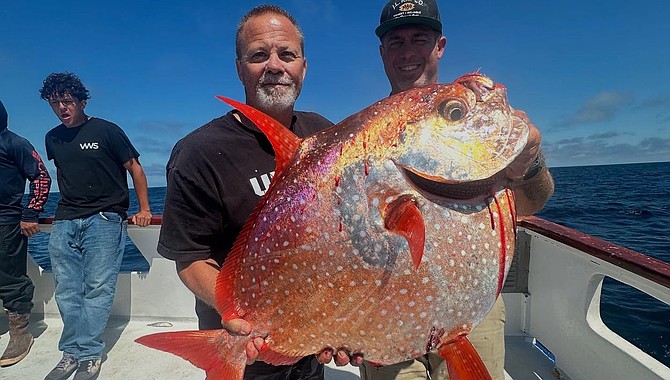
Pacifica captain Andrew Viola with angler Kevin Patch’s beautiful opah caught while dropping a jig on a 1.5-day run.
Dock Totals 7/20 – 7/26: 4376 anglers aboard 175 half-day to 3-day trips out of San Diego landings over the past week caught 101 barracuda, 1 black seabass (released), 3764 bluefin tuna (to 240 pounds), 11 bonito, 2 cabezon, 1009 calico bass, 9 halibut, 19 lingcod, 1 opah, 2090 rockfish, 1 rock sole, 903 sand bass, 6 sanddab, 995 sculpin, 75 sheephead, 632 whitefish, 4 white seabass, 5 yellowfin tuna, and 2555 yellowtail.
Saltwater: The yellowfin tuna still haven’t shown up in numbers since a few were caught a couple weeks back, but they are out there. The Pacific Dawn did report one 90-pound yellowfin on a recent outing; that’s a big one up here, far from the waters off the southern Baja peninsula where they are normally found. Conversely, bluefin tuna have been metered deep as well as popping up in foamers on the surface from off the northern Baja Peninsula up to the Channel Islands.
Much of the bluefin caught off the boiling schools has been in the 20- to 50-pound range, but there have still been some larger units reported to well over 200 pounds. Most of the daytime catch is still in the smaller range and up on the surface; during nighttime fishing, deeper is more productive for the larger units. Night fishing has still been mostly deep jigging on heavier gear, while the daytime bite higher in the water column has benefitted from a more varied approach, including live bait fly-lined or on a dropper loop, jigs, kited bait or artificials, and poppers casted into boiling spots.
A word on bait availability at the receivers: more sardine has been coming in, albeit still on the smallish side. Still, sardine is hardier than anchovy, especially when fly-lining a bait. Some boats are using the mixed bait to their best potential by chumming with anchovy and saving the sardine for the anglers aboard. Right now, the longer runs — from 1.5-day and up — have mostly been heading out west to San Clemente Island, where bluefin have been showing in good numbers from off China Point on the southeast end to past the west end and between there and Catalina.
Full-day runs have been more focused on the area around the Coronado Islands, where yellowtail fishing has been off the hook. Some bluefin have been hanging around there as well, as was the case for the Malihini on their full-day on July 26, resulting in 32 yellowtail, 32 whitefish, 4 calico bass, 52 rockfish, 15 barracuda, and 3 bluefin tuna. That’s quite a mix for a budget-friendly run to the Islands. The Malihini normally runs local ¾-day trips, but there's a full-day to the Coronados for $230, including biosphere permit and Mexican fishing license. Passports are required for those trips.
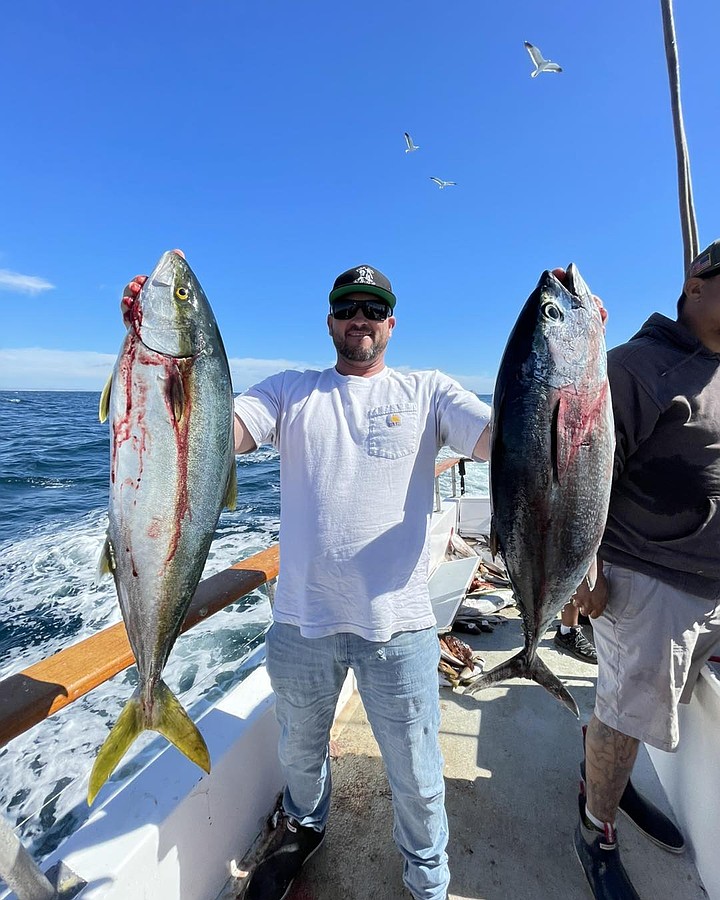
Happy angler aboard the Malihini with a yellowtail and a bluefin tuna caught near the Coronado Islands on a full-day run.
Another notable catch in the books this past week: the Pacifica out of Seaforth Landing called in with an opah on the deck during their 1.5-day outing. Angler Kevin Patch caught the beautiful and very tasty "moonfish," or opah while dropping a jig deep during a bluefin stop. Opah are colorful deep dwellers, feeding mostly on fish, cephalopods, and invertebrates in the mid to lower water column to several hundred feet deep. They are a warm-blooded species and usually ‘lone wolves’ in their domain — and thus are not too commonly caught by recreational anglers. Though we do see a few caught every year on long-range trips, an opah on a 1.5-day run is exceptionally rare.
To aid in their predation, opah flap their pectoral fins to "fly" through the water in what’s known as a “labriform” swimming method. And though they are slender when hatched, opah morph into their distinctive deep-bodied form by the time they are an inch long. Opah flesh is white and firm, making it a great selection for table fare in many different preparations. I like opah loin lightly seasoned and broiled until slightly browned on the outside but not overcooked. You can often find fresh opah loin at the Tuna Harbor Dockside Market on the Embarcadero near downtown. The price is usually about the same as yellowtail fillets, which was $14 per pound for either this past Saturday.
The inshore scene has been mostly bass — both calico and sand bass. A few halibut and lots of mostly short barracuda have been caught, along with the occasional yellowtail by the half-day runs. It seems that when the calicos are biting, the sand bass slow down and vice-versa. Rockfish and whitefish have been biting well when targeted, though with bass fishing so on fire, most boats have been concentrating on the kelp edges and sand flats instead of the deeper reefs for rockfish. Either way, summertime fishing has arrived, so whether the beach, bay, lake, or offshore, they’re out there so go out and get ‘em!
Here's something you might be interested in.
Fish Report: Bluefin near the Coronado Islands
Opah on a 1.5-Day Trip

Fish Report: Bluefin near the Coronado Islands
Opah on a 1.5-Day Trip
Pacifica captain Andrew Viola with angler Kevin Patch’s beautiful opah caught while dropping a jig on a 1.5-day run.
Dock Totals 7/20 – 7/26: 4376 anglers aboard 175 half-day to 3-day trips out of San Diego landings over the past week caught 101 barracuda, 1 black seabass (released), 3764 bluefin tuna (to 240 pounds), 11 bonito, 2 cabezon, 1009 calico bass, 9 halibut, 19 lingcod, 1 opah, 2090 rockfish, 1 rock sole, 903 sand bass, 6 sanddab, 995 sculpin, 75 sheephead, 632 whitefish, 4 white seabass, 5 yellowfin tuna, and 2555 yellowtail.
Saltwater: The yellowfin tuna still haven’t shown up in numbers since a few were caught a couple weeks back, but they are out there. The Pacific Dawn did report one 90-pound yellowfin on a recent outing; that’s a big one up here, far from the waters off the southern Baja peninsula where they are normally found. Conversely, bluefin tuna have been metered deep as well as popping up in foamers on the surface from off the northern Baja Peninsula up to the Channel Islands.
Much of the bluefin caught off the boiling schools has been in the 20- to 50-pound range, but there have still been some larger units reported to well over 200 pounds. Most of the daytime catch is still in the smaller range and up on the surface; during nighttime fishing, deeper is more productive for the larger units. Night fishing has still been mostly deep jigging on heavier gear, while the daytime bite higher in the water column has benefitted from a more varied approach, including live bait fly-lined or on a dropper loop, jigs, kited bait or artificials, and poppers casted into boiling spots.
A word on bait availability at the receivers: more sardine has been coming in, albeit still on the smallish side. Still, sardine is hardier than anchovy, especially when fly-lining a bait. Some boats are using the mixed bait to their best potential by chumming with anchovy and saving the sardine for the anglers aboard. Right now, the longer runs — from 1.5-day and up — have mostly been heading out west to San Clemente Island, where bluefin have been showing in good numbers from off China Point on the southeast end to past the west end and between there and Catalina.
Full-day runs have been more focused on the area around the Coronado Islands, where yellowtail fishing has been off the hook. Some bluefin have been hanging around there as well, as was the case for the Malihini on their full-day on July 26, resulting in 32 yellowtail, 32 whitefish, 4 calico bass, 52 rockfish, 15 barracuda, and 3 bluefin tuna. That’s quite a mix for a budget-friendly run to the Islands. The Malihini normally runs local ¾-day trips, but there's a full-day to the Coronados for $230, including biosphere permit and Mexican fishing license. Passports are required for those trips.
Happy angler aboard the Malihini with a yellowtail and a bluefin tuna caught near the Coronado Islands on a full-day run.
Another notable catch in the books this past week: the Pacifica out of Seaforth Landing called in with an opah on the deck during their 1.5-day outing. Angler Kevin Patch caught the beautiful and very tasty "moonfish," or opah while dropping a jig deep during a bluefin stop. Opah are colorful deep dwellers, feeding mostly on fish, cephalopods, and invertebrates in the mid to lower water column to several hundred feet deep. They are a warm-blooded species and usually ‘lone wolves’ in their domain — and thus are not too commonly caught by recreational anglers. Though we do see a few caught every year on long-range trips, an opah on a 1.5-day run is exceptionally rare.
To aid in their predation, opah flap their pectoral fins to "fly" through the water in what’s known as a “labriform” swimming method. And though they are slender when hatched, opah morph into their distinctive deep-bodied form by the time they are an inch long. Opah flesh is white and firm, making it a great selection for table fare in many different preparations. I like opah loin lightly seasoned and broiled until slightly browned on the outside but not overcooked. You can often find fresh opah loin at the Tuna Harbor Dockside Market on the Embarcadero near downtown. The price is usually about the same as yellowtail fillets, which was $14 per pound for either this past Saturday.
The inshore scene has been mostly bass — both calico and sand bass. A few halibut and lots of mostly short barracuda have been caught, along with the occasional yellowtail by the half-day runs. It seems that when the calicos are biting, the sand bass slow down and vice-versa. Rockfish and whitefish have been biting well when targeted, though with bass fishing so on fire, most boats have been concentrating on the kelp edges and sand flats instead of the deeper reefs for rockfish. Either way, summertime fishing has arrived, so whether the beach, bay, lake, or offshore, they’re out there so go out and get ‘em!