

Here's something you might be interested in.
Ask a Hipster — Advice you didn't know you needed
Big Screen — Movie commentary
Blurt — Music's inside track
Booze News — San Diego spirits
Classical Music — Immortal beauty
Classifieds — Free and easy
Close to Home — What it’s like on the street where you live
Cover Stories — Front-page features
Drinks All Around — Bartenders' drink recipes
Excerpts — Literary and spiritual excerpts
Feast! — Food & drink reviews
Feature Stories — Local news & stories
Fishing Report — What’s getting hooked from ship and shore
From the Archives — Spotlight on the past
Golden Dreams — Talk of the town
The Gonzo Report — Making the musical scene, or at least reporting from it
Letters — Our inbox
Movies@Home — Local movie buffs share favorites
Movie Reviews — Our critics' picks and pans
Musician Interviews — Up close with local artists
Neighborhood News from Stringers — Hyperlocal news
News Ticker — News & politics
Obermeyer — San Diego politics illustrated
Outdoors — Weekly changes in flora and fauna
Overheard in San Diego — Eavesdropping illustrated
Poetry — The old and the new
Reader Travel — Travel section built by travelers
Reading — The hunt for intellectuals
Roam-O-Rama — SoCal's best hiking/biking trails
San Diego Beer — Inside San Diego suds
SD on the QT — Almost factual news
Sheep and Goats — Places of worship
Special Issues — The best of
Street Style — San Diego streets have style
Surf Diego — Real stories from those braving the waves
Theater — On stage in San Diego this week
Tin Fork — Silver spoon alternative
Under the Radar — Matt Potter's undercover work
Unforgettable — Long-ago San Diego
Unreal Estate — San Diego's priciest pads
Your Week — Daily event picks
Toyon berry decorates our chaparral community, tree aloes are blooming
Cross-country skiers might get a gift

Red Toyon berries are common in San Diego's winter chaparral.
Toyon, or “Christmas-berry,” one of the more distinctive shrubs of Southern California’s native chaparral plant community, is now flaunting clusters of red berries. Here in coastal San Diego, toyon can be found wherever large patches of native vegetation survive, but especially in the thick chaparral covering some north-facing slopes. Toyon branches may look inviting to cut as a Christmas wreath — but they’re protected from picking by California state law.
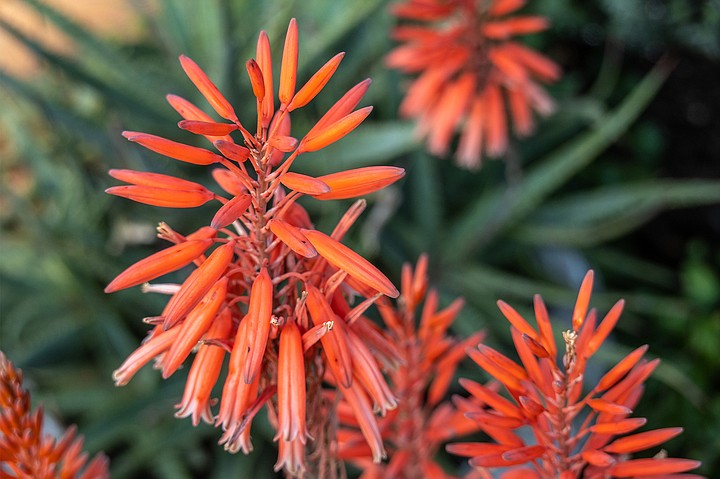
Butterflies and hummingbirds are attracted to the clusters of spiky, tube-shaped blooms that show up in winter.
Tree Aloes (Aloe Arborescens) Will Be At Their Blooming Best in January, but are already showing off around town. Krantz aloe or candelabra aloe, a common local tree aloe, are winter-blooming perennials and can be one of the most colorful plants in our winter landscape. The familiar succulents and their red-hot-poker-like flower clusters are a favorite winter hangout for birds, bees, and butterflies, and can grow to 9 feet tall when happy. Tree aloes have the third largest distribution amongst the aloe genus and are one of only a few species of aloe that can be found growing from sea level up to the tops of mountains. Large clumps of aloes can be seen at La Jolla Cove, at Mission San Diego de Alcalá, and scattered along the embankments overlooking Highway 163 in Balboa Park.
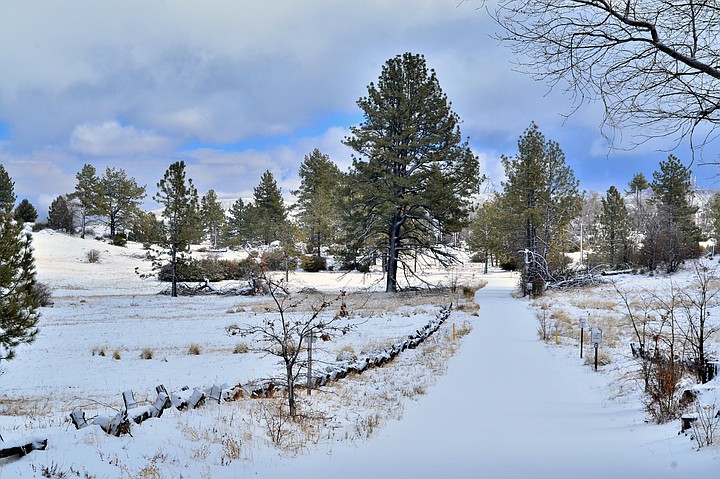
A snowy road in the Cuyamaca mountains.
Cross-Country Skiers Are In For A Short-lived Treat late this month through February if winter storms intense enough to drop several inches to two feet of snow hit San Diego County’s higher mountains. As the clouds are clearing, you may be able to take advantage of good skiing conditions along Highway 79 through Cuyamaca Rancho State Park and along Sunrise Highway through the Laguna Mountain Recreation Area. More limited opportunities for cross-country skiing may briefly exist on Palomar Mountain. Farther north in Southern California and higher in elevation, the forested crests of the San Gabriel, San Bernardino, and San Jacinto Mountains offer more dependably good snow conditions.
Here's something you might be interested in.
Toyon berry decorates our chaparral community, tree aloes are blooming
Cross-country skiers might get a gift

Toyon berry decorates our chaparral community, tree aloes are blooming
Cross-country skiers might get a gift
Red Toyon berries are common in San Diego's winter chaparral.
Toyon, or “Christmas-berry,” one of the more distinctive shrubs of Southern California’s native chaparral plant community, is now flaunting clusters of red berries. Here in coastal San Diego, toyon can be found wherever large patches of native vegetation survive, but especially in the thick chaparral covering some north-facing slopes. Toyon branches may look inviting to cut as a Christmas wreath — but they’re protected from picking by California state law.
Butterflies and hummingbirds are attracted to the clusters of spiky, tube-shaped blooms that show up in winter.
Tree Aloes (Aloe Arborescens) Will Be At Their Blooming Best in January, but are already showing off around town. Krantz aloe or candelabra aloe, a common local tree aloe, are winter-blooming perennials and can be one of the most colorful plants in our winter landscape. The familiar succulents and their red-hot-poker-like flower clusters are a favorite winter hangout for birds, bees, and butterflies, and can grow to 9 feet tall when happy. Tree aloes have the third largest distribution amongst the aloe genus and are one of only a few species of aloe that can be found growing from sea level up to the tops of mountains. Large clumps of aloes can be seen at La Jolla Cove, at Mission San Diego de Alcalá, and scattered along the embankments overlooking Highway 163 in Balboa Park.
A snowy road in the Cuyamaca mountains.
Cross-Country Skiers Are In For A Short-lived Treat late this month through February if winter storms intense enough to drop several inches to two feet of snow hit San Diego County’s higher mountains. As the clouds are clearing, you may be able to take advantage of good skiing conditions along Highway 79 through Cuyamaca Rancho State Park and along Sunrise Highway through the Laguna Mountain Recreation Area. More limited opportunities for cross-country skiing may briefly exist on Palomar Mountain. Farther north in Southern California and higher in elevation, the forested crests of the San Gabriel, San Bernardino, and San Jacinto Mountains offer more dependably good snow conditions.
Comments