

Here's something you might be interested in.
Ask a Hipster — Advice you didn't know you needed
Big Screen — Movie commentary
Blurt — Music's inside track
Booze News — San Diego spirits
Classical Music — Immortal beauty
Classifieds — Free and easy
Close to Home — What it’s like on the street where you live
Cover Stories — Front-page features
Drinks All Around — Bartenders' drink recipes
Excerpts — Literary and spiritual excerpts
Feast! — Food & drink reviews
Feature Stories — Local news & stories
Fishing Report — What’s getting hooked from ship and shore
From the Archives — Spotlight on the past
Golden Dreams — Talk of the town
The Gonzo Report — Making the musical scene, or at least reporting from it
Letters — Our inbox
Movies@Home — Local movie buffs share favorites
Movie Reviews — Our critics' picks and pans
Musician Interviews — Up close with local artists
Neighborhood News from Stringers — Hyperlocal news
News Ticker — News & politics
Obermeyer — San Diego politics illustrated
Outdoors — Weekly changes in flora and fauna
Overheard in San Diego — Eavesdropping illustrated
Poetry — The old and the new
Reader Travel — Travel section built by travelers
Reading — The hunt for intellectuals
Roam-O-Rama — SoCal's best hiking/biking trails
San Diego Beer — Inside San Diego suds
SD on the QT — Almost factual news
Sheep and Goats — Places of worship
Special Issues — The best of
Street Style — San Diego streets have style
Surf Diego — Real stories from those braving the waves
Theater — On stage in San Diego this week
Tin Fork — Silver spoon alternative
Under the Radar — Matt Potter's undercover work
Unforgettable — Long-ago San Diego
Unreal Estate — San Diego's priciest pads
Your Week — Daily event picks
Bison Bridge crosses over from fiction to reality
“Early readers asked me where to find the band before the book officially came out."
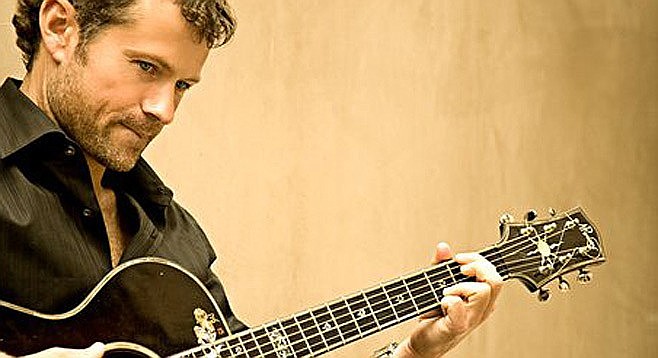
A band that didn’t exist, but needed to exist — for the sake of a book. A book that demanded songs, plus a band to sing and play them. But let’s back up a bit; let's start with the music. Alex Woodard, author of the new novel Ordinary Soil and the mastermind behind the affiliated Bison Bridge band, grew up in San Jose, but he’s called North County home for many years now.
“I lived in Leucadia for about 15 years, then moved to the very western edge of Rancho Santa Fe. Very different, of course, and reflective of the different eras of my life. I was single and still on the road quite a bit back when I lived in Leucadia, and was happy just to wake up within walking distance of the surf. But by the time I hit my 40s, I was looking to settle in somewhere with more space.”
As for music passions while growing up, he says “I liked the artists that no one else in junior high or high school would ever deem cool. Springsteen, Mellencamp, Petty, and other singer-songwriters with bands. That storytelling Americana genre was my wheelhouse. My first show was actually Bryan Adams at the Forum. I remember watching his guitar player and thinking to myself, ‘I wonder if I could be that guy.’ And in the crazy way the world sometimes works, that guy — Keith Scott — ended up playing on a couple of albums I produced, and we did a show or two together.”
Woodard also devoured Stephen King books, and then got onto John Steinbeck on the way to publishing several books of his own alongside his musical career. “I’m self-taught, both in music and writing, for better or worse. I went to UCLA and got a degree in Business Economics, which didn’t really teach me anything I needed to know later in life. The music definitely influences the prose from a songwriting standpoint. I learned to be really concise when writing songs — ‘Don’t bore us, get to the chorus’ — which has informed how I write books. As far as prose influencing music, when I’m setting a scene, I often get ideas for songs by imagining a soundtrack running behind the story. That’s how the not-so-fictional band Bison Bridge came about. Bison are sacred to Native culture, which is central to the book, so I wanted to incorporate that animal into the band name. I also wanted to communicate this idea of bridging generations and cultures.”
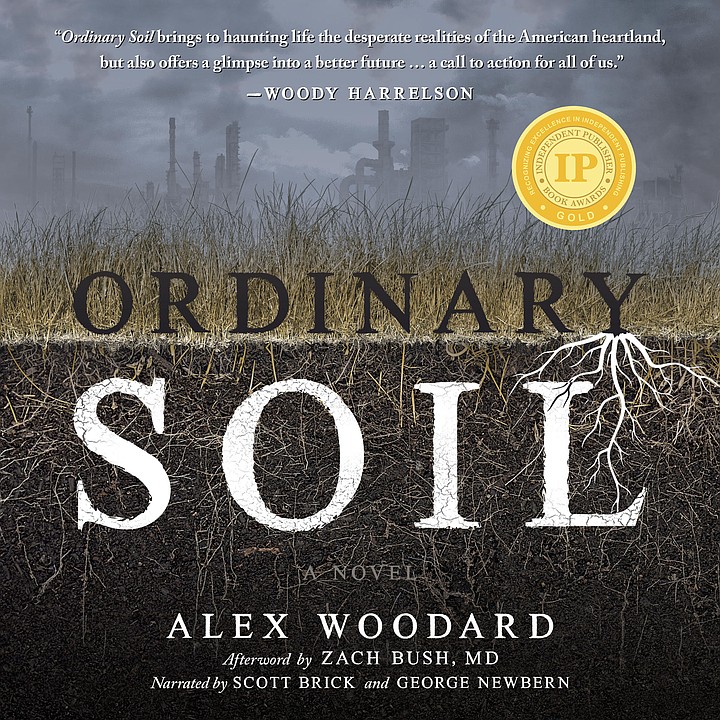
But Ordinary Soil, with its frequent references to that fictional band Bison Bridge, produced an odd response. “Early readers and reviewers asked me where to find the band before the book officially came out, and then as soon as it was released, people started emailing me through my website.”
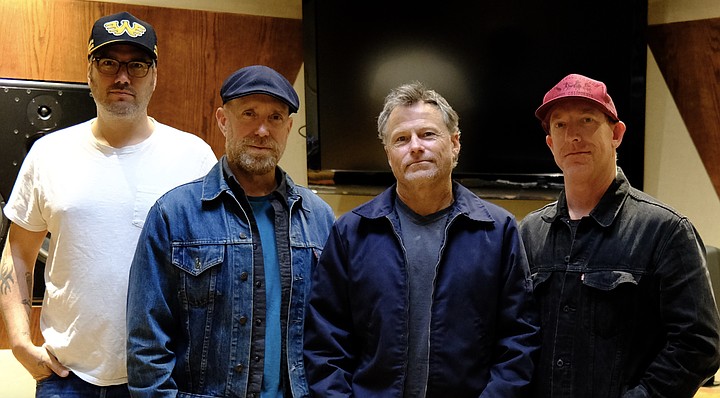
Then fate lent a hand. Some local fellows retained Woodard to play some Springsteen covers for a one-off bar gig, and he had to run through all of the covers with no rehearsing. “I knew one of the guys [bassist Patrick McClory], sort of knew one of the guys [guitarist Mike Butler], and didn’t know one at all [drummer Matt Lynott]. They’ve all played in so many bands and projects that they can be whatever you need them to be. But in that setting, they were a semi-sloppy, hard-hitting bar band. Which sounded pretty damn good to me.”
Around half way through the second song of the set, he started to feel that this bunch should become the real-life Bison Bridge band. Of course, he still needed real-life songs. “For me, everything happens at once. I sit down with a guitar, start playing, and weave words through the chords until a story surfaces. If it’s hard, that means I’m forcing it, and it’s time to go walk the dog or something.”
From bar band to Bison Bridge
Asked about the final results, incorporated into the new audiobook of Ordinary Soil, he says “I think they turned out really well, and wouldn’t change anything. Mike Butler engineered and produced the songs, and channeled just the right amount of grit to remind me of that night in the bar. My favorite song is called ‘The Seeing Kind,’ because it questions why God gets the credit for the good, but none of the bad. The lyrics speak directly to the struggles that the book characters are having, as they try to square their religion with their reality.”
Asked about local gigs and/or a tour for Bison Bridge, Woodard says “Everyone’s so busy, there’s nothing scheduled right now. The band is only a phone call away, though, if Mellencamp needs an opener.”
Here's something you might be interested in.
Bison Bridge crosses over from fiction to reality
“Early readers asked me where to find the band before the book officially came out."

Bison Bridge crosses over from fiction to reality
“Early readers asked me where to find the band before the book officially came out."
A band that didn’t exist, but needed to exist — for the sake of a book. A book that demanded songs, plus a band to sing and play them. But let’s back up a bit; let's start with the music. Alex Woodard, author of the new novel Ordinary Soil and the mastermind behind the affiliated Bison Bridge band, grew up in San Jose, but he’s called North County home for many years now.
“I lived in Leucadia for about 15 years, then moved to the very western edge of Rancho Santa Fe. Very different, of course, and reflective of the different eras of my life. I was single and still on the road quite a bit back when I lived in Leucadia, and was happy just to wake up within walking distance of the surf. But by the time I hit my 40s, I was looking to settle in somewhere with more space.”
As for music passions while growing up, he says “I liked the artists that no one else in junior high or high school would ever deem cool. Springsteen, Mellencamp, Petty, and other singer-songwriters with bands. That storytelling Americana genre was my wheelhouse. My first show was actually Bryan Adams at the Forum. I remember watching his guitar player and thinking to myself, ‘I wonder if I could be that guy.’ And in the crazy way the world sometimes works, that guy — Keith Scott — ended up playing on a couple of albums I produced, and we did a show or two together.”
Woodard also devoured Stephen King books, and then got onto John Steinbeck on the way to publishing several books of his own alongside his musical career. “I’m self-taught, both in music and writing, for better or worse. I went to UCLA and got a degree in Business Economics, which didn’t really teach me anything I needed to know later in life. The music definitely influences the prose from a songwriting standpoint. I learned to be really concise when writing songs — ‘Don’t bore us, get to the chorus’ — which has informed how I write books. As far as prose influencing music, when I’m setting a scene, I often get ideas for songs by imagining a soundtrack running behind the story. That’s how the not-so-fictional band Bison Bridge came about. Bison are sacred to Native culture, which is central to the book, so I wanted to incorporate that animal into the band name. I also wanted to communicate this idea of bridging generations and cultures.”
But Ordinary Soil, with its frequent references to that fictional band Bison Bridge, produced an odd response. “Early readers and reviewers asked me where to find the band before the book officially came out, and then as soon as it was released, people started emailing me through my website.”
Then fate lent a hand. Some local fellows retained Woodard to play some Springsteen covers for a one-off bar gig, and he had to run through all of the covers with no rehearsing. “I knew one of the guys [bassist Patrick McClory], sort of knew one of the guys [guitarist Mike Butler], and didn’t know one at all [drummer Matt Lynott]. They’ve all played in so many bands and projects that they can be whatever you need them to be. But in that setting, they were a semi-sloppy, hard-hitting bar band. Which sounded pretty damn good to me.”
Around half way through the second song of the set, he started to feel that this bunch should become the real-life Bison Bridge band. Of course, he still needed real-life songs. “For me, everything happens at once. I sit down with a guitar, start playing, and weave words through the chords until a story surfaces. If it’s hard, that means I’m forcing it, and it’s time to go walk the dog or something.”
From bar band to Bison Bridge
Asked about the final results, incorporated into the new audiobook of Ordinary Soil, he says “I think they turned out really well, and wouldn’t change anything. Mike Butler engineered and produced the songs, and channeled just the right amount of grit to remind me of that night in the bar. My favorite song is called ‘The Seeing Kind,’ because it questions why God gets the credit for the good, but none of the bad. The lyrics speak directly to the struggles that the book characters are having, as they try to square their religion with their reality.”
Asked about local gigs and/or a tour for Bison Bridge, Woodard says “Everyone’s so busy, there’s nothing scheduled right now. The band is only a phone call away, though, if Mellencamp needs an opener.”