

Here's something you might be interested in.
Ask a Hipster — Advice you didn't know you needed
Big Screen — Movie commentary
Blurt — Music's inside track
Booze News — San Diego spirits
Classical Music — Immortal beauty
Classifieds — Free and easy
Close to Home — What it’s like on the street where you live
Cover Stories — Front-page features
Drinks All Around — Bartenders' drink recipes
Excerpts — Literary and spiritual excerpts
Feast! — Food & drink reviews
Feature Stories — Local news & stories
Fishing Report — What’s getting hooked from ship and shore
From the Archives — Spotlight on the past
Golden Dreams — Talk of the town
The Gonzo Report — Making the musical scene, or at least reporting from it
Letters — Our inbox
Movies@Home — Local movie buffs share favorites
Movie Reviews — Our critics' picks and pans
Musician Interviews — Up close with local artists
Neighborhood News from Stringers — Hyperlocal news
News Ticker — News & politics
Obermeyer — San Diego politics illustrated
Outdoors — Weekly changes in flora and fauna
Overheard in San Diego — Eavesdropping illustrated
Poetry — The old and the new
Reader Travel — Travel section built by travelers
Reading — The hunt for intellectuals
Roam-O-Rama — SoCal's best hiking/biking trails
San Diego Beer — Inside San Diego suds
SD on the QT — Almost factual news
Sheep and Goats — Places of worship
Special Issues — The best of
Street Style — San Diego streets have style
Surf Diego — Real stories from those braving the waves
Theater — On stage in San Diego this week
Tin Fork — Silver spoon alternative
Under the Radar — Matt Potter's undercover work
Unforgettable — Long-ago San Diego
Unreal Estate — San Diego's priciest pads
Your Week — Daily event picks
Fish Report: Local Yellowtail on the chew
How about a Waterfront cleanup?
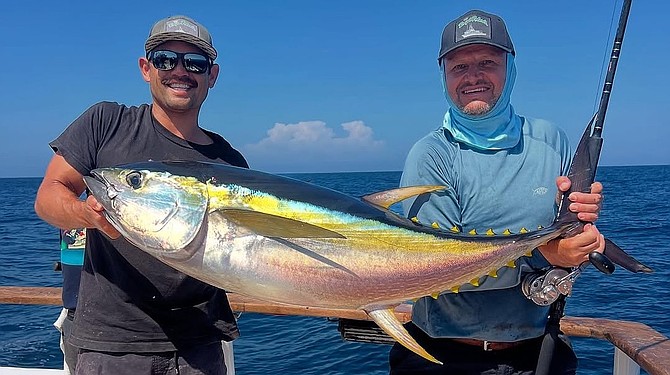
Yellowfin may be mostly absent off northern Baja this year, but they are biting well off the Ridge, as witnessed by this solid fish caught aboard the Royal Polaris during this week’s Fujimoto 8-day trip.
Dock Totals 8/10 – 8/16: 4483 anglers aboard 201 half-day to 3-day trips out of San Diego landings over the past week caught 153 barracuda, 2073 bluefin tuna (to 210 pounds), 166 bonito, 7 cabezon, 1338 calico bass, 3 dorado, 14 halibut, 1 leopard shark, 9 lingcod, 2727 rockfish, 676 sand bass, 255 sanddab, 325 sculpin, 225 sheephead, 1154 whitefish, 1 white seabass, 8 yellowfin tuna, and 2197 yellowtail.
Saltwater: Local boats fishing the coast have been doing very well on calico bass, bonito, rockfish and some decent yellowtail. It’s always fun to get yellowtail biting off the kelp edge for half-day anglers, and so far this August, anyone on the water from the kelp beds off La Jolla to the Coronado Islands has had a shot at landing at least one. Sand bass seemed to slack off a bit, as has been the case the past few weeks when calico counts are higher, but some of that is simply due to the location: boats have to choose between the flats or the outside of the kelp beds, depending on what is biting better on any given day.
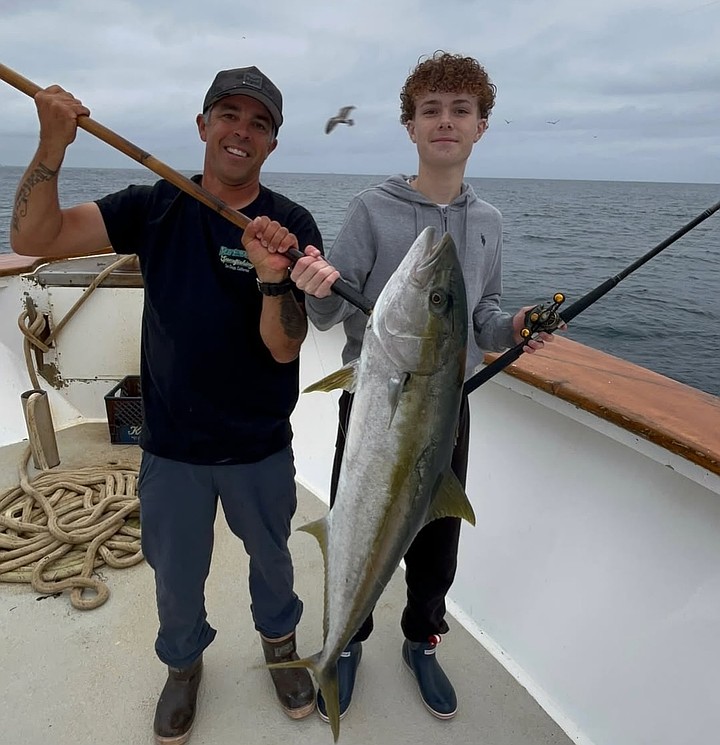
A solid local yellowtail caught aboard the New Seaforth’s early half-day run on Saturday morning.
Outside the Coronados and down to the banks off Ensenada, bluefin tuna continue to bite well in daylight hours. At times, some spots of fish seem to have lockjaw, but boats fishing 1.5-day and longer have plenty of time to find biters, and are usually posting limits or near limits caught. That daytime bite is still mostly smaller fish under 30 pounds, but some larger units to over 200 pounds are being caught day and night.
There are other areas to the northwest — from south of San Clemente Island up to the Channel Islands — where bluefin are still active. Between private boaters and sportboats, there has been a lot of traffic, but the fish aren’t really that boat shy. There have also been occasional yellowtail flurries in the same areas, with some especially nice fish to 40-plus pounds coming from around San Clemente Island. Even so, we are behind last year’s pace on yellowtail.
Year-to-year numbers for pelagic species can vary greatly, depending on bait availability and water temperature. With endemic species, it is often true that their numbers are more consistent, unless there have been regulation changes. This year has been a bit odd, considering the water temps have been fairly close to what we had last year. Given that our best fishing within 3-day range for the warmer water species like yellowfin tuna and dorado is usually late-summer into fall, numbers to date should be a little less than half of the previous year’s total. That is where we are with yellowtail, with 12,746 caught to date in 2025 and 28,360 total for the calendar year 2024.
But yellowfin and dorado are another story —so far, anyway. Last year, with much of the focus on bluefin, yellowfin tuna catches by the 3-day or less fleet totaled 4,104 caught by the fleet (Fisherman’s, Seaforth, Point Loma, and H&M landings). To date, there have been only 26 reported this year. And dorado have been basically a scratch, with three this week being the high point so far. We’ll see if things improve, but it's not going to be anything like a few years ago, when we were up to our armpits in dorado that ranged as far north as Oregon waters. With more boats concentrating on bluefin and not traveling further south than they need to, I reckon we’ll see a few dorado and yellowfin here and there, and mostly yellowtail and bluefin as our top pelagic catches.
As for as our endemic species, sand bass and halibut have been standouts this year. True, we normally see a few halibut caught compared to the fisheries to our north, but San Diego is still a decent area to target California halibut. Catches of halibut this year have already outpaced last year’s reports, as did the Dolphin during their four-month halibut derby from January to April. Still, I am seeing a few more in the weekly counts through the summer than the usual two or three.
Sand bass, however, have been on fire. In February, the California Department of Fish and Wildlife reduced the limit of sand bass from five to four fish per angler per day. This was done due to their census, which is partially based on sportboat totals. Even so, this year to date, a whopping 24,051 sand bass have been reported caught and kept, far eclipsing the 2024 total of 22,992 caught — with more than four months still to go. Calico bass, meanwhile, are pretty much on pace with last year, even though there were twice as many calicos this past week as there were sand bass. Go figure.
Every year I find myself comparing catch totals, species, conditions, and such, and every year I am reminded that our nearshore and offshore fishery is and always has been in flux. Each season brings its own surprises, and on any given day, fishing might be wide open, slow as molasses, or somewhere in between. Whether the beach, bay, lake, or offshore, they’re out there so go out and get ‘em!
PS: This Saturday, there will be a county-wide waterfront clean-up event: Operation Clean Sweep. There are several locations where volunteers can help out. Folks who would like to get involved should visit the Clean Sweep webpage for locations, times and a downloadable liability waiver. This, from the organizers: “Your waiver is your registration! Please print the waiver and bring a signed copy to the cleanup site of your choice. In exchange for your waiver, you will receive a volunteer t-shirt, cleaning supplies, water, and more. If you an SDWW member, participating in a private, tenant clean up, your site lead will have your t-shirt and supplies. Please email [email protected] if you have any questions.”
Here's something you might be interested in.
Fish Report: Local Yellowtail on the chew
How about a Waterfront cleanup?

Fish Report: Local Yellowtail on the chew
How about a Waterfront cleanup?
Yellowfin may be mostly absent off northern Baja this year, but they are biting well off the Ridge, as witnessed by this solid fish caught aboard the Royal Polaris during this week’s Fujimoto 8-day trip.
Dock Totals 8/10 – 8/16: 4483 anglers aboard 201 half-day to 3-day trips out of San Diego landings over the past week caught 153 barracuda, 2073 bluefin tuna (to 210 pounds), 166 bonito, 7 cabezon, 1338 calico bass, 3 dorado, 14 halibut, 1 leopard shark, 9 lingcod, 2727 rockfish, 676 sand bass, 255 sanddab, 325 sculpin, 225 sheephead, 1154 whitefish, 1 white seabass, 8 yellowfin tuna, and 2197 yellowtail.
Saltwater: Local boats fishing the coast have been doing very well on calico bass, bonito, rockfish and some decent yellowtail. It’s always fun to get yellowtail biting off the kelp edge for half-day anglers, and so far this August, anyone on the water from the kelp beds off La Jolla to the Coronado Islands has had a shot at landing at least one. Sand bass seemed to slack off a bit, as has been the case the past few weeks when calico counts are higher, but some of that is simply due to the location: boats have to choose between the flats or the outside of the kelp beds, depending on what is biting better on any given day.
A solid local yellowtail caught aboard the New Seaforth’s early half-day run on Saturday morning.
Outside the Coronados and down to the banks off Ensenada, bluefin tuna continue to bite well in daylight hours. At times, some spots of fish seem to have lockjaw, but boats fishing 1.5-day and longer have plenty of time to find biters, and are usually posting limits or near limits caught. That daytime bite is still mostly smaller fish under 30 pounds, but some larger units to over 200 pounds are being caught day and night.
There are other areas to the northwest — from south of San Clemente Island up to the Channel Islands — where bluefin are still active. Between private boaters and sportboats, there has been a lot of traffic, but the fish aren’t really that boat shy. There have also been occasional yellowtail flurries in the same areas, with some especially nice fish to 40-plus pounds coming from around San Clemente Island. Even so, we are behind last year’s pace on yellowtail.
Year-to-year numbers for pelagic species can vary greatly, depending on bait availability and water temperature. With endemic species, it is often true that their numbers are more consistent, unless there have been regulation changes. This year has been a bit odd, considering the water temps have been fairly close to what we had last year. Given that our best fishing within 3-day range for the warmer water species like yellowfin tuna and dorado is usually late-summer into fall, numbers to date should be a little less than half of the previous year’s total. That is where we are with yellowtail, with 12,746 caught to date in 2025 and 28,360 total for the calendar year 2024.
But yellowfin and dorado are another story —so far, anyway. Last year, with much of the focus on bluefin, yellowfin tuna catches by the 3-day or less fleet totaled 4,104 caught by the fleet (Fisherman’s, Seaforth, Point Loma, and H&M landings). To date, there have been only 26 reported this year. And dorado have been basically a scratch, with three this week being the high point so far. We’ll see if things improve, but it's not going to be anything like a few years ago, when we were up to our armpits in dorado that ranged as far north as Oregon waters. With more boats concentrating on bluefin and not traveling further south than they need to, I reckon we’ll see a few dorado and yellowfin here and there, and mostly yellowtail and bluefin as our top pelagic catches.
As for as our endemic species, sand bass and halibut have been standouts this year. True, we normally see a few halibut caught compared to the fisheries to our north, but San Diego is still a decent area to target California halibut. Catches of halibut this year have already outpaced last year’s reports, as did the Dolphin during their four-month halibut derby from January to April. Still, I am seeing a few more in the weekly counts through the summer than the usual two or three.
Sand bass, however, have been on fire. In February, the California Department of Fish and Wildlife reduced the limit of sand bass from five to four fish per angler per day. This was done due to their census, which is partially based on sportboat totals. Even so, this year to date, a whopping 24,051 sand bass have been reported caught and kept, far eclipsing the 2024 total of 22,992 caught — with more than four months still to go. Calico bass, meanwhile, are pretty much on pace with last year, even though there were twice as many calicos this past week as there were sand bass. Go figure.
Every year I find myself comparing catch totals, species, conditions, and such, and every year I am reminded that our nearshore and offshore fishery is and always has been in flux. Each season brings its own surprises, and on any given day, fishing might be wide open, slow as molasses, or somewhere in between. Whether the beach, bay, lake, or offshore, they’re out there so go out and get ‘em!
PS: This Saturday, there will be a county-wide waterfront clean-up event: Operation Clean Sweep. There are several locations where volunteers can help out. Folks who would like to get involved should visit the Clean Sweep webpage for locations, times and a downloadable liability waiver. This, from the organizers: “Your waiver is your registration! Please print the waiver and bring a signed copy to the cleanup site of your choice. In exchange for your waiver, you will receive a volunteer t-shirt, cleaning supplies, water, and more. If you an SDWW member, participating in a private, tenant clean up, your site lead will have your t-shirt and supplies. Please email [email protected] if you have any questions.”
Comments