

Here's something you might be interested in.
Ask a Hipster — Advice you didn't know you needed
Big Screen — Movie commentary
Blurt — Music's inside track
Booze News — San Diego spirits
Classical Music — Immortal beauty
Classifieds — Free and easy
Close to Home — What it’s like on the street where you live
Cover Stories — Front-page features
Drinks All Around — Bartenders' drink recipes
Excerpts — Literary and spiritual excerpts
Feast! — Food & drink reviews
Feature Stories — Local news & stories
Fishing Report — What’s getting hooked from ship and shore
From the Archives — Spotlight on the past
Golden Dreams — Talk of the town
The Gonzo Report — Making the musical scene, or at least reporting from it
Letters — Our inbox
Movies@Home — Local movie buffs share favorites
Movie Reviews — Our critics' picks and pans
Musician Interviews — Up close with local artists
Neighborhood News from Stringers — Hyperlocal news
News Ticker — News & politics
Obermeyer — San Diego politics illustrated
Outdoors — Weekly changes in flora and fauna
Overheard in San Diego — Eavesdropping illustrated
Poetry — The old and the new
Reader Travel — Travel section built by travelers
Reading — The hunt for intellectuals
Roam-O-Rama — SoCal's best hiking/biking trails
San Diego Beer — Inside San Diego suds
SD on the QT — Almost factual news
Sheep and Goats — Places of worship
Special Issues — The best of
Street Style — San Diego streets have style
Surf Diego — Real stories from those braving the waves
Theater — On stage in San Diego this week
Tin Fork — Silver spoon alternative
Under the Radar — Matt Potter's undercover work
Unforgettable — Long-ago San Diego
Unreal Estate — San Diego's priciest pads
Your Week — Daily event picks
Sessions at six
Taylor Steele's surf-music-art festival is a carefully curated cultural playlist
Encinitas rising: A session at Sessions
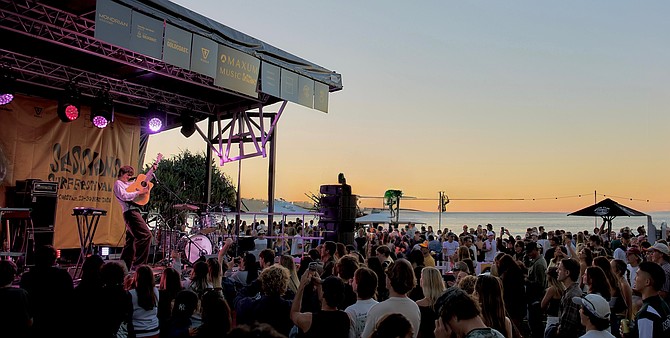
This weekend will see the return of the week-long Sessions Surf Festival to filmmaker and founder Taylor Steele’s North County stomping grounds. Saturday will lean into music, with Seaside Reef providing a beach venue for headliners The Osees, plus Unwritten Law, Bully, Yoke Lore, and more. Sunday is for surfing at Seaside (plus more music and entertainment). On Monday, the fest comes to rest at Carlsbad’s Hot Water Gallery for events and exhibitions running through the 19th. And Thursday begins the three-day surf film festival at La Paloma, including a (sadly sold out) 25th anniversary screening of Steele’s 2001 film Shelter.
Video:
Trailer: SHELTER
“All the films are handpicked by me,” says Steele. “I try to think of the night almost as a playlist and really keep the crowd entertained. You watch a local band play to start, then there are short films, and then there’s a feature. And there’s beer and margaritas.”
Thursday brings In Pieces Together. “This guy’s father committed suicide, and he wanted to bring awareness to a heavy subject by setting a world record for surfing the longest.” Saturday features Maps to Nowhere by Surfline — “They use Google maps to find waves, and they go to a spot where no one’s ever been” — and the world-premiere of ProCasual, by San Diego filmmaker Jack Coleman. Observes Steele, “In the ‘90s, it was very one-dimensional: MTV-esque films that were just surfing action with no real story.” Now, “powerful, important stories are being told.”
Video:
Trailer: IN PIECES TOGETHER
Steele had something to do with that ‘90s MTV style. When he was a kid, “surf rock” meant instrumental bands like The Ventures and songs like The Surfaris’ “Wipe Out.” But while Steele was into surfing, “the music that I was into in my teenage years was more punk rock.” And punk had the propulsive energy that the teenaged Steele — armed with a Canon L1 camera and the training he received from a video production class at Torrey Pines High School — wanted for the soundtrack of his movie Momentum. “It was all about showing the most high-performance waves you could do, and I wanted the music to exaggerate the performance level.”
He also wanted it to be intimately connected with the film itself. “My parameter was not using music that was on the radio. That way, you wouldn’t already have a relationship to the music. Your first experience of it would be when you saw the surfing. I watched surf movies as a kid, and I played the soundtracks over and over. They became ingrained in my own surf sessions.”
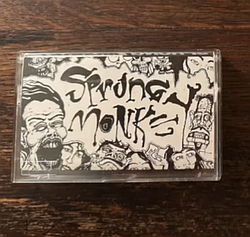
He recalls combing through the local music section at Lou’s Records in Encinitas. “It was small, probably 30 bands. There was a tape from a band called Sprung Monkey, and it had a cool hand-drawn logo on it. It was a white cassette with three songs. I played it in my car non-stop. I used it to make a rough cut of the movie, and when I saw Sprung Monkey was playing downtown, I went down and gave the guys a VHS copy of my movie and asked if I could use their music. They were like, ‘You made this? Yeah, of course. Use it.’”
Video:
SPRUNG MONKEY
It proved to be the start of a beautiful friendship between Steele and the musicians who showed up on his soundtracks. “I still run into people who say, ‘I was at that Momentum 2 premiere in ‘93 when Sprung Monkey and Pennywise played.’ That was at La Paloma. The first row of seats got ripped out, and there was a mosh pit in the theater. It was pretty wild, but everybody had fun. And I think that after their first album, every Pennywise release of the ‘90s was timed to the release of one of my films, starting with Unknown Road.”
Pennywise also headlined for the first tour of another band Steele famously helped break: Blink-182. “I met them when they were 17 years old and playing little house parties in San Diego. I think it was a birthday party, where there were like three people watching them. They quickly became my friends. Their music was fun, and we wanted to help them get big. The tour was connected to my film Good Times. The venue size was anywhere from 500 to 2000. The surf movie would start the night, and the bands would finish it.”
Video:
Blink-182 Good Times tour doc
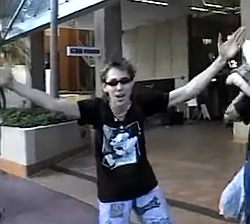
Later came another friend, an aspiring pro surfer named Jack Johnson. Steele met him when Johnson was 15 and living on Oahu's North Shore, in front of Pipeline. “At that time, he was just starting to play guitar, so we really didn't think much about any sort of future music career. It was more about him being a friend and helping him become a professional surfer.” That changed when Steele put Johnson’s song “Middle Man” at the top of the soundtrack for 1999’s Loose Change.
Jack Johnson is not anybody’s idea of punk, but as Steele got older, his movies mellowed and shifted. "The soundtrack for Shelter is almost like campfire music. After surfing, we’d be hanging out at the house and everybody had guitars, and they were just playing music, killing time. In 2006’s Sipping Jetstreams, I wanted to capture the feeling of the trip more than the progression of the surfing. If I’m going to an exotic location, I incorporate the local music.”
Video:
Trailer: JACK JOHNSON: SURFILMUSIC
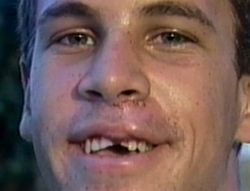
Steele had caught the travel bug when he was 16. “I traveled around Australia with some friends for a couple of months. I fell in love with what it did for my spirit.” By the time he had his first child, he was traveling for 10 months of the year. “I wanted to keep that gypsy lifestyle, but be more responsible. And so I decided that every six years, I’d move to a new country” First Bali, then Australia, then New York, “which feels like a different country.” And then, in 2019, Encinitas. “My daughter really wanted to come to school here. She loves the beach, and wanted to get back to it.”
As lovely and communal as Encinitas is, Steele found that “it’s hard to come home after being gone that long. It felt like not much had changed, but I had changed so much. I found myself comparing Encinitas to these different places, the excitement of them, and feeling a little bit frustrated. I missed the gatherings of creatives. So instead of complaining about what was missing, I decided to create it. That’s how Sessions was conceived.”
Six years in, he says, “it’s going great, and growing every year. There’s something going on every night, and you’re moving to different places. A band’s playing at a bar, there’s an art show somewhere else… Maybe not as big as it will ever be, but it’s in a sweet spot, where everything is packed and there’s a good energy to it. Everybody’s still got that excitement, which I crave and love.”
Here's something you might be interested in.
Sessions at six
Taylor Steele's surf-music-art festival is a carefully curated cultural playlist

Sessions at six
Taylor Steele's surf-music-art festival is a carefully curated cultural playlist
Encinitas rising: A session at Sessions
This weekend will see the return of the week-long Sessions Surf Festival to filmmaker and founder Taylor Steele’s North County stomping grounds. Saturday will lean into music, with Seaside Reef providing a beach venue for headliners The Osees, plus Unwritten Law, Bully, Yoke Lore, and more. Sunday is for surfing at Seaside (plus more music and entertainment). On Monday, the fest comes to rest at Carlsbad’s Hot Water Gallery for events and exhibitions running through the 19th. And Thursday begins the three-day surf film festival at La Paloma, including a (sadly sold out) 25th anniversary screening of Steele’s 2001 film Shelter.
Video:
Trailer: SHELTER
“All the films are handpicked by me,” says Steele. “I try to think of the night almost as a playlist and really keep the crowd entertained. You watch a local band play to start, then there are short films, and then there’s a feature. And there’s beer and margaritas.”
Thursday brings In Pieces Together. “This guy’s father committed suicide, and he wanted to bring awareness to a heavy subject by setting a world record for surfing the longest.” Saturday features Maps to Nowhere by Surfline — “They use Google maps to find waves, and they go to a spot where no one’s ever been” — and the world-premiere of ProCasual, by San Diego filmmaker Jack Coleman. Observes Steele, “In the ‘90s, it was very one-dimensional: MTV-esque films that were just surfing action with no real story.” Now, “powerful, important stories are being told.”
Video:
Trailer: IN PIECES TOGETHER
Steele had something to do with that ‘90s MTV style. When he was a kid, “surf rock” meant instrumental bands like The Ventures and songs like The Surfaris’ “Wipe Out.” But while Steele was into surfing, “the music that I was into in my teenage years was more punk rock.” And punk had the propulsive energy that the teenaged Steele — armed with a Canon L1 camera and the training he received from a video production class at Torrey Pines High School — wanted for the soundtrack of his movie Momentum. “It was all about showing the most high-performance waves you could do, and I wanted the music to exaggerate the performance level.”
He also wanted it to be intimately connected with the film itself. “My parameter was not using music that was on the radio. That way, you wouldn’t already have a relationship to the music. Your first experience of it would be when you saw the surfing. I watched surf movies as a kid, and I played the soundtracks over and over. They became ingrained in my own surf sessions.”
He recalls combing through the local music section at Lou’s Records in Encinitas. “It was small, probably 30 bands. There was a tape from a band called Sprung Monkey, and it had a cool hand-drawn logo on it. It was a white cassette with three songs. I played it in my car non-stop. I used it to make a rough cut of the movie, and when I saw Sprung Monkey was playing downtown, I went down and gave the guys a VHS copy of my movie and asked if I could use their music. They were like, ‘You made this? Yeah, of course. Use it.’”
Video:
SPRUNG MONKEY
It proved to be the start of a beautiful friendship between Steele and the musicians who showed up on his soundtracks. “I still run into people who say, ‘I was at that Momentum 2 premiere in ‘93 when Sprung Monkey and Pennywise played.’ That was at La Paloma. The first row of seats got ripped out, and there was a mosh pit in the theater. It was pretty wild, but everybody had fun. And I think that after their first album, every Pennywise release of the ‘90s was timed to the release of one of my films, starting with Unknown Road.”
Pennywise also headlined for the first tour of another band Steele famously helped break: Blink-182. “I met them when they were 17 years old and playing little house parties in San Diego. I think it was a birthday party, where there were like three people watching them. They quickly became my friends. Their music was fun, and we wanted to help them get big. The tour was connected to my film Good Times. The venue size was anywhere from 500 to 2000. The surf movie would start the night, and the bands would finish it.”
Video:
Blink-182 Good Times tour doc
Later came another friend, an aspiring pro surfer named Jack Johnson. Steele met him when Johnson was 15 and living on Oahu's North Shore, in front of Pipeline. “At that time, he was just starting to play guitar, so we really didn't think much about any sort of future music career. It was more about him being a friend and helping him become a professional surfer.” That changed when Steele put Johnson’s song “Middle Man” at the top of the soundtrack for 1999’s Loose Change.
Jack Johnson is not anybody’s idea of punk, but as Steele got older, his movies mellowed and shifted. "The soundtrack for Shelter is almost like campfire music. After surfing, we’d be hanging out at the house and everybody had guitars, and they were just playing music, killing time. In 2006’s Sipping Jetstreams, I wanted to capture the feeling of the trip more than the progression of the surfing. If I’m going to an exotic location, I incorporate the local music.”
Video:
Trailer: JACK JOHNSON: SURFILMUSIC
Steele had caught the travel bug when he was 16. “I traveled around Australia with some friends for a couple of months. I fell in love with what it did for my spirit.” By the time he had his first child, he was traveling for 10 months of the year. “I wanted to keep that gypsy lifestyle, but be more responsible. And so I decided that every six years, I’d move to a new country” First Bali, then Australia, then New York, “which feels like a different country.” And then, in 2019, Encinitas. “My daughter really wanted to come to school here. She loves the beach, and wanted to get back to it.”
As lovely and communal as Encinitas is, Steele found that “it’s hard to come home after being gone that long. It felt like not much had changed, but I had changed so much. I found myself comparing Encinitas to these different places, the excitement of them, and feeling a little bit frustrated. I missed the gatherings of creatives. So instead of complaining about what was missing, I decided to create it. That’s how Sessions was conceived.”
Six years in, he says, “it’s going great, and growing every year. There’s something going on every night, and you’re moving to different places. A band’s playing at a bar, there’s an art show somewhere else… Maybe not as big as it will ever be, but it’s in a sweet spot, where everything is packed and there’s a good energy to it. Everybody’s still got that excitement, which I crave and love.”
Comments