

Here's something you might be interested in.
Ask a Hipster — Advice you didn't know you needed
Big Screen — Movie commentary
Blurt — Music's inside track
Booze News — San Diego spirits
Classical Music — Immortal beauty
Classifieds — Free and easy
Close to Home — What it’s like on the street where you live
Cover Stories — Front-page features
Drinks All Around — Bartenders' drink recipes
Excerpts — Literary and spiritual excerpts
Feast! — Food & drink reviews
Feature Stories — Local news & stories
Fishing Report — What’s getting hooked from ship and shore
From the Archives — Spotlight on the past
Golden Dreams — Talk of the town
The Gonzo Report — Making the musical scene, or at least reporting from it
Letters — Our inbox
Movies@Home — Local movie buffs share favorites
Movie Reviews — Our critics' picks and pans
Musician Interviews — Up close with local artists
Neighborhood News from Stringers — Hyperlocal news
News Ticker — News & politics
Obermeyer — San Diego politics illustrated
Outdoors — Weekly changes in flora and fauna
Overheard in San Diego — Eavesdropping illustrated
Poetry — The old and the new
Reader Travel — Travel section built by travelers
Reading — The hunt for intellectuals
Roam-O-Rama — SoCal's best hiking/biking trails
San Diego Beer — Inside San Diego suds
SD on the QT — Almost factual news
Sheep and Goats — Places of worship
Special Issues — The best of
Street Style — San Diego streets have style
Surf Diego — Real stories from those braving the waves
Theater — On stage in San Diego this week
Tin Fork — Silver spoon alternative
Under the Radar — Matt Potter's undercover work
Unforgettable — Long-ago San Diego
Unreal Estate — San Diego's priciest pads
Your Week — Daily event picks
IMAX or 70mm?
Critic sets out on personal odyssey to spot the difference
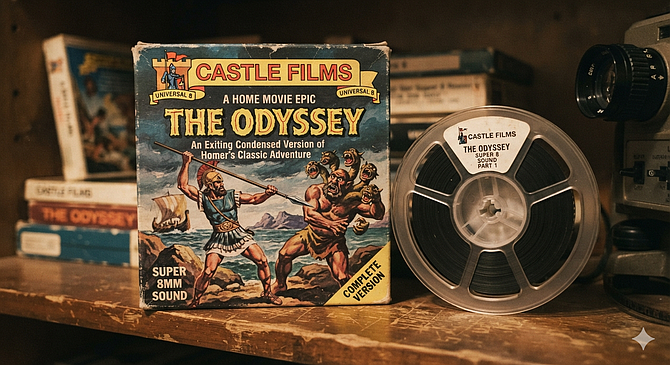
Why not bypass the theatre and wait for the Castle Films edition?
When was the last time I watched a movie in a theatre at 8 am? August 15, 1979, opening day for Apocalypse Now at Chicago’s State Lake. The two guys behind me were noisily downing a concession stand breakfast. I love the smell of hot dogs with chili, onions, and piccalilli in the morning.
Nobody was hot dogging it at my more recent early-morning excursion to the theater for my second screening of The Odyssey. But surprisingly, there were about 50 fellow viewers in attendance at that hour.
My goal was to compare the 70mm version screened for the press to how it looked on an IMAX screen. I’ll never see it exactly as Nolan intended, because only 25 theaters in the country can project 70mm IMAX. But I figured seeing the film both ways might help me piece together a mental facsimile. Standard 70mm is 2.20:1, while IMAX is 1.43:1. It’s like pan-and-scan in reverse; instead of losing the sides, you lose the top and bottom. The 70mm print was sharper, but given how much visual info is lost, IMAX is the way to go.
What really stinks is this: the late, lamented Grossmont Theatre was one of the few houses in town equipped with a wide gauge 70mm projector. (It was one of the theatres that Quentin Tarantino supplied with a projector to exhibit The Hateful 8.) I repeatedly begged Reading Cinema’s rep to take advantage of it, seeing as how there we had been blessed with newly-struck 70mm prints of 2001: A Space Odyssey, It’s a Mad, Mad, Mad, Mad World, West Side Story and other blockbusters, titles that people would have flocked to see in that rare ratio. And just think how much money Reading would have raked in had they stayed open a few months more to projected a 70mm print of The Odyssey in the giant #1 auditorium.
The one major difference in viewing the film in IMAX was the fillings-rattling bass emanating from the subwoofers that occasionally drowns out dialogue. Is deep bass the only way the format can create a stronger physical feeling and improve realism? Unlike standard formats, IMAX uses full-range channels and a crossover system to pump heavy bass to the subwoofers. What's the difference between IMAX audio and Sensurround? The latter was a gimmick. With IMAX, it’s strictly de rigueur.
Here's something you might be interested in.
IMAX or 70mm?
Critic sets out on personal odyssey to spot the difference

IMAX or 70mm?
Critic sets out on personal odyssey to spot the difference
Why not bypass the theatre and wait for the Castle Films edition?
When was the last time I watched a movie in a theatre at 8 am? August 15, 1979, opening day for Apocalypse Now at Chicago’s State Lake. The two guys behind me were noisily downing a concession stand breakfast. I love the smell of hot dogs with chili, onions, and piccalilli in the morning.
Nobody was hot dogging it at my more recent early-morning excursion to the theater for my second screening of The Odyssey. But surprisingly, there were about 50 fellow viewers in attendance at that hour.
My goal was to compare the 70mm version screened for the press to how it looked on an IMAX screen. I’ll never see it exactly as Nolan intended, because only 25 theaters in the country can project 70mm IMAX. But I figured seeing the film both ways might help me piece together a mental facsimile. Standard 70mm is 2.20:1, while IMAX is 1.43:1. It’s like pan-and-scan in reverse; instead of losing the sides, you lose the top and bottom. The 70mm print was sharper, but given how much visual info is lost, IMAX is the way to go.
What really stinks is this: the late, lamented Grossmont Theatre was one of the few houses in town equipped with a wide gauge 70mm projector. (It was one of the theatres that Quentin Tarantino supplied with a projector to exhibit The Hateful 8.) I repeatedly begged Reading Cinema’s rep to take advantage of it, seeing as how there we had been blessed with newly-struck 70mm prints of 2001: A Space Odyssey, It’s a Mad, Mad, Mad, Mad World, West Side Story and other blockbusters, titles that people would have flocked to see in that rare ratio. And just think how much money Reading would have raked in had they stayed open a few months more to projected a 70mm print of The Odyssey in the giant #1 auditorium.
The one major difference in viewing the film in IMAX was the fillings-rattling bass emanating from the subwoofers that occasionally drowns out dialogue. Is deep bass the only way the format can create a stronger physical feeling and improve realism? Unlike standard formats, IMAX uses full-range channels and a crossover system to pump heavy bass to the subwoofers. What's the difference between IMAX audio and Sensurround? The latter was a gimmick. With IMAX, it’s strictly de rigueur.