

Here's something you might be interested in.
Ask a Hipster — Advice you didn't know you needed
Big Screen — Movie commentary
Blurt — Music's inside track
Booze News — San Diego spirits
Classical Music — Immortal beauty
Classifieds — Free and easy
Close to Home — What it’s like on the street where you live
Cover Stories — Front-page features
Drinks All Around — Bartenders' drink recipes
Excerpts — Literary and spiritual excerpts
Feast! — Food & drink reviews
Feature Stories — Local news & stories
Fishing Report — What’s getting hooked from ship and shore
From the Archives — Spotlight on the past
Golden Dreams — Talk of the town
The Gonzo Report — Making the musical scene, or at least reporting from it
Letters — Our inbox
Movies@Home — Local movie buffs share favorites
Movie Reviews — Our critics' picks and pans
Musician Interviews — Up close with local artists
Neighborhood News from Stringers — Hyperlocal news
News Ticker — News & politics
Obermeyer — San Diego politics illustrated
Outdoors — Weekly changes in flora and fauna
Overheard in San Diego — Eavesdropping illustrated
Poetry — The old and the new
Reader Travel — Travel section built by travelers
Reading — The hunt for intellectuals
Roam-O-Rama — SoCal's best hiking/biking trails
San Diego Beer — Inside San Diego suds
SD on the QT — Almost factual news
Sheep and Goats — Places of worship
Special Issues — The best of
Street Style — San Diego streets have style
Surf Diego — Real stories from those braving the waves
Theater — On stage in San Diego this week
Tin Fork — Silver spoon alternative
Under the Radar — Matt Potter's undercover work
Unforgettable — Long-ago San Diego
Unreal Estate — San Diego's priciest pads
Your Week — Daily event picks
Now playing: NORMAL (2025)
Frozen in time, but a veritable squall of plot cracks the ice over the course of 24 hours.
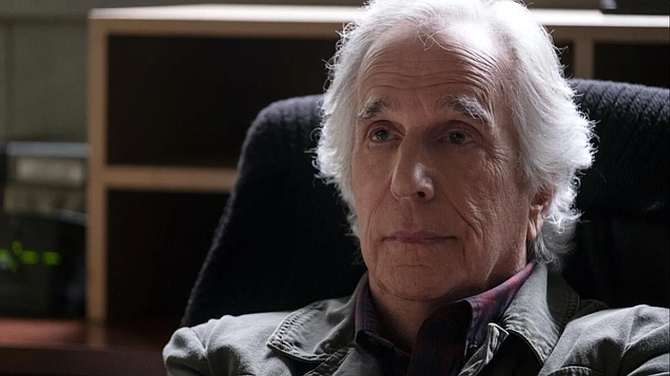
The generaly cuddlesome Henry Winkler, delightfully cast against type as a profanely combustible Mayor.
NORMAL (2026) Ben Wheatley / Writers: Derek Kolstad & Bob Odenkirk / Cinematography: Armando Salas (2 :35 : 1) /Design: Jean-Andre Carriere / Editing: Jonathan Amos / Composers: Harry Gregson-Williams & Ryder McNair / With: Bob Odenkirk, Ryan Allen, Billy MacLellan, Lena Headey, Peter Shinkoda, and Henry Winkler delightfully cast against type as a profanely combustible Mayor / Countries of Origin: Canada & USA / Magnolia Pictures / Rated R / 91 mins.
It stands to reason that any town named Normal — in this case, a remote burg buried deep in the frozen tundra of Minnesota — is bound to be anything but. A speck in the permafrost, the fictional town earns its name mightily, so much so that screenwriters Derek Kolstad and Bob Odenkirk (who also produced and starred) lean heavily into the title, pouncing on the obvious irony by naming the film after it.
As with Sightseers — director Ben Wheatley’s previous blend of crime, horror, and black comedy — character inconsistencies, plot contrivances, and blood-spattered frames are the order of the day. Odenkirk co-wrote himself the plum role of Ulysses Richardson, a composed, hopelessly devoted lawman who draws an eight-week gig as interim sheriff following the unexpected death of his predecessor.
Video:
Trailer: NORMAL
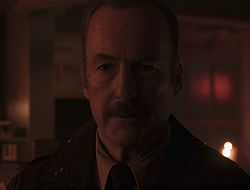
A gang of nattily dressed Yakuza from Osaka has chosen the Bank of Normal as the perfect out-of-the-way spot in which to stash several lifetimes' worth of large bills and gold bricks. No wonder the townsfolk don’t cotton to strangers; they’re all in on the grift. Plans to export the treasure just so happen to coincide with the first night of Ulysse's stint. On top of that slice of implausibility, I'm not sure I buy into the idea of a guy relating — in extraordinary detail — his most traumatic day on the job to a bartender he just met.
Normal is a small town built on petty trivialities and buckshot. The local eatery is a monument to firearms; loaded weapons of various shapes and sizes line the wall. For a place quite literally frozen in time, a veritable squall of plot cracks the ice over the course of a 24-hour period.
Please do not misconstrue what you are about to read as my taking a dump on Robert Altman’s equally imagined town of Presbyterian Church. What follows is by no means intended as a comment on quality, style, or artistry. In all three, cinematographer Vilmos Zsigmond’s ability to direct snow in McCabe and Mrs. Miller wins effortlessly. Still, I couldn't help but think of that film while watching Normal, the majority of which takes place over the course of a single blizzardy night.
Imagine it’s midnight. Through the windshield we observe two guys entering the front seat of a car. Upon closing the doors, the interior dash is so bright, the characters can read. Kudos to cinematographer Armando Salas, whose inky exterior work is delicately filmed under just enough illumination to reveal the information necessary to move things along.
Ultimately, what’s wrong with the movie lies in its double-edged title. Contemporary moviegoers have been inundated with thinly-drawn characters run through a litany of improbable actions that passes for storytelling. Unfortunately, Normal hopelessly offers up more of the same. **
Here's something you might be interested in.
Now playing: NORMAL (2025)
Frozen in time, but a veritable squall of plot cracks the ice over the course of 24 hours.

Now playing: NORMAL (2025)
Frozen in time, but a veritable squall of plot cracks the ice over the course of 24 hours.
The generaly cuddlesome Henry Winkler, delightfully cast against type as a profanely combustible Mayor.
NORMAL (2026) Ben Wheatley / Writers: Derek Kolstad & Bob Odenkirk / Cinematography: Armando Salas (2 :35 : 1) /Design: Jean-Andre Carriere / Editing: Jonathan Amos / Composers: Harry Gregson-Williams & Ryder McNair / With: Bob Odenkirk, Ryan Allen, Billy MacLellan, Lena Headey, Peter Shinkoda, and Henry Winkler delightfully cast against type as a profanely combustible Mayor / Countries of Origin: Canada & USA / Magnolia Pictures / Rated R / 91 mins.
It stands to reason that any town named Normal — in this case, a remote burg buried deep in the frozen tundra of Minnesota — is bound to be anything but. A speck in the permafrost, the fictional town earns its name mightily, so much so that screenwriters Derek Kolstad and Bob Odenkirk (who also produced and starred) lean heavily into the title, pouncing on the obvious irony by naming the film after it.
As with Sightseers — director Ben Wheatley’s previous blend of crime, horror, and black comedy — character inconsistencies, plot contrivances, and blood-spattered frames are the order of the day. Odenkirk co-wrote himself the plum role of Ulysses Richardson, a composed, hopelessly devoted lawman who draws an eight-week gig as interim sheriff following the unexpected death of his predecessor.
Video:
Trailer: NORMAL
A gang of nattily dressed Yakuza from Osaka has chosen the Bank of Normal as the perfect out-of-the-way spot in which to stash several lifetimes' worth of large bills and gold bricks. No wonder the townsfolk don’t cotton to strangers; they’re all in on the grift. Plans to export the treasure just so happen to coincide with the first night of Ulysse's stint. On top of that slice of implausibility, I'm not sure I buy into the idea of a guy relating — in extraordinary detail — his most traumatic day on the job to a bartender he just met.
Normal is a small town built on petty trivialities and buckshot. The local eatery is a monument to firearms; loaded weapons of various shapes and sizes line the wall. For a place quite literally frozen in time, a veritable squall of plot cracks the ice over the course of a 24-hour period.
Please do not misconstrue what you are about to read as my taking a dump on Robert Altman’s equally imagined town of Presbyterian Church. What follows is by no means intended as a comment on quality, style, or artistry. In all three, cinematographer Vilmos Zsigmond’s ability to direct snow in McCabe and Mrs. Miller wins effortlessly. Still, I couldn't help but think of that film while watching Normal, the majority of which takes place over the course of a single blizzardy night.
Imagine it’s midnight. Through the windshield we observe two guys entering the front seat of a car. Upon closing the doors, the interior dash is so bright, the characters can read. Kudos to cinematographer Armando Salas, whose inky exterior work is delicately filmed under just enough illumination to reveal the information necessary to move things along.
Ultimately, what’s wrong with the movie lies in its double-edged title. Contemporary moviegoers have been inundated with thinly-drawn characters run through a litany of improbable actions that passes for storytelling. Unfortunately, Normal hopelessly offers up more of the same. **
Comments