

Here's something you might be interested in.
Ask a Hipster — Advice you didn't know you needed
Big Screen — Movie commentary
Blurt — Music's inside track
Booze News — San Diego spirits
Classical Music — Immortal beauty
Classifieds — Free and easy
Close to Home — What it’s like on the street where you live
Cover Stories — Front-page features
Drinks All Around — Bartenders' drink recipes
Excerpts — Literary and spiritual excerpts
Feast! — Food & drink reviews
Feature Stories — Local news & stories
Fishing Report — What’s getting hooked from ship and shore
From the Archives — Spotlight on the past
Golden Dreams — Talk of the town
The Gonzo Report — Making the musical scene, or at least reporting from it
Letters — Our inbox
Movies@Home — Local movie buffs share favorites
Movie Reviews — Our critics' picks and pans
Musician Interviews — Up close with local artists
Neighborhood News from Stringers — Hyperlocal news
News Ticker — News & politics
Obermeyer — San Diego politics illustrated
Outdoors — Weekly changes in flora and fauna
Overheard in San Diego — Eavesdropping illustrated
Poetry — The old and the new
Reader Travel — Travel section built by travelers
Reading — The hunt for intellectuals
Roam-O-Rama — SoCal's best hiking/biking trails
San Diego Beer — Inside San Diego suds
SD on the QT — Almost factual news
Sheep and Goats — Places of worship
Special Issues — The best of
Street Style — San Diego streets have style
Surf Diego — Real stories from those braving the waves
Theater — On stage in San Diego this week
Tin Fork — Silver spoon alternative
Under the Radar — Matt Potter's undercover work
Unforgettable — Long-ago San Diego
Unreal Estate — San Diego's priciest pads
Your Week — Daily event picks
Now playing: VIDEOHEAVEN (2025)
Remnants of movie theatres live on but the only way to see a video store is by watching old movies.
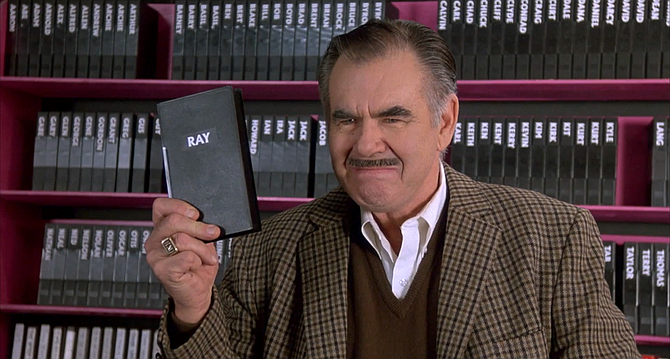
Russ Meyer. Enough said.
VIDEOHEAVEN (2025) Written, Directed & Produced by Alex Ross Perry / Editor: Clyde Folley / Narrator: Maya Hawke / Distributor: Cinema Conservancy / USA / Documentary / Length: 173
Exhaustive to the point of occasional long-windedness — an inevitability in a film such as this with a three-hour running time — Videoheaven analyzes the 40-year history of home video rental through an array of clips from films that featured scenes staged in and around video stores. No talking heads, no reminiscences from survivors of the era, and precious little in the way of commercials and television reports. (Original Entertainment Tonight anchor Ron Hendren dropping $800 on a VCR was a sentimental highlight.) The narration, at times cold and dispassionate, sounds like it was directly lifted from writer and director Alex Ross Perry’s doctoral thesis. But what a subject!
Video:
Trailer: VIDEO HEAVEN
There was a time when video was everywhere, with such unlikely outlets as convenience stores and grocery outlets apportioning half-an-aisle to rentals. An all-night Marathon gas station in my neighborhood hired an enterprising third-shift manager who sold bootleg VHS dubs of laserdiscs for $5 a pop, no questions asked. It was a revolution that began in the late '70s and hung on until the 2010’s, when streaming really began its sound pummeling of physical media.
One attribute Videoheaven tries hard to make stick is the element of danger associated with video stores. There was a long run before family-friendly Blockbuster arrived on the scene and did for rental outlets what Chuck E. Cheese did for pizzerias. Many video stores were kept afloat by X-rated rentals, and the film devotes a section to “the back room” behind the curtain where the adult films were sequestered. But in all these cases, the only element of real danger found among the stacks lay in the risk of taking home an unknown commodity.
For all the academic window dressing, Perry is no duffer when it comes to slumming, as witnessed by his borderline violently insane devotion to Troma and the infernal regions of cinema upon which it left its muddy fingerprints. Championing the studio’s subversive nature by pointing out that its posters adorn the walls of a video store in Toxic Avenger 3 is a bit of a reach — at best, it's a cheap throwaway gag, and given the relative anonymity of the product, it's barely even that.
There are moments when Perry’s insights are too hip for the room. The first onscreen video store to offer a direct link with pornography showed up in Brian de Palma's Body Double. When Craig Wasson asks if the film he's looking to rent is on VHS, the stoned clerk replies, “Yeah… VHS, whatever you want. Half inch, 3/4, Beta.” Instead of viewing it as a laconic one-liner from a bored, jaded clerk, Perry argues that the video store is “seen as an archive of unfathomable death, as evidenced by the knowledgeable clerk offering that they must have the film in several, albeit historically improbable and unlikely formats.” Maybe, maybe not. Maybe it was just a joke: a video rental employee could be high enough to forget his mother's maiden name, but he would still possess complete mastery of all video formats and aspect ratios.
Remnants of movie theaters still live on in the form of banks and other storefronts. The short duration of the video store as an actual place has culminated in its total absence. As Perry painstakingly points out, the only way to see a video store is by watching old movies. ****
Now playing at the Digital Gym.
Here's something you might be interested in.
Now playing: VIDEOHEAVEN (2025)
Remnants of movie theatres live on but the only way to see a video store is by watching old movies.

Now playing: VIDEOHEAVEN (2025)
Remnants of movie theatres live on but the only way to see a video store is by watching old movies.
Russ Meyer. Enough said.
VIDEOHEAVEN (2025) Written, Directed & Produced by Alex Ross Perry / Editor: Clyde Folley / Narrator: Maya Hawke / Distributor: Cinema Conservancy / USA / Documentary / Length: 173
Exhaustive to the point of occasional long-windedness — an inevitability in a film such as this with a three-hour running time — Videoheaven analyzes the 40-year history of home video rental through an array of clips from films that featured scenes staged in and around video stores. No talking heads, no reminiscences from survivors of the era, and precious little in the way of commercials and television reports. (Original Entertainment Tonight anchor Ron Hendren dropping $800 on a VCR was a sentimental highlight.) The narration, at times cold and dispassionate, sounds like it was directly lifted from writer and director Alex Ross Perry’s doctoral thesis. But what a subject!
Video:
Trailer: VIDEO HEAVEN
There was a time when video was everywhere, with such unlikely outlets as convenience stores and grocery outlets apportioning half-an-aisle to rentals. An all-night Marathon gas station in my neighborhood hired an enterprising third-shift manager who sold bootleg VHS dubs of laserdiscs for $5 a pop, no questions asked. It was a revolution that began in the late '70s and hung on until the 2010’s, when streaming really began its sound pummeling of physical media.
One attribute Videoheaven tries hard to make stick is the element of danger associated with video stores. There was a long run before family-friendly Blockbuster arrived on the scene and did for rental outlets what Chuck E. Cheese did for pizzerias. Many video stores were kept afloat by X-rated rentals, and the film devotes a section to “the back room” behind the curtain where the adult films were sequestered. But in all these cases, the only element of real danger found among the stacks lay in the risk of taking home an unknown commodity.
For all the academic window dressing, Perry is no duffer when it comes to slumming, as witnessed by his borderline violently insane devotion to Troma and the infernal regions of cinema upon which it left its muddy fingerprints. Championing the studio’s subversive nature by pointing out that its posters adorn the walls of a video store in Toxic Avenger 3 is a bit of a reach — at best, it's a cheap throwaway gag, and given the relative anonymity of the product, it's barely even that.
There are moments when Perry’s insights are too hip for the room. The first onscreen video store to offer a direct link with pornography showed up in Brian de Palma's Body Double. When Craig Wasson asks if the film he's looking to rent is on VHS, the stoned clerk replies, “Yeah… VHS, whatever you want. Half inch, 3/4, Beta.” Instead of viewing it as a laconic one-liner from a bored, jaded clerk, Perry argues that the video store is “seen as an archive of unfathomable death, as evidenced by the knowledgeable clerk offering that they must have the film in several, albeit historically improbable and unlikely formats.” Maybe, maybe not. Maybe it was just a joke: a video rental employee could be high enough to forget his mother's maiden name, but he would still possess complete mastery of all video formats and aspect ratios.
Remnants of movie theaters still live on in the form of banks and other storefronts. The short duration of the video store as an actual place has culminated in its total absence. As Perry painstakingly points out, the only way to see a video store is by watching old movies. ****
Now playing at the Digital Gym.