

Here's something you might be interested in.
Ask a Hipster — Advice you didn't know you needed
Big Screen — Movie commentary
Blurt — Music's inside track
Booze News — San Diego spirits
Classical Music — Immortal beauty
Classifieds — Free and easy
Close to Home — What it’s like on the street where you live
Cover Stories — Front-page features
Drinks All Around — Bartenders' drink recipes
Excerpts — Literary and spiritual excerpts
Feast! — Food & drink reviews
Feature Stories — Local news & stories
Fishing Report — What’s getting hooked from ship and shore
From the Archives — Spotlight on the past
Golden Dreams — Talk of the town
The Gonzo Report — Making the musical scene, or at least reporting from it
Letters — Our inbox
Movies@Home — Local movie buffs share favorites
Movie Reviews — Our critics' picks and pans
Musician Interviews — Up close with local artists
Neighborhood News from Stringers — Hyperlocal news
News Ticker — News & politics
Obermeyer — San Diego politics illustrated
Outdoors — Weekly changes in flora and fauna
Overheard in San Diego — Eavesdropping illustrated
Poetry — The old and the new
Reader Travel — Travel section built by travelers
Reading — The hunt for intellectuals
Roam-O-Rama — SoCal's best hiking/biking trails
San Diego Beer — Inside San Diego suds
SD on the QT — Almost factual news
Sheep and Goats — Places of worship
Special Issues — The best of
Street Style — San Diego streets have style
Surf Diego — Real stories from those braving the waves
Theater — On stage in San Diego this week
Tin Fork — Silver spoon alternative
Under the Radar — Matt Potter's undercover work
Unforgettable — Long-ago San Diego
Unreal Estate — San Diego's priciest pads
Your Week — Daily event picks
Now playing: THE LONG WALK (2025)
An exercise in counting backwards from 50 to 1.
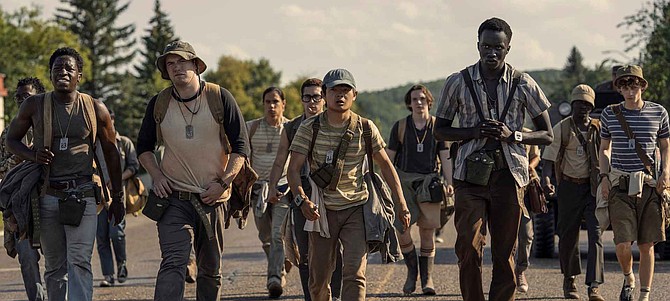
THE LONG WALK (2025) Francis Lawrence / Screenplay: JT Mollner based on the novel by Stephen King / Cinematographer: Jo Willems (2.35 : 1) / Design: Nicolas Lepage / Editors: Peggy Eghbalian & Mark Yoshikawa / Composer: Jeremiah Fraites / Acted by: Cooper Hoffman, David Jonsson, Tut Nyuot, Charlie Plummer, Garrett Wareing, Ben Wang, Mark Hamill, Josh Hamilton, Joshua Odjick, and Judy Greer as the only hen in the bantam house / USA / Distributor: Lionsgate / Rated R / Length: 108 mins.
Stephen King takes us on a long walk off a short premise in what may be the most compelling defense yet for banning women from competing in male sports. From the looks of things, a mother is dropping off her draftee son at an induction center, not a check-in station where contestants on a suicidal game show have a 1 in 50 chance of survival let alone victory. Think They Shoot Horses, Don’t They? with heel-and-toeing (and live ammo) replacing marathon dancing. The titular trek consists of fifty male volunteers, chosen through a lottery, who must walk at a pace of 3 mph, with the last man standing on the receiving end of unimaginable riches and the granting of a single wish. Losing contestants receive a death-parting gift by way of a bullet in the head. How does one come to know all this? The high-concept, brazenly lean premise is lazily doled out via car radio.
The participants start in rows of five, flanked by two tanks on either side and one behind. The Major (Mark Hamill, riotously riffing on George C. Scott’s Patton) growls out the rules of engagement, disclosing the number of warnings it will take before one of the soldiers takes you out. On the plus-side, the camera neither rests nor resorts to going tripod-free; there hasn’t been this much coverage of guys pointlessly walking around since Gus Van Sant’s Gerry. The downside of this is a repetitively unimaginative body count. The story feels more suited for the 60-minute trappings of commercial television; there’s not enough in the way of character development, edgy dialogue, or narrative complexity to justify a feature. With just a 2% probability of winning, what kind of man would literally put his life on the line for a promise of riches? We need to get to know, and fully understand, at least three or four characters to make it work. In their absence, it’s just an exercise in counting backwards from 50 to 1.
The question arises at every turn: what’s the point of this game? Who’s behind it? The players are all volunteers, not expendable prisoners with parole dangling as inducement, a la Con-Air. Are there millions to be reaped by packaging the event as a pay-per-view? By the end, sentimentality takes hold: contestants blubber and come to the aid of their fellow walkers. A designated loser sums up the event as, “One winner and no finish line.” But if that were the case, why the mob scene at the precise time and point the second-to-the-last-man standing falls and a winner is declared?
Francis Lawrence directs with the same degree of anonymity that made The Hunger Games such a box office smash. *
Trailer: THE LONG WALK
Here's something you might be interested in.
Now playing: THE LONG WALK (2025)
An exercise in counting backwards from 50 to 1.

Now playing: THE LONG WALK (2025)
An exercise in counting backwards from 50 to 1.
THE LONG WALK (2025) Francis Lawrence / Screenplay: JT Mollner based on the novel by Stephen King / Cinematographer: Jo Willems (2.35 : 1) / Design: Nicolas Lepage / Editors: Peggy Eghbalian & Mark Yoshikawa / Composer: Jeremiah Fraites / Acted by: Cooper Hoffman, David Jonsson, Tut Nyuot, Charlie Plummer, Garrett Wareing, Ben Wang, Mark Hamill, Josh Hamilton, Joshua Odjick, and Judy Greer as the only hen in the bantam house / USA / Distributor: Lionsgate / Rated R / Length: 108 mins.
Stephen King takes us on a long walk off a short premise in what may be the most compelling defense yet for banning women from competing in male sports. From the looks of things, a mother is dropping off her draftee son at an induction center, not a check-in station where contestants on a suicidal game show have a 1 in 50 chance of survival let alone victory. Think They Shoot Horses, Don’t They? with heel-and-toeing (and live ammo) replacing marathon dancing. The titular trek consists of fifty male volunteers, chosen through a lottery, who must walk at a pace of 3 mph, with the last man standing on the receiving end of unimaginable riches and the granting of a single wish. Losing contestants receive a death-parting gift by way of a bullet in the head. How does one come to know all this? The high-concept, brazenly lean premise is lazily doled out via car radio.
The participants start in rows of five, flanked by two tanks on either side and one behind. The Major (Mark Hamill, riotously riffing on George C. Scott’s Patton) growls out the rules of engagement, disclosing the number of warnings it will take before one of the soldiers takes you out. On the plus-side, the camera neither rests nor resorts to going tripod-free; there hasn’t been this much coverage of guys pointlessly walking around since Gus Van Sant’s Gerry. The downside of this is a repetitively unimaginative body count. The story feels more suited for the 60-minute trappings of commercial television; there’s not enough in the way of character development, edgy dialogue, or narrative complexity to justify a feature. With just a 2% probability of winning, what kind of man would literally put his life on the line for a promise of riches? We need to get to know, and fully understand, at least three or four characters to make it work. In their absence, it’s just an exercise in counting backwards from 50 to 1.
The question arises at every turn: what’s the point of this game? Who’s behind it? The players are all volunteers, not expendable prisoners with parole dangling as inducement, a la Con-Air. Are there millions to be reaped by packaging the event as a pay-per-view? By the end, sentimentality takes hold: contestants blubber and come to the aid of their fellow walkers. A designated loser sums up the event as, “One winner and no finish line.” But if that were the case, why the mob scene at the precise time and point the second-to-the-last-man standing falls and a winner is declared?
Francis Lawrence directs with the same degree of anonymity that made The Hunger Games such a box office smash. *
Trailer: THE LONG WALK