

Here's something you might be interested in.
Ask a Hipster — Advice you didn't know you needed
Big Screen — Movie commentary
Blurt — Music's inside track
Booze News — San Diego spirits
Classical Music — Immortal beauty
Classifieds — Free and easy
Close to Home — What it’s like on the street where you live
Cover Stories — Front-page features
Drinks All Around — Bartenders' drink recipes
Excerpts — Literary and spiritual excerpts
Feast! — Food & drink reviews
Feature Stories — Local news & stories
Fishing Report — What’s getting hooked from ship and shore
From the Archives — Spotlight on the past
Golden Dreams — Talk of the town
The Gonzo Report — Making the musical scene, or at least reporting from it
Letters — Our inbox
Movies@Home — Local movie buffs share favorites
Movie Reviews — Our critics' picks and pans
Musician Interviews — Up close with local artists
Neighborhood News from Stringers — Hyperlocal news
News Ticker — News & politics
Obermeyer — San Diego politics illustrated
Outdoors — Weekly changes in flora and fauna
Overheard in San Diego — Eavesdropping illustrated
Poetry — The old and the new
Reader Travel — Travel section built by travelers
Reading — The hunt for intellectuals
Roam-O-Rama — SoCal's best hiking/biking trails
San Diego Beer — Inside San Diego suds
SD on the QT — Almost factual news
Sheep and Goats — Places of worship
Special Issues — The best of
Street Style — San Diego streets have style
Surf Diego — Real stories from those braving the waves
Theater — On stage in San Diego this week
Tin Fork — Silver spoon alternative
Under the Radar — Matt Potter's undercover work
Unforgettable — Long-ago San Diego
Unreal Estate — San Diego's priciest pads
Your Week — Daily event picks
Now Playing: THE SOUND OF MUSIC (1965)
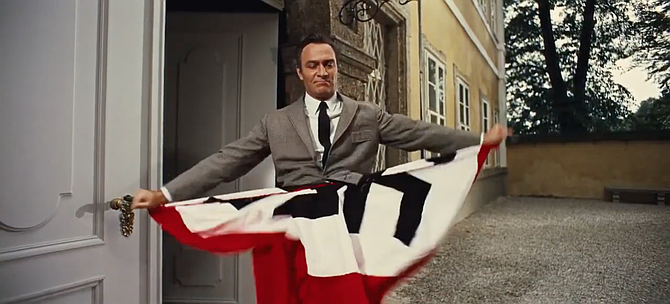
Maria’s advice on how to break up with a Nazi: “Cry a little and wait for the sun to come out. It always does.” In moments like this, one seriously considered cheering on the opposition.
One of my favorite things.
THE SOUND OF MUSIC (1965) Robert Wise / Screenplay: Ernest Lehman from the stage musical by Howard Lindsay & Russel Crouse, Maria Von Trapp's autobiography, and with the partial use of ideas by George Hurdalek / Cinematographer: Ted McCord (2.00 : 1) / Design: Boris Leven / Editor: William Reynolds / Composer: Richard Rodgers / Lyricist: Oscar Hammerstein / Acted by: Julie Andrews, Christopher Plummer, Eleanor Parker, Richard Haydn, Charmian Carr, Peggy Wood, Heather Menzies, Nicholas Hammond, Daniel Truhitte, Ben Wright, Angela Cartwright, Duane Chase, Kym Karath, and not enough Norma Varden! / USA / Rated G / Length: 172 mins.
Let’s start at the very beginning. The Sound of Music marked the first legitimate theatre production my mom took me to. I was eight, so don’t expect any wispy childhood reminiscences from a show that, other than the score (particularly the instantly learnable "Do Re Mi") left little impression. The Chicago premiere of the film adaptation was another matter. It opened at the eponymous Michael Todd Theatre, one of two remodels bought by the flamboyant showman (and Liz Taylor’s third husband) to showcase roadshow presentations of films shot in the splendor of his Todd-AO, a wide-gauge 70 mm process. For that, it's easy to dust off the memories: a giant screen, focus so sharp as to give the illusion of gazing through a massive picture window, waterfall curtains, and a sound system that made Uncle Jerry’s prized Zenith wooden console stereo sound like a transistor radio earpiece.
Pauline Kael dubbed it The Sound of Money. None other than the film’s star, Christopher Plummer, famously gnawed the hand that fed him, calling it The Sound of Mucus. (Oddly enough, Plummer was given creative free rein to rewrite the role as he saw fit.) Right on both counts: 20th Century Fox would have gone bankrupt were it not for the tremendous — if not overnight — success of the film. According to producer Richard Zanuck, the picture opened soft. Momentum kept building; it was word of mouth and repeat business that helped to put it over the top. This was before home video; one couldn't simply hit rewind and start the film all over again. An effort had to be made; a ticket had to be ripped. Four-and-a-half years separated the premiere from the day it sputtered out of steam on the bottom half of a drive-in double feature, the print containing so many vertical black scratches that it looked to have been shot through prison bars.
Video:
Trailer: THE SOUND OF MUSIC
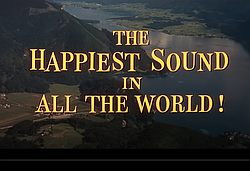
The 70 mm format was originally designed to bring audiences in by exploiting the one thing movies had over television: size. That accounts for the opening series of aerial shots, all designed to show off the scope and grandeur of nature. When someone at the Chicago International Film Festival asked director Wise why he chose to open The Sound of Music with the same style of aerial photography that he used in his previous film, West Side Story, he replied, “Because I felt like it.” But in a later interview with Julia Antopol Hirsch, Wise credited Ernest Lehman, who had scripted WSS for Wise, with the idea of opening from above, looking down on the grandeur of Salzburg in its final golden days of the '30s before caving in to Hitler. Wise couldn't come up with anything better and used it.
From afar, there doesn’t appear to be anything alive in them thar hills — just one majestic face-of-God shot after another. Perhaps overpowered by the grandeur of the natural location work, the viewer never stops to question how in hell Maria (Julie Andrews) got there. And how do you solve a problem like a director shorn of visual style and shooting in 70 mm? Robert Wise's staging doesn't live up to his last name; flat horizontal compositions add nothing in the way of depth. The exteriors are gorgeous, and given the surroundings, there's no such thing as a bad angle. But once inside the Abbey, it's reverse angles with three people on either side. Even on Broadway, staging like that would be called contrived.
The first rule of the Von Trapp family house is discipline. The Captain may profess to hate Hitler, but when he blows a boson's whistle to assemble his brood, it sounds like the Third Reich is calling. Governess Maria first stands up to the captain by refusing to answer to a whistle. Based on the way the Captain treats the children, Berlin will later offer him a commission in their Navy.
Wise must have been a delight to work with, particularly for the younger cast members. “They got a little loose a few times,” he recalled in a making-of doc, “and I had to sit them down and say it's not all fun and games here… you're over here to do the picture, it's work. I want you to shape up, behave and obey and not get out of hand, or I'll get your folks after you.” This is the way he remembers it years after the shoot. One wonders what was really said to those kids that made them want to flee the set.
At the time of production, both Andrews and Plummer were relative unknowns. When it came time to cast the role of Baroness Elsa von Schräder, Maria’s rival for the Captain’s affections, they went with Eleanor Parker, an old-school actress imbued with movie-star recognizability. I actually felt sorry for the Baroness as a kid. Hell, I still do. She was engaged to the Captain, and the manner in which he threw her over for a chaste cherub continues to rattle me decades later.
The Baroness is not only a better dresser, she smokes and flaunts her abundance of inherited wealth to any man who will have her. She also doesn’t want to be a nun when she grows up. Julie Andrews echoed my concern, worrying “whether it would be very saccharine — because when you add the beautiful scenery of Austria, and you've got seven children and everything else, it's kind of gooey and icky, and nuns as well. It could get very saccharine.”
Instead of making it look like she's the one being blown off, the envious Baroness hits back with, “I really don't think you're the right man for me.” She was looking for someone who needed her desperately, or at least needed her money desperately. No sooner does he give her the heave ho than she packs her bags and splits for Vienna, never to be heard from again. The Captain, on the other hand, beats a hasty retreat to Maria’s door. The Baroness lets him go too easily, but in doing so, she earns the biggest laugh line in the picture by telling the virile Captain that even she knows “the little lady will never be a nun.”
Wise’s handling of Nazis was, at best, simple minded. Liesel (Charmian Carr) falls for Rolfe (Daniel Truhitte), a proud member of Das Hitlerjugend. (His role was the last to be cast.) Fittingly enough, it is he who throws out the first “Heil Hitler!” A stock goose-stepping Nazi bootlicker, Rolfe’s main function is, once he evolves, to sic the stormtroopers on his future in-laws.
Herr Zeller (Ben Wright) first turns up at a lavish party thrown in honor of the Baroness to give the opulent Von Trapp family digs the once over, starting with the Austrian flag. A stereotypical “kraut” — even though we never see Zeller adorned in Nazi finery, Wright had the role of shifty-eyed weasel down to a science. He rats out the Von Trapp house to the Gestapo as the only one in the neighborhood not flying the flag of the fatherland — or, as precocious little Gretl (Kym Karath) calls it, “the flag with the black spider on it.” Maria’s advice on how to break up with a Nazi: “Cry a little and wait for the sun to come out. It always does.” In moments like this, one seriously considers cheering on the opposition. Still, Nazis are evil, not stupid. What kind of a Nazi would allow the Von Trapps to exit the stage, single-file, without having a stormtrooper waiting in the wings until they finished their song?
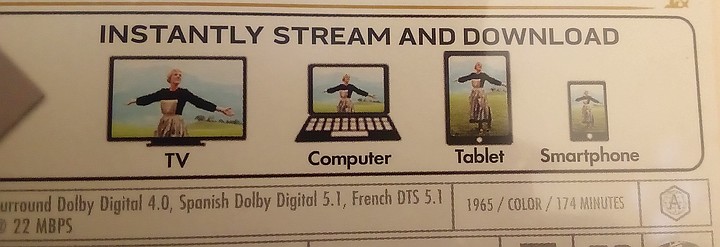
PIGS! DEFILERS! INFIDELS! WHY WOULD A STUDIO (FOX) ENCOURAGE AUDIENCES TO WATCH A MOVIE — ANY MOVIE, LET ALONE ONE SHOT IN 70mm — ON SOMETHING YOU CAN HOLD IN YOUR HAND? AND WHAT’S WITH THE F@#&NG VERTICAL ASPECT RATIO?! I DON'T CARE IF IT IS TSOM. NO FILM DESERVES THIS KIND OF DEBASEMENT.
My reasons for disliking the film have nothing to do with the performances or score — the former tolerable, the latter sublime — and everything to do with visual presentation. You’ll find more compositional tension in an Etch-A-Sketch than you do here. Why put all that time and effort into set dressing and costuming only to commit it to film in the least imaginative manner possible? In my college days, I inadvertently learned how not to make a movie from a one-eyed professor named Bob Edmunds, who taught lighting and film history at Columbia College in Chicago. In his book, Anthropology on Film, Edmunds dealt with the perils of shooting in widescreen in the era of pan-and-scan television. He encouraged budding filmmakers to shove all pertinent information in the center of the frame so it won't get lost in the netherworld cut-off of 4x3. The Sound of Music: From Fact to Phenomenon, an information-packed documentary found amid the blu-ray special features, hammers home my point. Produced in 1994, years before letterboxing became the rage, not one of the clips from the original is cropped. I defy you to find one shot that would lose any of its impact with the aid of the black bars.
You will have ample opportunities to see the 60th Anniversary presentation of a 4K remastered print, now playing at a theatre near you.
Here's something you might be interested in.
Now Playing: THE SOUND OF MUSIC (1965)
Maria’s advice on how to break up with a Nazi: “Cry a little and wait for the sun to come out. It always does.” In moments like this, one seriously considered cheering on the opposition.

Now Playing: THE SOUND OF MUSIC (1965)
Maria’s advice on how to break up with a Nazi: “Cry a little and wait for the sun to come out. It always does.” In moments like this, one seriously considered cheering on the opposition.
One of my favorite things.
THE SOUND OF MUSIC (1965) Robert Wise / Screenplay: Ernest Lehman from the stage musical by Howard Lindsay & Russel Crouse, Maria Von Trapp's autobiography, and with the partial use of ideas by George Hurdalek / Cinematographer: Ted McCord (2.00 : 1) / Design: Boris Leven / Editor: William Reynolds / Composer: Richard Rodgers / Lyricist: Oscar Hammerstein / Acted by: Julie Andrews, Christopher Plummer, Eleanor Parker, Richard Haydn, Charmian Carr, Peggy Wood, Heather Menzies, Nicholas Hammond, Daniel Truhitte, Ben Wright, Angela Cartwright, Duane Chase, Kym Karath, and not enough Norma Varden! / USA / Rated G / Length: 172 mins.
Let’s start at the very beginning. The Sound of Music marked the first legitimate theatre production my mom took me to. I was eight, so don’t expect any wispy childhood reminiscences from a show that, other than the score (particularly the instantly learnable "Do Re Mi") left little impression. The Chicago premiere of the film adaptation was another matter. It opened at the eponymous Michael Todd Theatre, one of two remodels bought by the flamboyant showman (and Liz Taylor’s third husband) to showcase roadshow presentations of films shot in the splendor of his Todd-AO, a wide-gauge 70 mm process. For that, it's easy to dust off the memories: a giant screen, focus so sharp as to give the illusion of gazing through a massive picture window, waterfall curtains, and a sound system that made Uncle Jerry’s prized Zenith wooden console stereo sound like a transistor radio earpiece.
Pauline Kael dubbed it The Sound of Money. None other than the film’s star, Christopher Plummer, famously gnawed the hand that fed him, calling it The Sound of Mucus. (Oddly enough, Plummer was given creative free rein to rewrite the role as he saw fit.) Right on both counts: 20th Century Fox would have gone bankrupt were it not for the tremendous — if not overnight — success of the film. According to producer Richard Zanuck, the picture opened soft. Momentum kept building; it was word of mouth and repeat business that helped to put it over the top. This was before home video; one couldn't simply hit rewind and start the film all over again. An effort had to be made; a ticket had to be ripped. Four-and-a-half years separated the premiere from the day it sputtered out of steam on the bottom half of a drive-in double feature, the print containing so many vertical black scratches that it looked to have been shot through prison bars.
Video:
Trailer: THE SOUND OF MUSIC
The 70 mm format was originally designed to bring audiences in by exploiting the one thing movies had over television: size. That accounts for the opening series of aerial shots, all designed to show off the scope and grandeur of nature. When someone at the Chicago International Film Festival asked director Wise why he chose to open The Sound of Music with the same style of aerial photography that he used in his previous film, West Side Story, he replied, “Because I felt like it.” But in a later interview with Julia Antopol Hirsch, Wise credited Ernest Lehman, who had scripted WSS for Wise, with the idea of opening from above, looking down on the grandeur of Salzburg in its final golden days of the '30s before caving in to Hitler. Wise couldn't come up with anything better and used it.
From afar, there doesn’t appear to be anything alive in them thar hills — just one majestic face-of-God shot after another. Perhaps overpowered by the grandeur of the natural location work, the viewer never stops to question how in hell Maria (Julie Andrews) got there. And how do you solve a problem like a director shorn of visual style and shooting in 70 mm? Robert Wise's staging doesn't live up to his last name; flat horizontal compositions add nothing in the way of depth. The exteriors are gorgeous, and given the surroundings, there's no such thing as a bad angle. But once inside the Abbey, it's reverse angles with three people on either side. Even on Broadway, staging like that would be called contrived.
The first rule of the Von Trapp family house is discipline. The Captain may profess to hate Hitler, but when he blows a boson's whistle to assemble his brood, it sounds like the Third Reich is calling. Governess Maria first stands up to the captain by refusing to answer to a whistle. Based on the way the Captain treats the children, Berlin will later offer him a commission in their Navy.
Wise must have been a delight to work with, particularly for the younger cast members. “They got a little loose a few times,” he recalled in a making-of doc, “and I had to sit them down and say it's not all fun and games here… you're over here to do the picture, it's work. I want you to shape up, behave and obey and not get out of hand, or I'll get your folks after you.” This is the way he remembers it years after the shoot. One wonders what was really said to those kids that made them want to flee the set.
At the time of production, both Andrews and Plummer were relative unknowns. When it came time to cast the role of Baroness Elsa von Schräder, Maria’s rival for the Captain’s affections, they went with Eleanor Parker, an old-school actress imbued with movie-star recognizability. I actually felt sorry for the Baroness as a kid. Hell, I still do. She was engaged to the Captain, and the manner in which he threw her over for a chaste cherub continues to rattle me decades later.
The Baroness is not only a better dresser, she smokes and flaunts her abundance of inherited wealth to any man who will have her. She also doesn’t want to be a nun when she grows up. Julie Andrews echoed my concern, worrying “whether it would be very saccharine — because when you add the beautiful scenery of Austria, and you've got seven children and everything else, it's kind of gooey and icky, and nuns as well. It could get very saccharine.”
Instead of making it look like she's the one being blown off, the envious Baroness hits back with, “I really don't think you're the right man for me.” She was looking for someone who needed her desperately, or at least needed her money desperately. No sooner does he give her the heave ho than she packs her bags and splits for Vienna, never to be heard from again. The Captain, on the other hand, beats a hasty retreat to Maria’s door. The Baroness lets him go too easily, but in doing so, she earns the biggest laugh line in the picture by telling the virile Captain that even she knows “the little lady will never be a nun.”
Wise’s handling of Nazis was, at best, simple minded. Liesel (Charmian Carr) falls for Rolfe (Daniel Truhitte), a proud member of Das Hitlerjugend. (His role was the last to be cast.) Fittingly enough, it is he who throws out the first “Heil Hitler!” A stock goose-stepping Nazi bootlicker, Rolfe’s main function is, once he evolves, to sic the stormtroopers on his future in-laws.
Herr Zeller (Ben Wright) first turns up at a lavish party thrown in honor of the Baroness to give the opulent Von Trapp family digs the once over, starting with the Austrian flag. A stereotypical “kraut” — even though we never see Zeller adorned in Nazi finery, Wright had the role of shifty-eyed weasel down to a science. He rats out the Von Trapp house to the Gestapo as the only one in the neighborhood not flying the flag of the fatherland — or, as precocious little Gretl (Kym Karath) calls it, “the flag with the black spider on it.” Maria’s advice on how to break up with a Nazi: “Cry a little and wait for the sun to come out. It always does.” In moments like this, one seriously considers cheering on the opposition. Still, Nazis are evil, not stupid. What kind of a Nazi would allow the Von Trapps to exit the stage, single-file, without having a stormtrooper waiting in the wings until they finished their song?
PIGS! DEFILERS! INFIDELS! WHY WOULD A STUDIO (FOX) ENCOURAGE AUDIENCES TO WATCH A MOVIE — ANY MOVIE, LET ALONE ONE SHOT IN 70mm — ON SOMETHING YOU CAN HOLD IN YOUR HAND? AND WHAT’S WITH THE F@#&NG VERTICAL ASPECT RATIO?! I DON'T CARE IF IT IS TSOM. NO FILM DESERVES THIS KIND OF DEBASEMENT.
My reasons for disliking the film have nothing to do with the performances or score — the former tolerable, the latter sublime — and everything to do with visual presentation. You’ll find more compositional tension in an Etch-A-Sketch than you do here. Why put all that time and effort into set dressing and costuming only to commit it to film in the least imaginative manner possible? In my college days, I inadvertently learned how not to make a movie from a one-eyed professor named Bob Edmunds, who taught lighting and film history at Columbia College in Chicago. In his book, Anthropology on Film, Edmunds dealt with the perils of shooting in widescreen in the era of pan-and-scan television. He encouraged budding filmmakers to shove all pertinent information in the center of the frame so it won't get lost in the netherworld cut-off of 4x3. The Sound of Music: From Fact to Phenomenon, an information-packed documentary found amid the blu-ray special features, hammers home my point. Produced in 1994, years before letterboxing became the rage, not one of the clips from the original is cropped. I defy you to find one shot that would lose any of its impact with the aid of the black bars.
You will have ample opportunities to see the 60th Anniversary presentation of a 4K remastered print, now playing at a theatre near you.