

Here's something you might be interested in.
Ask a Hipster — Advice you didn't know you needed
Big Screen — Movie commentary
Blurt — Music's inside track
Booze News — San Diego spirits
Classical Music — Immortal beauty
Classifieds — Free and easy
Close to Home — What it’s like on the street where you live
Cover Stories — Front-page features
Drinks All Around — Bartenders' drink recipes
Excerpts — Literary and spiritual excerpts
Feast! — Food & drink reviews
Feature Stories — Local news & stories
Fishing Report — What’s getting hooked from ship and shore
From the Archives — Spotlight on the past
Golden Dreams — Talk of the town
The Gonzo Report — Making the musical scene, or at least reporting from it
Letters — Our inbox
Movies@Home — Local movie buffs share favorites
Movie Reviews — Our critics' picks and pans
Musician Interviews — Up close with local artists
Neighborhood News from Stringers — Hyperlocal news
News Ticker — News & politics
Obermeyer — San Diego politics illustrated
Outdoors — Weekly changes in flora and fauna
Overheard in San Diego — Eavesdropping illustrated
Poetry — The old and the new
Reader Travel — Travel section built by travelers
Reading — The hunt for intellectuals
Roam-O-Rama — SoCal's best hiking/biking trails
San Diego Beer — Inside San Diego suds
SD on the QT — Almost factual news
Sheep and Goats — Places of worship
Special Issues — The best of
Street Style — San Diego streets have style
Surf Diego — Real stories from those braving the waves
Theater — On stage in San Diego this week
Tin Fork — Silver spoon alternative
Under the Radar — Matt Potter's undercover work
Unforgettable — Long-ago San Diego
Unreal Estate — San Diego's priciest pads
Your Week — Daily event picks
Spectacular Sensory Overload at San Diego Symphony
Tchaikovsky lineup was a lot to take in
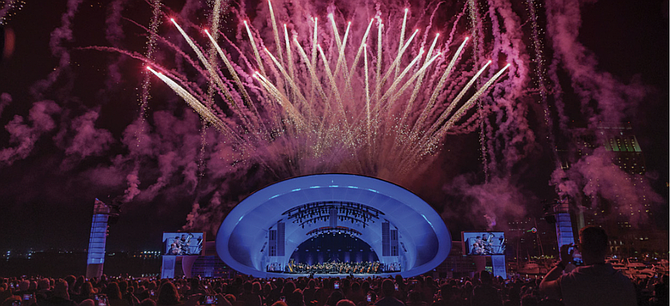
On Saturday, August 30, I went to my first Tchaikovsky Spectacular at the Rady Shell at Jacobs Park. The concert is the traditional conclusion of the San Diego Symphony’s summer pops season. I have eschewed this event in the past due to a guilty conscience. Every serious classical music fan loves Tchaikovsky, but none of us wants to admit it. He is the guilty pleasure we all want to hide.
I knew I wouldn’t be able to look at myself in the mirror for days without turning away in disgust, but I went anyway. Happily, my self-loathing quickly turned to dancing as the orchestra launched into the “Polonaise” from Tchaikovsky’s Eugene Onegin. The famous “Waltz” from the same opera followed, and the trio of Onegin pieces finished with the “Ecossaise”.
Tchaikovsky’s ridiculously famous Romeo and Juliet Overture-Fantasy was next. It is easy to forget just how hard this piece hits in live performance. The orchestra strikes during Romeo’s rage were thunderous as the brass blasted their way through the duel with Tybalt. The strings had their moment as the ecstatic love theme returned in all its glory as the lovers were united before Romeo drinks the poison and Juliet turns to the dagger.
Video:
Tchaikovsky: Romeo and Juliet
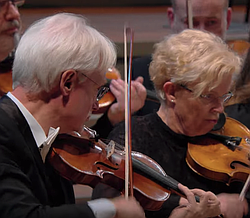
After the intermission, things ground to a halt with Frédéric Chopin’s Piano Concerto No. 1. The piece was well-performed by Juilliard undergraduate Kirov Anton Tellian, but felt out of place with the general energy of the rest of the concert. Chopin is a masterful composer — for the piano. As the orchestra meandered through the lengthy opening of the concerto, I found myself urging Chopin to get to the point and let the piano take over the show. The non-stop dramatic energy of Tchaikovsky had set my aural palette to an 11, and Chopin was coming in at about a three.
I must emphasize that this wasn’t because of the performance. Tellian’s performance was right in line with what I would expect from a world-class pianist. In fact, I wouldn’t be surprised if he was swept onto the world’s stage before he finishes his degree.
The concert concluded with Tchaikovsky’s 1812 Overture Solennelle. As was the case with Romeo and Juliet, this piece hits hard when experienced live. The 1812 Overture depicts the battle of Borodino, in which Napoleon defeated the Russians before being defeated, himself, by the Russian winter. As the music rushed toward its epic conclusion, fireworks replaced the canons that Tchaikovsky originally placed within the score.
The entire audience scrambled for their phones in order to document the spectacular display. It was a lot to take in. In fact, I’d say it was sensory overload. However, it was sensory overload at its absolute best.
Here's something you might be interested in.
Spectacular Sensory Overload at San Diego Symphony
Tchaikovsky lineup was a lot to take in

Spectacular Sensory Overload at San Diego Symphony
Tchaikovsky lineup was a lot to take in
On Saturday, August 30, I went to my first Tchaikovsky Spectacular at the Rady Shell at Jacobs Park. The concert is the traditional conclusion of the San Diego Symphony’s summer pops season. I have eschewed this event in the past due to a guilty conscience. Every serious classical music fan loves Tchaikovsky, but none of us wants to admit it. He is the guilty pleasure we all want to hide.
I knew I wouldn’t be able to look at myself in the mirror for days without turning away in disgust, but I went anyway. Happily, my self-loathing quickly turned to dancing as the orchestra launched into the “Polonaise” from Tchaikovsky’s Eugene Onegin. The famous “Waltz” from the same opera followed, and the trio of Onegin pieces finished with the “Ecossaise”.
Tchaikovsky’s ridiculously famous Romeo and Juliet Overture-Fantasy was next. It is easy to forget just how hard this piece hits in live performance. The orchestra strikes during Romeo’s rage were thunderous as the brass blasted their way through the duel with Tybalt. The strings had their moment as the ecstatic love theme returned in all its glory as the lovers were united before Romeo drinks the poison and Juliet turns to the dagger.
Video:
Tchaikovsky: Romeo and Juliet
After the intermission, things ground to a halt with Frédéric Chopin’s Piano Concerto No. 1. The piece was well-performed by Juilliard undergraduate Kirov Anton Tellian, but felt out of place with the general energy of the rest of the concert. Chopin is a masterful composer — for the piano. As the orchestra meandered through the lengthy opening of the concerto, I found myself urging Chopin to get to the point and let the piano take over the show. The non-stop dramatic energy of Tchaikovsky had set my aural palette to an 11, and Chopin was coming in at about a three.
I must emphasize that this wasn’t because of the performance. Tellian’s performance was right in line with what I would expect from a world-class pianist. In fact, I wouldn’t be surprised if he was swept onto the world’s stage before he finishes his degree.
The concert concluded with Tchaikovsky’s 1812 Overture Solennelle. As was the case with Romeo and Juliet, this piece hits hard when experienced live. The 1812 Overture depicts the battle of Borodino, in which Napoleon defeated the Russians before being defeated, himself, by the Russian winter. As the music rushed toward its epic conclusion, fireworks replaced the canons that Tchaikovsky originally placed within the score.
The entire audience scrambled for their phones in order to document the spectacular display. It was a lot to take in. In fact, I’d say it was sensory overload. However, it was sensory overload at its absolute best.
Comments