

Here's something you might be interested in.
Ask a Hipster — Advice you didn't know you needed
Big Screen — Movie commentary
Blurt — Music's inside track
Booze News — San Diego spirits
Classical Music — Immortal beauty
Classifieds — Free and easy
Close to Home — What it’s like on the street where you live
Cover Stories — Front-page features
Drinks All Around — Bartenders' drink recipes
Excerpts — Literary and spiritual excerpts
Feast! — Food & drink reviews
Feature Stories — Local news & stories
Fishing Report — What’s getting hooked from ship and shore
From the Archives — Spotlight on the past
Golden Dreams — Talk of the town
The Gonzo Report — Making the musical scene, or at least reporting from it
Letters — Our inbox
Movies@Home — Local movie buffs share favorites
Movie Reviews — Our critics' picks and pans
Musician Interviews — Up close with local artists
Neighborhood News from Stringers — Hyperlocal news
News Ticker — News & politics
Obermeyer — San Diego politics illustrated
Outdoors — Weekly changes in flora and fauna
Overheard in San Diego — Eavesdropping illustrated
Poetry — The old and the new
Reader Travel — Travel section built by travelers
Reading — The hunt for intellectuals
Roam-O-Rama — SoCal's best hiking/biking trails
San Diego Beer — Inside San Diego suds
SD on the QT — Almost factual news
Sheep and Goats — Places of worship
Special Issues — The best of
Street Style — San Diego streets have style
Surf Diego — Real stories from those braving the waves
Theater — On stage in San Diego this week
Tin Fork — Silver spoon alternative
Under the Radar — Matt Potter's undercover work
Unforgettable — Long-ago San Diego
Unreal Estate — San Diego's priciest pads
Your Week — Daily event picks
Theater Review: Eisenhower: This Piece of Ground at North Coast Rep
A commanding, winning performance
For as long as I’ve been aware of politics, I’ve been aware of the progressive warning that this or that Republican politician “wants to take America back to the ‘50s” — that awful era of conformity and repression before abortion was legal, before the Civil Rights movement, before the anti-war protests against American military action overseas. Just a terrible, dark time. And you know who was president for most of it? Dwight D. Eisenhower. How bad was this guy from a progressive standpoint? He chose Nixon as his VP! Small wonder that when a team of historians published a ranking of American presidents in the New York Times Magazine in 1962, Eisenhower came in 22nd out of 35.
Except now, progressives have Trump to reckon with, and suddenly, maybe Eisenhower doesn’t seem so bad. Throughout John Rubinstein’s commanding performance in this one-man show, I kept thinking, “This is a progressive’s dream of a conservative.” Here are a few of the words and phrases I heard from the stage: service, dignity, understanding, integrity, moderation, self-discipline, “work for the common good,” “dialogue with mutual trust and respect,” duty, freedom, responsibility, “laws and not men are supreme,” peace, moral courage. Just the sort of person you would want on the other side of the aisle. It doesn’t matter that he deployed American troops on American soil, that he lied to the world about American covert activity, or that he bowed to party pressure and failed to defend his friend and mentor George C. Marshall against Joseph McCarthy’s allegations of communist sympathies while on McCarthy’s home turf in Wisconsin. Because he regrets those things, you see, while Trump regrets nothing.
Why mention Trump when discussing a play set in 1962? Because he looms large over the proceedings, and both the play and the audience know it. When Eisenhower tears into the isolationists who want to build a wall around America and be safe, the crowd nods. When he rails against General Douglas MacArthur’s egotism bordering on megalomania, the crowd murmurs. When he excoriates McCarthy’s obsession with loyalty to McCarthy, the crowd says “ah” in recognition. And when he hangs his head in shame and says that he doesn’t want to see troops in our streets ever again — that “it’s not our cities we need to conquer, it’s our souls, but that takes moral courage, and if you don’t have it…” — the crowd sighs with sympathy. (But at least Ike was trying to enforce desegregation!) Though he’s never mentioned, Trump provides a healthy measure of the drama.
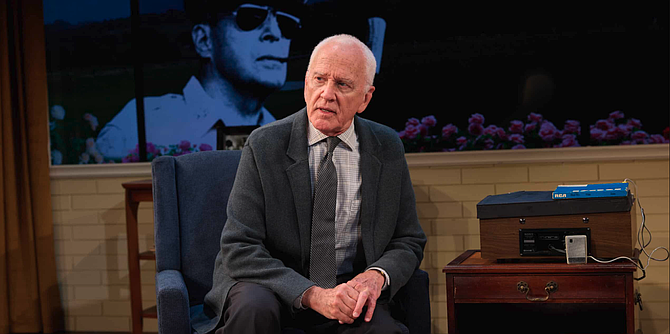
But this is a play — not a speech, not a history lesson, not even a biography. This is a meeting with Eisenhower the man. To that end, there’s a little bit of introductory irascibility — “What in hell?” “Damnation!” “For heaven’s sake!” — but the chief mechanisms here are a tape recorder and the aforementioned New York Times Magazine rankings. The retired general who launched D-Day and former President of the United States has been trying to write a book, and it turns out that an apologia pro vita sua contra the Times may be just the breakthrough he needs. (As with What the Constitution Means to Me, it helps when the actor is not simply speaking to the audience, even when alone onstage.)
I already used “commanding” to describe Rubinstein’s performance. I’ll add “winning.” He’s excellent at conveying the tamped-down frustration that goes along with his all-gray ‘50s ensemble. This is a man long accustomed to controlling himself and keeping his counsel, who is only now breaking his longstanding policy of never discussing personalities and never answering criticism directly. The floodgates are opened, but just a crack. Just enough for him to be able to discuss his hardscrabble childhood, his beloved parents, his military education and career, his family, and oh yes, a presidency that produced “peace, more or less, and prosperity, more or less.” Eisenhower is pricked by the charge that he is a great American, but not a great President, and spends the show wrestling with what the latter ought to mean. In the end, he lands somewhere near preferring goodness to greatness.
Here's something you might be interested in.
Theater Review: Eisenhower: This Piece of Ground at North Coast Rep
A commanding, winning performance

Theater Review: Eisenhower: This Piece of Ground at North Coast Rep
A commanding, winning performance
For as long as I’ve been aware of politics, I’ve been aware of the progressive warning that this or that Republican politician “wants to take America back to the ‘50s” — that awful era of conformity and repression before abortion was legal, before the Civil Rights movement, before the anti-war protests against American military action overseas. Just a terrible, dark time. And you know who was president for most of it? Dwight D. Eisenhower. How bad was this guy from a progressive standpoint? He chose Nixon as his VP! Small wonder that when a team of historians published a ranking of American presidents in the New York Times Magazine in 1962, Eisenhower came in 22nd out of 35.
Except now, progressives have Trump to reckon with, and suddenly, maybe Eisenhower doesn’t seem so bad. Throughout John Rubinstein’s commanding performance in this one-man show, I kept thinking, “This is a progressive’s dream of a conservative.” Here are a few of the words and phrases I heard from the stage: service, dignity, understanding, integrity, moderation, self-discipline, “work for the common good,” “dialogue with mutual trust and respect,” duty, freedom, responsibility, “laws and not men are supreme,” peace, moral courage. Just the sort of person you would want on the other side of the aisle. It doesn’t matter that he deployed American troops on American soil, that he lied to the world about American covert activity, or that he bowed to party pressure and failed to defend his friend and mentor George C. Marshall against Joseph McCarthy’s allegations of communist sympathies while on McCarthy’s home turf in Wisconsin. Because he regrets those things, you see, while Trump regrets nothing.
Why mention Trump when discussing a play set in 1962? Because he looms large over the proceedings, and both the play and the audience know it. When Eisenhower tears into the isolationists who want to build a wall around America and be safe, the crowd nods. When he rails against General Douglas MacArthur’s egotism bordering on megalomania, the crowd murmurs. When he excoriates McCarthy’s obsession with loyalty to McCarthy, the crowd says “ah” in recognition. And when he hangs his head in shame and says that he doesn’t want to see troops in our streets ever again — that “it’s not our cities we need to conquer, it’s our souls, but that takes moral courage, and if you don’t have it…” — the crowd sighs with sympathy. (But at least Ike was trying to enforce desegregation!) Though he’s never mentioned, Trump provides a healthy measure of the drama.
But this is a play — not a speech, not a history lesson, not even a biography. This is a meeting with Eisenhower the man. To that end, there’s a little bit of introductory irascibility — “What in hell?” “Damnation!” “For heaven’s sake!” — but the chief mechanisms here are a tape recorder and the aforementioned New York Times Magazine rankings. The retired general who launched D-Day and former President of the United States has been trying to write a book, and it turns out that an apologia pro vita sua contra the Times may be just the breakthrough he needs. (As with What the Constitution Means to Me, it helps when the actor is not simply speaking to the audience, even when alone onstage.)
I already used “commanding” to describe Rubinstein’s performance. I’ll add “winning.” He’s excellent at conveying the tamped-down frustration that goes along with his all-gray ‘50s ensemble. This is a man long accustomed to controlling himself and keeping his counsel, who is only now breaking his longstanding policy of never discussing personalities and never answering criticism directly. The floodgates are opened, but just a crack. Just enough for him to be able to discuss his hardscrabble childhood, his beloved parents, his military education and career, his family, and oh yes, a presidency that produced “peace, more or less, and prosperity, more or less.” Eisenhower is pricked by the charge that he is a great American, but not a great President, and spends the show wrestling with what the latter ought to mean. In the end, he lands somewhere near preferring goodness to greatness.
Comments