

Here's something you might be interested in.
Ask a Hipster — Advice you didn't know you needed
Big Screen — Movie commentary
Blurt — Music's inside track
Booze News — San Diego spirits
Classical Music — Immortal beauty
Classifieds — Free and easy
Close to Home — What it’s like on the street where you live
Cover Stories — Front-page features
Drinks All Around — Bartenders' drink recipes
Excerpts — Literary and spiritual excerpts
Feast! — Food & drink reviews
Feature Stories — Local news & stories
Fishing Report — What’s getting hooked from ship and shore
From the Archives — Spotlight on the past
Golden Dreams — Talk of the town
The Gonzo Report — Making the musical scene, or at least reporting from it
Letters — Our inbox
Movies@Home — Local movie buffs share favorites
Movie Reviews — Our critics' picks and pans
Musician Interviews — Up close with local artists
Neighborhood News from Stringers — Hyperlocal news
News Ticker — News & politics
Obermeyer — San Diego politics illustrated
Outdoors — Weekly changes in flora and fauna
Overheard in San Diego — Eavesdropping illustrated
Poetry — The old and the new
Reader Travel — Travel section built by travelers
Reading — The hunt for intellectuals
Roam-O-Rama — SoCal's best hiking/biking trails
San Diego Beer — Inside San Diego suds
SD on the QT — Almost factual news
Sheep and Goats — Places of worship
Special Issues — The best of
Street Style — San Diego streets have style
Surf Diego — Real stories from those braving the waves
Theater — On stage in San Diego this week
Tin Fork — Silver spoon alternative
Under the Radar — Matt Potter's undercover work
Unforgettable — Long-ago San Diego
Unreal Estate — San Diego's priciest pads
Your Week — Daily event picks
Ramen Station brings instant noodles to the Convoy District
Call it convenient or call it dystopian, at least there's beer
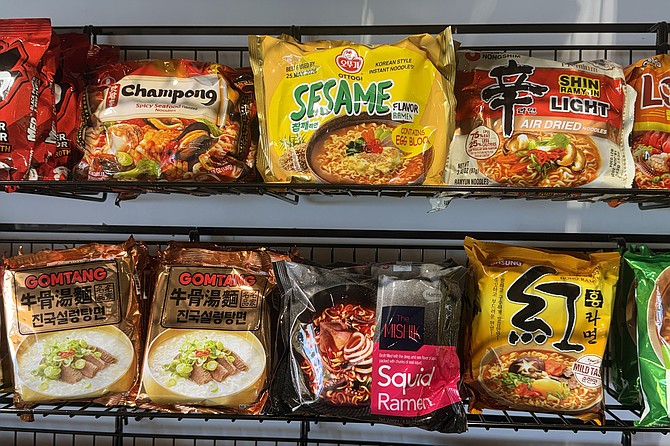
A small fraction of the instant noodle options at self-serve eatery, Ramen Station
Push the right buttons, add flavor packets, and stir.
That's basically all it takes at Ramen Station, the latest self-serve noodle place to open in greater San Diego. Walk through its doors and the first thing you see is a wall of instant noodle packs hailing from Japan, Korea, China, and Southeast Asia. Next is a cooler stocked with optional, add-on toppings; then a bevy of cooking stations, where customers may boil their own noodles.
This distinctive dining trend has arrived in the United States with the advent of a new generation of Korean ramen cookers. These dedicated appliances are set up to dispense precise amounts of water, heated to specific temperatures, with programmable timers that tell the user when the noodles are soft enough to eat. Set up a counter shop with a handful of these devices, and a decent selection of instant ramen noodles, and you're in business.
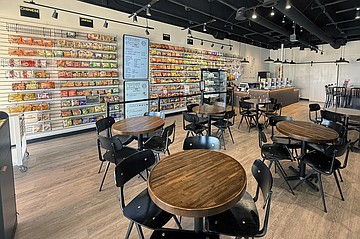
A new, make it yourself ramen shop in Convoy District
I don't know that the proliferation of such places has reached "craze" levels yet, but a Google News search shows plenty of them opening up in a number of American cities over the past two years, led by New York, Houston, and Los Angeles. But it's not just large cities getting in on the concept; in fact, self-serve ramen spots more commonly open in secondary cities, such as Temple Terrace, Florida; Wilmington, North Carolina; and State College, Pennsylvania.
As that last one suggests, what these smaller markets have in common is large populations of college students. The method of cooking ramen may have changed, but the target demographic hasn't. Ramen Station sits on Clairemont Mesa Boulevard in the Convoy District, but SDSU Aztec imagery is all over the shop, and the people filling the tables seem college-age.
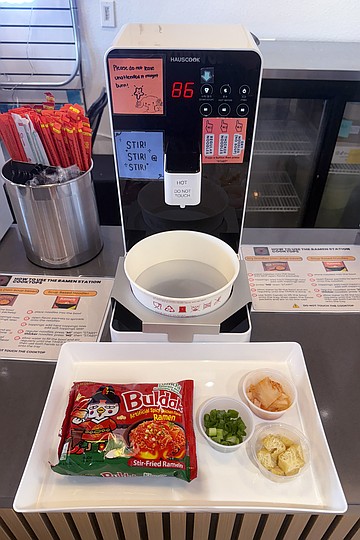
A new-fangled ramen cooker offers two-button cooking of three types of instant noodles: thin, thick, and dry
The bigger sign that times have changed is the price: $8 for a bowl of DIY instant noodles probably seems steep to those of us who recall buying 4-packs of Top Ramen at the supermarket for about a buck-twenty. But it makes perfect sense to me: inflation's choking the restaurant business as much as any other, the "guv'mint's" not making things any better, and despite all the promises AI companies have made to Americans of late, to my knowledge, not one has offered to spring for dinner.
So you can look at the matter in two ways: it's either really expensive self-serve ramen, or really inexpensive DIY restaurant fare. I prefer the latter; it sounds more sociable.
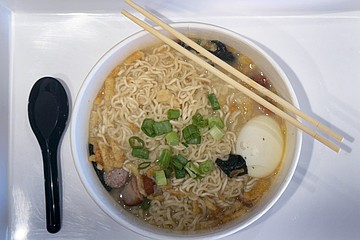
Add-on toppings include green onions, sliced sausage, and boiled egg
About that DIY: in the case of Ramen Station, I won't go so far as to claim that the operation has been streamlined entirely past the point of customer service. When I visited, the cashier proved both friendly and helpful — and certainly more conversant on the subject of off-the-shelf noodles than a local-beat restaurant writer. This particular DIY ramen shop offers relatively more staff support than others, thanks to its status as part of a multi-pronged business: it shares shopping strip space with the matcha green tea café Maiko.
More precisely: Maiko has been there for several years, and its owner recently took over the neighboring suite and knocked down the wall between them to form a loosely shared dining room. The prior tenant in Ramen Station's space was shoe store, and its rack system has been repurposed to display the likes of instant ramen, chow mein, masi goreng, and pho instead of the latest offerings from Nike, Addidas, and Buster Brown.
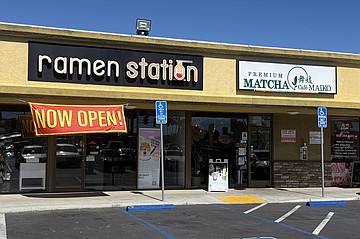
A dual storefront with plenty of youth appeal
Besides the knowledgeable staff, we know there must be some level of food prep somewhere along the line: at least the boiling eggs and chopping of green onions for the add-on toppings. The green onions are free, while the likes of boiled egg, fired tofu, grated cheese, kimchi, corn, and Kurobuta sausage cost a buck or two apiece.
But what really ties the room together, so to speak, is that Ramen Station's ownership overlaps with that of Miramar's Embolden Beer Co., and with the business's grand opening the first week of November, it will begin serving beer. Initially, Ramen Station will pour cans of Embolden's "east-meets-west" brand, Shogun, which embraces flavors associated with Asian products (yuzu, ube, matcha) in collaboration with Matcha Cafe Maiko. Eventually, owners hope to offer an expanded range — on tap.
True, a pint of beer here might double the price of dinner, but these days, who doesn't need a drink?
Here's something you might be interested in.
Ramen Station brings instant noodles to the Convoy District
Call it convenient or call it dystopian, at least there's beer

Ramen Station brings instant noodles to the Convoy District
Call it convenient or call it dystopian, at least there's beer
A small fraction of the instant noodle options at self-serve eatery, Ramen Station
Push the right buttons, add flavor packets, and stir.
That's basically all it takes at Ramen Station, the latest self-serve noodle place to open in greater San Diego. Walk through its doors and the first thing you see is a wall of instant noodle packs hailing from Japan, Korea, China, and Southeast Asia. Next is a cooler stocked with optional, add-on toppings; then a bevy of cooking stations, where customers may boil their own noodles.
This distinctive dining trend has arrived in the United States with the advent of a new generation of Korean ramen cookers. These dedicated appliances are set up to dispense precise amounts of water, heated to specific temperatures, with programmable timers that tell the user when the noodles are soft enough to eat. Set up a counter shop with a handful of these devices, and a decent selection of instant ramen noodles, and you're in business.
A new, make it yourself ramen shop in Convoy District
I don't know that the proliferation of such places has reached "craze" levels yet, but a Google News search shows plenty of them opening up in a number of American cities over the past two years, led by New York, Houston, and Los Angeles. But it's not just large cities getting in on the concept; in fact, self-serve ramen spots more commonly open in secondary cities, such as Temple Terrace, Florida; Wilmington, North Carolina; and State College, Pennsylvania.
As that last one suggests, what these smaller markets have in common is large populations of college students. The method of cooking ramen may have changed, but the target demographic hasn't. Ramen Station sits on Clairemont Mesa Boulevard in the Convoy District, but SDSU Aztec imagery is all over the shop, and the people filling the tables seem college-age.
A new-fangled ramen cooker offers two-button cooking of three types of instant noodles: thin, thick, and dry
The bigger sign that times have changed is the price: $8 for a bowl of DIY instant noodles probably seems steep to those of us who recall buying 4-packs of Top Ramen at the supermarket for about a buck-twenty. But it makes perfect sense to me: inflation's choking the restaurant business as much as any other, the "guv'mint's" not making things any better, and despite all the promises AI companies have made to Americans of late, to my knowledge, not one has offered to spring for dinner.
So you can look at the matter in two ways: it's either really expensive self-serve ramen, or really inexpensive DIY restaurant fare. I prefer the latter; it sounds more sociable.
Add-on toppings include green onions, sliced sausage, and boiled egg
About that DIY: in the case of Ramen Station, I won't go so far as to claim that the operation has been streamlined entirely past the point of customer service. When I visited, the cashier proved both friendly and helpful — and certainly more conversant on the subject of off-the-shelf noodles than a local-beat restaurant writer. This particular DIY ramen shop offers relatively more staff support than others, thanks to its status as part of a multi-pronged business: it shares shopping strip space with the matcha green tea café Maiko.
More precisely: Maiko has been there for several years, and its owner recently took over the neighboring suite and knocked down the wall between them to form a loosely shared dining room. The prior tenant in Ramen Station's space was shoe store, and its rack system has been repurposed to display the likes of instant ramen, chow mein, masi goreng, and pho instead of the latest offerings from Nike, Addidas, and Buster Brown.
A dual storefront with plenty of youth appeal
Besides the knowledgeable staff, we know there must be some level of food prep somewhere along the line: at least the boiling eggs and chopping of green onions for the add-on toppings. The green onions are free, while the likes of boiled egg, fired tofu, grated cheese, kimchi, corn, and Kurobuta sausage cost a buck or two apiece.
But what really ties the room together, so to speak, is that Ramen Station's ownership overlaps with that of Miramar's Embolden Beer Co., and with the business's grand opening the first week of November, it will begin serving beer. Initially, Ramen Station will pour cans of Embolden's "east-meets-west" brand, Shogun, which embraces flavors associated with Asian products (yuzu, ube, matcha) in collaboration with Matcha Cafe Maiko. Eventually, owners hope to offer an expanded range — on tap.
True, a pint of beer here might double the price of dinner, but these days, who doesn't need a drink?
Comments