

Here's something you might be interested in.
Ask a Hipster — Advice you didn't know you needed
Big Screen — Movie commentary
Blurt — Music's inside track
Booze News — San Diego spirits
Classical Music — Immortal beauty
Classifieds — Free and easy
Close to Home — What it’s like on the street where you live
Cover Stories — Front-page features
Drinks All Around — Bartenders' drink recipes
Excerpts — Literary and spiritual excerpts
Feast! — Food & drink reviews
Feature Stories — Local news & stories
Fishing Report — What’s getting hooked from ship and shore
From the Archives — Spotlight on the past
Golden Dreams — Talk of the town
The Gonzo Report — Making the musical scene, or at least reporting from it
Letters — Our inbox
Movies@Home — Local movie buffs share favorites
Movie Reviews — Our critics' picks and pans
Musician Interviews — Up close with local artists
Neighborhood News from Stringers — Hyperlocal news
News Ticker — News & politics
Obermeyer — San Diego politics illustrated
Outdoors — Weekly changes in flora and fauna
Overheard in San Diego — Eavesdropping illustrated
Poetry — The old and the new
Reader Travel — Travel section built by travelers
Reading — The hunt for intellectuals
Roam-O-Rama — SoCal's best hiking/biking trails
San Diego Beer — Inside San Diego suds
SD on the QT — Almost factual news
Sheep and Goats — Places of worship
Special Issues — The best of
Street Style — San Diego streets have style
Surf Diego — Real stories from those braving the waves
Theater — On stage in San Diego this week
Tin Fork — Silver spoon alternative
Under the Radar — Matt Potter's undercover work
Unforgettable — Long-ago San Diego
Unreal Estate — San Diego's priciest pads
Your Week — Daily event picks
Travel Story: Argentina’s Iguazu is a truly Big Water
275 cataracts, all individually named
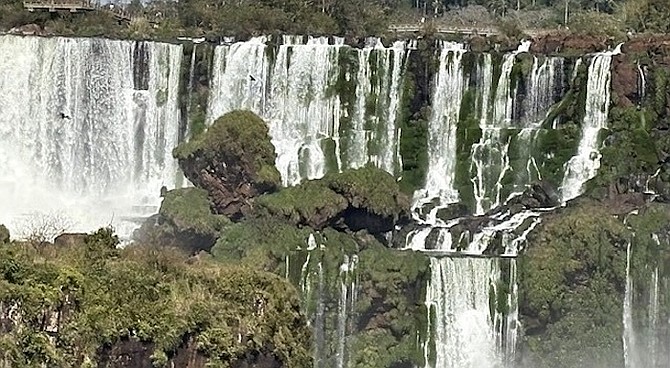
I find waterfalls to be incomparable displays of dynamic force and pure primal beauty. Sensory overload is often off the charts. The hydraulic fury is enough to mesmerize many into staring spellbound into the deluge for hours. Throw in those elusive negative ions — mainly found at falls and believed to elevate serotonin levels and boost your moody mojo — and what a package of plusses a killer cascade can be.
I’m a bonafide believer in the bodacious benefits of quality waterfall time, and just returned from one that must be seen to be believed. Iguazu is “Big Water” in the local Guarani language, and a more apt title is impossible to imagine. It’s actually a network of falls spanning over a mile of sheer basalt cliffs, 90% of which are are in Argentina, and the rest in Brazil. Argentina provides a far superior perspective of the massive marvel, with 275 cataracts, all individually named.
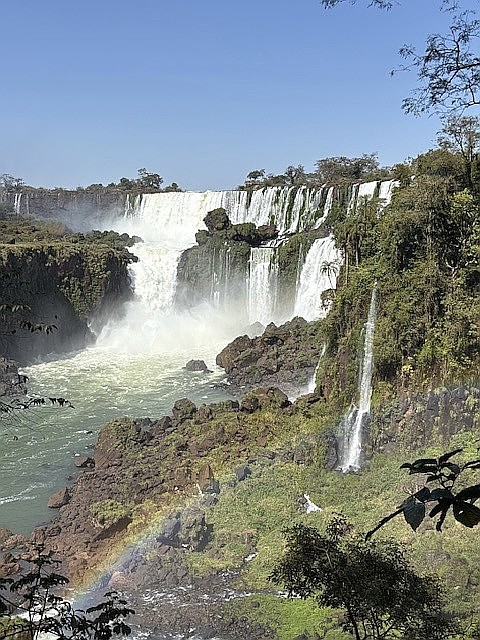
The park welcomes a million and a half visitors annually, and if your visit happens to coincide with one of the many Argentine holidays, forget it. Get the earliest feasible start. Admission for non-Argentines is US$40, but if you keep your ticket, you can revisit for half price, and two days is all the better for admiring, gaping, listening and savoring.
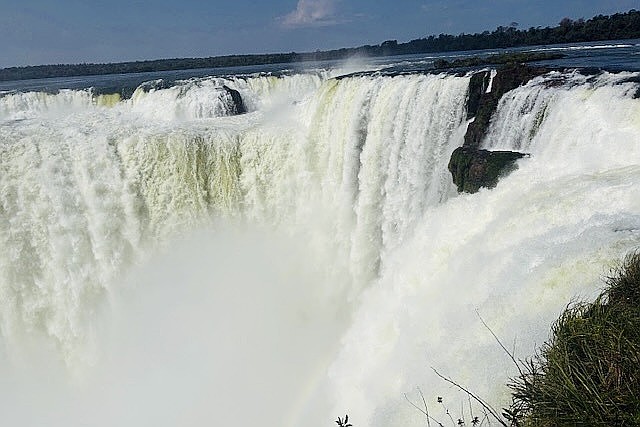
The centerpiece of this grand earth sculpture is La Garganta del Diablo, a spellbinding, monumental, semi-circular indentation in the basalt wall where the water drops 80 meters. A new and improved catwalk leads to the edge of the abyss; the old one was flooded out two years ago. Walking across the calm, flat water on the way to the Garganta does little to prepare you for the fluvial earthquake at the end of the line. It’s best to get to earlier rather than later. A toy train leaves every half hour transporting peepers to the trail. It’s free, but tickets need to be procured ahead of time (if only 10 minutes). It’s also possible to walk to the Garganta trail, but it takes about twice as long.
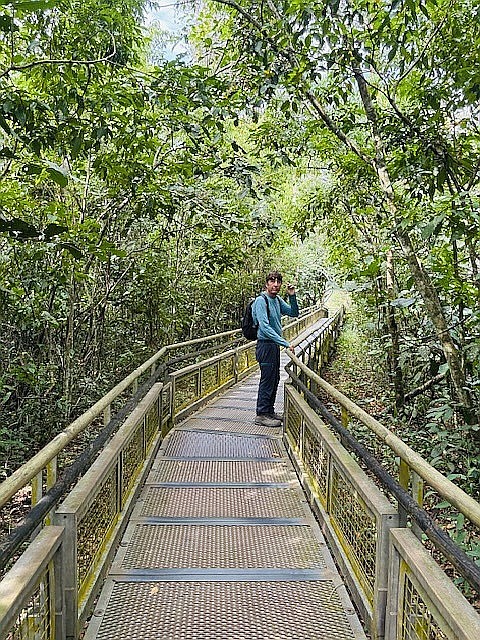
The other two principal catwalk trails are the sunny Superior, up high on the brink of the falls, and the shady Inferior, closer to the bottom of the bodacious basin. Each of these is less than 2 kilometers long, and not very strenuous. The Superior is on top and absolutely flat, while the lower Inferior has lots of stairs and ramps but provides decidedly superior views of the full faces of the falls.
The final approach is through the Jungle Adventure, a half-hour boat ride up the river to the base of a couple of the major falls. The staff is professional, the boats are brawny, and the $75 ticket is worth it. Everybody gets 100% drenched, but jumbo wet bags are provided. The trip begins with an open-air jeep ride through the jungle to the rio. Life jackets are distributed, and then the skipper guns the boat up the river, past smaller falls and thick vegetation. A thrilling set of rapids gives way to a quiet cove with flat water, and the captain gives his instructions for the main attraction: basically, just hang onto your shit.
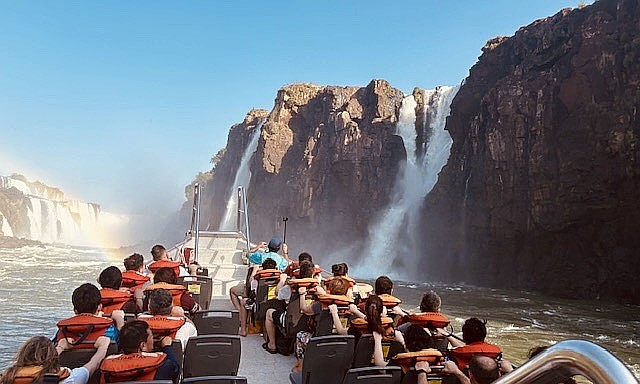
He makes a beeline for the base of an enormous cascade near La Garganta, and while we don’t go full monty under this whopper, we get close enough to get everybody doused from head to toe, resulting in whoopin’ and hollerin’ galore. This maneuver gets repeated from a couple of different angles, and then we do it all over again below a neighboring behemoth. I admire the skill of our skipper, who scares the snot out of half the party, but keeps the ship moving and steady. The trip back down the river is warm and happy, and we change into dry duds back at the dock before leaving the park at five, having done Iguazu from top to bottom.
Iguazu is easily reached by air from Buenos Aires, and the adjacent town of Puerto Iguazu has very developed tourist services, including accommodations, transportation and scores of restaurants. A popular scenic walk along the river arrives at a point where two rivers and three countries meet. The vista and roar of the falls will stick in my memory for years, maybe forever.
Here's something you might be interested in.
Travel Story: Argentina’s Iguazu is a truly Big Water
275 cataracts, all individually named

Travel Story: Argentina’s Iguazu is a truly Big Water
275 cataracts, all individually named
I find waterfalls to be incomparable displays of dynamic force and pure primal beauty. Sensory overload is often off the charts. The hydraulic fury is enough to mesmerize many into staring spellbound into the deluge for hours. Throw in those elusive negative ions — mainly found at falls and believed to elevate serotonin levels and boost your moody mojo — and what a package of plusses a killer cascade can be.
I’m a bonafide believer in the bodacious benefits of quality waterfall time, and just returned from one that must be seen to be believed. Iguazu is “Big Water” in the local Guarani language, and a more apt title is impossible to imagine. It’s actually a network of falls spanning over a mile of sheer basalt cliffs, 90% of which are are in Argentina, and the rest in Brazil. Argentina provides a far superior perspective of the massive marvel, with 275 cataracts, all individually named.
The park welcomes a million and a half visitors annually, and if your visit happens to coincide with one of the many Argentine holidays, forget it. Get the earliest feasible start. Admission for non-Argentines is US$40, but if you keep your ticket, you can revisit for half price, and two days is all the better for admiring, gaping, listening and savoring.
The centerpiece of this grand earth sculpture is La Garganta del Diablo, a spellbinding, monumental, semi-circular indentation in the basalt wall where the water drops 80 meters. A new and improved catwalk leads to the edge of the abyss; the old one was flooded out two years ago. Walking across the calm, flat water on the way to the Garganta does little to prepare you for the fluvial earthquake at the end of the line. It’s best to get to earlier rather than later. A toy train leaves every half hour transporting peepers to the trail. It’s free, but tickets need to be procured ahead of time (if only 10 minutes). It’s also possible to walk to the Garganta trail, but it takes about twice as long.
The other two principal catwalk trails are the sunny Superior, up high on the brink of the falls, and the shady Inferior, closer to the bottom of the bodacious basin. Each of these is less than 2 kilometers long, and not very strenuous. The Superior is on top and absolutely flat, while the lower Inferior has lots of stairs and ramps but provides decidedly superior views of the full faces of the falls.
The final approach is through the Jungle Adventure, a half-hour boat ride up the river to the base of a couple of the major falls. The staff is professional, the boats are brawny, and the $75 ticket is worth it. Everybody gets 100% drenched, but jumbo wet bags are provided. The trip begins with an open-air jeep ride through the jungle to the rio. Life jackets are distributed, and then the skipper guns the boat up the river, past smaller falls and thick vegetation. A thrilling set of rapids gives way to a quiet cove with flat water, and the captain gives his instructions for the main attraction: basically, just hang onto your shit.
He makes a beeline for the base of an enormous cascade near La Garganta, and while we don’t go full monty under this whopper, we get close enough to get everybody doused from head to toe, resulting in whoopin’ and hollerin’ galore. This maneuver gets repeated from a couple of different angles, and then we do it all over again below a neighboring behemoth. I admire the skill of our skipper, who scares the snot out of half the party, but keeps the ship moving and steady. The trip back down the river is warm and happy, and we change into dry duds back at the dock before leaving the park at five, having done Iguazu from top to bottom.
Iguazu is easily reached by air from Buenos Aires, and the adjacent town of Puerto Iguazu has very developed tourist services, including accommodations, transportation and scores of restaurants. A popular scenic walk along the river arrives at a point where two rivers and three countries meet. The vista and roar of the falls will stick in my memory for years, maybe forever.
Comments