

Here's something you might be interested in.
Ask a Hipster — Advice you didn't know you needed
Big Screen — Movie commentary
Blurt — Music's inside track
Booze News — San Diego spirits
Classical Music — Immortal beauty
Classifieds — Free and easy
Close to Home — What it’s like on the street where you live
Cover Stories — Front-page features
Drinks All Around — Bartenders' drink recipes
Excerpts — Literary and spiritual excerpts
Feast! — Food & drink reviews
Feature Stories — Local news & stories
Fishing Report — What’s getting hooked from ship and shore
From the Archives — Spotlight on the past
Golden Dreams — Talk of the town
The Gonzo Report — Making the musical scene, or at least reporting from it
Letters — Our inbox
Movies@Home — Local movie buffs share favorites
Movie Reviews — Our critics' picks and pans
Musician Interviews — Up close with local artists
Neighborhood News from Stringers — Hyperlocal news
News Ticker — News & politics
Obermeyer — San Diego politics illustrated
Outdoors — Weekly changes in flora and fauna
Overheard in San Diego — Eavesdropping illustrated
Poetry — The old and the new
Reader Travel — Travel section built by travelers
Reading — The hunt for intellectuals
Roam-O-Rama — SoCal's best hiking/biking trails
San Diego Beer — Inside San Diego suds
SD on the QT — Almost factual news
Sheep and Goats — Places of worship
Special Issues — The best of
Street Style — San Diego streets have style
Surf Diego — Real stories from those braving the waves
Theater — On stage in San Diego this week
Tin Fork — Silver spoon alternative
Under the Radar — Matt Potter's undercover work
Unforgettable — Long-ago San Diego
Unreal Estate — San Diego's priciest pads
Your Week — Daily event picks
Now streaming: THE JEWISH NAZI? (2025)
“You can't change what happened, you can only remember it,”
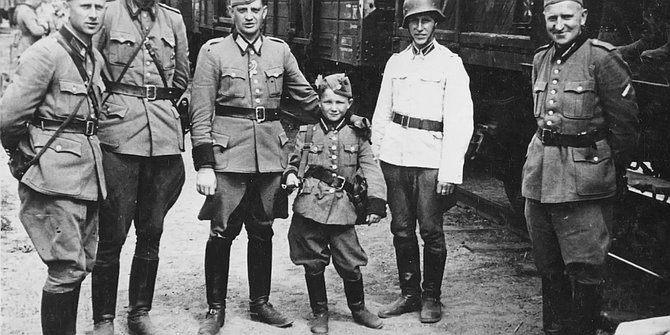
They're so cute when they're young.
THE JEWISH NAZI? (2025) Dan Goldberg / Writers: Jaya Balendra & Dan Goldberg / Cinematographer: Nathan Barlis (Multi-Ratio) / Editor: Mark Middis / The Cast: Alex Kurzem, Maris Lakis, Leon Eidelman, Ben Sulsky, Lindy Meshwork, Barry Resnick, Colleen Fitzpatrick / Keith Moor, Konrad Kwiet, & Lonnie Kulis / Australia / Distributor: Greenwich Films / Australia / Not Rated / Length: 90 min.
Two questions bubbled up before the light even hit the screen. Is this a documentary account of Solomon Perel, the subject of Angieszka Holland’s similarly fact-based scenario Europa, Europa (1990)? And why is the title phrased in the form of a question? It appears that history can account for at least two biopics of orphaned lonsman who survived the war by passing for Hitlerjugend. Meet the pseudonymous Alex Kurzem, aka The Jewish Nazi, the man who kept his party affiliation a secret for 50 years before embarking on a 25-year search for his true identity.
As for the punctilious punctuation, filmmaker Dan Goldberg’s fateful account of guilt by association keeps one guessing as to the veracity of Kurzem’s interpretation of the truth right up until the end — yet I’m still not certain that I buy what he’s selling.
Video:
Trailer: THE JEWISH NAZI?
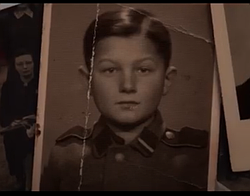
One thing registered as contrary even before one of the film’s numerous witnesses pointed it out: his mother told five-year-old Alex that the family was to be shot the next day. This wasn’t a dinner reservation. The Gestapo didn’t pencil in assassinations; they killed on the spot.
“You can't change what happened, you can only remember it,” Alex would later muse. The last memories he had of his family were of their corpses, lives extinguished while the child looked on. He escaped through the back fence and hid in the hills of a nearby village.
Not wanting to kill a child, the Latvian soldier who found Alex took pity on the boy and brought him home before turning him over to the Nazis. What saved Alex? Blonde hair and blue eyes, just as the Führer ordered!
Somewhat of a novelty, the youngest soldier in the Nazi Party quickly became their “Mascot.” First assignment: mastering the art of pretending to hate your own. In any other situation, it would be a case of if you can’t join ‘em, beat ‘em — preferably with spiked bats. But this was a six-year-old babe witnessing acts of torture that would make grownups collapse with fear.
The Holocaust Centre in Melbourne was collecting the testimonies of survivors, and a friend thought that Alex would benefit from telling his story. Part of me wanted more stories from the old country, but the narrative resisted, quietly tugging in the direction of something even more outrageous.
Hello? What’s this? A skeptic in the crowd crying, “Nazi hoax!”
What follows is truly not to be believed. Refusing to spoil the ride, I’ll stop here and suggest you track down a copy of Europa, Europa and make it a double-feature. ****
Now platforming in a stream you!
Here's something you might be interested in.
Now streaming: THE JEWISH NAZI? (2025)
“You can't change what happened, you can only remember it,”

Now streaming: THE JEWISH NAZI? (2025)
“You can't change what happened, you can only remember it,”
They're so cute when they're young.
THE JEWISH NAZI? (2025) Dan Goldberg / Writers: Jaya Balendra & Dan Goldberg / Cinematographer: Nathan Barlis (Multi-Ratio) / Editor: Mark Middis / The Cast: Alex Kurzem, Maris Lakis, Leon Eidelman, Ben Sulsky, Lindy Meshwork, Barry Resnick, Colleen Fitzpatrick / Keith Moor, Konrad Kwiet, & Lonnie Kulis / Australia / Distributor: Greenwich Films / Australia / Not Rated / Length: 90 min.
Two questions bubbled up before the light even hit the screen. Is this a documentary account of Solomon Perel, the subject of Angieszka Holland’s similarly fact-based scenario Europa, Europa (1990)? And why is the title phrased in the form of a question? It appears that history can account for at least two biopics of orphaned lonsman who survived the war by passing for Hitlerjugend. Meet the pseudonymous Alex Kurzem, aka The Jewish Nazi, the man who kept his party affiliation a secret for 50 years before embarking on a 25-year search for his true identity.
As for the punctilious punctuation, filmmaker Dan Goldberg’s fateful account of guilt by association keeps one guessing as to the veracity of Kurzem’s interpretation of the truth right up until the end — yet I’m still not certain that I buy what he’s selling.
Video:
Trailer: THE JEWISH NAZI?
One thing registered as contrary even before one of the film’s numerous witnesses pointed it out: his mother told five-year-old Alex that the family was to be shot the next day. This wasn’t a dinner reservation. The Gestapo didn’t pencil in assassinations; they killed on the spot.
“You can't change what happened, you can only remember it,” Alex would later muse. The last memories he had of his family were of their corpses, lives extinguished while the child looked on. He escaped through the back fence and hid in the hills of a nearby village.
Not wanting to kill a child, the Latvian soldier who found Alex took pity on the boy and brought him home before turning him over to the Nazis. What saved Alex? Blonde hair and blue eyes, just as the Führer ordered!
Somewhat of a novelty, the youngest soldier in the Nazi Party quickly became their “Mascot.” First assignment: mastering the art of pretending to hate your own. In any other situation, it would be a case of if you can’t join ‘em, beat ‘em — preferably with spiked bats. But this was a six-year-old babe witnessing acts of torture that would make grownups collapse with fear.
The Holocaust Centre in Melbourne was collecting the testimonies of survivors, and a friend thought that Alex would benefit from telling his story. Part of me wanted more stories from the old country, but the narrative resisted, quietly tugging in the direction of something even more outrageous.
Hello? What’s this? A skeptic in the crowd crying, “Nazi hoax!”
What follows is truly not to be believed. Refusing to spoil the ride, I’ll stop here and suggest you track down a copy of Europa, Europa and make it a double-feature. ****
Now platforming in a stream you!