

Here's something you might be interested in.
Ask a Hipster — Advice you didn't know you needed
Big Screen — Movie commentary
Blurt — Music's inside track
Booze News — San Diego spirits
Classical Music — Immortal beauty
Classifieds — Free and easy
Close to Home — What it’s like on the street where you live
Cover Stories — Front-page features
Drinks All Around — Bartenders' drink recipes
Excerpts — Literary and spiritual excerpts
Feast! — Food & drink reviews
Feature Stories — Local news & stories
Fishing Report — What’s getting hooked from ship and shore
From the Archives — Spotlight on the past
Golden Dreams — Talk of the town
The Gonzo Report — Making the musical scene, or at least reporting from it
Letters — Our inbox
Movies@Home — Local movie buffs share favorites
Movie Reviews — Our critics' picks and pans
Musician Interviews — Up close with local artists
Neighborhood News from Stringers — Hyperlocal news
News Ticker — News & politics
Obermeyer — San Diego politics illustrated
Outdoors — Weekly changes in flora and fauna
Overheard in San Diego — Eavesdropping illustrated
Poetry — The old and the new
Reader Travel — Travel section built by travelers
Reading — The hunt for intellectuals
Roam-O-Rama — SoCal's best hiking/biking trails
San Diego Beer — Inside San Diego suds
SD on the QT — Almost factual news
Sheep and Goats — Places of worship
Special Issues — The best of
Street Style — San Diego streets have style
Surf Diego — Real stories from those braving the waves
Theater — On stage in San Diego this week
Tin Fork — Silver spoon alternative
Under the Radar — Matt Potter's undercover work
Unforgettable — Long-ago San Diego
Unreal Estate — San Diego's priciest pads
Your Week — Daily event picks
Theater Review: Small at The Old Globe
An extraordinary autobiographical story
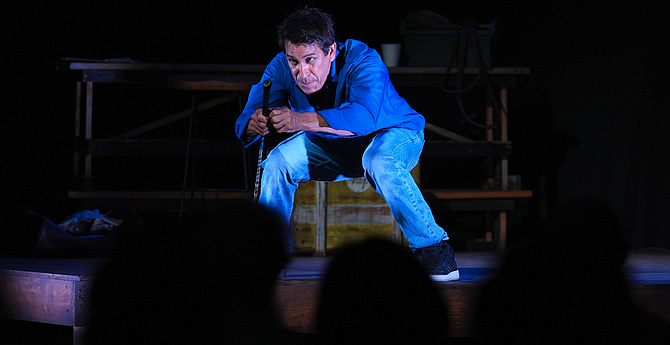
This is the extraordinary autobiographical story of Robert Montano, who had a successful career as a jockey and then a mega-successful career as a dancer. He tells this story “in the round” at the Old Globe. I applaud the results, while remaining daunted by the prospect of a one-man show delivered in the round. The set is minimalist, with a few props dispersed to evoke key moments. He talks with us as if we were friends — as if, indeed, the whole world were friends.
Here’s the story. A small, 10-year-old boy gets bullied at school , so he prays that God will make him grow so he can face his bullies. Soon after, his mom takes him to Belmont Park where he catches the fever — not for gambling but for horses. Although his mother wants to keep him away from this den of sin, circumstances conspire for him to re-meet with his mom’s friend, a famous jockey who seems to him to be both everything a man should be — strong, courageous, kind — and also small. He believes he has found his calling. He begs and pleads and prays to be able to go back to the stables, but his parents are concerned for his physical and moral safety. After he finagles a visit, it is revealed that he has an innate gift with horses.
Despite his parents’ objections, he is allowed a summer job, and after paying his dues mucking stalls, he is finally allowed to ride a thoroughbred — a high-spirited breed that most riders work up to over years of riding. He survives that debut, a bit the worse for wear, and so earns respect. And then, with blood, sweat, and tears, he becomes a real jockey. And then and only then, God answers his prayer for a growth spurt. Now he starts praying just as fervently that God will make him NOT grow.
Montano’s narrates in the voice of his growing-up self (beginning at age 10 and moving up through his early 20s). He also plays all the important people in his life: his parents, neighbors, jockeys, and trainers. His impression of his sassy Latina mother is splendid, his artist father endearing, his mentor edifying, and the various neighbors, trainers, and jockeys just hilarious. His mercury-quick transitions are dazzling and sometimes dizzying.
This is a story of passion, pursuit, achievement, and loss, of devotion to family, and of the search for meaning. In this, Montano is Everyman. We can all relate to him — or at least, we can all want to relate to him, and the worldly virtues he embodies. But there is a spiritual dimension to the story as well: a man repeatedly knocking in the hope that the door will be opened to him. A man who fights against God's will as expressed in the playing out of events — sometimes in extreme fashion — then experiences profound change when he surrenders.
Worldly success is not the best measure of a life well-lived, and I think this is the next challenge that Montano is facing. He gives us many spiritual lessons in his very personal story. I thank him for it, and I hope to hear about his next great quest.
Here's something you might be interested in.
Theater Review: Small at The Old Globe
An extraordinary autobiographical story

Theater Review: Small at The Old Globe
An extraordinary autobiographical story
This is the extraordinary autobiographical story of Robert Montano, who had a successful career as a jockey and then a mega-successful career as a dancer. He tells this story “in the round” at the Old Globe. I applaud the results, while remaining daunted by the prospect of a one-man show delivered in the round. The set is minimalist, with a few props dispersed to evoke key moments. He talks with us as if we were friends — as if, indeed, the whole world were friends.
Here’s the story. A small, 10-year-old boy gets bullied at school , so he prays that God will make him grow so he can face his bullies. Soon after, his mom takes him to Belmont Park where he catches the fever — not for gambling but for horses. Although his mother wants to keep him away from this den of sin, circumstances conspire for him to re-meet with his mom’s friend, a famous jockey who seems to him to be both everything a man should be — strong, courageous, kind — and also small. He believes he has found his calling. He begs and pleads and prays to be able to go back to the stables, but his parents are concerned for his physical and moral safety. After he finagles a visit, it is revealed that he has an innate gift with horses.
Despite his parents’ objections, he is allowed a summer job, and after paying his dues mucking stalls, he is finally allowed to ride a thoroughbred — a high-spirited breed that most riders work up to over years of riding. He survives that debut, a bit the worse for wear, and so earns respect. And then, with blood, sweat, and tears, he becomes a real jockey. And then and only then, God answers his prayer for a growth spurt. Now he starts praying just as fervently that God will make him NOT grow.
Montano’s narrates in the voice of his growing-up self (beginning at age 10 and moving up through his early 20s). He also plays all the important people in his life: his parents, neighbors, jockeys, and trainers. His impression of his sassy Latina mother is splendid, his artist father endearing, his mentor edifying, and the various neighbors, trainers, and jockeys just hilarious. His mercury-quick transitions are dazzling and sometimes dizzying.
This is a story of passion, pursuit, achievement, and loss, of devotion to family, and of the search for meaning. In this, Montano is Everyman. We can all relate to him — or at least, we can all want to relate to him, and the worldly virtues he embodies. But there is a spiritual dimension to the story as well: a man repeatedly knocking in the hope that the door will be opened to him. A man who fights against God's will as expressed in the playing out of events — sometimes in extreme fashion — then experiences profound change when he surrenders.
Worldly success is not the best measure of a life well-lived, and I think this is the next challenge that Montano is facing. He gives us many spiritual lessons in his very personal story. I thank him for it, and I hope to hear about his next great quest.
Comments