

Here's something you might be interested in.
Ask a Hipster — Advice you didn't know you needed
Big Screen — Movie commentary
Blurt — Music's inside track
Booze News — San Diego spirits
Classical Music — Immortal beauty
Classifieds — Free and easy
Close to Home — What it’s like on the street where you live
Cover Stories — Front-page features
Drinks All Around — Bartenders' drink recipes
Excerpts — Literary and spiritual excerpts
Feast! — Food & drink reviews
Feature Stories — Local news & stories
Fishing Report — What’s getting hooked from ship and shore
From the Archives — Spotlight on the past
Golden Dreams — Talk of the town
The Gonzo Report — Making the musical scene, or at least reporting from it
Letters — Our inbox
Movies@Home — Local movie buffs share favorites
Movie Reviews — Our critics' picks and pans
Musician Interviews — Up close with local artists
Neighborhood News from Stringers — Hyperlocal news
News Ticker — News & politics
Obermeyer — San Diego politics illustrated
Outdoors — Weekly changes in flora and fauna
Overheard in San Diego — Eavesdropping illustrated
Poetry — The old and the new
Reader Travel — Travel section built by travelers
Reading — The hunt for intellectuals
Roam-O-Rama — SoCal's best hiking/biking trails
San Diego Beer — Inside San Diego suds
SD on the QT — Almost factual news
Sheep and Goats — Places of worship
Special Issues — The best of
Street Style — San Diego streets have style
Surf Diego — Real stories from those braving the waves
Theater — On stage in San Diego this week
Tin Fork — Silver spoon alternative
Under the Radar — Matt Potter's undercover work
Unforgettable — Long-ago San Diego
Unreal Estate — San Diego's priciest pads
Your Week — Daily event picks
The Waymo challenge for Uber drivers is here
How many times can rivals try the orange cone trick?
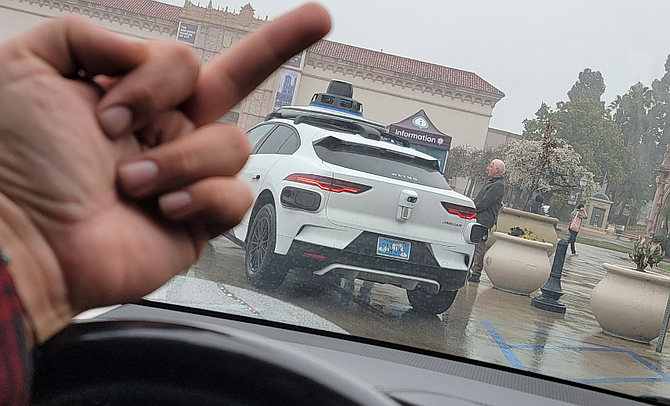
Carlos Medina posted a photo: him flipping off a driverless Waymo.
Uber and Lyft drivers knew this day would come. Now it’s here: Waymo’s driverless cars are rolling through San Diego, and human gig workers say the robo-taxis are slicing into their livelihoods.
Many local drivers describe the white, sensor-stacked Jaguar I-Pace EVs as dystopian, spaceship-adjacent machines showing up in their busiest zones. The frustration is boiling over — creatively yet destructively.
Local driver Abel Arroyo suggested to "Sticker bomb the sensors so it won’t move." Others have been disabling the cars without touching them, confusing the 360-degree lidar system by placing orange traffic cones around the Waymo — a simple trick that causes the vehicle to freeze in the middle of the street.
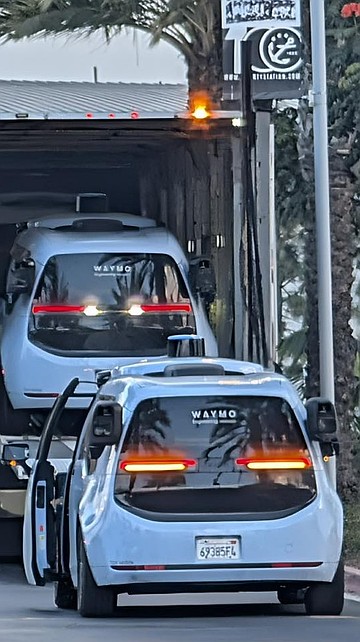
Sensor-stacked Jaguar I-Pace EVs are showing up in busiest ride share zones.
Not every driver is going guerrilla, yet. Most are venting online, trying to make sense of the sudden competition and figure out a plan B.
"With Waymo coming to San Diego, it will definitely put us drivers out of business," said Doug Vannier, an Uber and Lyft driver for five years. Like many locals, he juggles multiple gigs — selling homes in a challenging real estate climate, helping film crews, and raising his daughter.
"As a single father, with ride share, I was able to run home in the morning and make breakfast for my daughter, then drive her to school, then get back to earning money," he continued. "The flexibility of the hours worked OK, but it has been 12 hours a day, seven days a week for several years."
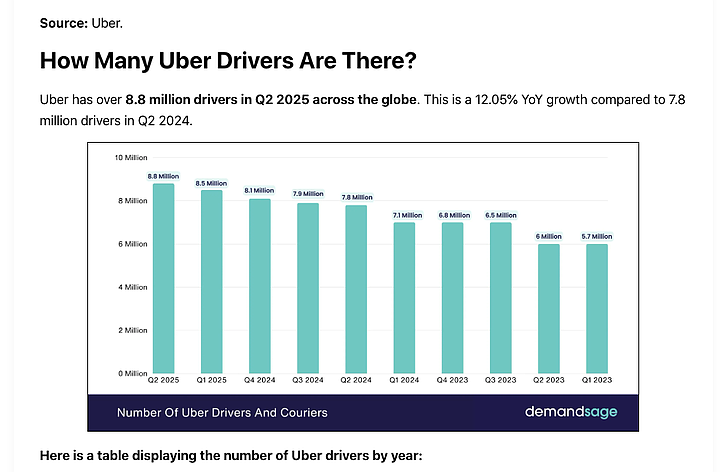
In one of the most expensive regions in the country, we gotta do what we gotta do. For many, rideshare is the only job that enables San Diegans to balance rent, bills, and parenting. Now Lyft drivers are competing not just with Uber drivers, but with emotionless robots and cold AI — a massive shift for the 8.8 million Uber drivers worldwide who serve 180 million passengers, generating almost $44 billion last year, according to DemandSage. And that doesn’t even include Lyft’s numbers.
Vannier fears that even a small dent in business will have significant consequences. "I understand that it won’t replace us completely nor immediately, but taking 15%, 20% even 30% share of the business is enough to keep us waiting long periods of time between rides," he calculated. "Which means we’re down to making 5 to 10 bucks an hour. We have to be rolling all the time to gross 20-25 bucks an hour." And these numbers don’t include gas, tires, insurance, or repairs.
With Waymo fleets expanding in San Diego, rideshare drivers say they’re bracing for longer hours and thinner margins. Some already know what marathon shifts feel like — including Arroyo.
"I don’t think those passengers realize that some drivers work 18-hour shifts some days," Arroyo said. "When I paid off my debt I was working both apps (Uber and Lyft) 'till I could no longer go. I remember dropping off my last passenger and being so tired I would park anywhere and go to sleep for like three hours and be woken up by the heat or security… or at the old airport lot once the sun was too bright and the car got hot and then drive home."
Drivers say the Waymo effect is already hitting their pockets.
Online, human rideshare workers are consoling each other as fares dip and wait times stretch. Benjamin D. asked, "What is going on with the rides? It seems like the longer rides are paying less by as much as $5!"
Rich M. backed him up: "That's why our fares have been LOWERED again!" Cory P. offered a harsher interpretation: "They (Uber and Lyft) are getting you used to the new pay due to staying competitive with Waymo when they launch here in SD. Unfortunately, this is how they will slowly faze human drivers out by giving them less and less until they quit."
And some drivers don’t bother hiding how they feel. Carlos Medina posted a photo: him flipping off a driverless Waymo idling in front of his Tesla — a silent protest captured in one frame.
As more Waymo cars appear on local San Diego streets, the tension between humans and robots is growing. The future is imminent, soon to be sitting right next to us at every stoplight.
Here's something you might be interested in.
The Waymo challenge for Uber drivers is here
How many times can rivals try the orange cone trick?

The Waymo challenge for Uber drivers is here
How many times can rivals try the orange cone trick?
Carlos Medina posted a photo: him flipping off a driverless Waymo.
Uber and Lyft drivers knew this day would come. Now it’s here: Waymo’s driverless cars are rolling through San Diego, and human gig workers say the robo-taxis are slicing into their livelihoods.
Many local drivers describe the white, sensor-stacked Jaguar I-Pace EVs as dystopian, spaceship-adjacent machines showing up in their busiest zones. The frustration is boiling over — creatively yet destructively.
Local driver Abel Arroyo suggested to "Sticker bomb the sensors so it won’t move." Others have been disabling the cars without touching them, confusing the 360-degree lidar system by placing orange traffic cones around the Waymo — a simple trick that causes the vehicle to freeze in the middle of the street.
Sensor-stacked Jaguar I-Pace EVs are showing up in busiest ride share zones.
Not every driver is going guerrilla, yet. Most are venting online, trying to make sense of the sudden competition and figure out a plan B.
"With Waymo coming to San Diego, it will definitely put us drivers out of business," said Doug Vannier, an Uber and Lyft driver for five years. Like many locals, he juggles multiple gigs — selling homes in a challenging real estate climate, helping film crews, and raising his daughter.
"As a single father, with ride share, I was able to run home in the morning and make breakfast for my daughter, then drive her to school, then get back to earning money," he continued. "The flexibility of the hours worked OK, but it has been 12 hours a day, seven days a week for several years."
In one of the most expensive regions in the country, we gotta do what we gotta do. For many, rideshare is the only job that enables San Diegans to balance rent, bills, and parenting. Now Lyft drivers are competing not just with Uber drivers, but with emotionless robots and cold AI — a massive shift for the 8.8 million Uber drivers worldwide who serve 180 million passengers, generating almost $44 billion last year, according to DemandSage. And that doesn’t even include Lyft’s numbers.
Vannier fears that even a small dent in business will have significant consequences. "I understand that it won’t replace us completely nor immediately, but taking 15%, 20% even 30% share of the business is enough to keep us waiting long periods of time between rides," he calculated. "Which means we’re down to making 5 to 10 bucks an hour. We have to be rolling all the time to gross 20-25 bucks an hour." And these numbers don’t include gas, tires, insurance, or repairs.
With Waymo fleets expanding in San Diego, rideshare drivers say they’re bracing for longer hours and thinner margins. Some already know what marathon shifts feel like — including Arroyo.
"I don’t think those passengers realize that some drivers work 18-hour shifts some days," Arroyo said. "When I paid off my debt I was working both apps (Uber and Lyft) 'till I could no longer go. I remember dropping off my last passenger and being so tired I would park anywhere and go to sleep for like three hours and be woken up by the heat or security… or at the old airport lot once the sun was too bright and the car got hot and then drive home."
Drivers say the Waymo effect is already hitting their pockets.
Online, human rideshare workers are consoling each other as fares dip and wait times stretch. Benjamin D. asked, "What is going on with the rides? It seems like the longer rides are paying less by as much as $5!"
Rich M. backed him up: "That's why our fares have been LOWERED again!" Cory P. offered a harsher interpretation: "They (Uber and Lyft) are getting you used to the new pay due to staying competitive with Waymo when they launch here in SD. Unfortunately, this is how they will slowly faze human drivers out by giving them less and less until they quit."
And some drivers don’t bother hiding how they feel. Carlos Medina posted a photo: him flipping off a driverless Waymo idling in front of his Tesla — a silent protest captured in one frame.
As more Waymo cars appear on local San Diego streets, the tension between humans and robots is growing. The future is imminent, soon to be sitting right next to us at every stoplight.
Comments