

Here's something you might be interested in.
Ask a Hipster — Advice you didn't know you needed
Big Screen — Movie commentary
Blurt — Music's inside track
Booze News — San Diego spirits
Classical Music — Immortal beauty
Classifieds — Free and easy
Close to Home — What it’s like on the street where you live
Cover Stories — Front-page features
Drinks All Around — Bartenders' drink recipes
Excerpts — Literary and spiritual excerpts
Feast! — Food & drink reviews
Feature Stories — Local news & stories
Fishing Report — What’s getting hooked from ship and shore
From the Archives — Spotlight on the past
Golden Dreams — Talk of the town
The Gonzo Report — Making the musical scene, or at least reporting from it
Letters — Our inbox
Movies@Home — Local movie buffs share favorites
Movie Reviews — Our critics' picks and pans
Musician Interviews — Up close with local artists
Neighborhood News from Stringers — Hyperlocal news
News Ticker — News & politics
Obermeyer — San Diego politics illustrated
Outdoors — Weekly changes in flora and fauna
Overheard in San Diego — Eavesdropping illustrated
Poetry — The old and the new
Reader Travel — Travel section built by travelers
Reading — The hunt for intellectuals
Roam-O-Rama — SoCal's best hiking/biking trails
San Diego Beer — Inside San Diego suds
SD on the QT — Almost factual news
Sheep and Goats — Places of worship
Special Issues — The best of
Street Style — San Diego streets have style
Surf Diego — Real stories from those braving the waves
Theater — On stage in San Diego this week
Tin Fork — Silver spoon alternative
Under the Radar — Matt Potter's undercover work
Unforgettable — Long-ago San Diego
Unreal Estate — San Diego's priciest pads
Your Week — Daily event picks
Now playing: BLACK PHONE 2 (2025)
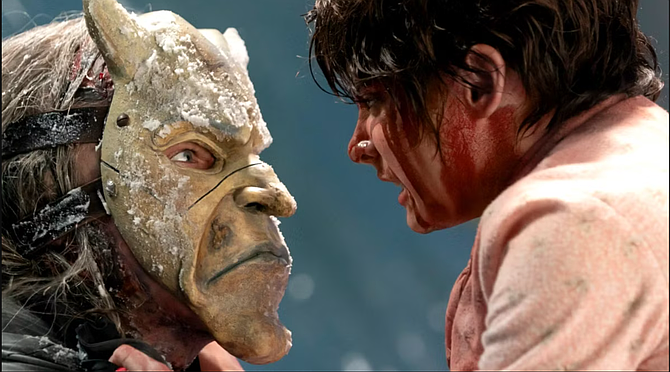
Consider it a paid vacation for Hawke, who spends the first 53 minutes of the picture literally phoning in his performance.
Frowny face
BLACK PHONE 2 (2025) Scott Derricksen / Writers: C. Robert Cargill & Scott Derrickson / Cinematography: Pär M. Ekberg (2.35 : 1) / Design: Patti Podesta / Editing: Louise Ford / Composer: Atticus Derrickson / Acted by: Mason Thames, Madeleine McGraw, Jeremy Davies, Demián Bichir, Miguel Mora, James Ransone, and Ethan Hawke / Countries of Origin: USA & Canada / A Blumhouse Production released by Universal / Rated R / Length: 114 mins.
I recall being quite enthusiastic over The Black Phone, noting, ”The first hour affords viewers more genuine nerve damage… than any Blumhouse horror outing since Paranormal Activity.” That was then, this is not, in what can best be described as a return to business as usual at Blumhouse. Denver, 1982: same phone booth, different movie. (Kudos for precisely pinpointing the period with Night Flight on the telly.) Four years after Grabber's death at the hands of Finney Blake (Mason Thames), his telekinetic younger sister Gwen (Madeleine McGraw) begins dreaming of homicides that occurred at Alpine Lake Camp in 1957. (Gwen dreams in grainy, hand-held Panavision Super8.)
Video:
Trailer: BLACK PHONE 2
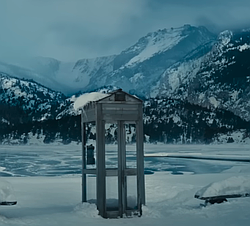
Then she gets a call from the Christian youth camp that her dead mother attended in her teens. That proves to be a good enough reason for Gwen, Finney, and Ernesto to spend part of their winter at a deserted overnight camp. Miguel Mora is the luckiest kid actor in Hollywood. Though his character was done away with in part one, Mora has a second life here, returning as the brother of the deceased.
In the first installment, it was Finney who was on the receiving end of the mysterious phone calls. Now it’s his little sis’s turn to save the day — in more ways than one. Not only must she take down the Grabber, Finney has a reefer on his back! It’s at this point that the film veers dangerously in the direction of a Public Service Announcement.
Consider it a paid vacation for Hawke, who spends the first 53 minutes of the picture literally phoning in his performance. Scott Derrickson’s direction alternates between flash frames, jittercam, and showy jump cuts. And as much as I’m all for taking aim at organized religion, that fact that the uni-dimensional husband and wife evangelicals that run the camp exist solely to be slaughtered for shits and giggles isn't exactly a searing critique. No stars.
Here's something you might be interested in.
Now playing: BLACK PHONE 2 (2025)
Consider it a paid vacation for Hawke, who spends the first 53 minutes of the picture literally phoning in his performance.

Now playing: BLACK PHONE 2 (2025)
Consider it a paid vacation for Hawke, who spends the first 53 minutes of the picture literally phoning in his performance.
Frowny face
BLACK PHONE 2 (2025) Scott Derricksen / Writers: C. Robert Cargill & Scott Derrickson / Cinematography: Pär M. Ekberg (2.35 : 1) / Design: Patti Podesta / Editing: Louise Ford / Composer: Atticus Derrickson / Acted by: Mason Thames, Madeleine McGraw, Jeremy Davies, Demián Bichir, Miguel Mora, James Ransone, and Ethan Hawke / Countries of Origin: USA & Canada / A Blumhouse Production released by Universal / Rated R / Length: 114 mins.
I recall being quite enthusiastic over The Black Phone, noting, ”The first hour affords viewers more genuine nerve damage… than any Blumhouse horror outing since Paranormal Activity.” That was then, this is not, in what can best be described as a return to business as usual at Blumhouse. Denver, 1982: same phone booth, different movie. (Kudos for precisely pinpointing the period with Night Flight on the telly.) Four years after Grabber's death at the hands of Finney Blake (Mason Thames), his telekinetic younger sister Gwen (Madeleine McGraw) begins dreaming of homicides that occurred at Alpine Lake Camp in 1957. (Gwen dreams in grainy, hand-held Panavision Super8.)
Video:
Trailer: BLACK PHONE 2
Then she gets a call from the Christian youth camp that her dead mother attended in her teens. That proves to be a good enough reason for Gwen, Finney, and Ernesto to spend part of their winter at a deserted overnight camp. Miguel Mora is the luckiest kid actor in Hollywood. Though his character was done away with in part one, Mora has a second life here, returning as the brother of the deceased.
In the first installment, it was Finney who was on the receiving end of the mysterious phone calls. Now it’s his little sis’s turn to save the day — in more ways than one. Not only must she take down the Grabber, Finney has a reefer on his back! It’s at this point that the film veers dangerously in the direction of a Public Service Announcement.
Consider it a paid vacation for Hawke, who spends the first 53 minutes of the picture literally phoning in his performance. Scott Derrickson’s direction alternates between flash frames, jittercam, and showy jump cuts. And as much as I’m all for taking aim at organized religion, that fact that the uni-dimensional husband and wife evangelicals that run the camp exist solely to be slaughtered for shits and giggles isn't exactly a searing critique. No stars.
Comments