

Here's something you might be interested in.
Ask a Hipster — Advice you didn't know you needed
Big Screen — Movie commentary
Blurt — Music's inside track
Booze News — San Diego spirits
Classical Music — Immortal beauty
Classifieds — Free and easy
Close to Home — What it’s like on the street where you live
Cover Stories — Front-page features
Drinks All Around — Bartenders' drink recipes
Excerpts — Literary and spiritual excerpts
Feast! — Food & drink reviews
Feature Stories — Local news & stories
Fishing Report — What’s getting hooked from ship and shore
From the Archives — Spotlight on the past
Golden Dreams — Talk of the town
The Gonzo Report — Making the musical scene, or at least reporting from it
Letters — Our inbox
Movies@Home — Local movie buffs share favorites
Movie Reviews — Our critics' picks and pans
Musician Interviews — Up close with local artists
Neighborhood News from Stringers — Hyperlocal news
News Ticker — News & politics
Obermeyer — San Diego politics illustrated
Outdoors — Weekly changes in flora and fauna
Overheard in San Diego — Eavesdropping illustrated
Poetry — The old and the new
Reader Travel — Travel section built by travelers
Reading — The hunt for intellectuals
Roam-O-Rama — SoCal's best hiking/biking trails
San Diego Beer — Inside San Diego suds
SD on the QT — Almost factual news
Sheep and Goats — Places of worship
Special Issues — The best of
Street Style — San Diego streets have style
Surf Diego — Real stories from those braving the waves
Theater — On stage in San Diego this week
Tin Fork — Silver spoon alternative
Under the Radar — Matt Potter's undercover work
Unforgettable — Long-ago San Diego
Unreal Estate — San Diego's priciest pads
Your Week — Daily event picks
Physical Media Rules: The Tom Tyler Silent Film Collection (2025)
A pair of 1929 silent westerns, all duded up in stunning 2K restorations
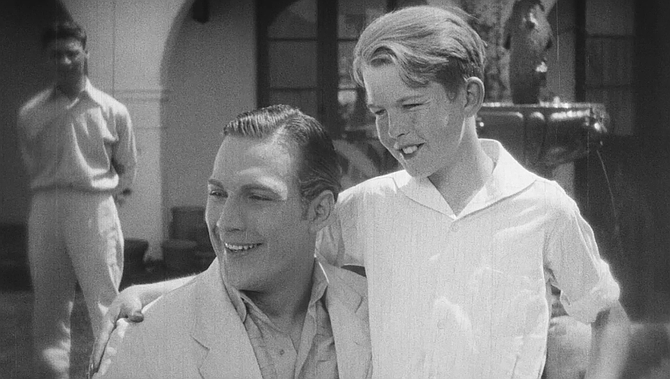
Tom Tyler and Robert Parrish star in The Law of The Plains (1929), one-half of this week's silent westerns double-feature.
THE MAN FROM NEVADA (1929) Producer & Director: J.P. McGowan / Writer: Sally Winters / Cinematography: Hap Depew / Editor: Charles J. Hunt / Musical Score: Ben Model / Acted By: Tom Tyler, Natalie Joyce, Al Ferguson, J.P. McGowan, William Nolte, Francis Walker, Robert Parrish and Cliff Lyons / Studio: Syndicate Pictures Corporation / USA / Length: 48 mins.
Despite all the talk of “forerunners of progress” that opens the show, even at the time of its release, The Man From Nevada was a descendant of a formula. Paleozoic earth-movers and bulldozers paved the broad path to prosperity that made Duvall County a magnet for settlers. It’s also a hub for hooligans. How do we know that? The note attached to the end of the quivering dagger stuck in Jim Watkins' (Al Heuston) door is rife with spelling errors.
Months after his wife died, Watkins still can’t keep his three sons in tow. Look away for a second and “Wobbles” Watson (Frank Crane), still in diapers, is the lone passenger in a wagon drawn by galloping, out-of-control horses. Jack Carter (Tom Tyler), known in these parts as The M.F.N., grabs a smoke while his stuntman does the heavy lifting, leaping from horseback to wagon to save the day. After a beat, Wobbles’ older siblings “Wart” Watkins (Kip Cooper) and “Wiggles” Watkins (Godfrey Craig) wide up… I mean, ride up to assess the damage. Never mind their assigned ages: the ruddy-faced Watson boys — the only thing redder than their freckles are their shocks of red hair — all appear to be in their mid-forties. As for older sister Virginia (Natalie Joyce), she looks to be the right age and shape to win Carter’s affections.
Carter suggests that the best way to deal with bad guy Luke Baldridge (Al Ferguson) is to bust his pie-hole shut. Pacifist Pop Watkins allows as how he's never been one to settle a score with his mitts, to which Carter replies, “Well, it’s about time you started.” After that dust-up goes terribly wrong, Baldridge comes up with an idea to slip some of his beef into Carter’s corral, accuse him of rebranding the herd, and frame him for cattle rustling.
The action is as steady as the naturally lit exteriors are majestic. Stay tuned for the second feature, shot the same year and with most of the cast and crew regrouping for another nimble oater.
THE LAW OF THE PLAINS (1929) Producer & Director: J.P. McGowan / Writer: Sally Winters / Cinematography: Hap Depew (1.33:1) / Editor: Charles J. Hunt / Musical Score: Ben Model / Stunts: Cliff Lyons / Acted By: Tom Tyler, Natalie Joyce, Al Ferguson, J.P. McGowan, William Nolte, Francis Walker, Robert Parrish and Cliff Lyons / Studio: Syndicate Pictures Corporation / USA / Length: 55 mins. (marked down to 38 mins. due to a missing reel 4)
Can you feel the ripple of days gone by, a time when you didn't need an opening crawl or a pre-credits sequence all to set things in motion, just a simple inter-title that began, “Somewhere in…” Welcome to South America, home of rancher Dan O’Brien (Tom Tyler) and his young son Dan Jr. (Robert Parrish*). Even Junior has to question the veracity of the pair of ominous goons looking to purchase the ranch, Juan Sepulveda (Al Ferguson) and “Limpy” Seagrue, the man with the Fu Manchu (J.P. McGowan). Back in the day, it was 100% acceptable to name characters after conditions affecting the musculoskeletal system. To add insult to injury, a title card introduces “Limpy“ as “Deformed in mind and body.”
Given the revolution spiraling out of control all around them, one might reasonably wonder why anyone who wasn't "deformed in mind" to consider dropping $200,000 on a home smack in the middle of a battlefield. But the fog of war has its uses: with the conflict serving as a distraction, Seagrue and his crew seize the opportunity to storm the ranch. As the battle rages, nine-year-old Junior runs reconnaissance amid the crossfire. By the time he tracks down a platoon, it’s too late, but take heart, Tyler fans: Don Sr.’s death opens the door for our hero to play a dual role as gunned-down Daddy and grown up Junior.
Time passes, and business remains plentiful for Sepulveda and Seagrue. The change in fortune naturally gives rise to a change of identity: the latter, now known as Serrano, shaves his head, giving him a Daddy Warbucks mien, while the only thing different about Sepulveda is his name. As George London, he looks to help himself to Serrano’s fortune — as well as his comely niece Natalie (Natalie Joyce).
B-westerns were extremely popular in their day; the liner notes refer to them as “the bread and butter of most small-town theaters in the 1920s and 1930s.” Growing up, silent westerns were a rare commodity for me. It wasn’t until later in life that I was introduced to such western legends as William S. Hart, Tom Mix, and Fred Thompson. Had it not been for Undercrank, I’d still be waiting to see Tom Mix in action.
Undercrank Productions is more than a boutique label; it’s a proud “collector’s brand” specializing in sparkling restorations of silent films saved from the scrap heap of time, many of which are funded by devout fans. Ben Model, the overlord of Undercrank, personally oversees each HD or 2K scan as well as composing and performing the music that accompanies them. Unless you have the chance to see a silent movie screened with live musical accompaniment, the presentation doesn’t get better.
*Robert Parrish would age into a fine picture-maker in his own right. Before assuming his rightful seat in the director’s chair, “Bobby” Parrish appeared in uncredited bit roles for Raoul Walsh, F.W. Murnau, Harold Lloyd, Cecil B. DeMille, Frank Borzage, Frank Capra, Charlie Chaplin, and — in 9 (!) features — John Ford. He would later edit a pair of war documentaries for Ford (The Battle of Midway, December 7th) as well as cutting Body and Soul for Robert Rossen, George Cukor’s A Double Life, and one of the best examples of film noir you’ve never heard of, Max Ophuls’ Caught. He signed his first feature at 35 and went on to sign such memorable works as Cry Danger, Lucy Gallant, Fire Down Below, and one of the finest war films you’ve never heard of, The Purple Plain. Dubious Distinction Award: Parrish refereed the on-set grapple between Orson Welles and Peter Sellers in Casino Royale.
Here's something you might be interested in.
Physical Media Rules: The Tom Tyler Silent Film Collection (2025)
A pair of 1929 silent westerns, all duded up in stunning 2K restorations

Physical Media Rules: The Tom Tyler Silent Film Collection (2025)
A pair of 1929 silent westerns, all duded up in stunning 2K restorations
Tom Tyler and Robert Parrish star in The Law of The Plains (1929), one-half of this week's silent westerns double-feature.
THE MAN FROM NEVADA (1929) Producer & Director: J.P. McGowan / Writer: Sally Winters / Cinematography: Hap Depew / Editor: Charles J. Hunt / Musical Score: Ben Model / Acted By: Tom Tyler, Natalie Joyce, Al Ferguson, J.P. McGowan, William Nolte, Francis Walker, Robert Parrish and Cliff Lyons / Studio: Syndicate Pictures Corporation / USA / Length: 48 mins.
Despite all the talk of “forerunners of progress” that opens the show, even at the time of its release, The Man From Nevada was a descendant of a formula. Paleozoic earth-movers and bulldozers paved the broad path to prosperity that made Duvall County a magnet for settlers. It’s also a hub for hooligans. How do we know that? The note attached to the end of the quivering dagger stuck in Jim Watkins' (Al Heuston) door is rife with spelling errors.
Months after his wife died, Watkins still can’t keep his three sons in tow. Look away for a second and “Wobbles” Watson (Frank Crane), still in diapers, is the lone passenger in a wagon drawn by galloping, out-of-control horses. Jack Carter (Tom Tyler), known in these parts as The M.F.N., grabs a smoke while his stuntman does the heavy lifting, leaping from horseback to wagon to save the day. After a beat, Wobbles’ older siblings “Wart” Watkins (Kip Cooper) and “Wiggles” Watkins (Godfrey Craig) wide up… I mean, ride up to assess the damage. Never mind their assigned ages: the ruddy-faced Watson boys — the only thing redder than their freckles are their shocks of red hair — all appear to be in their mid-forties. As for older sister Virginia (Natalie Joyce), she looks to be the right age and shape to win Carter’s affections.
Carter suggests that the best way to deal with bad guy Luke Baldridge (Al Ferguson) is to bust his pie-hole shut. Pacifist Pop Watkins allows as how he's never been one to settle a score with his mitts, to which Carter replies, “Well, it’s about time you started.” After that dust-up goes terribly wrong, Baldridge comes up with an idea to slip some of his beef into Carter’s corral, accuse him of rebranding the herd, and frame him for cattle rustling.
The action is as steady as the naturally lit exteriors are majestic. Stay tuned for the second feature, shot the same year and with most of the cast and crew regrouping for another nimble oater.
THE LAW OF THE PLAINS (1929) Producer & Director: J.P. McGowan / Writer: Sally Winters / Cinematography: Hap Depew (1.33:1) / Editor: Charles J. Hunt / Musical Score: Ben Model / Stunts: Cliff Lyons / Acted By: Tom Tyler, Natalie Joyce, Al Ferguson, J.P. McGowan, William Nolte, Francis Walker, Robert Parrish and Cliff Lyons / Studio: Syndicate Pictures Corporation / USA / Length: 55 mins. (marked down to 38 mins. due to a missing reel 4)
Can you feel the ripple of days gone by, a time when you didn't need an opening crawl or a pre-credits sequence all to set things in motion, just a simple inter-title that began, “Somewhere in…” Welcome to South America, home of rancher Dan O’Brien (Tom Tyler) and his young son Dan Jr. (Robert Parrish*). Even Junior has to question the veracity of the pair of ominous goons looking to purchase the ranch, Juan Sepulveda (Al Ferguson) and “Limpy” Seagrue, the man with the Fu Manchu (J.P. McGowan). Back in the day, it was 100% acceptable to name characters after conditions affecting the musculoskeletal system. To add insult to injury, a title card introduces “Limpy“ as “Deformed in mind and body.”
Given the revolution spiraling out of control all around them, one might reasonably wonder why anyone who wasn't "deformed in mind" to consider dropping $200,000 on a home smack in the middle of a battlefield. But the fog of war has its uses: with the conflict serving as a distraction, Seagrue and his crew seize the opportunity to storm the ranch. As the battle rages, nine-year-old Junior runs reconnaissance amid the crossfire. By the time he tracks down a platoon, it’s too late, but take heart, Tyler fans: Don Sr.’s death opens the door for our hero to play a dual role as gunned-down Daddy and grown up Junior.
Time passes, and business remains plentiful for Sepulveda and Seagrue. The change in fortune naturally gives rise to a change of identity: the latter, now known as Serrano, shaves his head, giving him a Daddy Warbucks mien, while the only thing different about Sepulveda is his name. As George London, he looks to help himself to Serrano’s fortune — as well as his comely niece Natalie (Natalie Joyce).
B-westerns were extremely popular in their day; the liner notes refer to them as “the bread and butter of most small-town theaters in the 1920s and 1930s.” Growing up, silent westerns were a rare commodity for me. It wasn’t until later in life that I was introduced to such western legends as William S. Hart, Tom Mix, and Fred Thompson. Had it not been for Undercrank, I’d still be waiting to see Tom Mix in action.
Undercrank Productions is more than a boutique label; it’s a proud “collector’s brand” specializing in sparkling restorations of silent films saved from the scrap heap of time, many of which are funded by devout fans. Ben Model, the overlord of Undercrank, personally oversees each HD or 2K scan as well as composing and performing the music that accompanies them. Unless you have the chance to see a silent movie screened with live musical accompaniment, the presentation doesn’t get better.
*Robert Parrish would age into a fine picture-maker in his own right. Before assuming his rightful seat in the director’s chair, “Bobby” Parrish appeared in uncredited bit roles for Raoul Walsh, F.W. Murnau, Harold Lloyd, Cecil B. DeMille, Frank Borzage, Frank Capra, Charlie Chaplin, and — in 9 (!) features — John Ford. He would later edit a pair of war documentaries for Ford (The Battle of Midway, December 7th) as well as cutting Body and Soul for Robert Rossen, George Cukor’s A Double Life, and one of the best examples of film noir you’ve never heard of, Max Ophuls’ Caught. He signed his first feature at 35 and went on to sign such memorable works as Cry Danger, Lucy Gallant, Fire Down Below, and one of the finest war films you’ve never heard of, The Purple Plain. Dubious Distinction Award: Parrish refereed the on-set grapple between Orson Welles and Peter Sellers in Casino Royale.