

Here's something you might be interested in.
Ask a Hipster — Advice you didn't know you needed
Big Screen — Movie commentary
Blurt — Music's inside track
Booze News — San Diego spirits
Classical Music — Immortal beauty
Classifieds — Free and easy
Close to Home — What it’s like on the street where you live
Cover Stories — Front-page features
Drinks All Around — Bartenders' drink recipes
Excerpts — Literary and spiritual excerpts
Feast! — Food & drink reviews
Feature Stories — Local news & stories
Fishing Report — What’s getting hooked from ship and shore
From the Archives — Spotlight on the past
Golden Dreams — Talk of the town
The Gonzo Report — Making the musical scene, or at least reporting from it
Letters — Our inbox
Movies@Home — Local movie buffs share favorites
Movie Reviews — Our critics' picks and pans
Musician Interviews — Up close with local artists
Neighborhood News from Stringers — Hyperlocal news
News Ticker — News & politics
Obermeyer — San Diego politics illustrated
Outdoors — Weekly changes in flora and fauna
Overheard in San Diego — Eavesdropping illustrated
Poetry — The old and the new
Reader Travel — Travel section built by travelers
Reading — The hunt for intellectuals
Roam-O-Rama — SoCal's best hiking/biking trails
San Diego Beer — Inside San Diego suds
SD on the QT — Almost factual news
Sheep and Goats — Places of worship
Special Issues — The best of
Street Style — San Diego streets have style
Surf Diego — Real stories from those braving the waves
Theater — On stage in San Diego this week
Tin Fork — Silver spoon alternative
Under the Radar — Matt Potter's undercover work
Unforgettable — Long-ago San Diego
Unreal Estate — San Diego's priciest pads
Your Week — Daily event picks
Now Streaming: THE KISS (2023)
One senses early on this is going to end badly for all parties concerned.
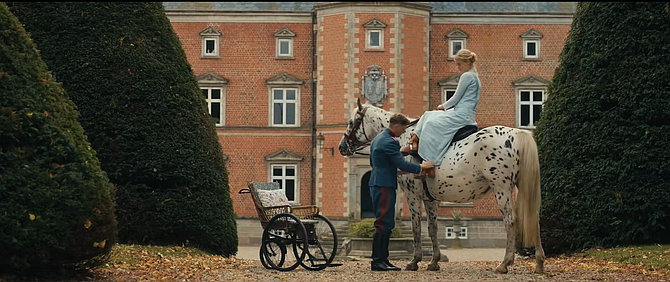
Esben Smed and Clara Rosager, lovers doomed from the fade-in.
THE KISS (2022) Billie August / Writers: Greg Latter & Bille August / Cinematographer: Sebastian Blenkov (2.35:1) / Design: Jette Lehmann / Editors: Janus Billeskov & Jansen Anne Østerud / Composer: Henrik Skram / Acted by: Esben Smed, Clara Rosager, Lars Mikkelsen, Rosalinde Mynster, David Dencik, Kurt Dreyer, Klaus Søndergaard, and Henrik Blauner Clausen / Distributor: World Wide Motion Pictures Corporation & Juno Films / Length: 116 mins.
If last week's Bound left you spoiling for a more mature approach to the topic of mental illness, you're in luck: they don’t come much wiser than 76-year-old Billie August’s (Pelle the Conqueror, The House of Spirits, Les Miserables) sumptuous downer period drama The Kiss.
We open on a hiccup. Not a technical glitch, but an audible diaphragmatic skip, originating from rich Tante Lily (Lane Lind) in anticipation of a visit from her niece Alma Abildgaard (Lone Rødbroe) and her boy Anton (Esben Smed), palms up and on the trail of a touch. Eager to restore his family's honor — dad was a bit of a bounder — Anton looks to join the cavalry. Meeting the cost of a sword, a horse, lodging, five uniforms, and a manservant is where Lily comes in.
Credits roll under stock shots of a column of mounted troops on a battlefield. (WARNING: Horses were harmed during the making of the historical footage.) Then cavalry thunders out of the fuzzy squared black-and-white frame of yesteryear and into the modern world of color and widescreen. Alas for the eager lad, Second Lieutenant Anton and his men get stuck skewering straw soldiers instead of riding into real battles. Then comes the fateful day when Anton's life is forever changed by a baron, a Model T, and a pair of ruts.
Video:
Trailer: THE KISS
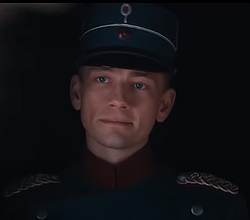
With the rear wheel of Baron Løvenskjold’s (Lars Mikkelsen) roadster whirling in a mud puddle, Anton takes it upon himself to instruct his men to extricate the auto. The baron proclaims Anton a savior, and by way of reward, invites him to dine at the castle. It’s here that Anton encounters the second rut: the baron’s daughter Edith (Clara Rosager, harrowingly menacing).
One last unforeseen hurdle stands between Anton and dinner: it seems a soldier’s horse has broken its leg and must be put down. As much as Anton would like to set a good example for his men by personally pulling the trigger, he once again assigns the dirty task to an underling. First a flat, next a hoof. If the “law of threes” holds true, can a set of paralyzed limbs be far off? Anton asks Edith to dance and is rewarded with a horrified “Didn’t you get the memo?” look that crosses her face just as the the officer catches sight of her leg braces.
Suspecting the family doctor will be more likely to lie to him regarding Edith’s prognosis than his future son-in-law, the baron uses Anton to ask if the paralysis can be cured. Further, if the doc needs to devote a few quality minutes to talking Anton into loving Edith, chances are the lad is panning for gold, not romance. Is it Edith’s love or the all-access pass to Shangri-La that comes with it that spurs Anton? No matter: in the eyes of the baron, this well-mannered yet curiously duplicitous soldier is his last chance to spare his already suffering daughter from a life of spinsterhood. He pleads on bended knee for Anton to stay, pledging his castle, his fortune, anything he desires in trade for exchanging vows.
You see, the baron has always blamed himself for his daughter's “illness.” He wanted her to ride, so ride she did, and at 18, a fall from a horse left her paralyzed from the waist down. In the terminology of the day, Edith was lame: an outcast, burdened with a much deeper-felt despair. She lacks the capacity to be loved for who she is and not pitied for the hand God dealt her. When friends at the pub later on confront Anton about marrying a cripple for her money, he denies it. Even a superior officer assures Anton that his future is with the army, not some crippled woman.
Director August has been at it for going on 50 years, and it shows in every frame. He allows time for emotions to build. Rather than relying on a stream of actor-friendly closeups, the camera adopts a distanced view of the action. One senses early on this was going to end badly for all parties concerned. There are tear-jerkers, and then there are romantic drama so intense that they render ducts too devastated to sprinkle. ****
Here's something you might be interested in.
Now Streaming: THE KISS (2023)
One senses early on this is going to end badly for all parties concerned.

Now Streaming: THE KISS (2023)
One senses early on this is going to end badly for all parties concerned.
Esben Smed and Clara Rosager, lovers doomed from the fade-in.
THE KISS (2022) Billie August / Writers: Greg Latter & Bille August / Cinematographer: Sebastian Blenkov (2.35:1) / Design: Jette Lehmann / Editors: Janus Billeskov & Jansen Anne Østerud / Composer: Henrik Skram / Acted by: Esben Smed, Clara Rosager, Lars Mikkelsen, Rosalinde Mynster, David Dencik, Kurt Dreyer, Klaus Søndergaard, and Henrik Blauner Clausen / Distributor: World Wide Motion Pictures Corporation & Juno Films / Length: 116 mins.
If last week's Bound left you spoiling for a more mature approach to the topic of mental illness, you're in luck: they don’t come much wiser than 76-year-old Billie August’s (Pelle the Conqueror, The House of Spirits, Les Miserables) sumptuous downer period drama The Kiss.
We open on a hiccup. Not a technical glitch, but an audible diaphragmatic skip, originating from rich Tante Lily (Lane Lind) in anticipation of a visit from her niece Alma Abildgaard (Lone Rødbroe) and her boy Anton (Esben Smed), palms up and on the trail of a touch. Eager to restore his family's honor — dad was a bit of a bounder — Anton looks to join the cavalry. Meeting the cost of a sword, a horse, lodging, five uniforms, and a manservant is where Lily comes in.
Credits roll under stock shots of a column of mounted troops on a battlefield. (WARNING: Horses were harmed during the making of the historical footage.) Then cavalry thunders out of the fuzzy squared black-and-white frame of yesteryear and into the modern world of color and widescreen. Alas for the eager lad, Second Lieutenant Anton and his men get stuck skewering straw soldiers instead of riding into real battles. Then comes the fateful day when Anton's life is forever changed by a baron, a Model T, and a pair of ruts.
Video:
Trailer: THE KISS
With the rear wheel of Baron Løvenskjold’s (Lars Mikkelsen) roadster whirling in a mud puddle, Anton takes it upon himself to instruct his men to extricate the auto. The baron proclaims Anton a savior, and by way of reward, invites him to dine at the castle. It’s here that Anton encounters the second rut: the baron’s daughter Edith (Clara Rosager, harrowingly menacing).
One last unforeseen hurdle stands between Anton and dinner: it seems a soldier’s horse has broken its leg and must be put down. As much as Anton would like to set a good example for his men by personally pulling the trigger, he once again assigns the dirty task to an underling. First a flat, next a hoof. If the “law of threes” holds true, can a set of paralyzed limbs be far off? Anton asks Edith to dance and is rewarded with a horrified “Didn’t you get the memo?” look that crosses her face just as the the officer catches sight of her leg braces.
Suspecting the family doctor will be more likely to lie to him regarding Edith’s prognosis than his future son-in-law, the baron uses Anton to ask if the paralysis can be cured. Further, if the doc needs to devote a few quality minutes to talking Anton into loving Edith, chances are the lad is panning for gold, not romance. Is it Edith’s love or the all-access pass to Shangri-La that comes with it that spurs Anton? No matter: in the eyes of the baron, this well-mannered yet curiously duplicitous soldier is his last chance to spare his already suffering daughter from a life of spinsterhood. He pleads on bended knee for Anton to stay, pledging his castle, his fortune, anything he desires in trade for exchanging vows.
You see, the baron has always blamed himself for his daughter's “illness.” He wanted her to ride, so ride she did, and at 18, a fall from a horse left her paralyzed from the waist down. In the terminology of the day, Edith was lame: an outcast, burdened with a much deeper-felt despair. She lacks the capacity to be loved for who she is and not pitied for the hand God dealt her. When friends at the pub later on confront Anton about marrying a cripple for her money, he denies it. Even a superior officer assures Anton that his future is with the army, not some crippled woman.
Director August has been at it for going on 50 years, and it shows in every frame. He allows time for emotions to build. Rather than relying on a stream of actor-friendly closeups, the camera adopts a distanced view of the action. One senses early on this was going to end badly for all parties concerned. There are tear-jerkers, and then there are romantic drama so intense that they render ducts too devastated to sprinkle. ****
Comments