

Here's something you might be interested in.
Ask a Hipster — Advice you didn't know you needed
Big Screen — Movie commentary
Blurt — Music's inside track
Booze News — San Diego spirits
Classical Music — Immortal beauty
Classifieds — Free and easy
Close to Home — What it’s like on the street where you live
Cover Stories — Front-page features
Drinks All Around — Bartenders' drink recipes
Excerpts — Literary and spiritual excerpts
Feast! — Food & drink reviews
Feature Stories — Local news & stories
Fishing Report — What’s getting hooked from ship and shore
From the Archives — Spotlight on the past
Golden Dreams — Talk of the town
The Gonzo Report — Making the musical scene, or at least reporting from it
Letters — Our inbox
Movies@Home — Local movie buffs share favorites
Movie Reviews — Our critics' picks and pans
Musician Interviews — Up close with local artists
Neighborhood News from Stringers — Hyperlocal news
News Ticker — News & politics
Obermeyer — San Diego politics illustrated
Outdoors — Weekly changes in flora and fauna
Overheard in San Diego — Eavesdropping illustrated
Poetry — The old and the new
Reader Travel — Travel section built by travelers
Reading — The hunt for intellectuals
Roam-O-Rama — SoCal's best hiking/biking trails
San Diego Beer — Inside San Diego suds
SD on the QT — Almost factual news
Sheep and Goats — Places of worship
Special Issues — The best of
Street Style — San Diego streets have style
Surf Diego — Real stories from those braving the waves
Theater — On stage in San Diego this week
Tin Fork — Silver spoon alternative
Under the Radar — Matt Potter's undercover work
Unforgettable — Long-ago San Diego
Unreal Estate — San Diego's priciest pads
Your Week — Daily event picks
I rent Al Gore for an evening
Torching more bridges
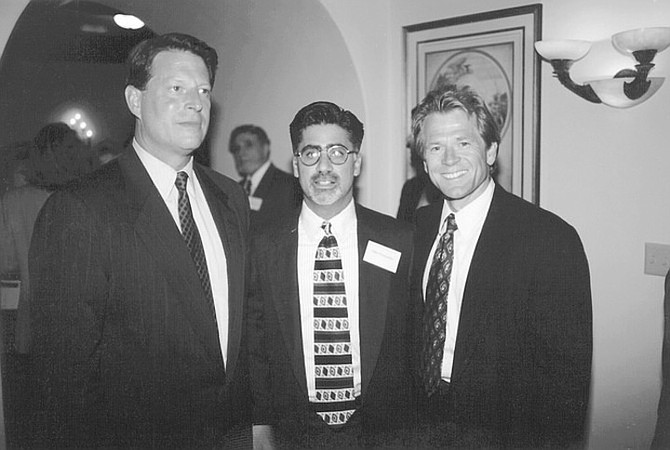
Al Gore, Michael Portantino, Peter Navarro. The Gore event almost didn’t come off at all, because at one point my gracious host Chuck Davenport nearly pulled the plug.
The Reader has started this series of its best stories from the past 52 years — 2600 cover stories and some remarkable interior features — to help make up for the loss of its physical edition, which was once large enough to hold whole oceans of print. These stories will feature all the original illustrations and photos (plus easy-to-read typography), and will include new background information about the authors — some of it taken from personal correspondences.
^^^^^^^^^^^
Read the first part of this story by Peter Navarro from Wednesday
CHAPTER 15: What's the Price of an Al Gore?
Someone to watch over me. — From the song of the same name
I took my third trip to Washington, D.C., at the end of March, hut I felt more like Santa Claus than the Easter Bunny: I was bringing the Democratic Party $100,000 in cold, hard cash in the hopes of closing a deal I had cut with the Democratic Congressional Campaign Committee (D-Triple-C) to rent Al Gore for an evening. This is not as sleazy as it sounds.
Shortly after I won the primary election, I went to visit two of my favorite people on the planet, Chuck and Darlyn Davenport. Over the years, Chuck and Darlyn have been among my strongest and most loyal supporters. Not only have these guardian angels always donated the maximum allowable under law to my campaigns, they have hosted several successful fund-raisers and solicited friends and family on my behalf. For any politician, the support of people like Chuck and Darlyn is invaluable — and all the more so because they are that rare breed of donor that gives to politics because of a sense of public purpose rather than self-interest.
Chuck and Darlyn live in a meticulously restored historic mansion in Point Loma. In this part of town, there are more conservative Republicans per square inch than there are germs on a dirty Kleenex. As a Democrat, Chuck once told me that he felt more surrounded by hostile forces than General Custer had at Little Big Horn.
On a fine and sunny chamber-of-commerce day, Chuck, Darlyn, and I sat in their spacious living room overlooking the sparkling harbor and Coronado, and even before our conversation began, I felt particularly blessed to live in my little town and have such fine friends.
Chuck started off the conversation by saying that he really wanted me to win this time and that he and Darlyn wanted to do something extra to make that happen. Besides, he thought that Gingrich and the Republicans were going way overboard in their attacks on the environment and education, and we needed to get rid of the SOBs.
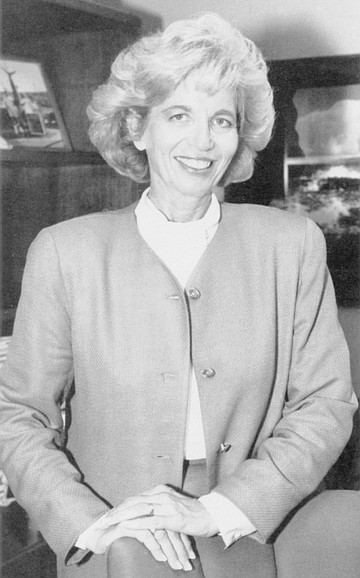 The hapless dupe that Susan Golding’s political consultant Tom Shepard recruited at her frantic behest was Dee Rich.
What Chuck had in mind was making what he called a “modest” donation to the Democratic Party on my behalf. His idea was to use that money to get some political star out to his house so that we could throw the mother of all fundraisers for my campaign. I liked the sound of that, so I asked him what kind of donation he had in mind, and he said “up to $100,000.” At that, my jaw dropped so far it almost fractured on his Spanish tile floor.
Until that moment, I didn’t know that Chuck was so wealthy. He’s not the type to flaunt his wealth. How Chuck made his money is an interesting story in and of itself. He was trained in accounting and was dutifully playing the role of the faceless midlevel executive at a nameless mid-sized company when the energy crisis hit in the 1970s. Out of that crisis emerged a whole slew of complicated subsidies for alternative energy sources. With his accounting background, Chuck figured out that you could make a bundle developing wind farms with virtually no financial risk.
Today, Chuck is the chief executive officer and major stockholder of the largest wind company in the world, Sea-West, and every time the wind blows, Chuck’s cash register goes ka-ching. What’s neat is that he’s in an industry that provides a real contribution to society — clean energy.
Once Chuck laid his money card on the table, my task was to figure out how to play it. It’s moments like this that separate the successful candidates from the unsuccessful ones because this is when you have to think fast on your feet. At least that day, I was lightning quick.
My brilliant idea was to not get Bill Clinton to come to the Davenports. Not only would the president be difficult to get, he’s just not that popular in my little town. No, the obvious choice was the vice president. Al Gore has all of the positive attributes of Bill Clinton but is saddled with none of his negatives. He’s a great big teddy bear of a political figure — Teflon coated, road tested, and everyone’s nice guy. Besides, Gore’s strong environmentalism would dovetail nicely with my own campaign themes as well as with Chuck’s interest in alternative energy. My job, then, was to figure out how to rent Al for the evening, and all I knew was that I had $100,000 to make it happen.
I should say here that the millisecond that the words “one hundred thousand dollars” popped out of Chuck’s mouth, I realized that my campaign had hit the lottery. This is because such a major gift would work on so many levels.
 My opponent would be retired submarine commander and development-industry lobbyist Harry Mathis.
Sure, it would help me raise money: By bringing the Veep in as a headliner for a fund-raiser, I could easily pull in a six-figure sum. But the Davenport gift would also separate me from the pack of challengers jockeying to be one of the D-Triple-C’s targeted seats. Such targeting would, in turn, greatly enhance my chances for mega-PAC funding — the name of the game. So leaving Chuck and Darlyn’s home, I was about as excited as I ever am with my clothes on, and I couldn’t wait to get on the horn to my Washington fundraiser, Steve Pederson, and ask him how to go about this process. When I talked to him, Steve got almost as excited as I was, and he pointed out a few more benefits of such a gift that I hadn’t even thought of.
First, the gift would give us immediate access to top Democratic congressional leaders — from Dick Gephardt, Vic Fazio, and Steny Hoyer to key players in the (California delegation like Henry Waxman and Howard Berman. The reason is that these guys want direct access to the big donors for their own political purposes, and I could be the gatekeeper in the venture. This role would allow me, in turn, to ask them to make some calls on my behalf to the PACs — and when a Dick Gephardt or Vic Fazio calls, the PACs listen.
Second, Steve said that we would now almost certainly get the full $65,000 of financial support that the D-Triple-C is allowed to provide each candidate by law but only provides to a select targeted few. And the D-Triple-C is where Steve suggested we start trying to make the Gore event happen. The man to call was Matt Angle, executive director of the D-Triple-C, and I did so the first thing in the morning.
Wheeling and Dealing at the D-Triple-C
Matt is an early-40s good old boy from Texas with a brooding Hamlet countenance that is only rarely brightened by a big wide grin. Matt found himself running the D-Triple-C because he did such a great job as chief of staff to Congressman Martin Frost, the D-Triple-C’s chairman; and I can think of no better guy to work with than Matt Angle on anything. He “gets it,” and he gets it right away, and that’s the highest compliment I can give anybody at the tactical level of politics.
At first, Matt greeted my good news with more skepticism than excitement — no doubt a prudent reaction. After all, it’s not every day that an unknown challenger for a Democratic congressional seat calls him up with a $100,000 gift for his organization. However, as I filled Matt in on Chuck’s background, he warmed up to the venture.
As luck would have it, the White House had jobbed Vice President Gore out to help the D-Triple-C build up its campaign war chest. However, the White House would only allow Gore to do three events, and, even as we were speaking, Matt and his assistant Noah Mamet were in the process of searching for two more lucrative locations — with Boca Raton already promised a date. The major criterion for landing Gore was the amount of money that could be raised. It was just like an auction. Whoever could promise the most money would get the vice president. Period.
 Bruce Henderson publicly called me the “Tom Hayden of San Diego.”
So how much does an Al Gore cost? Matt said we had to hit at least $200,000. I said that would be a piece of cake because, in addition to the Davenport check, we could easily raise another $100,000 at the event itself.
So we met the most important criterion for getting Gore, but what also worked in our favor was that the Davenports were fresh donors who had never contributed to the Democratic Party. That meant that of the $100,000 they were offering, a full $40,000 was precious “hard money.”
The beauty of hard money is that it can be given directly by a political party to a candidate and be used for any purpose. But there is a strict $20,000-per-person contribution limit per election cycle. In contrast, soft money, which can be given in unlimited amounts, must be laundered through local- and state-party organizations to provide indirect — and less effective — help through mechanisms such as voter-registration drives and get-out-the-vote efforts.
The beast of hard money is that the Democratic Party has a smaller number of large hard-money donors relative to the Republicans, so the Republican Party has a distinct advantage in the hard-money category. To get an idea of the order of magnitude of this problem, suppose the D-Triple-C wants to contribute the maximum $65,000 of support to just 100 of the 435 candidates running for Congress. That’s $6.5 million, and it all has to be hard money. That’s easy for the deep-pocket Republicans, but it’s a dachshund stretch for the dog’s lunch Dems.
The bottom line here is that new donors like Chuck and Darlyn and the hard money they can bring to the table are literally worth their weight in gold, so by the end of my first conversation with Matt Angle, he was as stoked about the Al Gore venture as I was.
I told him I would be in Washington, D.C., next week, and perhaps between now and then, he could work out some of the details with the White House. I also indicated that there were important things to negotiate to ensure that my campaign directly benefited financially from the Gore event at the same time that the D-Triple-C got its $200,000.
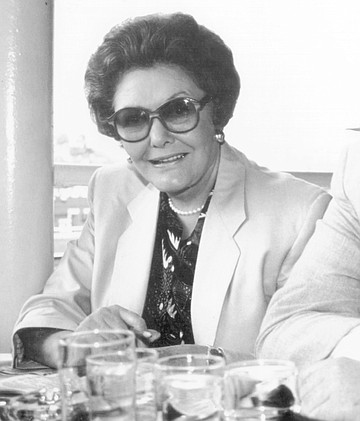 Helen Copley. When Jim Copley himself wound up on the obituary page, Helen inherited the whole shebang.
Matt said he’d be happy to hammer all this out in a week hence, but the one thing he had to do before then was check the bona fides on the Davenports. The two big questions: Did they really have the money or were they just blowing smoke? And were the Davenports the type of fine, upstanding citizens that the vice president and the White House wanted to be associated with?
I assured him that the Davenports were as clean as Rocky Mountain rain and suggested a conference call between Matt, Chuck, and me where Matt could ask Chuck about his willingness to donate. It was probably one of the shortest phone calls in political history. The next day, as Chuck and I huddled around the speaker phone in his home office. Matt popped the $100,000 question. Chuck simply said “yes.”
After a long pause at Matt’s end — he expected Chuck to say more, but Chuck rarely does — Matt said he would need at least $50,000 of the gift up front as earnest money to make it all happen. Chuck said he would be happy to send it with me to Washington next week to seal the deal. Another long pause. Then Matt said. Great, it’s done. I’ll see you next week.
For my campaign, this was like striking oil, hitting a home run, and getting lucky on a lonely Saturday night all at the same time. I couldn’t wait to get on that big bird to the land of cherry blossoms and bull dung.
CHAPTER 16: PAC Attack
No snowflake in an avalanche ever feels responsible. —Stanislaw Jerzy Lec
Washington, D.C, is a remarkably beautiful city. Any damn fool who flies into the place on a clear and sparkling night as I did in late March can see that, and God bless the architect Pierre-Charles L'Enfant for the type of long-range planning and foresight that the political denizens of the Washington deep rarely exhibit.
On this, my third trip to the land of milk subsidies and honey price supports, there were two things to accomplish. One, of course, was to nail down the Al Gore event with Matt Angle at the Democratic Congressional Campaign Committee. The other was to continue my magical mystery tour of the several hundred PAC directors on my target list.
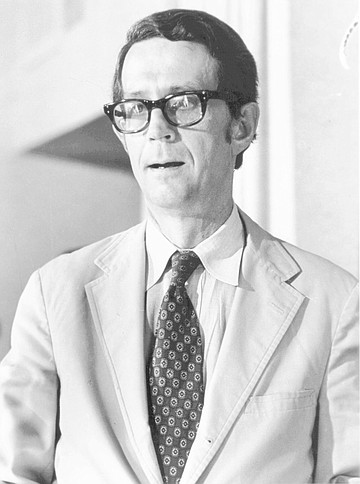 Gerald Warren asked me my position on NAFTA, the North America Free Trade Agreement. I told him that, as an economist, I supported free trade but opposed NAFTA. Warren appeared to turn down his hearing aid and left the room.
That’s all you need with these PAC types: one face-to-face meeting. They take your measure, you take theirs, and the rest is follow-up phone calls. But without that face-to-face, you’re a half step behind the competition, and in the PAC game, the competition is fierce.
During my first two trips to D.C., my PAC fund-raiser Steve Pederson and I had done a good job making the PAC rounds. Over a span of eight working days, Steve had introduced me to 40 of the major PACs.
My favorite PAC directors so far were Linda Canan of the American Federation of State, County and Municipal Employees and Kenny Montoya of the Air Traffic Controllers.
Linda is bright, cheerful, and not yet jaded by the congressional candidates who descend on her every two years like a swarm of locusts. Unlike 98 percent of the PAC directors, she returns phone calls, so that alone makes her a pearl among whines.
Kenny has a warm, infectious grin and a kind habit of telling you when and how much money his PAC can donate to your campaign before you even ask. It is a nice change of pace in a world where begging on both knees is the norm.
My least favorite PAC director was Marta David of the AFL-CIO. Imagine a drill sergeant with a cattle prod suffering from chronic paranoia and you get the idea of how unpleasant it was to spend time with this insufferable martinet.
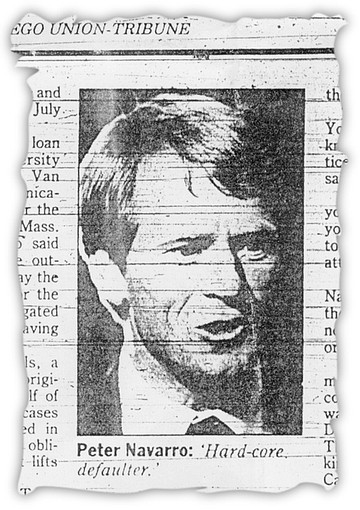 Union-Tribune, October 16, 1992. Under my picture, the caption read, “Hard-core defaulter” — no question mark, just a statement of fact.
I had met Marta on my second trip to D.C. months before. This was when the AFL-CIO was already beginning to unveil its $32 million attack ad campaign against a targeted list of vulnerable freshman Republicans. As with wooing the D-Triple-C, my job as a candidate was to make sure that the 49th Congressional District of San Diego was part of the AFL-CIO’s target, and it was up to Marta and her boss Steve Rosenthal to make that decision.
As it would turn out, the AFL-CIO would commit the same strategic mistake as Martin Frost and the D-Triple-C did by starting their anti-Gingrich propaganda far too early in the election season. AFL-CIO leaders like John Sweeney further compounded the problem by publicly bragging about the big bucks they were throwing about. This braggadocio generated lots of bad press, discontent in the rank and file, and an 11th-hour voter backlash against the very candidates the AFL-CIO was supposed to be helping.
The ultimate result of the AFL-CIO’s ham-handed approach was to give Republican strategists time to inoculate their candidates against the attacks of big labor, and I’m certainly not giving away any of the plot of this story if I tell you that of the numerous Republican freshman targeted by labor, only a handful lost.
The irony of this for my campaign was that I would wind up getting the worst of both worlds from the AFL-CIO: I would be accused by my opponent of having big labor do my dirty work, but the AFL-CIO would never actually drop a bundle in my district to attack Bilbray.
The Daily Grind
On this third trip to D.C., my PAC fund-raiser Steve Pederson wanted to kick things up a notch, so our schedule was unusually brutal: From 8:00 a.m. to 6:00 p.m., there would be one PAC meeting per hour with no time budgeted for lunch. That’s ten PAC directors a day, so over the space of a four-day trip like this one you can knock off almost one-fourth of your PAC primary target list.
To pull off such a tight schedule, you have to budget no more than a half hour for each meeting and then hope you can slalom your way through the D.C. traffic In another half hour to be on time for your next appointment.
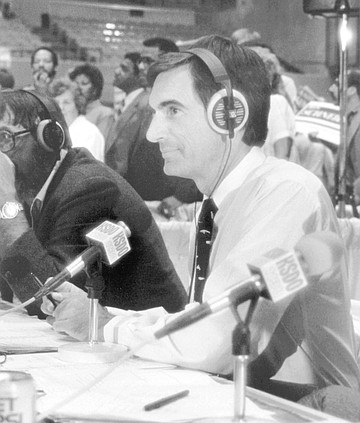 Roger Hedgecock: "You mean the Tom Hayden of San Diego politics, that no-good carpetbagging limousine liberal? The guy who cheated on his student loans and made Susan Golding cry?"
On this first day, Steve and I started out with the American Nurses Association. The ANA PAC leans Democratic, they’ve got a pretty big war chest, and Steve figured that this one should be bankable.
The ANA’s rep was a young woman named Jennifer Sassel. Imagine a Valley Girl with a thick Boston accent, and that’s Jennifer.
Now every PAC has its issue list, and for the nurses, the big issues are job security in a world of HMO downsizing and being allowed to encroach more and more on traditional physicians’ turf — writing prescriptions, diagnosing, and so on.
Of the two issues, the HMO one is the far more serious. Medical professionals are being devastated by the consolidation of the industry into large monopolistic gatekeepers of health care. What you have now in this new market is a monopoly middleman — the HMO — that exploits doctors and nurses on the producer side of the health-care equation and patients on the consumer side.
I told Jennifer that, as an economist, I thought the HMO trend was very unhealthy and that the central problem with HMOs is that they have a financial incentive to not treat people rather than to treat them.
Jennifer loved to hear this, and the best part was that I was sincere in expressing views consistent with the ANA. In fact, for me, having these policy discussions was the fun of PAC-wooing. I am, after all, a policy wonk by profession, and by visiting the PACs, an academic such as I can learn a lot through a real-world lens — encrusted with political grease though it may be.
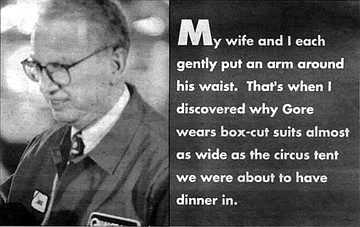 Irwin Jacobs. The entrepreneurial Jacobs has a reputation for coming in at the eleventh hour and buying things up at bargain prices, and this is what I think he might have done with the Gore visit.
Unfortunately, over the next several months, romancing the ANA would be a whole lot of unrequited love. In the end, they sold my carcass down the river and stayed out of the race. Jennifer’s reason was that my Republican opponent Brian Bilbray was on a key congressional committee (Commerce), and the ANA didn’t want to risk alienating him.
This is a problem I would bump into again and again. Newt Gingrich is a shrewd man, and he knows that the best way to ensure the reelection of vulnerable troops like Bilbray is to put them on powerful committees like Commerce and Ways and Means. Being on these committees not only allows the members to raise larger sums of money than the poor stiffs stuck on lesser committees, it also helps cut off the money of any potential challengers, as it did for me with the ANA and numerous other PACs.
The bigger problem with the risk-averse political behavior exhibited by the ANA is that it reinforces the institution of incumbency at the same time as it dims the prospects that the Democrats will ever win the House back. Of course, when Gingrich and the Republicans inevitably wind up screwing the ANA and the many other Democratic-leaning but weakkneed PACs that refuse to back a Democratic challenger over a Republican incumbent, these cautious folks should look no farther than the mirror to understand how the hot poker wound up up their butts. But as the saying goes, “No snowflake ever feels responsible for an avalanche,” and the ANA will never assume any responsibility for Newt Gingrich retaining his majority.
Of Cabotage and Kings
At our next stop, the Air Line Pilots Association (ALPA), Steve and I learned about the mysteries of “cabotage.” This is the practice of allowing only American air carriers to fly domestic routes. In other words, with cabotage, you’ll never be able to fly Lufthansa or Nippon Airlines from Detroit to New York. Keeping foreign carriers off American routes is essential to preserve the monopoly power of the pilots as well as the oligopoly power of the domestic airlines.
The main man at ALPA is Jerry Baker. He walks, talks, and acts like an airline pilot, but he isn’t. What he is is a good navigator around the hostile skies above Capitol Hill. Jerry is a cautious man by nature, and he would take considerable wooing to extract a modest contribution.
Not so with the Teamsters. They do their PAC screening in a tag team. Bill Hamilton is an ex-radio jock with a golden voice and sardonic manner. His flat-line personality is nicely offset, however, by the enthusiasm of the younger, hipper, and more hyper Mike Mathis.
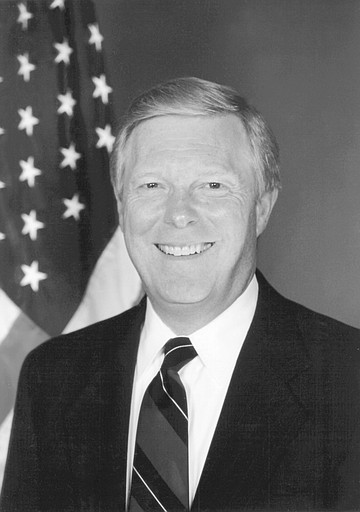 Richard Gephardt was ready to go to the mat for candidates like me because he knew we held the keys back to power.
The Teamsters’ main issue is loyalty: vote the labor line and they’ll love you to death. Cross them and they’ll put you in the political equivalent of cement boots. I’ve got no problem with that because I strongly support labor issues, and I liked these guys.
In fact, in the initial stage of the campaign, the Teamsters would be a great help to me, and they would be the second PAC to deliver the maximum check to my campaign coffers. However, in the end, the Teamsters, too, would fail me, and in a big way. The problem was internal. There was an election looming for Teamster president between the incumbent Ron Carey, who had started to clean up the union, and the challenger James Hoffa Jr.
I would have the misfortune of living in a city in which the local Teamsters chose the insurgent Hoffa side. As part of their punishment, Carey refused to honor the local’s request for additional PAC assistance for me.
Unfortunately, the same thing would happen to me with the Communications Workers of America union. In that case, the local guy, Tim Sexton, backed the wrong man for state president, and I wound up the poorer for it.
I’d like to say these were isolated events and that most of the unions have their acts together, but such is not the case. Indeed, far too many unions let internal politics interfere with broader goals like winning back the Congress from antilabor Republicans, and that is a good part of why union power is declining.
The D-Triple-C Negotiations
At day's end, Steve and I wound up hungry and exhausted at a hole-in-the-wall restaurant a stone’s throw from Capitol Hill. Our day’s work was far from done, however. After a quick burger, we hiked the few blocks over to the headquarters of the Democratic Congressional Campaign Committee to meet executive director Matt Angle. We were doing this meeting after regular business hours so I could maximize my PAC contacts during the day; and Matt Angle liked the fact that I had requested an evening meeting. It was a subtle but nonetheless strong cue that I knew how the money game was played and that I had my priorities straight — raising PAC money.
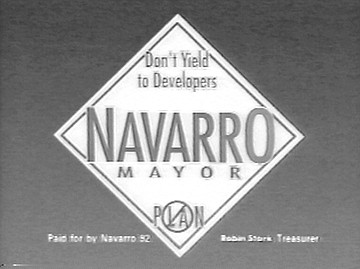 In the general election, I flat-out wanted to drop the “Don’t Yield to Developers” theme and move on a “Jobs and Economy.”
The D-Triple-C building looks, perhaps appropriately, like a concrete bunker, and the building’s interiors are about as far from opulence as Oprah is from intellectualism. After introductions and a brief exchange of pleasantries, Matt and I got down to business.
He started off with the good news: the Davenports had passed the White House background check with flying colors, and the vice president’s office had tentatively signed on to the Davenport fund-raising event. I told him that was great but that I had three points to cover.
First, Chuck Davenport’s concern was to establish that the primary purpose of bringing Al Gore to San Diego was to raise money for my campaign — not just for the D-Triple-C. This brought up a delicate issue because, as Matt informed me, neither Bill Clinton nor Al Gore as a matter of policy raised money directly for candidates but rather only for the party organizations — the Democratic National Committee, the D-Triple-C, and the Democratic Senatorial Campaign Committee.
The White House had adopted this policy as a defensive measure: If it raised money for some candidates, jealous others would demand the same favor and things would get out of control. So as far as the White House was concerned, Matt insisted, the purpose of Gore’s visit must be to raise money solely for the D-TripIe-C.
Matt is nothing if not savvy, however, so he quickly offered a way for us to bend this rule. Specifically, if a donor were to contribute to my campaign, he or she would be allowed a “credit” toward the cost of the event.
The cost, by the way, would be a hefty $5000 per couple. Thus, under Matt’s scheme, if my campaign got a donor to come to the event, the donor could give me the maximum of $2000 per couple, and they would only have to pay $3000 more to meet the Veep. To grease the wheels for this deal, I would be listed as a special cohost on the invitation.
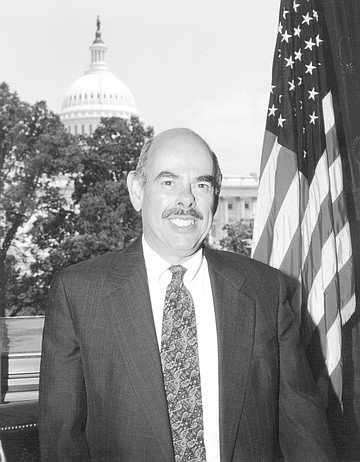 In West Hollywood and Brentwood and Bel Air, Henry Waxman is as close to a political god as you can get.
At the same time, the D-Triple-C would pay for the postage and printing to send out a second letter with a remit envelope to all of the invitees explaining the “Navarro option,” and to make it work, Matt promised that the event coordinator, Noah Mamet, would quietly work the Navarro option for us on the phone as he rounded up donors.
Under these rules, there was no reason why my campaign shouldn’t be able to raise at least $50,000, and we could do this without explicitly violating the White House policy. It was a generous offer from Matt, a win-win for everybody, and a sign of his good faith. The second negotiation point was to start extracting some of the $65,000 that the D-Triple-C could legally donate to my campaign. This, too, was a delicate matter because, by law, there can be no earmarking of funds. In other words, I, as a candidate, can’t go out and get a guy like Chuck Davenport to give the D-Triple-C money under the assumption that they will simply launder it and hand it over to me. However, there is at least a tacit understanding on both sides of the political aisle that any candidate who helps his party raise money is more likely to get some help in return.
My thinking was to start out small with Matt: What I asked for — all the while making it clear that it had nothing to do with the Davenport gift — was some help financing a public-opinion poll to see where we stood in the race.
This request, in fact, was a risk on my part. If the D-Triple-C paid for the poll, it would own the results, and if the poll came back highly negative, any chance of raising big bucks from the D-Triple-C, as well as from the PAC community, would go right down the chute. Nonetheless, I believed this was a gamble worth taking for several reasons.
For one thing, I didn’t want to spend the $15,000 that it would cost to do the poll. But I also thought the poll would be a more powerful fund-raising weapon if it were done independently by the D-Triple-C. That way, none of the PAC directors could accuse me of cooking the books — a common practice among candidates who do their own polls. Finally, by getting the D-Triple-C to pay for the poll, I could get the pollster I wanted, a fellow named Bob Meadow of Decision Research.
I’ll introduce you to Bob later, but for now, you should know that he had polled against me during my mayoral and council races, and he had also done a poll for Bilbray years before when Bilbray ran for county supervisor. In this race, Bob wanted to work for me, and we had started down that path. However, when his association with my campaign became known, political consultant Tom Shepard had put some screws to him, and he had backed away. We could solve that thorny problem by sticking a third party between us — the D-Triple-C — and that suited me fine.
 Nancy Pelosi. Steve’s goal with Pelosi was to have her help organize a San Diego fund-raiser that featured all of the women of the California delegation.
Matt readily agreed to fund the poll for the simple reason that he, too, wanted to find out if I had a chance. It looked to Matt as if I were emerging as a strong candidate, he thought Bilbray was a lightweight, and, hey, Matt’s job was to get back the Congress from the Republicans, and this was one of the seats he’d have to get to do it.
The last part of the negotiation with Matt involved a local San Diego congressman named Bob Filner. As I shall explain in detail shortly, the Democrat Filner is a prickly personality who has a well-deserved reputation for horning in on other people’s fund-raising events.
In fact, Filner had managed to steal away a White House event from Lynn Schenk during her failed reelection bid, and in the process, he had cost her tens of thousands of dollars in campaign donations as well as a great media opportunity. Three years later, Lynn was still steaming from this, and in her ongoing mentoring of my candidacy, Lynn had urged me to put the “Filner problem” right on Matt’s table and get it dealt with.
My negotiating position was that this was my campaign event and that while Filner would be invited as a courtesy. he would not speak and he would not enjoy any of the financial spoils of the hunt. While Matt said that it was his job to serve all the Democratic members of Congress, he also promised that Filner would not be allowed to poach on our turf.
With that, Matt and I shook hands on the deal, I handed over Chuck’s $50,000 check, and Steve and I left the D-Triple-C flying above at least cloud eight. There were bogies in the sky, however, waiting to shoot us down, and one of them was piloted by none other than the treacherous Bob Filner.
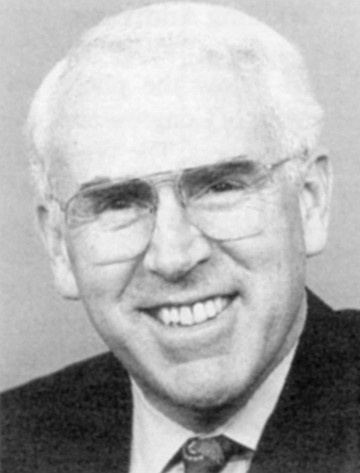 If you are going to get on the leadership’s targeted list, it’s got to be Vic Fazio who gives you the nod.
CHAPTER 17: Me and Bill Clinton, Part 1
It's great to be in San Francisco. — Bob Dole, upon arriving in San Diego
My first of what would be three encounters with President Clinton came in early June. The president was in town to give Bob Dole a clinic on how to run for office. It was an impressive display of high campaign art in which Clinton played the elegant Matisse to Bob Dole’s bumbling housepainter.
For the life of me, I cannot figure out how a political party with so much money and so much intellectual horsepower could allow itself to be saddled with a presidential nominee as inchoate and incompetent as Bob Dole.
What brought the president to town was a vicious — and misplaced — attack by Dole on U.S. Attorney Alan Bersin. Bersin’s office has jurisdiction over more than 1000 miles of border, and he is the de facto immigration czar for the western United States. Unlike many political appointees, Bersin is up to his difficult job, which is another way of saying that Dole picked the wrong guy to mess with.
Nonetheless, in late May Dole blew into San Diego with Governor Pete Wilson in tow for the obligatory genuflection to the Father, Son, and Holy Ghost of Southern California politics: crime, illegal immigration, and affirmative action. In Southern California, these three issues are so potent and so thoroughly dominate other issues such as education and the environment that any politician who is, quite literally, on the “right” side of them can not only lock up all the Republican support, he can chisel away at large chunks of the Democratic base, particularly frightened seniors and white-and-angry blue-collar men.
On this day, Dole was trying to hit two of the three points of the fear-mongering trinity by attacking Bersin for being lax on illegal-immigrant drug smugglers. To make his case, Dole held a press conference in City Heights. This, of course, was really dumb because City Heights is an overwhelmingly Democratic neighborhood. It was easy for Clinton’s rapid-response team to pull a General Custer on Dole, that is, surround the hapless fool with shouting demonstrators.
 Howard Berman. So Vic’s suggestion was for me to contact Los Angeleno Howard Berman and ask him to play the role of mentor and advocate.
Location wasn’t Dole’s biggest mistake, however. That mistake was attacking Alan Bersin. Going after Bersin is like riding a bicycle without a helmet really, really fast into the Rock of Gibraltar. This is San Diego’s golden boy — a patrician tough guy cut in the mold of Teddy “walk softly but carry a big stick” Roosevelt.
Bersin was a star guard on the Harvard football team, a Rhodes scholar who roomed with Bill Clinton at Oxford, and he is a man who has earned praise from both sides of the political aisle for his aggressive approach to the impossible job of controlling the U.S. border.
Dole’s attack on Bersin was based on an article published several days before in the Los Angeles Times. The article reported that, rather than prosecuting drug smugglers from Mexico who had been caught with less than 125 pounds of marijuana, Bersin’s office was slapping them on the wrist with a deportation.
On the surface, such a revelation looked like filet mignon to Dole’s press lions, but the problem was that the Times had subsequently issued a nine-paragraph clarification that substantially exonerated Bersin from any criticism. That didn’t stop Dole, however.
Clinton’s response to Dole's attack on Bersin was swift and massive. In the political equivalent of laying down mortar rounds to soften up the lines before the president’s invasion, the Clinton team first lined up third parties to lambaste Dole for lying about the Times article. In doing so, these spin doctors turned Bersin into a martyr wrongly nailed to the cross of presidential politics, and the spin was so good that the Clintonites even had the Republican San Diego Union-Tribune rushing to Bersin’s defense.
With this foundation laid down, Clinton flew Air Force One into town for the final bombing and strafing of Dole’s pathetic little village of campaign idiots. The weapon of choice was a presidential speech in which Clinton was surrounded by a gaggle of fawning Republican law-enforcement officials — all gathered at the strongest symbol of law and order in the city, the gleaming police headquarters.
 When a political handicapper like Charlie Cook says you can’t win your race, he's just saddled you with an extra hundred pounds of weight to carry around the track.
My New-Found Status
It was during the preliminary scheduling of Clinton’s event that I celebrated my new-found status as the Democratic nominee in the race for the 49th Congressional District. Before the primary election, Clinton had visited San Diego, but my campaign’s attempts to cozy up to him had been rebuffed. This time, however, as the official nominee for a seat the president needed to get back his majority in Congress, we didn’t even have to call. Instead, Ray Martinez of Clinton’s advance team called us, and he assured my campaign manager that we would get all the help they could lend down the road.
The only bummer about this trip was that it was an official rather than a campaign visit; that meant there could be no joint press opportunities. Nonetheless, I was more than happy with my half a loaf — a VIP seat in the front row at the event. This placement would allow me to strut my stuff in front of several thousand screaming Democrats and also legitimize my candidacy with the other Democratic VIPs who would be in attendance — from major campaign donors like Sol Price and Murray Galinson to Democratic politicos like city councilmembers Valerie Stallings and Chris Kehoe.
As is his custom, the president was late for the event, and on this day, the wait was grueling. While Clinton was supposed to be there at 11:00 am, by high noon, he still hadn’t showed, and the bright San Diego sun was bearing down on the sweltering crowd like a red-hot broiler at a Burger King.
Rather than sweat through my pinstripes in my seat, I used this waiting time to work the crowd. Retail politics happens to be one of my best skills as a campaigner, and it’s probably because, unlike many politicians, I like to go out and shake hands. During a campaign, the trick is to spend no more than 15 to 30 seconds with anyone and to keep moving so that you not only shake a few hundred hands but also have a thousand people see you doing it.
Such a maneuver Is harder than it looks because most candidates will get into a crowd, and, within a few minutes, some motormouth will collar them and bend their ear for 15 minutes. The way around this, mon candidate, is to pretend you have a destination you are moving toward and can’t be late for. That way, no one can ever call you rude.
A Lesson Learned
During my retail-politics reconnaissance of the crowd, one hand I didn’t shake — because she refused to offer it — was that of Christine Kehoe, the only openly gay member of the San Diego City Council. Kehoe is a bespectacled lesbian with the thick, amorphous body of a bull dyke gone to seed. She’s also one of the coldest fish that I’ve ever met in politics. Her coldness to me is, however, mostly my own fault.
 Tom Shepard. Hedgecock used Shepard's consulting firm to launder money. Shortly after Hedgecock took office, he and Shepard were indicted. Shepard cut a deal that strengthened the D.A.’s case against Hedgecock.
Five years before, during a voter-initiative drive that my growth-management organization PLAN! was spearheading, I had had the poor judgment to read Ms. Kehoe the riot act. The situation was this:
PLAN! had spent over $100,000 qualifying a ballot initiative to manage growth in San Diego, but a hostile Republican judge had thrown the initiative off the ballot because of a legal technicality. However, because PLAN! had gotten over 100,000 signatures to qualify the petition, the mayor of San Diego at the time, Maureen O’Connor, wanted to put the initiative back on the ballot sans the illegal section, and she was helping me try to line up five of the nine votes on the council to do it.
We had four solid votes at the lime, but the fifth vote we had to get was that of Democratic City Councilman John Hartley. By all measures, Hartley should have been our strongest supporter since he had campaigned on the growth-management issue. However, Hartley had aspirations of running for mayor in 1992, and that left him vulnerable to lobbying by the powerful building-trades unions who opposed the initiative.
After realizing that Hartley was about to stick the knife squarely in my back, I wound up in his office in a shouting match. The person I was shouting at was not Hartley — he had gone into hiding before the big vote. Rather, it was his chief aide, Chris Kehoe. My mistake was to shoot the messenger — Kehoe — and to do it with a messy round of verbal buckshot.
Mon candidate, you can’t do things like that in politics and not expect them to catch up to you. Several years later when Kehoe had replaced Hartley on the council, she would exact her revenge by supporting my Republican opponent, Ron Roberts, in our matchup for the county board of supervisors. Her opposition helped cost me that election because it whittled off about 10 percent of the gay vote.
I should say here that in that race, I think Kehoe would have sold me out even if I had never offended her. However, my bad-tempered behavior just made it that much easier for her.
The reason she probably would have sold me out is that to advance her own political agenda on the city council, Kehoe had thrown in her lot with Mayor Susan Golding and Ron Roberts. While these two Republicans had helped Kehoe get funding for her AIDS projects and thereby appease her gay constituencies, Kehoe had gone along with the Golding-Roberts Republican line, particularly on issues like growth and the environment. For all practical purposes, the Democrat Kehoe is a Republican except when it comes to gay politics.
Anyway, my conversation with Kehoe was as brief as it was unpleasant. Before I even opened my mouth, she said, “I don’t care what you say to me now or ever, I’m not going to endorse you for Congress.” When I asked her if we could at least talk about it, her reply was equally succinct: “We have nothing to say to each other.”
This time, I just smiled. My days of throwing tantrums were long behind me, and it was Kehoe who was practicing bad politics. There was no need for her to gratuitously alienate me. A simple “no” to my entreaties would have sufficed so long as it was accompanied by a smile and some believable excuse about how she had to get along with my opponent Bilbray to get federal funds for the people in her district.
The Speech
As I disengaged from Kehoe with a bad case of frostbite, “Hail to the Chief” started to boom over the loudspeakers. Clinton had finally arrived, and, in short order, the day’s program began. It was a program of sheer political brilliance — one that I have never, ever seen the likes of.
What the Clinton team had done was to co-opt every major Republican law-enforcement official in the county, all of whom were now on the dais with him solemnly kissing his keister — from Police Chief Jerry Sanders and Sheriff Bill Kolender to District Attorney Paul Pfingst. Indeed, each of these top cops tried to outdo the last in praising Alan Bersin and the president for embracing the toughest anti-immigration policies of any administration in the last 20 years. Take that. Bob Dole!
In truth, all of these Republicans campaigning for Clinton should have done what Mayor Susan Golding did that day — found other pressing engagements. But the presidential seal is a powerful magnet and, I suppose, each of these guys wanted to see himself on the tube that night with the Prez.
Walking away from that masterpiece of campaigning, I was feeling good about my chances of beating Brian Bilbray. Not only was I now sure that Clinton was going to whip Bob Dole pretty good and give me some nice coattails to cling to, I also got the feeling that the White House would get behind my candidacy — a premonition that turned out to be correct.
Chapter 18: The Uncoordinated Campaign
One for all. All for one. — Motto of the Three Musketeers
If I were to win my congressional race, a lot of things would have to go right. One of them would be the successful execution of the Democratic Party’s “Triple Overlap Strategy.”
Within every one of the 40 state senate districts in California, there are two state assembly districts. Typically overlapping this senate and assembly turf is a single congressional district. Hence, for any given piece of political soil in California, there is a “triple overlap” of senate, assembly, and congressional seats.
The turf where my congressional race would be contested was not just any triple overlap, however. Rather, it was one of a small handful of such clusters statewide where the balance of power would be determined not only in Congress but also in the state senate and state assembly.
In the state senate race, the Democratic Party badly needed Assemblywoman Dede Alpert to move up to the senate seat being vacated by the retiring Lucy Killea. Otherwise, the senate might fall into Republican hands — as the state assembly had done in the last election.
To take back that state assembly, the Democratic Party had to help incumbent Susan Davis hang on to her assembly seat. It also had to help the relatively unknown Howard Wayne capture the open assembly seat being vacated by Alpert.
Given the overwhelming strategic importance of this triple overlap, it is hardly surprising that the California Democratic Party wanted to focus its entire San Diego campaign on the territory encompassing my 49th Congressional District. What may be surprising, however, is that the party coordinated that campaign so poorly—unless you’re familiar with the Will Rogers bon mot: “I don’t belong to any organized party. I’m a Democrat.”
The Three Musketeers
The original plan was to have all four candidates — Dede Alpert, Susan Davis, Howard Wayne, and yours truly — pool resources to hire a Triple Overlap coordinator. This person would run the effort under the auspices of the Clinton-Gore coordinated campaign.
I was excited about the idea because the woman on tap to run the Triple Overlap was Gayle Jaskalainen. Not only was she a strong ally of mine and a good friend of my campaign manager’s, she was also one very good organizer.
More broadly, such campaign solidarity among the four candidates would mean an efficient and far less expensive canvassing and voter-contact effort. A coordinated ground operation would, in turn, save my campaign a lot of money and thereby liberate that money so it could be spent on more TV ads.
Unfortunately, just as the deal was about to be consummated, it crashed and burned. There were two reasons. The first is that the women of the Triple Overlap — Dede Alpert and Susan Davis — bailed on the men, Howard Wayne and yours truly. The second reason had to do with Congressman Bob Filner. Let's start with my “women problem” first.
In her early 50s, the gray-blond Dede Alpert has a reputation for being one of the nicest, smartest, most congenial, and most effective legislators in Sacramento, and, after you get to know San Diego's "Miss Manners,” it’s hard not to agree with that assessment. However, because of her popularity, Alpert looked to be a lock for winning the senate seat she was pursuing. That meant from her point of view, there was nothing to be gained from throwing her lot in with either me, who carried a lot of negative baggage, or the virtually unknown Howard Wayne, who would have trouble carrying his own financial weight in a coordinated campaign.
This same risk-averse attitude was shared by incumbent Susan Davis; and of the two assembly races — Howard Wayne’s and hers — Davis’s race was by far the easier. This was because while Davis had direct access to the cesspool that is Sacramento lobbying money, Howard Wayne didn’t have a financial pot to piss in. In fact, Howard had gone into considerable personal debt just to win his primary election, and he was flat broke.
So early on, the two Musketeers — Alpert and Davis — rowed off in their lifeboats, leaving Howard Wayne and me to sink or swim. At the same time, the third Musketeer, Congressman Bob Filner, effectively ran his selfish sword straight through the heart of the Triple Overlap. So much for “One for all, and all for one.”
Filner's Coup D'etat
It was my and my campaign manager’s distinct impression that Filner was opposed to the Triple Overlap Strategy, because it meant that all the resources of the Democratic Party’s efforts would be focused away from his congressional district. Never George Stevens mind that Filner was going to win his race by 20 points, running as he was in a heavily Democratic district against a refugee from the lunatic fringe. Nope, better that Bob make really sure of his very sure thing.
Well, I don’t know just how Filner did what he allegedly did. What I heard is that he first called his buddy Shelia Lawrence — widow of the late Larry Lawrence — who, in turn, called her buddy John Emerson in the White House who, in turn, called Tom Umberg at the California Clinton-Gore office. But if and however Filner did it, one day my friend Gayle Jaskalainen was in as the director of the coordinated campaign and the next day she was out — replaced by Filner’s former chief of staff, Vince Hall.
With this coup d’etat, the message was clear. Vince might look as if he would focus on the Triple Overlap, but you knew that Filner would get more than his share of resources. And that’s what happened. But I’ll save Vince Hall’s best work for a later chapter. For now, let’s do a day in the life of a candidate running for Congress.
CHAPTER 19: Long Day's Journey into Night
You like me. You really like me! — Sally Field at the Oscars
If after reaching this point in my cautionary tale you still harbor illusions that being a candidate for Congress is either (a) glamorous or (b) a barrel of laughs, you may want to skip this chapter — at least if you want to maintain those illusions. Because by April, I had settled into a monotonous and tedious daily routine that involved two things: raising money and walking precincts. Here’s a day in the life.
Up at 5:00 a.m., a hot shower, a cold breakfast, then on the phone by 6:00 a.m. calling PAC directors in Washington, D.C., for money. It’s a great advantage to run for Congress from California when it comes to PAC fundraising. This is because you can make all your calls to the Hast Coast during their prime time — 9:00 a.m. to noon — before the business day even begins in sunny Southern California.
As for which PACs I would call, I’d start with the first letter of the alphabet — AFL-CIO, AFSCME, and Air Line Pilots Association — and work my way to the end — United Transportation Workers, Voters for Choice, and Zond. It would take about a week to work through the several hundred PACs on my list, and then I’d start over again. Through the course of the campaign, I must have called every PAC in D.C. at least ten times begging for bucks, and if I’m known for anything back there, it is for being persistent.
At 9:00 a.m. — noon and power-lunch time in D.C. — I’d jog around the fish pond next to my condo. Thirty minutes later. I’d be back on the phones. At that point, I would cycle through all the state and local contacts for the PACs I had been talking with in D.C.
For example, if I had spoken with George Landers of the United Food and Commercial Workers in D.C. that morning. I’d touch base with John Perez up in Buena Park and Norm Bell locally. Or if Chris Tully at the Amalgamated Transit Union told me he still hadn’t heard from their local union requesting funds. I’d call and badger Ted Closter of the local bus drivers’ union to send them the requisite memo.
Once these calls were through, I’d shift gears to my local-donor base fundraising. I’d call people at work for whom I didn’t have home phone numbers. For some reason, there was a high preponderance of lawyers on this list, and as a group, I can’t think of any folks who are harder to get money from, except, of course, physicians, who are tighter than a Beverly Hills face-lift when it comes to political donations.
By lunchtime, after five hours on the phone, somebody from my staff would mercifully come over to my house to discuss the campaign. Most of the time it would be my local fundraiser Kerry Martin.
Kerry was a dream hire, about as efficient as they get, and she did a heck of a job. My only problem with Kerry was making sure she didn’t get discouraged at all the refusals we were getting when she asked for money. I tried to explain that this was typical, and if we had as high a success rate as even the 30 percent she was hitting, we were doing well. But I know it was tough on her because she hadn’t done it before.
Besides Kerry, Dale Kelly Bankhead, my campaign manager, might come over and update me on the latest campaign news. At other times, my field coordinator Tom Husted would brief me on our progress in the trenches.
Unfortunately, my meetings with Tom were always depressing because we were continually falling short of our voter-contact goals. This was partly because Tom couldn’t get enough volunteers. However, it was mostly because we didn’t have enough money to hire the five full-time walkers we had originally budgeted for.
Once 1:00 p.m. rolled around, whoever was visiting had to leave. It was time for me to get back on the fundraising phone, and this I would do until 4:00 p.m., when I would go precinct walking. I’d knock on doors until dark, grab a quick dinner, then get back on the phone until 9:00 p.m. to call prospective donors for whom I had home phone numbers.
I should add that with every call I made beginning at 6:00 a.m. and ending at 9:00 p.m., I encoded the response in my computer. This was essential because promptly at 9:30 p.m., I would begin generating follow-up letters off my laser printer to everyone I had talked with that day. These personalized letters summarized our discussion and, if there had been a promise of funds, I would also include a remit envelope. At 10:30 p.m., Tom or Kerry would come by to pick up the letters and get them into the mailbox by midnight to ensure not only my prompt response but the fastest possible return of any promised donations.
My final act of the day was to take a long, hot shower and then settle onto my couch to watch an episode of Home Improvement that I had taped earlier. That show cracks me up, and the laughter it generated provided a nice transition from the rigors of campaigning to the deep recesses of a far too brief sleep. Because, like Bill Murray in the movie Groundhog Day, I would have to get up and do exactly the same thing the next day and the next and the next. Arrgh!
By the Rivers of Babylon
Of this process, precinct walking was the only time I halfway enjoyed myself, but in this campaign, even precinct walking was not as fun as it might have been. Before I tell you why, let me explain a little bit about the art and science of knocking on doors.
I got my start in precinct walking in 1991 on the campaign of City Councilman George Stevens. George is a pure form. Part Huey Newton, part George Jefferson, and all Baptist preacher, George gets away with stuff in San Diego that nobody else could.
I could use a thousand more words to describe George, but in his case, one cartoon does it best. You might have seen it, by J.D. Crowe — it’s a caricature of Preacher George pointing down at a big hole in the road with a caption something like "Lord, heal that pothole!” That pretty much summarizes the often bizarre fusion of church and state that epitomizes the Honorable Councilman Stevens.
Anyway, George is the only black on the city council, and he got there by defeating another black named Wes Pratt. How did I, a white guy fighting to keep the suburbs safe from traffic congestion, get involved in a political race about gang-bangers and urban blight? Simple. Pratt left his own neighborhood to come mess with mine.
What Pratt did was provide the swing vote on two major highway-construction projects for the widest freeway in the Western Hemisphere — a full 24 lanes. This monstrosity would not only be near some of the most sensitive environmental areas left in the city, it would also be less than two miles from my house. So right after the vote, I called up Brother George and said I wanted to help him. and here’s what I did.
After surveying the district, I concluded that its swing voters were in the mostly white enclave of Oak Park. The way I figured it, the best thing for George to do would be to battle Wes for votes in black, brown, and Asian neighborhoods like Southeast and Webster and Paradise Hills and leave me, the white guy, to take care of Oak Park. And for once in his life, George took the advice of somebody other than the Great Almighty and let me do it.
It was a campaign within a campaign, run — or more precisely walked — by me and a guy who would later be field director for my mayor’s race, Peter Andersen. In a four-month period, I walked and made calls to every precinct in Oak Park at least three times, and Peter Andersen walked about half of them at least once with his young daughter Kirsten in tow. Kids — now that’s a nice touch.
And I just knew that George was going to kick Pratt’s butt the Thursday before the election when ole Wes himself came out from behind his desk and his bag of cheeseburgers to stalk me one afternoon in Oak Park. He got right behind me on my walking schedule and, with eating holes in the armpits of his fancy dress shirt, he went to every door I did to try and undo what his polling was now telling him was some very' significant damage. I loved it because it was not only a compliment to my effort but it was stupid. Wes was not the kind of person that most of the white folk in Oak Park wanted to see banging on their front door — even if he was wearing a tie.
When the dust cleared, George had carried Oak Park by a solid two-to-one margin and by several hundred more votes than the 573 that he won the district by.
Operation Soccer Mom
My second foray into precinct walking was on my own behalf. It involved my 1993 run for the First District City Council seat. I knew going into the race that my opponent would be retired submarine commander and development-industry lobbyist Harry Mathis. His voter base would be University City, where he had been a permanent fixture on the area planning committee. My base would be the Carmel Valley-Del Mar area — a hotbed of environmentalism. That meant that if I were to win the race. I’d have to win and win big in the land of soccer moms and Little League, suburban Rancho Penasquitos.
It was this sprawling turf that I set about precinct walking right after New Year’s Day in 1993, just a few short months after my mayoral defeat. Between January and the September primary election, I managed to knock on almost every voter’s door, and it was a brilliant strategy, if I do say so myself.
In fact, I would have won that council race if the opposition hadn’t come up with an even more brilliant strategy. This was to enter a third, spoiler, candidate to sap my strength on my home turf and force me into a runoff. The hapless dupe that Susan Golding’s political consultant Tom Shepard recruited at her frantic behest was Dee Rich, who lived a little more than a mile from me. You’d think that a woman with an IQ over 130 would have the good sense to know when she was being had, but dear, dumb Dee fell for the oldest trick in the political book — “You can win.”
When I heard Dee was being recruited, I knew I would lose if she got into the race. So I went and explained to her why it was impossible for her to win: Both Mathis and I had strong constituency bases that would guarantee us at least 40 percent of the vote each, and that didn’t leave her with enough left over to even survive the primary. I also told her that the only impact she would have on the race would be to force me into a runoff with Mathis, that the runoff would allow him to raise several hundred thousand more dollars to beat me into submission, and in all likelihood I would lose. That, in turn, would mean that the precious environmental lands just to the east of our neighborhood would be turned into more condo farms.
Unfortunately, Dee Rich couldn’t see any of it. After all, it is a heady thing to have the mayor call you and tell you that she “needs you on the council.” And, of course, both Tom Shepard and Larry Remer came in and told her exactly how she, a woman, could triumph over one punk in pinstripes (Mathis) and one just plain punk (yours truly). The icing on this wooing cake was “The Call.” It came from Councilwoman Valerie Stallings, who gushed how wonderful it would be to have an environmentalist like Dee as a colleague.
Stalling's involvement was the only one that really made me mad. After all, Golding was just protecting her turf, and Shepard and Remer were just doing what they always try to do, which is to make money. But a few months earlier, Stallings had asked me to run; and what made Stallings's stab in the back even more galling was that I was one of a handful of people who were directly responsible for her own election victory. Here’s the story:
Tom Hayden Meets "Ban the Bruce"
About a week before the 1991 primary election, incumbent Bruce Henderson, whom Stallings was challenging, publicly called me the “Tom Hayden of San Diego” at a city council meeting. Well, screw Bruce Henderson, I thought. So the next day, I called up 50 of my loyal financial supporters and raised enough money to help send a mailer to over 10,000 households. The mailer was from a committee called “Ban the Bruce," and it had been formed to beat Henderson. However, it had been having difficulty raising funds, and I hadn’t had time to help because I was walking precincts for George Stevens.
Thanks to Gary Rotto’s efforts, it was a very effective mailer. It went out the weekend before the election, and it helped turn what was Henderson’s almost certain victory into his eventual defeat. There are two lessons in that race — one for Henderson and one for me.
For Henderson, it was that if he had kept his mouth shut, he would still be on the council or in some higher office. For me, it was that no good deed goes unpunished. Stallings not only refused to publicly support me for mayor but also played the pivotal role in the seduction of Dee Rich.
When Stallings got Dee Rich into the race, I should have gotten out, and I remember just how agonizing my decision was. I had put in all that work canvassing Peñasquitos, and it would all go for nothing if I bailed.
I also remember discussing the thing with Mike McKinnon, the owner of KUSI, where I was working part-time as a television commentator. Mike gave some of the best advice I’ve ever gotten. He told me to stick with doing the KUSI commentaries, that I was doing great TV work, that it was softening the rough edges around my hard-guy image, and that if I wanted to run again for something, I should do it in a couple more years after all the wounds had healed. It was great advice, and, if you’re reading this, Mike, I want to apologize for not taking it, because Mike was absolutely right — as was my assessment of Dee Rich’s candidacy. In the September primary election, both Mathis and I got about 40 percent of the vote while Dee Rich finished a distant third — $50,000 poorer after dumping a bundle of her own money into the race.
What was most interesting about this primary election was how effective my eight months of precinct walking in Rancho Peñasquitos had been. I carried that community by an almost two-to-one margin — proof that if you bust your hump knocking on doors, it can pay off.
Alas, my big win in Rancho Peñasquitos was not to hold up in the runoff. As I had predicted, Mathis raised another big bundle of money for the general election, and he used virtually all of it to run a slick mail campaign targeted almost entirely at Peñasquitos; and when the ballots were counted again in November, Mathis had beaten me back in that community to dead even. I lost that race by a heartbreaking 800 votes.
They Don't Like Me, They Really Don't Like Me
Now, three years later, I found myself once again beating on doors, this time in swinging — as in swing district — Clairemont. Like Oak Park and Peñasquitos before it, Clairemont would be where the race would be won or lost.
So how do I describe Clairemont? How about Ozzie and Harriet with an attitude? How about Middle America gone to seed? It was not always this way.
Clairemont’s best days were in the 1950s when San Diego’s first true suburb was built. In those days of Ike and Elvis, the typical head of a Clairemont household was a young redneck with a blue collar and a wife and 2.5 kids drawing a nice paycheck from the nearby, booming General Dynamics defense plant. The beer was cold, the weather was warm, and life was good.
However, when the Berlin Wall came crashing down, so, too, did General Dynamics. Ten thousand high-paying jobs are a lot for any city to lose, and that loss hit Clairemont particularly hard.
Today, the young bucks of the 1950s who once roamed free in the hangars of GenDyne have gone gray, and many sit sullenly at home doing a slow burn because they can’t find good work. Still others who invested well or retired before the unemployment curtain came down count their blessings while they polish their RVs. But many of these more fortunate ones still find themselves saddled with the financial responsibility of their grown children who were likewise caught in the unemployment lines — blue-collar detritus in an increasingly white-collar world.
In short, this was a community seething with anger, racked by uncertainty, and steeped in alienation, and its hostile terrain would prove impenetrable to me and my brand of politics. My problem was that I was perceived as an upscale yuppie, aging hippie, strong environmentalist, and smart-guy college professor. Ozzie and Harriet with an attitude couldn’t relate to me — even if I wanted to protect their Social Security and Medicare from the ravages of the Gingrich revolution. And I knew after knocking on just a few doors early in the campaign that the people of Clairemont didn’t like me. They really didn’t like me. As far as I could tell, the people of Clairemont didn’t like anybody in politics very much — especially Bill Clinton.
I’m not sure why so many people in Clairemont hate Clinton. Maybe it’s because he’s an upscale yuppie, aging hippie, and smart guy, too. Or maybe it’s because, in this community plastered with American flags and American legion decals, Clinton dodged the draft. Or maybe it’s because he married an uppity woman and everyone thinks he has six mistresses on the side. Who knows?
What I do know is that the almost visceral hatred of Clinton throughout Clairemont confronted me with a Hobson’s choice when it came to campaign strategy. To win the election, I had to wrap myself around Clinton tighter than Gennifer Flowers’s thighs. But every time I did that, a little bit more of Clairemont drifted into the Bilbray camp.
In the end, while my precinct-walking efforts in Oak Park and Rancho Peñasquitos were spectacular successes, the months that I would spend banging on doors in Clairemont would be my most spectacular failure. On Election Day, I would lose Ozzie and Harriet land by an Alf Landon margin.
CHAPTER 20: Frank You, Frank Me, Frank That Voter Behind the Tree
He knows nothing; he thinks he knows everything — that clearly points to a political career. — George Bernard Shaw
The franking privilege is one of the most powerful weapons that an incumbent congressman can wield against a challenger. This is because the frank is, in essence, free printing and postage paid for by taxpayers. It allows a congressman to mail a virtual blizzard of campaign propaganda to voters under the very thinnest guise of public information. This makes the frank public financing for congressional campaigns — but only for incumbents.
So it was that my opponent Brian Bilbray began to use the frank with increasing regularity after the March primary election. Week after week, month after month, in letter after letter, Bilbray’s consultants used the frank to lay down what would become the basic themes of his campaign.
The overarching theme was that Bilbray was the “independent congressman": He was the guy who had stood up for San Diego to bring home the bacon. He was the guy who had stood up to the tax-and-spend profligacy of the Democrats and the Washington establishment. He was even the guy who would get in Newt’s face when Gingrich and Bilbray’s fellow Republicans went over the line.
This last claim was, of course, the finest grade of warm, moist bull dung, because during his first term in office, Bilbray had been about as independent as a Stepford wife. In fact, Bilbray had voted with the Gingrich agenda over 90 percent of the time, and the few times Bilbray would vote against Newt were typically when Newt winked and looked the other way.
Because of this unwavering loyalty, Bilbray was listed on the Internet in the Top Ten list of “Newt Toadies.” Nonetheless, among the Mindless Minority — that cluster of poorly informed voters who ultimately determine elections — Bilbray’s independence theme would strike a resonant cord.
Interwoven into this independence theme were the key hot-button issues of Southern California politics, from crime and drugs to illegal immigration and affirmative action. In his franked mail, Bilbray played these issues with all the intensity of a Bach fugue.
At the same time, Bilbray’s consultants skillfully used the frank to inoculate Bilbray against what would be my inevitable attacks on him for his anti-environmentalist and anti-choice voting record. It was, in fact, a horrible voting record — shutting down the EPA, denying abortion rights to women in the military, destroying wetlands, and on and on. However, reading Bilbray’s little franked epistles, you would have thought that he was a card-carrying member of the Sierra Club and NOW.
For my campaign team, these franked letters were mostly a source of amusement. My press secretary Lisa Ross, in particular, took great pleasure in finding and ridiculing the many errors of spelling and grammar in them.
However, for me, Bilbray’s franking frenzy was like a Chinese water torture. Any one letter didn’t do much damage. In fact, our polling showed that over the many months that these letters were sent out, Bilbray’s reelect number — his overall measure of popularity — didn’t move at all from an anemic 35 percent. Nonetheless, I felt that these franked letters would have a powerful cumulative effect that ultimately would be devastating. This is because through repetition — the most important principle of effective voter contact — these letters began to lay a firm foundation for what would eventually be a million-dollar rush of slick TV commercials and glossy mail.
Lucky Is As Lucky Does
So who is this guy I was running against, Brian Bilbray? Let me start by saying that, yes, there are many men and women of intelligence and integrity who are in Congress. On the Democratic side, they include Nancy Pelosi, Vic Fazio, Steny Hoyer, and Howard Berman, just to name a few.
However, it is clear that Brian Bilbray is not cut from that same fine cloth. Put simply, Bilbray is the kind of person who has no business being in Congress, and the reason is that the job demands more than a person who is an uneducated and often unintelligible self-professed “redneck” with a chronic case of demagoguery.
But Bilbray is, if nothing else, one of the luckiest of men. He’s the day laborer who hit the Super Lotto jackpot and is now farting through silk, the horny teenager who caught Madonna on a lonely night and got the screw of his life, or the hack golfer who hits a hole in one on a monstrously long par three.
My guess is that if God were to spin the Wheel of Life a million times to determine the course of Bilbray’s life, most of the time it would come up something like used-car salesman, repo man, drug smuggler, surf rat. Hell’s Angel, or Hitler youth. Only once in that million times would the wheel stop at congressman, and right then and there, God would check to see if Lucifer had been messing with it.
But let me stop here for a minute and make something clear. I’m not trashing Bilbray because he beat me, although from this rant, that might be a reasonable conclusion to draw. Nope, I’m simply not that kind of vengeful guy, and let me prove it to you.
There are three other people who have beaten me: professional politician Susan Golding for mayor, retired Submarine Commander Harry Mathis for city council, and architect Ron Roberts for supervisor. Of my four opponents, Bilbray is the only one — and by a wide margin — who doesn’t have the intellectual horsepower to do the job for which he was elected.
Mathis and Roberts are decent and intelligent men who simply have a different view of the world than I do. They were worthy opponents, and they are now doing the jobs that I had sought with at least some modicum of skill. Golding, too, is doing a tolerable, if uninspired, job as mayor, and the only thing that scares me about her is not a lack of intelligence but rather her seeming lack of any moral compass or ethics.
Of my four opponents, Bilbray is in a class by himself. He was truly one of the bumbling wackos of the 1994 Republican freshman class, right up there with Nearer to God Than Thee Andrea Seastrand and Ruby Ridge pinup girl Helen Chenoweth.
The funny thing is that Bilbray and I have a remarkable physical resemblance. We’re about the same age (in our late 40s). We have similar builds — he’s a little more wiry and I’m a little more muscular, but we both look more like athletes than accountants or politicians. We even have the same color hair — a blondish, sun-bleached, surferesque brown.
In fact, when I’d walk through neighborhoods knocking on doors during the campaign, people would often mistake me for Bilbray. This was really a drag because much of the benefit of walking precincts comes not from the actual contact with a voter at the door but rather from being seen by all the other people in the neighborhood as you do it. This type of door-to-door campaigning shows you care, but to the extent that people mistook me for Bilbray, I was basically campaigning on his behalf.
Of course, this physical resemblance cut both ways because people would also mistake him for me. Bilbray likes to tell a story about how some irate guy once chased him down the street shouting and waving a baseball bat yelling, “I’m going to get you, Navarro.” I think this actually happened because, although no such fate has ever befallen me out in the trenches, I do inspire that type of response in certain people — usually pot-bellied Republican men in soiled undershirts on the far side of 60 with a flatulence problem.
The Bilbray Bio
But let’s cut to the chase: Brian Bilbray was born in (Coronado and raised in Imperial Beach. His father was a Navy man and his mother an Australian war bride — a small irony given Bilbray’s anti-immigration positions.
Imperial Beach, or I.B., was, during Bilbray’s formative years, so wild and woolly that the mere mention of its name conjured up images of bikers and dopers and drug smuggling. I mention this because one of the greatest frustrations of our campaign was the failure to verify some of the juiciest rumors that have ever been circulated about a politician.
My press secretary Lisa Ross and I talked to a number of people in I.B. who had known Bilbray in his youth. Unfortunately, none of our sources would go public, and it was impossible to verify any tantalizing tidbits. The closest anybody has gotten to using any such information was in Bilbray’s first campaign for Imperial Beach City Council when his detractors brought up Bilbray’s penchant for riding motorcycles as a way of tarring him with the Hell’s Angels brush.
What we could confirm about Bilbray’s youth is that he had trouble in school because of a reading disability and that he dropped out of junior college to ride a motorcycle around Europe. Perhaps it was during one of his motorized meditations on the Autobahn that Bilbray had his political epiphany. He would become a politician — a perfect profession for someone who, to paraphrase George Bernard Shaw, “knows nothing but thinks he knows everything.”
And give Bilbray credit for getting out of the starting blocks with lightning speed. At the tender age of 25, after working a few years as a lifeguard, Bilbray was elected to the Imperial Beach City Council. A mere two years later, in 1978, he was elected as the youngest mayor of any of the almost 20 cities in San Diego’s sprawling county.
To understand what happened next in his career, you have to know a bit about Imperial Beach. I.B.’s claim to fame is that, for decades, it has been the unwilling toilet bowl for Tijuana. Because of the prevailing ocean currents, every time Tijuana has a major sewage spill — this happens about as often as cabbies in New York exhibit their middle finger —Mexico’s crap winds up on the shores of I.B. And every time this happens, I.B. has to close its beaches to surfing and swimming, enraging surfers like Bilbray.
So it was that in 1980 to vent his rage, Bilbray experienced the defining moment of his political career. After calling up all the TV stations to get their cameras down to the border, Bilbray “spontaneously” hopped upon a bulldozer and tried to seal off the Tijuana River and its fetid flow of Mexican sewage by bulldozing mud into the river’s mouth.
It was a great TV moment, and to the cheering people and surfers of San Diego — many of them literally sick from Mexico’s excrement — this singular act of defiance had about the same impact as that little tea party had had on the consciousness of Bostonians two hundred years before. Overnight, Bilbray was a celebrity, and within a few years, the fame and notoriety of this incident allowed him to leap up and over a well-funded but uncharismatic incumbent onto the next rung of the political ladder. That was the county board of supervisors — the highest local office in the county other than San Diego mayor.
On the board, Bilbray quietly bided his time, serving for over a decade. It was an undistinguished tenure, during which he mostly kept his head down and assiduously courted San Diego’s inner circle of power brokers and big developers. For a guy known for making and riding waves, this seemed out of character, but what Bilbray was doing, quite consciously, was building up a financial base and name identification to capture the prize he had always aimed for and which one of his cousins had already won — a seat in Congress. (Ironically, Nevada Congressman and Democrat Jim Bilbray was swept out of Congress in 1994 by the same Gingrich tide that swept in Brian Bilbray.)
In 1994, Bilbray took the plunge, and it was perfect timing. Freshman Democrat Lynn Schenk had gotten on the wrong side of voters by voting for Bill Clinton’s 1993 tax package, and the patrician Schenk had exacerbated the situation in the plebeian, blue-collar swing areas of the district by brushing off her vote in a let-them-eat-cake manner.
Moreover, the street-fighter Bilbray was Schenk’s worst nightmare as an opponent because his campaign strength — grass-roots politicking — perfectly mirrored Schenk’s greatest weakness. So while Schenk was pinned down in Washington in legislative session and was reluctant to knock on doors even when she visited the district on weekends, Bilbray and a small army of supporters plastered every single neighborhood with yard signs and campaign literature.
At the same time, Bilbray’s peasant-with-a-pitchfork message was devastating in the Year of the Newt: while he portrayed Schenk as the coasummate politician who had sold her soul to the reviled Clintonites and Washington establishment, Bilbray vamped as the citizen activist and independent outsider. This was all the more ironic because it was Bilbray who had been the career politician for almost 20 years while Schenk had been in elected office for a mere 24 months.
By the time Election Day rolled around, Schenk was history and Bilbray was off to Washington vowing to make some.
CHAPTER 21: Freedom of the Press Belongs to the One Who Owns It
The most truthful part of a newspaper is the advertisements. — Thomas Jefferson
It wasn’t just the franking privilege and taxpayer money that Brian Bilbray was using to press his advantage against me in the early stages of our campaign. He had in his comer two of the most powerful media outlets in town: the right-wing San Diego Union-Tribune and the ultra-right-wing Roger Hedgecock radio talk show.
Let’s start with the newsprint side of this media equation — well get to talk radio in the next chapter. And let me start by saying that the next time you pick up your local newspaper, remember that you are holding in your ink-smudged hands the intellectual equivalent of an Uzi. Should you ever choose to run for office, that newspaper can, at the whim of its publisher, assassinate your character as quickly as a teenage rebel in Somalia can torch a village.
The enormous political power of often-arrogant newspaper publishers has always been a problem in American democracy — going back to the war-mongering mischief of William Randolph Hearst and the days of yellow journalism. Today we have reached a more subtle and arguably more troublesome point in our nation’s journalistic history. This is because of the sharp decline of competition and the collateral rise of the kingmaker monopoly newspaper in local newspaper markets.
The emergence of the Internet as an alternative method of disseminating news coupled with a steep rise in the cost of newsprint have surely contributed to the death of the multipaper town. However, the bigger force driving this trend is television: most Americans prefer getting their news in bite-size chunks from the little screen than from large servings of the written word.
Of course, this might not be so bad for democracy if local TV stations actually covered local politics. However, many stations do not. This is because the consensus within the TV industry is that viewers would rather watch a test pattern or the Home Shopping Network than stories about local politics. As a result, local newspapers have become the primary vehicle for local political news, and that is where the problem begins.
In fact — as I have so painfully learned — there are a hundred different ways that a hostile newspaper can beat you in a political campaign. The obvious way is to inundate voters with puff pieces about your opponent and hit pieces on you. More subtle tactics include favored access to the op-ed page, the use of misleading headlines, and, my favorite, using flattering, air-brushed photos of the paper's friends and using photos of the paper’s foes that look like they came off a driver’s license or out of a police lineup. Let me show you how this worked with the San Diego Union-Tribune in my congressional race.
A Junta's Jackhammer Efficiency
The San Diego Union-Tribune is one of the largest local papers in America; and for all practical purposes, it is now the only major newspaper in San Diego. This is because in 1992, after years of losing money, its major competitor, the Los Angeles Times closed its San Diego County edition and beat a retreat back north up the freeway.
The U-T, as we call it here in America’s Finest, got its start as an avowedly Republican newspaper back in the early 1900s as part of the Copley News chain. In those good old days of yellow journalism, it was common practice for newspapers to pick a political party and then use their pages to advocate (dare I say “pimp”) for the party’s positions. At least with the U-T, not much has changed in lo these many years.
The paper is run by a junta of exiles from the deposed Nixon regime, most notably Nixon’s former aides Herb Klein and Gerald Warren (Warren is now retired). These gentlemen have run the paper under the same dark, dour cloud of Nixonian paranoia that once permeated the White House like sulfuryl fluoride under a termiting tent.
The paper is owned by the reclusive Helen Copley, a former secretary to Jim Copley, owner and publisher of the paper. When Jim’s wife died, Helen wound up marrying the boss. Then, when Jim himself wound up on the obituary page, Helen inherited the whole shebang.
Under Jim Copley, the U-T was staunchly conservative and rabidly Republican, and since Jim’s death over a decade ago, Helen, with the help of Klein and Warren, has carried on that tradition with jack hammer efficiency. It is an eclectic opinion that combines an ultraconservative ideology with small-town boosterism and financial self-interest.
On the ideological front, the paper is yellow-doggedlv Republican in its political endorsements. No candidate seems too right wing to get the paper’s blessing, and the only Democrats likely to get endorsed are unbeatable incumbents who publicly recant their liberalism.
On the boosterism front, the paper will regularly violate its putatively fiscally conservative principles to support all manner of ludicrous pork-barrel projects — a $214 million convention-center expansion, a $500 million bay-to-bay link, a $245.7 million trolley extension, a $154.8 million downtown basketball arena, a $78 million stadium expansion, and on and on.
Note, however, that the construction of these lavish baubles invariably comes at the expense of the more mundane but essential functions of local government, such as filling the lunar-crater-size pot-holes that pockmark city streets, fixing the city’s dilapidated sewer system that regularly spews raw sewage into Mission Bay, or putting more cops on graffiti-lined streets that have the lowest ratio of cops to people of any major city in the country.
If there is one incident for me that best summarizes the closed-minded, tight-sphinctered attitude at the U-T, it is this one: When I was running for mayor in 1992, I went to visit the editorial board for its obligatory endorsement meeting. Even though Colonel Qaddafi will win the Nobel Peace Prize before I will ever get the U-T’s endorsement, I, like Nixon, believe in going to China — or, in this case, the U-T — if for no other reason than to maybe help thaw things out a bit.
Anyway, the aforementioned Gerald Warren was presiding at this meeting, and after several of his lieutenants threw a few hardballs at my head just to see how fast I could duck — abortion, guns, gays — Warren asked me my position on his pet issue. This was NAFTA, the North America Free Trade Agreement. I told him that, as an economist, I strongly supported free trade but reluctantly opposed NAFTA and began to explain my concern over low wages and environmental pollution. At that point, Warren appeared to turn down his hearing aid and then he left the room.
Ink by the Barrel
Now from the tone of this chapter, you might have guessed that the U-T is not my favorite paper and, perhaps even more to the point, that I am not their favorite political candidate. In this regard, the U-T's antipathy toward me began back in my days of growth-management activism, and at least originally, it was nothing personal — just a bottom-line decision for the paper.
You see, the U-T earns even more money in advertising revenues from the development industry than it does from what I find to be the only truly revealing part of the paper — the lingerie ads. So my philosophy of slowing down the growth machine did not endear me to Helen Copley or the paper’s ruling free marketers.
In this regard, it’s probably useful to add that the U-T's subscription level has been basically stagnant for almost a decade. This, mind you, is in a county that has seen its population increase by more than 500,000 in the same period. Over the years, my suggestion to Helen Copley to solve this problem has been to improve the quality of her product, not add another million people to an already overcongested and heavily polluted land mass. Her suggestion to me, as least as it has been communicated through her paper, has been to mind my own business and stay out of politics. But lest I digress too much, let me show you how a kingmaker monopoly paper like the U-T goes about electing its friends and burying its foes.
For starters, the paper will shamelessly use its editorial page to cheerlead for Republicans and bludgeon Democrats. Of course, from an ethical point of view, the paper is well within its bounds to do so. After all, Helen Copley owns the paper, and she’s free to use its editorial pages to promote or bash anyone she wants.
Second, however — and here’s where the ethical problem begins — the U-T does not confine its editorial position to its editorial page. Rather, it lets that dark, dank opinion spill over onto its coverage of the straight news like black coffee seeping into a bone white carpet.
The U-T's Drumbeat
So it was that as my congressional campaign began to pick up steam, the U-T began to provide Brian Bilbray with a steady drumbeat of favorable editorials, puff-piece feature articles, and twisted “straight” news articles reinforcing Bilbray’s campaign themes and messages.
One indignant and self-righteous editorial defended Bilbray against an alleged smear campaign by big labor. This editorial was clearly done preemptively and in all likelihood at the urging of Bilbray’s consultant. Its purpose was to help inoculate Bilbray against any future attacks by the AFL-CIO, which was known to be gearing up for its $32 million independent expenditure campaign.
As for the puff pieces, most of them were written by Stephen Green, a Washington-based correspondent for the Copley Press, and they read exactly as if they were written by Bilbray’s campaign consultants. These pieces again echoed many of the themes set forth in Bilbray’s franked mail and the paper’s editorials. In addition, Bilbray had ready access for his own ghostwritten articles to the paper’s op-ed page and he was frequently cited favorably in news stories.
This favorable blanket coverage by the U-T was an effective tactic because the paper’s articles and editorials provided Bilbray with a citable source for, and third-party verification of, his campaign themes. Bilbray, in turn, would reproduce the articles and editorials and incorporate them into his campaign literature. And here’s the broader point:
If you costed out all of the U-T’s propaganda on Bilbray’s behalf over the course of the campaign, it was worth at least a couple hundred thousand dollars in free advertising. Put another way, Helen Copley was, in effect, providing Bilbray with an indirect, in-kind donation from the paper far in excess of the maximum direct contribution of $4000 that she and her son donated to Bilbray’s campaign several days after I got into the race. Freedom of the press does indeed belong to the one who owns it.
Been Down So Long It Looks Like Up to Me
Now contrast this with the treatment my own campaign got from the paper. In a later chapter, I will tell you about how the U-T totally ignored the fact that the vice president of the most powerful nation in our galaxy came to San Diego specifically to help me fund-raise. Here’s a smaller example, which, in some sense, makes the point even better than the Gore incident, because it shows you how, even at the smallest level of detail, the paper will try to screw its enemies.
The incident involved the most important swing community in my district, the neighborhood of Clairemont. Every year, this blue-collar bastion of family values and recreational vehicles has a street fair, and every election year politicians line up like chorus girls at Radio City to strut their stuff. This I dutifully did for about five hours in the broiling sun one Saturday while my opponent Brian Bilbray probably went surfing. In the U-T the next day, however, an article reported that Bilbray, along with a number of other candidates for state assembly and state senate, had booths at the festival, but our campaign — and the huge bannered booth that our volunteers had staffed — went unmentioned.
Which leads me to the cheapest trick the paper has ever pulled on me: it concerns the photo and accompanying caption the paper used to publicize my alleged failure to pay my student loan (more about that later). Under my picture, the caption read, “Hard-core defaulter” — no question mark, just a statement of fact.
Now here’s one last trick I want to share with you about how a paper can manipulate an election, and that has to do with the letters-to-the-editor section. For those of you who still believe in the Easter Bunny and that the letters that appear in your local newspaper come from concerned citizens who really care, I’ve got troubling news.
At least in politics, most of the letters that get published on the letters-to-the-editor page originate in the campaign headquarters of the candidates. The campaign consultant usually writes them and the campaign manager gets some volunteer to sign the letter and off it goes in the mail. How the U-T screwed me here is that they would rarely, if ever, publish any of our letters.
The Punch Line
The broader point is that in many American cities, local political coverage is dominated by a monopoly newspaper that often does not share the same ideology or viewpoint of the majority of the readers and voters that it serves. Using its considerable power of the press, such a paper can unduly influence elections. This is all the more true if the newspaper and its editors are willing to so thoroughly blur the line between news and opinion that the two are indistinguishable.
In my view, this is one of the most untalked-about problems in American politics today. It is important, however, because the vast majority of our federal legislators bubble up from the muck of local politics, so if the selection process is biased against true representative government, it’s going to yield a perverse result. If you don’t believe me, look no farther than San Diego, which has some of the dumbest, knee-jerk, and far-right-wing congressmen in the nation — from Duncan Hunter and Duke Cunningham to Ron Packard and, yes, Brian Bilbray.
The worst part is that I’m not sure that there is anything that can be done about this problem in the way of legal reforms within the constraints of the First Amendment. However, I am sure that there is much that can be done at the legislative level in another area of media abuse, that of talk radio — a subject to which we now turn. (By the way, if this were talk radio, you’d have to sit for the next three minutes through a barrage of commercials extolling the virtues of hemorrhoid medicines, gold investments, and penile enlargement before getting to the next chapter — so be grateful that you are reading a story.)
CHAPTER 22: I Love Hate Radio
Bucket of wings, right wings only.
The Rush Limbaugh Special
Okay. A small confession here. Every time I tried to write this chapter, I got nauseous. It’s got something to do with talk radio. I can’t quite put my finger on it. Anyway, rather than keep throwing up on my computer (it makes the keys sticky), I've decided to take the easy way out. I’ll just let you peruse a transcript of a typical Roger Hedgecock Show. First, however, a little background:
Like his right-wing radio peers G. Gordon Liddy and Oliver North, Hedgecock got his start in an ugly political scandal. After the briefest of reigns as mayor of San Diego, Hedgecock was forced to resign on charges relating to alleged campaign money laundering. Soon thereafter, he hooked up with KSDO, one of the local talk-radio stations, and thus began his early days of radio rage.
This was the 1980s, and at KSDO, Hedgecock did what he had done very well as an iconoclastic politician: rattle the establishment’s cage. To many San Diegans, these were Hedgecock’s best years — years in which he performed an important public service in San Diego as the de facto outlet for alternative opinion.
However, all that changed with the coming of Rush Limbaugh. Hedgecock saw in Rush something he desperately yearned for — a national market for his show — and he quickly adopted Rush’s anti-government, liberal-thrashing, anti-feminist, environmental-wacko bashing, gay-baiting rhetoric.
The irony of Hedgecock’s conservative conversion was that in his political days, Hedgecock was a moderate Republican who supported the causes he now began bitterly and often all too bluntly lambasting — from protecting the environment and affirmative action to promoting gay rights and the rights of immigrants.
Anyway, here’s the transcript I promised. This transcript should give you at least a little taste of the reactionary crapola I had to put up with through most of my congressional race from the esteemed Mr. Hedgecock.
KSDO Transcript #KDV-343-13
ANNOUNCER: And now here’s the Radio Mayor of San Diego, ROGERRRRRRRR HEDGECOCKKKKKKK!
ROGER: Good afternoon, San Diego, and welcome to The Roger Hedgecock Show. Although this show is named after me, this is really your show, San Diego, so let’s light up the phones. I want to hear what’s on your mind, so just dial 1-900-ROGERISRIGHT. That’s 1-900-ROGERISRIGHT.
And speaking of lighting things up, we’ve got a busy weekend planned for all you right-thinking people. On Friday night, we’ll be doing our one-year anniversary “Light Up the Border" demonstration and GUESS WHAT: the national news media is FINALLY going to pay some attention to the drug dealers and car thieves crossing our border in the dead of night. That’s right. CNN is going to be covering this one and ITS GOING TO BE BIGGG!
But the fun won’t stop there. On Saturday afternoon, we'll be crashing the Gay Pride Parade in Hillcrest with our Normal People’s brigade. And crash that parade we must because, GET THIS! yesterday afternoon, some liberal, homo-loving judge slapped a restraining order on us. Says we can't march in Alice’s parade. Well, I say so WHAT! We’ll have our own damn parade a few streets over. So all you Normal People out there in Hedgecock land, bring your flags and Bibles and dysfunctional families, and we'll have a thumping good time! (pause) Now let's take our first call. It’s Shirley in Rancho Bernardo.
SHIRLEY: Oh, Roger, I just want to thank you so much for your show. We here at the rest home wouldn’t know what to do with our afternoons if it weren't for you.
ROGER: Thanks so much, Shirley.
SHIRLEY: And, Roger, I don’t care what they say. I’m glad you were forced to resign as mayor. You know why, Roger?
ROGER: Why, Shirley?
SHIRLEY: Because you have more power now than you ever did as mayor. Those wimpy politicians downtown, Roger. You say “jump," they all shout “how high?”
ROGER: Uh, thanks Shir...
SHIRLEY: And I don't even care that you laundered that money...
ROGER: Thanks, Shirley! Let’s go to Bob in Del Cerro.
BOB: Hey, Roge. I just wanted to get some directions to your “Light Up the Border’’ sortie this Friday night.
ROGER: Well, Bob, basically you get on the 1-5 and head south. Then you stop where you see a large group of white people on one side of the border waving placards and an even larger group of brown people on the other side of the border carrying knapsacks and drugs.
BOB: Do I need to bring one of my guns? I can bring my M-16. Or my semi-automatic assault rifle with armor-piercing bullets. Or I’ve got a really neat German Luger from World War II.
ROGER: Bob...
BOB: And speaking of guns...
ROGER: BOB! Slow down. No guns, okay? We’re peaceful demonstrators. We just stay in our Cadillacs and recreational vehicles and point our lights at the brown people. They’ll get the point and CNN will get a good sound bite.
BOB: Well, how about if I just bring a little handgun...
ROGER: Thanks. Bob. Let’s go to Laverne in La Jolla.
LAVERNE: Roger, I’m just appalled that some liberal judge won't let us Normal People march in the Gay Pride Parade. It’s so damn un-American. And that Hillcrest is just a Sodom and Gomorrah.
ROGER: Laverne, don’t you worry. We’re going to have our Normal People's Parade anyway, and no one in Fagtown is going to stop us from celebrating our hetero-sexuality and the primacy of the American nuclear family.
LAVERNE: Oh good, Roger. What should I wear?
ROGER: Mink, Shirley. Wear your mink. That way we can piss off the animal-rights activists at the same time as the faggots. Now let’s go to David in Hillcrest.
DAVID: Roger, you may remember me. I was one of your strongest supporters when you ran for mayor.
ROGER: Well, thanks, David...
DAVID: But it was the biggest mistake of my life. You're nothing but a hypocrite. When you ran for mayor, you came to our community and said you supported gay rights, but now you want to destroy our parade. Don't you have any conscience?
ROGER: David, dear David. That was then — I needed your votes. This is now — I’m making a zillion dollars ridiculing you and your miscreant friends. So blow me! Dalton in Rancho Peñasquitos, you’re on the air.
DALTON: You know, Roger, I used to go out and play golf in the afternoons before the prostate surgery. And my wife and I had a lot of fun traveling before she ran off with my accountant and half my pension. Then they repossessed my RV because I couldn’t meet the payments. So I’ve got no place to go and nothing to do but listen to you, Roger, (sound of man breaking into tears) Oh, thanks so much for being there.
ROGER: Thank you too, Dalton. I feel your pain. Now, we’ll be right back after some crass commercial messages.
FOUR-MINUTE COMMERCIAL BREAK
Hemorrhoid commercial. Hair replacement commercial. Flat-tax commercial paid for by the Committee to Deify Steve Forbes. Penile-enlargement commercial.
BACK TO THE SHOW
ANNOUNCER: And now, here’s the biggest dick in San Diego, Roger Hedgecock.
ROGER: Welcome back, my acolytes. I’m truly honored to tap into your anger and resentments and exploit them shamelessly. Now let’s see who’s on Line 2. None other than our esteemed mayor, Susan Golding. Hello, Susan, you’re on KSDO.
SUSAN: Roger, I just wanted to thank you so very much for withdrawing your opposition to the stadium expansion when it really mattered. You and I both know how important that project is to the economy of San Diego. And even if the taxpayers are going to have to cough up a few hundred thousand dollars per game to subsidize the Chargers ownership, we know it’s worth it because it means that the San Diego Chargers will stay in our town.
ROGER: Thanks SO much Susan. You know I’m a fiscal conservative, but when it comes to subsidizing sports teams, I’m just an old-fashioned liberal. Let’s spend whatever it takes to keep that mediocre football team right here.
SUSAN: Amen, Roger.
ROGER: And I just want to make one thing very clear: that libelous story in that hippie rag was completely false. Sure, the owners of this radio station called me into their office and told me that the stadium was a really important project and, yes, they made it very clear that they didn't want anyone opposing it. But that had nothing to do with my decision to completely change my position and support it.
SUSAN: Of course not, Roger. No one could ever pressure you. You’re the Radio Mayor of San Diego. Bye, now.
ROGER: Oh, she's such a wonderful mayor. Now let’s go to Line 5 with the director of Common Cause.
COMMON CAUSE DIRECTOR: Mr. Hedgecock, our organization has been monitoring your show, and yesterday on this show, you publicly endorsed Republican Brian Bilbray for Congress. That's the 25th Republican candidate you've endorsed this year.
ROGER: So what? This is MY show!
COMMON CAUSE DIRECTOR: So you know you’re not supposed to use the public airwaves to give hundreds of thousands of dollars of free radio advertising to partisan candidates. It’s against the letter and spirit of the Fairness Doctrine passed by Congress.
ROGER: Hey. Haven’t you noticed? The Fairness Doctrine is dead. Expired. Terminated. Ka-PUT! So I can say whatever the hell I want and Congress — especially THIS Republican Congress — isn’t going to say boo.
COMMON CAUSE DIRECTOR: But, Roger, don’t you think it’s unfair for a radio station to use the public airwaves to so blatantly promote a political agenda.
ROGER: Boy, you liberals really grab my gonads. Just what do you think blow-dried commies like Dan Rather and Jim Lehrer haw been doing for decades on TV if not spreading left-wing propaganda. Huh?... HUH?
COMMON CAUSE DIRECTOR: That’s highly inacc...
ROGER: So now we grab control of the radio airwaves and all you hypocrites can do is bitch, bitch, bitch. Well, up yours. You’re outta here. Let's go to Thorne in Coronado.
THORNE: Dittos to King Roger from the little island with the big nuclear missiles.
ROGER: Muchos gracias, Thorne. What’s up?
THORNE: Union tyranny is what’s up.
ROGER: Tell me.
THORNE: Well, I'm in the plumbers' union and, sure, I make about 50 bucks an hour and get great medical and retirement benefits and a month a year in paid vacations, but do you know what my union has done to me lately?
ROGER: What has it done to you, Thorne?
THORNE: It and that damn AFL-CIO want to use my dues money to support DEMOCRATS in Congress. ExCUSE ME! All that party ever does is try to take my guns away and tax me to death to pay for black welfare mothers with no husbands and too many kids. I’m so sick of this shit — uh, sorry, can I say "shit” on the radio, Roger?
ROGER: On my show you can. Especially when it’s used in the same sentence as unions and black welfare mothers. But now I’ve got to interrupt you because we've got a special guest that just phoned in. Let’s go to Republican Congressman Brian Bilbray on Line 1. Welcome, Brian.
BRIAN BILBRAY: Roger, it’s so great to be on your show. If it weren’t for this show, I don’t know how right-thinking San Diegans would ever get their news.
ROGER: Thanks for kissing my ass yet again, Brian. I love the way you do that. Now can you update us on the bill you are sponsoring in Congress to deny U.S. citizenship to pregnant Mexican women who illegally cross our border?
BRIAN BILBRAY: Of course, Roger. I think the bill just might pass this year, but right now I'm taking just a little heat from the liberal media.
ROGER: What’s the problem?
BRIAN BILBRAY: Nothing really. Except you know that my mother was an Australian citizen who married a Navy guy, and she rushed over to America so I could be born a U.S. citizen just like those Mexican women are doing now.
ROGER: So?
BRIAN BILBRAY: So people are calling me a hypocrite every time I try to talk about the bill. I think my liberal opponent Peter Navarro is behind this.
ROGER: You mean the Tom Hayden of San Diego politics, that no-good carpetbagging limousine liberal? The guy who cheated on his student loans and made Susan Golding cry? The idiot who wants to let drug addicts have clean needles so they won’t get AIDS?
BRIAN BILBRAY: That’s the one, Roger, Peter "Hayden" Navarro.
ROGER: Well, Brian, I’ve said this before and I’ll say it again. AIDS is just God’s way of getting rid of the misfits in our society. It should be a warning to every homo in Hillcrest and every dope fiend shoving heroin up their veins.
BRIAN BILBRAY: Bless you, Roger. And thanks so much for blessing me yesterday with your endorsement.
ROGER: My pleasure, lust make sure you win so I don’t look bad.
BRIAN BILBRAY: No problem. I’m using the congressional franking privilege to blanket the district with pro-Bilbray propaganda. I’ve got the San Diego Union-Tribune running my puff pieces, and I’ve raised over a million bucks from fat-cat corporate PACs, so I can bury no-name Navarro with TV commercials. He’s toast!
ROGER: Good. Kick his lying ass. And give us a call anytime you want to get on the air. We’re here to serve you and the Newt. Now I’ve got to go to a news break. Adios.
Okay. Another small confession. That wasn’t a real transcript from the Hedgecock show. It was also a little over the top. But, hey, I don’t feel nauseous anymore. And with my apologies to Jonathan Swift, maybe you get the picture.
CHAPTER 23: Al Gore's Love Handles
If a tree falls in the woods and nobody hears it, does it still make a sound?
— Zen koan
On July 2, Vice President Al Gore came to San Diego for my fund-raiser, I raised over $100,000, and I got to ride in a vice presidential motorcade. I also got to watch Al Gore inhale a chocolate cake. All in all, it was a grand day and evening, but, like many things in life, it did not come easy.
In fact, the Gore event almost didn’t come off at all, because at one point my gracious host Chuck Davenport nearly pulled the plug. If you guessed that the problem was with Congressman Bob Filner — the Grand Canyon of assholes — you win a free, one-way trip with Bob to the Aleutian Islands.
As you may recall from an earlier chapter, in my initial negotiations with the Democratic Congressional Campaign Committee (D-Triple-C) I had warned executive director Matt Angle and chairman Congressman Martin Frost that Filner would try to crash my party and raise money I would otherwise get. I got Angle and Frost to promise as part of our deal that they wouldn't let it happen.
Well, so much for a Washington, D.C., promise. When Filner heard about the event, he threatened to storm to the Democratic caucus and publicly accuse Frost and the D-Triple-C of playing favorites with challengers over sitting members of Congress. It took all of about 15 seconds for Frost and Angle to cave in to Hemorrhoid Bob.
When Chuck Davenport found out that Filner was muscling in, he got so mad that he threatened to pull the plug on the deal. Note that this would have cost the Democratic Party over a hundred thousand dollars in good, clean, Buddhist Temple-free donations. It would also have prevented me from raising another hundred thousand dollars myself. Crisis? What crisis?
Fortunately, after Chuck and I calmed down, we decided that to cancel an event with the vice president would be to shoot ourselves in the foot as well as to play into Filner’s destructive little hands. So the show went on.
What's the Price of an Al Gore, Redux
Besides Hemorrhoid Bob, the only other unpleasant thing about the Davenport event was that the White House opted to do their pre-fund-raising press event at Qualcomm Inc. rather than at Children’s Hospital. Whenever the White House does an evening fundraiser, they always schedule a press event during the day. This allows part of the bill for the travel to be charged to official business. It’s also good politics because it gets a front-page story that provides additional spin for the campaign’s issue du jour.
For months, I had lobbied the D-Triple-C and the White House to make that press event a visit by Gore to christen the new Healing Garden at Children’s Hospital. I wanted to make this happen because Darlyn Davenport was president of the Children's Hospital Auxiliary. She had played a key role raising funds to build it, and it would have meant a lot to this fine woman who is one of the sweetest and kindest people I know.
In making the case for Children’s Hospital, I told the White House schedulers that it would be great PR. It not only tapped into the theme of resentment against Gingrich for cutting funds to worthy places like Children’s, it also fit in with the personal tragedy that Gore had experienced when his son was hit by a car and spent months in a hospital recovering.
Despite my entreaties, the White House nixed the Children’s Hospital venue and instead chose a visit to the high-tech digital-phone manufacturer Qualcomm. Qualcomm is one of the most successful, most profitable, and fastest-growing companies in the country, and Gore’s visit would fit in nicely with the Clinton-Gore campaign theme of hurtling down the information superhighway. Nonetheless, I believe in my gut the real reason Gore’s staff chose Qualcomm over Children’s Hospital was because of Qualcomm CEO Irwin Jacobs and his $20,000 check.
In soliciting a donation from Jacobs — one of San Diego’s most well-heeled Democratic fat cats — the D-Triple-C’s representative Noah Mamet had gotten subtle but nonetheless strong signals that if Jacobs were to lay down 20 grand to sit at the head table with Gore, it might be a good idea if the Veep dropped by his company for a visit. And don’t get me wrong here. Irwin Jacobs is a class act with a great company and he, along with his trusty lieutenant Alan Viterbi, have been very kind to me in my political career.
But the entrepreneurial Jacobs also has a reputation for coming in at the eleventh hour and buying things up at bargain prices, and this is what I think he might have done with the Gore visit. And of course this irritated me to no end because here Chuck and Darlyn Davenport had ponied up five times what Jacobs was giving, but because the White House already had their money in the bank, Jacobs wound up with the press event.
Al Gore's Code Name
So it was that I began my Day of the Gore at Qualcomm’s headquarters watching Al give a speech that got laughs and applause. This is because Gore has not only developed a fine sense of comic timing, he has acquired a stable of good Hollywood comedy writers. Some Gore gems that day: “If you use a strobe light, it looks like Al Gore is moving." "Al Gore is so boring his code name is Al Gore.” “How can you tell Al Gore from his Secret Service agents? Al Gore is the stiff one.”
When it was over, I went outside and met my press secretary Lisa Ross in front of Gore’s stretch limo. Little Lisa had spent days insuring that I would ride to the Davenports’ with the Veep — one of my perquisites for setting up the event — and it was supposed to be a done deal. Nobody told the Secret Service agents, however, and the closest I got to the limo was a rough hand on my chest and some directions toward a waiting phalanx of vehicles. The next thing I knew I was being ushered into some cheesy Ford Aerostar minivan that would wind up playing the caboose in the motorcade.
I remember two things about the ride. The first was how badly I wanted to find the sadist with the twisted sense of humor who decided to put me in the same vehicle as Bob Filner. (At least Bob didn’t get to ride in the limo either.)
The second thing I remember was the same strange feeling in the pit of my stomach I had gotten reading the post-nuclear-war novel On the Beach. Riding in a vice presidential motorcade is one of the closest things to a post-apocalyptic experience you can have. This is because the Secret Service and local cops clear out every potential gun-toting human or bomb-carrying vehicle within miles of the route.
So riding down Interstate 5 in the motorcade, there were no cars or people in sight, and it was such an eerie feeling, I didn’t even have time to feel bad for the thousands of rush-hour commuters cooling their heels in gridlock so one politician could go raise money for another politician.
Circus Maximus
Arriving at the Davenport house, we found the mood festive. In fact, the place looked like a circus, right up to and including the circus tent. The tent was necessary because as big as the Davenport house is, it wasn’t configured in a way that any one room could accommodate a hundred guests at a sit-down dinner. Noah Mamet’s not-so-elegant solution to the problem had been to pitch a large tent over the driveway. It would be under this tent that dinner and a big speech would be served to the fat cats. Later in the evening, a second group of smaller, $250 donors would be joined by the Veep inside the house for a little speech.
But first things first, because the most important part of the evening was the photo line with the Veep. An eight-by-ten glossy with the president or vice president is one of the reasons big donors shell out big bucks to go to political events. So my wife and I dutifully stood in a long line snaking around the building to participate in the photo op. And when it was our turn, my wife and I got to feel Al Gore’s love handles.
It was an innocent occurrence. Nothing kinky at all. We stood on either side of him, Al Gore graciously put his arms gently on our shoulders, and my wife and I each gently put an arm around his waist. That’s when I discovered why Gore wears box-cut suits almost as wide as the circus tent we were about to have dinner in.
How big are Al Gore’s love handles? Big enough to lift the Queen Mary. Boy, was it easy for my wife and me to smile for the camera; we both almost burst out laughing after copping a feel of that gelatinous White House girth. We got a great picture of the three of us too, but the only way I'm going to vote in the year 2000 for Al instead of slim, trim Dick Gephardt is if Al hits the StairMaster, and hard.
Pass the Chocolate Cake
With the photo opportunity out of the way, it was time to trundle into the tent for some political bread and circus. The first rule of campaigning, mon candidate, is to never sit down at a fund-raising dinner. Your job is to go to every table and shake every hand and let these people know just how glad you are to see them. At this event, I not only dutifully did this but also had one of the camera guys follow me around to take cameos with people who had come at my personal invitation. This is so I could send the pictures to these smiling folks later when I tried to hit them up for more dough.
Perhaps the most surprising occurrence of the evening was the warm and funny speech that Bob Filner gave on my behalf. He started it with a pretty good joke that went something like this: “You know, Peter Navarro and I have a lot in common. He’s a professor and I’m a professor. He went to an Ivy League school. Harvard, and I went to an Ivy League school, Cornell. And, as you all know, we’re both humble, shy, and unassuming individuals.” Mon candidate, there is nothing better than self-deprecating humor to win an audience, and the fact that the joke brought down the house underscored that those people in the tent had gotten both our personalities right.
After this joke, Filner played another one, this time on me. With the sincerity of Mother Teresa ladling soup to a leper, he proceeded to talk about what a great congressman I would make and how “we” needed me to take back Congress from the evil Newt. Of course, the only reason Bob made this speech was that he wanted to show Gore that he was a team player. More importantly, he knew that not one comma in the speech would get beyond that tent, because the press — including my own press secretary — was not allowed inside.
After Gore’s speech. Gore and I slipped out of the tent and went over to the house to greet the small donors. Along the way, we passed through the kitchen where a long row of chocolate cakes sat deliciously, ready to be cut for the dessert course. As I continued on toward the living room where the throng was waiting, I somehow lost the Veep. That’s when, doubling back to the kitchen to find him, I watched, my mouth agape, as an aide handed him a whole cake on a plate. (Isn’t that what aides are for?)
The Veep grabbed the entire gooey mass in his bare hands and simply inhaled it. He didn’t quite get it all into his mouth, however, and crumbs and frosting oozed from his lips. I cracked up. It was about the funniest thing I’d ever seen. (It also put his love handles in clearer focus.) But so as not to embarrass him or myself, I took my chortles into the hall and let him have his moment of pleasure.
Al Gore's Zen Koan
A few minutes later, I was looking out into the faces of about 100 smiling people crammed like sardines into Chuck and Darlyn’s living room, and I earnestly introduced the Veep. It was a nice moment in my political life even if I had to hear Gore give the same speech yet a third time in the last few hours. (The jokes were still funny.) There are only two other things to tell you about that fine night.
First, as I escorted the Veep away, my buddy Mike Portantino came up to me and begged for a photo with me and Gore for the cover of his magazine. This put me in a dilemma because Mike is the publisher of the Gay and Lesbian Times, and while I had no qualms about associating with Mike, I wasn’t sure if the White House did gay photo ops. But after looking into Mike’s pleading eyes, I said to myself “screw this,” grabbed the Veep by the elbow, and made it happen. Glad that I did too, because if politicians like Clinton and Gore are going to talk the gay-support talk, they should walk the walk.
Second, there is the matter of Al Gore’s Zen koan. It is this: “If a major political event happens in San Diego and the major newspaper in town doesn’t report it, do the voters know it really happened?”
Let me put this inscrutable koan more directly by way of making the point once again that the San Diego Union-Tribune can find more ways to screw you than Madonna. Here we have the vice president of the greatest nation in the world come to town to do a fundraiser for congressional candidate Peter Navarro, and the paper of record in town does not report that fact in its coverage of the visit.
Oops. That’s not exactly correct. In fact, the precise truth is worse. The U-T did report that fact in the article on Gore’s visit in the North County edition of the paper. But in the city edition, which just happens to cover the turf within the 49th Congressional District, that little item in the article was excised. I’m sure the paper wasn’t trying to screw me. In fact, the paper’s ombudsman Gina Lubrano assured me and Lisa Ross that the omission was done purely for “space constraints." Right.
CHAPTER 24: Henry Waxman Smokes a Hookah
Money talks. Bullshit walks.
— Pope John (Just kidding)
Two weeks after the Al Gore fund-raiser, I boarded a plane for Washington, D.C I was taking off with over $100,000 in my campaign coffers and high hopes that the great success of the Gore event would open fund-raising doors for me on Capitol Hill.
But before we get into that, let me first observe that the Democrats in Congress have no one to blame but themselves for their Joss of the House to Newt Gingrich and the Republicans in 1994 and their failure to win it back in 1996. Here’s why.
Bob Meadow was named as an unindicted co-conspirator and granted immunity from prosecution so he could testify against Hedgecock.
The Republicans will always hold the fund-raising edge in congressional races — it’s getting close to two to one now. This is because the Republican Party is the party of the rich and big business, and its pockets are simply deeper. Nonetheless, the Democratic leadership in Congress could level this playing field, at least for the 30 or so Nancy Pelosi candidates competing for key, targeted seats. The leadership could do this by mobilizing its members to act in a coordinated fashion. Just do the math with me.
Suppose every Democratic congressperson promised to contribute or raise $5000 for each candidate in the top 30 targeted seats — an easy pledge given their ready access to campaign dollars. Since there are over 200 Democratic congress-members, this handful of people could thus ensure that every candidate had over a million dollars to get his or her message across.
Now add to this another half million in PAC money and whatever the candidate can scrounge up locally, and you wind up with each of the 30 candidates having between $1.5 and $2 million to run the race. In most cases, this would be enough to win any close race, because while the Republicans always have the money advantage, they usually get mowed down by the Democrats at the grassroots.
Well, so much for the ideal. The ugly "real” is that trying to get every Democratic congressman to pitch into the collective pot is like trying to herd cats or get Major League Baseball owners to act in the best interests of the game. This is despite the fact that every single Democrat on Capitol Hill has a huge incentive to help poor schmucks like me get elected. Being in the Democratic majority means bigger offices, prestigious committee chairmanships, less difficulty raising funds from the PAC community, even more people smooching your keister, and a host of other perquisites of power. So what’s the problem? Let me show you through the microcosm of my little campaign.
Money Talks
After a fitful night’s sleep at the Georgetown Inn — I had the exclusive, second-floor Honking Horns Suite, facing congested Wisconsin Avenue — my fund-raiser Steve Pederson scraped my jet-lagged body off the curb, and we joined the morning gridlock oozing its way down to Capitol Hill. While we would be visiting PACs on this visit, Steve had a much grander plan for the trip — storming Capitol Hill.
Indeed, it would be on thus trip that Steve Pederson’s considerable fund-raising expertise would really kick in. For it was Steve who knew that the Democratic congressional leadership would soon be urging its fellow members of Congress to donate funds to a list of select candidates — so we had to get on that list. And it was Steve who knew that getting key congressional leaders to sponsor our D.C. fund-raisers would ensure their success.
Our first visit was to the former Speaker of the House and now Democratic Minority leader, the Honorable Richard A. Gephardt (D-Missouri), and I found him to be nothing less than a warm, sincere, intelligent, and extremely helpful individual. More importantly, he also had the eye of the tiger — the eye of a man who wanted to wrest back the Speaker of the House’s gavel from Newt Gingrich and feel it once again in his own hands. That meant he was ready to go to the mat for candidates like me because he knew we held the keys back to power. And all the better if the candidate (me) had just brought a new major donor into the Democratic Party and helped raise several hundred thousand dollars for the cause. (Absolutely no question about it: Money talks and bullshit walks.)
So when Steve Pederson asked, Gephardt readily agreed to the “ten-call promise.” This is a typical favor on Capitol Hill, and it would involve Gephardt making fund-raising calls on my behalf to ten key political-action-committee directors — calls that would be good as gold in terms of bringing in PAC dollars.
Next on Steve’s list were two key members of California’s delegation, Vic Fazio and Nancy Pelosi. Vic Fazio is the answer to the Jeopardy question: What key I Democratic leader in Congress first won his seat in 1978 by replacing an incumbent congressman convicted of bigamy? Vic Fazio is also one of the highest-ranking members of the Democratic congressional leadership as well as the lead dog in California congressional politics. If you’re going to get support from the California caucus and get on the leadership’s targeted list, it’s got to be Vic Fazio who gives you the nod.
What amazed me was not how friendly Vic was or how helpful he would be in my campaign but rather that he was so helpful even though he was in the dogfight of his life for his own seat. In 1994, Fazio had narrowly squeaked by Republican Tim LeFever during the Gingrich revolution, and now this same right-wing pit bull was gnawing uncomfortably close to Vic’s heels (and higher) again — this time with voters in his district increasingly angered over the impending closure of McClellan Air Force Base.
But Fazio was as hungry to get back a Democratic majority as Gephardt. This was largely because it had been Vic’s bad luck to have had Martin Frost’s job as chairman of the Democratic Congressional Campaign Committee in 1994 during the Gingrich bloodbath — and Vic had taken more than his share of blame for the debacle.
What Steve and I wanted out of Vic, besides getting on the leadership’s list, was some help with fund-raising in the state, particularly in Sacramento. We also needed Vic’s blessing if we were to bring in donations from the other 20-plus members of the California delegation.
Vic’s advice in this regard was to find someone in the California delegation who would help champion me in the state. While we both noted that the logical person would be my fellow San Diegan Bob Filner, Vic seemed to understand better than I that this was not in Filner’s nature. So Vic’s suggestion was for me to contact Los Angeleno Howard Berman and ask him to play the role of mentor and advocate, and Steve indicated to Vic that Howard was at the top of our list of people to see that week.
Coincidentally, as Steve and I were leaving Vic, we bumped into Congresswoman Jane Harman. I say “coincidentally” because on that day Harman provided a sharp counterpoint to the effusive Fazio.
Harman is a hypertensive, 50ish woman going on 90 who looks like stress warmed over and who should be having more fun than she seems to be having. After all, she represents the Southern California coastal district where the Beach Boys used to surf, where skateboarding got its start, and where there is an annual beer-drinking and vomitfest every Fourth of July. But faced with a race every bit as tough as Vic Fazio’s, Jane was in no mood to help anyone but herself. So she limply shook my hand, wished me well, and then went on her frenetic way — never to be seen or heard from again, at least by my campaign.
Our next stop was to see Congresswoman Nancy Pelosi. Pelosi is the mother of five, the daughter of a former congressman, and the sister of the former mayor of Baltimore. Her district covers four-fifths of San Francisco, and she is as classy as the Tony Bennett song celebrating that city by the bay.
Nancy also has one of the safest seats on Capitol Hill; every year, her reelection is a slam dunk. This means that she has a free reign in helping others like me get elected, and she takes that responsibility seriously. Steve’s goal with Pelosi was to have her help organize a San Diego fund-raiser that featured all of the women of the California delegation — from Lynn Woolsey, Anna Eshoo, and Zoe Lofgren up north to Maxine Waters and Lucille Roybal-Allard in the south. In 1994, Lynn Schenk had been able to do this, and it had been an astonishing success.
Nancy readily agreed to help put this event together and even suggested a date. Her idea was to piggyback the event with a big Clinton fund-raiser in Los Angeles. That way, all of the women of the delegation would be in the area, and they could caravan down to San Diego in the morning, do a hind-raising lunch for my campaign, and be back in LA. that evening for the Clinton soiree. Best of all, Nancy volunteered to send out letters to her colleagues asking them to attend the event, and she was even willing to make follow-up calls. Mon candidate, it truly is wonderful when you don’t have to ask for everything in the political world — when street-smart, savvy folks like Nancy Pelosi already have it figured out.
Now in the Gephardt/Fazio/Pelosi helping-hand mold, one other member of Congress who went out of his way for me should be mentioned (although there were many others). That was Cal Dooley.
Dooley is a fourth-generation farmer from California’s fertile Central Valley, and he looks more like Sheriff Matt Dillon than some wimp with a last name like Dooley. He’s also a conservative “Blue Dog” Democrat who is often at odds with the more liberal Democratic leadership — a strategic necessity in a congressional district with strong Republican and Independent constituencies.
Steve wanted us to visit Dooley because we were trying to put together a fund-raiser with the agriculture lobby, and getting the influential Dooley as a sponsor on the invitation would be essential if we were to raise any significant agricultural cash. Dooley, of course, wouldn’t actually attend the event, but that wasn’t the point. The lobbyists who would come to contribute to my campaign already saw enough of guys like Dooley in the hallways of Capitol Hill. No, what Dooley’s name would do is send the appropriate signals to the money folks that I was okay.
It is probably also worth noting here that under most circumstances it would be well nigh impossible for a challenger like me to raise money from agricultural PACs. But my incumbent opponent Brian Bilbray had not only made a number of anti-agricultural votes. He had also made the rookie mistake of getting up on the House floor and bad-mouthing the agricultural lobby, particularly sugar and peanut interests. So Steve had seen an opening and we were hoping to drive a Brinks truck through it.
What I really liked about Cal Dooley was not that he welcomed us right into his office without an appointment or that he immediately agreed to co-host our agricultural event — which he did. Nope. What was even better is that Dooley remembered that Brian Bilbray had voted against one of the most important subsidy programs for California farmers. And it was Dooley’s feeling — which would be borne out later by fact — that this vote alone would allow us to leverage considerable PAC dollars from agricultural interests.
From Good Luck to Bad Karma
Besides trying to raise money from the agricultural community, the other D.C. fund-raiser Steve and I were planning was with the free-market wing of the electric utility industry. That’s how we ran afoul of our first real congressional jerk, Ed Markey of Massachusetts. The first sign that Markey would be a problem was Henry Waxman said that he wouldn’t meet with us directly. Instead, he pawned off Steve and me on one of the most pompous aides on Capitol Hill I’ve ever met, although I am told that pompous aides on Capitol Hill are as ubiquitous as roaches in a New York apartment.
I had met Markey almost 20 years before when I was a research associate at Harvard’s Energy and Environmental Policy Center. At the time, Markey was a big opponent of nuclear power, and I had gone to talk with him about the issue. In the process, I had committed one of the biggest faux pas of my young political life.
What Markey and I had in common then was that we were both in our 30s, but with our boyish countenances we looked like kids. So when this kid came out and started talking to me without introduction, I assumed he was one of the congressman’s aides — not the real deal himself. You can imagine my embarrassment when after 15 minutes with the guy I found out my mistake. That happened when I asked when I would see the congressman, he said I already had, and off he went on his merry way.
My bad karma was to continue with the Honorable Ed Markey, because, as it would turn out, Markey was on the other side of the utility issue that I was trying to leverage in my fund-raising campaign. Let me explain by first introducing my all-time favorite lobbyist on the planet, Mark Irion of the Dutko Group.
Lobbyists Are Us
The Dutko Group is one of the most influential lobbying firms in Washington, D.C., and it is famous or notorious — take your pick — for hosting lavish fund-raisers for both Democrats and Republicans in its spacious headquarters. Well, Steve Pederson thought that maybe the Dutko Group would do me just such a favor, so we had called upon one of Steve’s contacts there, Pat Mitchell. He helped handle the Democratic side of the firm’s business.
Much as Pat wanted to help us, he let us know that with the Republicans in power, Gingrich and company were making it very uncomfortable for the folks at Dutko to host events for anybody but the highest-ranking Democratic incumbents — so challengers like me were non-starters. Nonetheless, Pat was sympathetic to my plight, so when the topic of utility deregulation came up, he had an idea.
Dutko had a number of utility clients who wanted to push a radical deregulation bill through Congress. Since I happened to be one of the leading academic advocates of such radical deregulation, these clients might find it in their self-interest to get financially behind my campaign. So Pat introduced me to Mark Irion, a vice president at Dutko who headed the utility section.
If you were to put Mark in front of a TV audience and ask each person to guess his occupation, no one would guess lobbyist. Pediatrician, botanist, high school teacher, assistant to Mr. Rogers, or maybe even public-interest lawyer. But never lobbyist. While he has the grace and charm for the job, there is not an ounce of sleaze or guile in or on him.
Fortunately, Mark took an immediate liking to me, as I did to him, and he jumped into my campaign with both feet. The grand plan that he and Steve developed was to put together several fund-raisers with the “white hat” utilities that favored radical deregulation. One of these events would be in Washington with lower-ranking energy lobbyists. However, Mark also wanted to corral a group of chief executive officers in the Dutko box at the Democratic National Convention for the same purpose. After he had cranked the numbers, he figured we might be able to raise as much as $50,000 in PAC money if we played our cards right. That’s one of the many reasons I like Mark — he thinks big.
Unfortunately, it was also Mark’s idea to send me over to Ed Markey’s to see if Markey would cosponsor the D.C. event. This is because Ed Markey is one of the leading energy gurus in Congress. I regret to inform you this was not the best idea Mark Irion has ever had.
In fact, Mark himself had been a little leery of it and cautioned me at the outset that it was a gamble. The problem was that Markey represents a state served by Boston Edison, and he has also developed a close relationship with Southern California Edison. Both of these “black hat” utilities were fighting hard against rapid utility deregulation, and I was the Antichrist to them. So it may not surprise you that Markey absolutely refused to help sponsor my energy fundraiser. Still and all, Ed Markey was not my biggest disappointment on Capitol Hill. That would have to be Henry Waxman. Hands down.
Peter in Wonderland
Waxman is a short, bald, earnest man who smiles about as frequently as it snows in Los Angeles. But in the upscale, tony neighborhoods of West Hollywood and Brentwood and Bel Air that he represents Waxman is as close to a political god as you can get. Together with his sidekick Howard Berman from the San Fernando Valley, the Waxman-Berman machine had controlled L.A. politics for decades.
Steve and I went to Waxman for a specific purpose. We wanted him to host a fund-raiser in San Diego targeting the Jewish community. In that community, Waxman is an icon, and his hosting of such an event was a guarantee of at least $20,000, and probably a lot more. More importantly, Waxman’s blessing would once and for all remove the cloud of anti-Semitism that had hung over my head since the mayor’s race, in at least a segment of San Diego’s Jewish community.
I’ve been accused of a lot of things in my life, and at least some of the time there has been a grain of truth in the accusations, but the anti-Semite label that Susan Golding helped pin on me in that campaign was even more outrageous than her pornographer ploy. Here’s what happened.
At one point in a speech, I had openly criticized scam artists like Charles Keating and Michael Milken for ruining the American economy. A would-be ally of Golding’s was Don Harrison, editor of the newspaper Jewish Heritage; and Harrison used that criticism to wave the bloody shirt of anti-Semitism at me because Milken is Jewish.
This was about the cheapest shot anybody has ever taken at me in politics, and all the more so because it came from some pious hypocrite hiding behind the shield of religion. It also astounded me, because, for starters, I didn’t associate Milken with being Jewish. More importantly, I was surprised that anyone would even try to defend the king of junk bonds on the flimsy basis of religious persecution.
Unfortunately, the charge stuck, particularly with some of San Diego’s Jewish Democrats who perhaps needed a good excuse to back the Jewish Republican Golding. Henry Waxman could have helped me heal this long-festering wound. However, I could tell about 30 seconds into the meeting that it was not going to be. But at least I got a good laugh out of the visit.
Walking into Waxman’s office, there was little Henry sitting in a big chair at an even bigger desk, a gigantic picture window behind him with a stunning view of the Capitol. For some reason, he looked to me like the blue caterpillar in Alice in Wonderland, and the only thing missing was Henry puffing on a hookah.
Talking to him that day, I thought Henry maybe could have used a hookah, because he’s one of the tightest people I’ve ever met. While Dick Gephardt, Vic Fazio, Nancy Pelosi, and Cal Dooley had all been outgoing and friendly, Waxman hardly said a word. He just stared at Steve and me as we spoke — only occasionally nodding his head.
Finally, I popped the question: “Can you come down to San Diego and do an event for us in the Jewish community? It would really mean a lot for my campaign.” He said he’d think about it, and maybe he did, but the thought never got out of his mind — despite repeated follow-up requests by Steve and me. And while Waxman did send me a check very late in the game, I can’t help but think that it is the Henry Waxmans and Ed Markers and Jane Harmans and Bob Filners of the Democratic Party who are ultimately responsible for its fall from power.
CHAPTER 25: My Handicap with the Handicappers
The newsletter is primarily used by lobbyists to make money decisions.
— Charlie Cook on the use for his Cook Political Report
While Steve Pederson and I were barnstorming Capitol Hill, my press secretary Lisa Ross was busy trying to spin the Washington press corps. Lisa’s spin was that I was competing in one of the top 20 races that would determine who controlled Congress and that with a vice presidential fund raiser now on the horizon, I had become one of the hottest candidates in the country.
It was pretty good spin, and if people in the national press started writing it, it would help my fund-raising enormously. The problem, however, is that the two most important people in the media weren’t buying it. These guys were the “bookies” of Washington politics — Charlie Cook and Stu Rothenberg. Through their subscription newsletter “racing forms,” they handicap the congressional races for the PAC community and the broader Washington establishment.
These two newsletters have a minuscule circulation. However, the few hundred PAC directors and corporate lobbyists that comprise the bulk of their readership also happen to be the most important political people in D.C., at least when it comes to raising money.
Now here’s the difference between a horse-race handicapper and a congressional-race handicapper. At the racetrack, how a handicapper rates a horse has no impact on how the horse runs. The handicap only influences how the bets are spread across the board.
In contrast, when a political handicapper like Charlie Cook says you can’t win your race, he's just saddled you with an extra hundred pounds of weight to carry around the track. Indeed, when Cook rates a close race like mine “leans Republican” instead of “toss-up,” he can reduce the amount of money a Democratic challenger like me can raise from the PAC community by more than a hundred thousand dollars. This is because many of Washington’s PAC directors don’t take the time to do their own research into a race. Instead, they use the Cook and Rothenberg newsletters as their funding bibles.
The upshot is that what Cook and Rothenberg write about a race often becomes a self-fulfilling prophecy: If Cook and Rothenberg say you can’t win, then you can’t raise enough money to win.
Now, if these guys were honest brokers who called all races fairly, I wouldn’t really have a problem with this. In fact, their newsletters could save a candidate like me a lot of time and money. I could read about whether I could win the race and only throw my hat into the ring if Cook and Rothenberg — the Siskel and Ebert of congressional races — gave me two thumbs up.
Unfortunately, I don’t believe that either one of these guys fits the honest-broker bill, and of the two, Cook is probably the more dangerous to a Democratic candidate’s health. This is because, at least among the PAC directors I talked to, Stu Rothenberg has a reputation of leaning Republican himself in his projections of races.
To understand this possible bias, you have to understand where the Republican Rothenberg’s career began. He is an unabashed right-winger who got his start at the conservative Institute for Government and Politics in Washington. Given his right-wing roots, his prognostications are taken with a liberal grain of salt by many of the Democratic-leaning PACs who fear that Rothenberg's hidden agenda is to maintain a Republican majority in Congress.
Charles E. Cook Jr., however, is a slightly more complicated beast. This good ole boy from Louisiana started out in politics in 1972 as a high school senior working on the campaign of Democratic Senator Bennett Johnston. Cook also has worked for the Democratic Policy Committee and the Democratic Senatorial Campaign Committee and did a turn as the regional director for the 1980 presidential bid of Teddy Kennedy.
Unlike the apparently thicker-skinned Rothenberg, the once liberal Cook seems sensitive to the criticism of harboring bias, and over the years he’s tried to distance himself from the Democratic Party. In my view, however, in trying to look fair, Cook’s pendulum sometimes swings too for the other way, and he winds up giving some Republicans — like my opponent Brian Bilbray — an unwarranted edge.
Absolute Power Corrupts Absolutely
My press secretary Lisa Ross had set up a meeting between Cook and Rothenberg and me to try to get them to reevaluate the “leans Republican” rating both had given to the 49th Congressional District. Lisa thought that rating was ridiculous for a lot of reasons, and she was right.
First, in our polling Bilbray had a very low reelect number. It was under 40 percent consistently, and anything less than 50 percent means an incumbent is in trouble. Second, Bilbray had a voting record incongruent with the majority in the district — he was anti-environment, anti-Medicare, anti-abortion, and anti-gay.
Third, this was a presidential election year, and that meant a high voter turnout. As turnout increases, the percentage of Democrats voting relative to Republicans increases significantly. Indeed, while in a low-turnout race my 49th District might lean Republican, in a high-turnout race it leans Democratic.
Finally, yes, I was a candidate with considerable baggage. However, I also had 90 percent name recognition, a strong core constituency, and proven campaign and fund-raising skills.
Of course, sitting around a big conference table with Cook and Rothenberg, this all fell on deaf ears. Because while all Lisa and I wanted to talk about were the reasons I was going to win, all Charlie and Stu wanted to talk about were the reasons I was going to lose.
Now here’s what I find most interesting: Cook would eventually change his evaluation of my race to “toss-up" based on many of the same reasons that Lisa and I had offered to him. However, Cook would only make this change a few weeks before the election, and by then, it was too late to have any impact on my PAC fund-raising.
In my view, this was nothing short of a screw job because Cook’s holding back the “toss-up" label cost me tens of thousands of dollars in PAC money and really hurt my chances of winning. Indeed, this is the broader problem I see with congressional handicappers. They have too much influence over the balance of power in Washington.
Consider this: Of the 535 senatorial and congressional races that Cook and Rothenberg handicap each political cycle, over 400 of these races are slam dunks that any damn fool could accurately predict. All you have to do is look at party registration and campaign cash on hand and presto! you pick a winner.
This means that where Cook’s and Rothenberg’s expertise really matter are in the handful of swing races like mine. And given that a thumbs down can all but doom a candidate, it follows that the PAC community has given Cook and Rothenberg far too much power.
My bottom line? If the Democrats want to get the Congress back from the Republicans, they should stop listening to people like Charlie Cook and Stu Rothenberg and start thinking for themselves.
CHAPTER 26: I Play the Straight Man at the Gay Pride Parade
I have noticed that nothing I never said ever did me any harm.
— Calvin Coolidge
On July 27, I marched in the Gay Pride Parade in Hillcrest, arm in arm with members of the San Diego Democratic Club. On the face of it, this was about as plausible as Norman Mailer walking down the aisle to remarry one of his battered ex-wives. I’m not talking about walking in the parade per se, but just that I was doing it under the banner of the San Diego Democratic Club — a gay-and lesbian organization that had declared political war on me just two years earlier during my race for county supervisor.
I am of the school that believes, for the most part, that gays are born and not made. That is, I believe — and there appears to be significant scientific evidence to back me up — that there is a genetic predisposition to be gay. This is an important distinction because it means that any attempts to convert gays to heterosexuality and thereby “cure” a psychologically rooted “illness” makes about as much sense as trying to turn a duck into a chicken or Rush Limbaugh into a tender and humane, gay-tolerant individual.
More importantly, this distinction clearly suggests that the sexual practices of gays and lesbians are not “perverse” — at least not from any biological standpoint. Accordingly, gays should not be condemned for their sexual orientation but rather treated as other individuals in our society are, which is to say, fairly and equally.
Having expressed my tolerance on gay issues, I nonetheless wish I had never taken a position on gay rights. This is because my strong pro-gay positions and subsequent descent into the labyrinthian hell of gay politics played a major role in my losing both my mayor’s race and my county supervisor’s race.
So Much for Tolerance
My falling on the sword of gay politics began innocently enough in 1992 at a mayoral debate in Hillcrest sponsored by the aforementioned San Diego Democratic Club. Let me say at this point that the San Diego Democratic Club is one of the biggest charades in San Diego politics. This is because many unsuspecting voters believe that an endorsement by this club is equivalent to an endorsement by the official local Democratic Party.
Not so. In fact, if there were truth in political advertising, the club would have to call itself something like “A Small Handful of Gay and Lesbian Activists Who Happen to Be Democrats but Frequently Screw Their Party and Their Fellow Gays to Promote I heir Own Political Agenda.”
Anyway, as part of appearing at the debate, I had to fill out a questionnaire stating my positions on a panoply of gay issues, the key ones being domestic partnership and needle exchange. At that time in my political career, I was too naive to realize that you don’t have to take a position on everything. Nor did I realize that the best political strategy is often to take no position at all — particularly on issues as controversial as gay rights. Instead, being the policy wonk I am, I carefully looked at the domestic-partner and needle-exchange issues and wound up strongly supporting both.
Domestic-partnership laws allow both homosexual and unmarried heterosexual couples to share in the same job benefits as married couples. For example, if Jack is living with Jim or Jill, and Jack has health benefits at his job, domestic-partnership policies make it possible to put Jim or Jill on the policy. Such laws make sense because they allow unmarried couples to gain financial security in a world where things like health care and pension benefits are becoming more and more elusive.
On the surface, needle-exchange might seem like a disgusting and even wacky policy, and you’ve heard the simplistic patter on talk radio: “Give needles to drug addicts so they can safely shoot up? Get real! Let these disgusting degenerates kill themselves with dirty needles and we’ll be rid of the vermin."
Nice try, but the fact is: The biggest victims of dirty needles are not the dopers themselves but the non-drug-addicted, sexually active women between 16 and 35 who have the poor judgment to sleep with the dopers. It is these women — and their children — who wind up doing the long, slow death dance of AIDS. And if you don’t believe me, just ask the National Institutes of Health, Yale University, or the American Medical Association, which supports such programs. Or, better yet, check out the successful needle-exchange programs in Hartford and Baltimore and San Francisco, which have saved thousands of lives.
In light of the overwhelming scientific evidence in support of these programs, let me now get as close to hyperbole as I will ever get in this tale. Here goes: Demagogues like Susan Golding and her mentor Governor Pete Wilson who oppose needle-exchange programs just to win elections may as well be the brutal murderers of innocent women and children. They are no better than the gangsters they are always threatening to put behind bars, and, in fact, Golding and Wilson are much worse than the gangsters because they are smart enough to know better.
Smart enough to know a hot issue when she sees one, too, is Susan Golding. Because Golding took that needle-exchange issue and rammed it so deep into my carotid artery that I saw red for the rest of the election. The worst of this demagoguery was a commercial featuring Harry Eastus, head of the cops' union, intoning that if elected, I would bring drug addicts to San Diego. I regret to say that this commercial played particularly well in conservative hotbeds like Rancho Bernardo and La Jolla, where these rich, smart people, too, should know a whole lot better.
The “Navarro Loves Drug Addicts” commercial wasn’t the most devastating one the Golding sleaze machine ran against me, however. That had to be the one about me selling city hall to pornographors. The story behind this bears reporting not only because it has its roots in gay politics, but because it provides one of the most tantalizing unsolved mysteries in San Diego.
The Case of the Devious Drag Queen
Let me set the scene for you: It’s late summer, a few months before the general election, and my mayoral campaign is foundering on the shoals of financial insolvency, while Susan Golding has amassed close to a half million dollars of developer money to crush me. Looking for a quick infusion of cash, I schedule a gay fund-raiser against the strong advice of my advisor Richard Carson, who warns me, “Any money that you raise in the gay community now will cost you even more money later to undo the damage.” Pig-head that I was, however, I pushed ahead, and spearheading the effort was Michael Portantino, publisher of the leading gay newspaper in town, the Gay and Lesbian Times.
Mike’s a great guy, and if there has been any benefit from my support for gay issues, it has been getting to know him and a close friend of his, Mark Morgan. Like me, Mike Portantino is too outspoken for his own good, but he’s probably done more to help me in politics than any other individual in San Diego (except, of course, for my key financial donors).
Mike cast out his gay fund-raising net far and wide, and on the anointed evening, he delivered almost $30,000 in campaign contributions. But my elation that night from receiving those funds was wiped out by a phone call the next day from a San Diego Union-Tribune reporter asking for comment about a campaign contribution I had received from an alleged pornographer. The events that were to follow would culminate in an ugly and decisive turning point in my campaign, so first let me give you the facts and then let me tell you what I believe really happened.
The facts are: I received a campaign contribution from Robert Smith on the evening of the fund-raiser. The check was delivered to Mike Portantino with the help of a transvestite drag queer named Nicole Ramirez Murray. On that same evening, Smith was arrested on the charge of “conspiracy to distribute obscene material.” The next afternoon I was called by the Union-Tribune reporter.
Since at that point, I had not reported this contribution on my campaign filings — indeed, as far as I know, only Mike, Nicole, and Bob Smith knew that I had it — I inquired of that reporter how he found out about the check. His answer was that he had gotten an anonymous tip.
The next day a big story appeared in the Union-Tribune with allegations that my campaign was funded by pornographers. During this same time, Susan Golding’s campaign conducted a poll with a set of questions comparing public attitudes toward candidates who are funded by developers (like her) versus candidates funded by pornographers (like now, supposedly, me). Shortly thereafter, Susan Golding began running a TV ad accusing me of selling city hall to the pornography industry.
This TV ad was an absolute killer, and I got about as angry as I ever got about anything when I saw it. Big mistake! Because at this point, one of my aides, John Wainio, began advocating that I should publicly attack Golding at our next TV debate for having a prostitute on her campaign committee. The prostitute in question turned out to be the transvestite drag queen Nicole Ramirez Murray, and she had, in fact, previously been busted for sex crimes. The problem, however — and what Wainio didn’t tell me — was that Nicole’s arrests had been years before, and Nicole had done much to rehabilitate herself, including becoming one of the city’s leading AIDS fund-raisers.
This was an important piece of information that Wainio withheld from me because without it, I walked into what I believe was a carefully laid trap. I took Wainio’s advice and, on TV, let Golding have it with both barrels. The next day Nicole held a press conference and showed a picture of me side-by-side with her when she was in drag.
The picture, of course, was meant to convey my hypocrisy. After displaying it to reporters, she burst into tears on TV, cried about how vicious I was, and, while admitting her past wrongs, talked about how hard she had worked to rehabilitate herself. It was a remarkable performance straight out of Tennessee Williams, and my “martyring” of Nicole hurt me more than even Golding’s original pornography ad because it made me look mean and nasty, two of the worst attributes a candidate can evince.
So the mystery that has lingered unsolved in my mind is whether Golding just got lucky with the way this episode fell out or whether it was all an elaborate trap into which I ingloriously fell. Based on the circumstantial evidence that I have collected, here’s what I believe may have happened.
First, Nicole got a picture snapped of the two of us at an AIDS fund-raiser. (Mon candidate, don’t ever allow yourself to be photographed with a transvestite.) Second, Golding’s brain trust — probably Tom Shepard — thought about how her campaign could counter my potent charge that Golding was funded by developers — and w'hat better way to do that than to allege funding by pornographers. Third, Nicole, who already supported Golding, was enlisted to solicit a check from Bob Smith for one of my fund-raisers. Fourth, and if this is true it is truly outrageous, the cops, who had endorsed Golding, were enlisted to bust Smith. (The evidence in support of this supposition is that the bust happened on the very same night I got Smith’s check and, perhaps more importantly, the charges were dropped after the election.) Fifth, Nicole or one of her emissaries leaked the fact that I had received the tainted check to the Union-Tribune. Finally, Wainio promptly went to work for Tom Shepard after my defeat. That makes me wonder whether he had been working for Shepard all along while on my campaign. It also makes me wonder whether he urged me to attack Nicole knowing it would be a public relations disaster.
Well, I say this to Nicole and Wainio and Shepard and Harry Eastus of the cops’ union and Golding: If, in fact, you all really planned this drag-queen caper as I believe you did, then hats off to you, because it was one of the most well executed and brilliant political traps in San Diego history. But I’ll probably never know.
What I do know is that this was not the only bit of treachery inflicted upon me by gay politics. Indeed, if The Case of the Devious Drag Queen was the most treacherous, then The Cabaret Caper had to be the funniest — although I still haven’t been able to laugh at it, and I'm still not sure whether it was intentional treachery or sheer stupidity by the gay hairdresser who pulled it off.
This caper happened two days before the mayoral general election on a prime-time Sunday night live TV debate hosted by KNSD, the local NBC affiliate. Earlier that day, my campaign manager Beckie Mann had gotten a call from a gay hairdresser who volunteered to do my TV makeup for that important night. Well, why not?
Here’s why not: The makeup, including gobs and gobs of mascara and eyeliner, was applied in such a fashion that when I sat down in my chair across from Golding for the big debate — a debate to be viewed by several hundred thousand voters — I looked more like a cabaret queen than the city’s next mayor. I’m sure it cost me thousands of votes, and it might have even cost me the election.
The Vichy Gays
So gay politics have not served me very well in my career, and the biggest insult added to my various mayoral injuries was the vocal opposition of the San Diego Democratic Club to my candidacy for the board of supervisors in 1994. In that race, this “Democratic” club endorsed Republican Ron Roberts for the only Democratic seat on the board, and the person I hold most responsible for this treason is Rand Conley.
I first met Rand when he was the volunteer treasurer on the Valerie Stallings city council campaign, and after Stallings’s victory, I asked Rand to be campaign treasurer for my mayor’s race. He agreed but only if I promised to include a computer with the job. I thought that was more than fair because there would be a lot of paperwork involved, but unbeknownst to me at the time, my campaign manager put the kibosh on the deal for lack of funds and simply told me that it had been Rand who had backed out. The upshot was that Rand thought I was a liar who had reneged on our deal, and. while I’m not sure this was the main reason behind his actions, Rand did wind up getting even with me in the supervisor’s race.
In that race, Rand led the charge against my endorsement by the Democratic Club, arguing that City Councilman Ron Roberts deserved the endorsement because he had just gotten taxpayers to foot almost half of the bill for a new $2 million, 27,000-square foot building for the AIDS Foundation. Appropriating this money in the middle of a campaign was pretty shrewd on Roberts’s part. However, I also thought it was pretty dumb for the members of the San Diego Democratic Club not to sec through this obvious political opportunism. And what I found doubly galling was that, more than any other politician in the city, I had stood up for gay issues and never wavered.
Equally outraged was Mike Portantino, who had always regarded most of the leaders of the Democratic Club to be “Vichy Gays” — far too willing to collaborate with the enemy than fight for the good of the community. And to Portantino, Roberts dearly was the enemy — as councilman he had never fought for gay issues and as supervisor he never would.
Unfortunately, neither Mike nor I had the juice to stop the Roberts endorsement. With the help of key players like Craig Roberts, Rick Moore, and Doug Case, Rand Conley carried the day for Roberts, and the San Diego Democratic Club’s endorsement dealt me what turned out to be the death blow to my supervisor’s race. While I still carried the gay precincts handily with upwards of 60 percent of the vote, the Democratic Club’s endorsement managed to shave off what should have been a 75 percent margin, and I wound up narrowly losing that race.
What Goes Around Comes Around
Predictably, Ron Roberts has been a big disappointment to the gay community on the board of supervisors. Ironically, too, Roberts’s “bribe” to the San Diego Democratic Club for its support — taxpayer subsidies for a bigger building for the AIDS Foundation — turned out to be the foundation's financial undoing. Unable to raise enough operating funds to keep its new Titanic afloat, the foundation abruptly closed its doors two years after it had opened them — nearly a million dollars in debt and leaving its 2600 clients to go elsewhere for help.
Perhaps the failure of Ron Roberts was why one of the first calls I got after declaring for Congress was from my old nemesis Rand Conley. While he never apologized for supporting Roberts, he made it clear that this time he would do everything he could to make sure I got the full support of both the San Diego Democratic Club and the broader gay community. And that was how on July 27, I found myself marching arm in arm with the Vichy Gays.
CHAPTER 27: More Baggage Than Samsonite
Initially, I was motivated by the sense that I could play a part in changing the political system and making it more equitable. The sense that you can make a difference and make government better is still a factor, but other motivations drive me now....
— Tom Shepard, political consultant
In an ideal political world, the campaign pollster plays Edgar Bergen to the candidate’s Charlie McCarthy. For it is the role of the campaign pollster to put the winning message in the candidate’s mouth. For this reason, the campaign pollster is arguably the most important member of the campaign team.
The pollster I wanted to do my race was Bob Meadow. I wanted Meadow because he knew more about me — in fact, had done more to me — than any other pollster on the planet. He helped orchestrate Susan Golding’s devastating negative campaign against me for mayor. He sliced and diced me as the pollster for Harry Mathis in our city council race. On top of all that, he once worked for Brian Bilbray, so he had a pretty good read on my current opponent as well.
Bob had actually called me shortly after I had declared for Congress to express a strong interest in doing my race. On the face of it, that might sound strange given our past history, but Bob was at a stage in his career when he was trying to complete the leap out of non-partisan local politics into the Big Pond — the national partisan stage. That meant finding Democratic congressional clients.
I had been delighted to get Bob’s call and welcomed him right onboard. What happened next, however, was pretty ugly and illustrates just how hard it is to beat the power structure in my little town: As soon as word got out that Meadow was taking my race, Tom Shepard called Meadow and put the hammer down.
Darth Vader with a Mustache
Tom Shepard is San Diego’s Darth Vader of political consultants. When the power brokers want to blast a reforming Luke Skywalker out of the galaxy, Tom is the guy most likely to get the nod. Strange. Because Tom Shepard had started out in politics on the other side of the fence, as a 1960s-style radical out to reform San Diego’s political system.
It had been Tom Shepard who had first gotten Bob Meadow out of academia and into politics to fight that battle. That was in the early 1980s. Shepard had just started his consulting firm, and he had recruited Meadow from the political science department at UCSD to do polling for Roger Hedgecock’s mayoral race.
At the time. Meadow, Shepard, and Hedgecock all considered themselves to be white-knight crusaders fighting on the side of the Good, the True, and the Beautiful. But a funny thing happened on the way to Utopia. During that race, Hedgecock went head to head with two very wealthy opponents, and, at least according to the indictments issued by the district attorney, Hedgecock got around that financial disadvantage by using Shepard's consulting firm to launder money from a major contributor — almost $400,000.
Shortly after Hedgecock took office, he and Shepard were indicted. Bob Meadow was named as an unindicted co-conspirator and granted immunity from prosecution so he could testify against Hedgecock. The rest is history: Hedgecock resigned from office in disgrace, Shepard cut a plea bargain deal that strengthened the D.A.’s case against Hedgecock, and Shepard and Meadow wandered for a long time in the political wilderness.
To their credit, Shepard and Meadow have made remarkable recoveries. Although it took them almost ten years to return to the pinnacle of their professions, they did so as part of the team that helped win another defining mayor’s race in San Diego’s history. This time, however, these much more cynical Old Turks were on the side of establishment-candidate Susan Golding fighting the new reformer — yours truly.
For Tom Shepard, the mutation from radical visionary to guardian of the status quo has been most grotesque. Having once been indicted for one of the worst crimes in politics, he’s chosen to practice his profession out of the same muck from which he was resurrected. Indeed, ‘Tom Shepard-type tactics” are now part of the local lexicon of San Diego politics.
For Bob Meadow, the mutation is perhaps more benign. In his own mind, he seems to have adopted the ethics of a lawyer, meaning that any client he works for has a right to the best polling possible. If that entails smear tactics and mudslinging, then so be it. That’s simply part of winning — and it’s nothing personal with the opponent, as it so often is with Shepard.
I should say at this point that the most chilling conversation I’ve ever had in politics was with Bob Meadow. In an unguarded moment, I asked him whether he had felt any qualms about attacking me in the mayor’s race for my alleged ties to pornographers. His answer surprised me because in giving it, his eyes lit up and he got very animated. "Hell, no” was his answer. He thought it was brilliant. That, mon candidate, is what you are up against when you brandish the cudgel of reform.
Anyway, when Tom Shepard heard that Bob Meadow was working for me, he called Meadow and told him not to — at least if he wanted to get any more polling business from Shepard. Since Shepard was a big part of Bob’s meal ticket. Bob called me to back off from my race.
End of story? Not quite. Because I could tell from our conversation that Meadow was quietly seething inside from having to buckle under to Shepard’s blackmail. So several months later when I got the Democratic Congressional (Campaign Committee to cough up $20,000 for my polling, I came up with a possible way around the Shepard veto and called Bob to discuss it. I told him that since it was the D-Triple-C that would pay for the polling, it would be the D-Triple-C that would be Meadow’s client — not me. That gave Meadow the excuse he needed — so back onboard he came.
Getting Focused
There are two basic instruments used by campaign pollsters to probe voter psyches: the focus group and the opinion survey. A focus group is like a choreographed bull session. You put 8 to 12 voters in a room, guide them through a series of questions about your candidate and his opponent, give them great latitude in responding, videotape their responses through a one-way minor (with their knowledge, of course), and then analyze the results.
Unlike with an opinion survey, the group you select is usually not a random sample of the entire electorate. Rather, you typically put together a group of swing voters from a particular demographic group. In my case, preliminary polling indicated I was running up against an attitudinal brick wall with: (1) older Democratic and Independent men who should be voting for me out of partisan loyalty but weren’t, and (2) moderate Republican women whom we might move to our side because of Bilbray’s anti-choice extremism. It was these two groups that Bob Meadow wanted to test, and that’s what we did the last week of July.
The result was a videotape that, at least for me, was even scarier than the first Alien movie — scary because these focus groups revealed to me a frightening part of my personality that I had been denying even existed. It’s that evil twin part of me that always comes out at the absolute wrong political moment like a demon possessing my soul, it exhibits itself as an arrogance or disdain or obnoxiousness or meanness or anger or pettiness — all traits that are lethal in politics.
It therefore was a humbling experience to watch these men and women talk about this phenomenon because I realized that these folks — a solid slice of the San Diego electorate — had seen right through me. One woman who had watched several of my debates said, “It’s like everything is a war with him.” All too true — I’m wound pretty tight.
Another, recalling the day the city council had refused to put the PLAN! Initiative on the ballot: “He’s always throwing temper tantrums,” while still another who objected to my treatment of Susan Golding during the mayor’s race said, “He comes off as very harsh” and “He gets very adversarial over everything.” Perhaps the most sage observation came from the only supporter at the table: “He should stick to ideas rather than resorting to personal attacks." Indeed.
Of course, watching the video for the first time, my psyche tried to fight back: “Didn’t these bozos understand just how many times I had been beaten down and battered by the power brokers in this town? My anger was justified!” “And why shouldn’t I have kicked the crap out of Susan Golding after she called me a pornographer who wanted to bring drug addicts to San Diego. She deserved it!" And as for having that so-called temper tantrum the day the city council refused to put the PLAN! Initiative on the ballot — defying the will of 100,000 San Diegans who had signed our petition: “Damn straight, I shouted at those idiots for ignoring the public interest — anybody would have.”
But by the tenth viewing of these focus groups, I realized my excuses were just so much temporizing garbage. I also realized — with the sharp and sudden pain of an angina attack — just how much I had blown it politically. It never was because of my positions or policies that people refused to vote for me. In fact, most people agreed with my policy agenda.
Rather, the problem was my personality. The fact is, mon candidate, that most folks would rather vote for a nice person they sometimes disagree with than for an asshole who perfectly represents their views. And with that insight came the fear that in my race for Congress, I would have more baggage than Samsonite. That fear was confirmed in spades when Bob Meadow handed me his report from the more comprehensive public-opinion survey that we conducted the week after the focus groups.
Ask Not for Whom the Poll Tolls
With a typical full-benchmark opinion poll, you call a random sample of three to four hundred respondents, with each call taking about 20 to 30 minutes to complete. Such a poll can cost anywhere from $10,000 to $30,000 depending on the pollster and the sample, but it can give you an accurate snapshot of voter attitudes as well as a critical road map for campaign strategy and message.
Such a poll usually starts out with a broad question about whether the respondent thinks the country is “on the right track.” This is a way of segmenting the sample into happy and unhappy campers — with unhappy campers being more likely to vote against an incumbent like Bilbray.
Next, respondents are asked whether they have a favorable or unfavorable view of a list of organizations and public figures. In that list, you always include both your own candidate and the opponent, and it was this question that was the source of some of my worst news in the poll. It showed that both Brian Bilbray and I had name identification of about 90 percent — astonishingly high for someone like me who’s never held public office. But it also showed that I had equally astonishingly high negatives, meaning that while 26 percent viewed me favorably, an even larger number, 33 percent, had an unfavorable opinion of me. In contrast, Bilbray’s ratio was a healthy 41 to 19 percent, favorable to unfavorable.
In the open-ended question that followed, respondents were asked what they liked or disliked about me and Bilbray. On the plus side, people described me as “intelligent, gives a good appearance, determined, energetic, and honest." On the negative side, however, the responses were much like those we had gotten in the focus group: “overbearing and obnoxious, arrogant and insincere, dishonest and untrustworthy, too much like a politician, does not really believe in anything, a mudslinger, a perennial candidate, an opportunist, a loser.” Ouch. No. Big ouch.
Ordinarily for someone with negatives as high as mine, the game would be over. There would be no hope of overcoming that. But with an extraordinary and brilliant pollster like Bob Meadow, the game wasn’t over at all. So let’s keep going.
The next poll ingredient is the reelect question, followed by the first trial heat. Meaning that you start by asking, If the election were held today, would you Bob Meadow vote for Brian Bilbray or someone else? This reelect question showed Bilbray down in the 35 percent dumps — meaning that a nobody would beat his somebody. However, in the trial heat with me, Bilbray rose to 50 percent as compared to only 27 percent for me. Big ouch again.
But it ain’t over till it’s over. Because once the first trial heat is complete, what ensues is a long list of questions about the negative and positive attributes of each of the two candidates. The idea is to better educate the voters about each candidate’s pluses and minuses and then do the all-important push question. That is, at the end, you redo the trial heat to see how many voters have been pushed to your side by the information that you have given them.
Typically, the candidate’s positives and negatives have been developed with the help of the opposition researcher, and the goal of the poll is to winnow the long list into a few salient items that will constitute your basic message. Of the items, several will be positive messages why voters should vote for you and several will be negative messages about your opponent.
With me, we didn’t have to waste valuable polling time to test my negatives. We already knew what they were. As for Bilbray, we tested his votes against the environment, children and seniors, Medicare and Social Security — truly a Gingrichian horror show.
We also tested specific items such as Bilbray’s widely publicized statement that he favored white men’s rights. What was most interesting and most disconcerting, however, is that none of these issues yielded a wooden stake to drive through his vampire heart.
Nonetheless, that stake eventually did emerge toward the end of the poll. What Meadow had figured out from the focus groups was that my problem was personality based rather than issue based. So the logical thing to do was to test whether an apology for my past behavior might lead voters to forgive me.
Good thinking, Bob, and The Apology had an enormous impact on my favorable-unfavorable ratio. In fact, after the “Apology” question in the poll, my favorables rose higher than Bilbray's, to 49 percent as compared to only 36 percent for my negatives — a huge swing.
Next, Meadow tested the Vote of Your Life — yet another way to get me and my personality out of the equation. The idea here was to make the race not about me and Bilbray but about whether Gingrich would remain in control of the Congress. The incredible news here was that once the race was characterized as one of the 20 most important in the country that would determine whether Gingrich stayed in office, my favorable rating jumped to 57 percent. In the final push question, I moved from losing the race by 50 to 27 percent to winning it by 49 to 43 percent.
Wow, were we stoked at that result! This poll not only seemed to offer strong proof to the winnability of the race, it also cemented our relationship with the Democratic Congressional Campaign Committee as a campaign it would go to the mat for — both financially and logistically.
The Campaign Message
From the poll came our three-pronged campaign message. First, there must be The Apology: I would apologize for negative campaigning in the past and do so in a way that I would be perceived as being a better person for it.
Second, the vote must be characterized as the Vote of Your Life. As Meadow wrote in his polling report, “If you want Gingrich — and all that entails in terms of cuts in Social Security, Medicare, education, environmental cuts and threats to a woman’s right to choose — then Bilbray is your choice. If you want to protect us from cuts in Social Security and Medicare, student loans, a loosening of environmental laws and to protect a woman’s right to choose, then vote for Navarro."
Third, we had to make sure that voters understood the extremist record of Brian Bilbray — because the poll indicated that they didn’t. Meadow’s idea was that since people currently viewed Bilbray as a moderate, we had to say something like “Bilbray went to Washington as a moderate but came home an extreme Gingrich conservative, no longer representing San Diego’s moderate values.” Moreover, we had to convey this portion of the message gingerly, by expressing disappointment with Bilbray rather than through a mean-spirited frontal assault that would exacerbate my reputation for mudslinging.
It was this three-pronged message that we would take to the voters through our TV commercials. In the original plan, the only ad I would appear in would be The Apology, which we hoped to excerpt live from my upcoming speech at the Democratic National Convention. After that, credible third parties — Ed Asner and President Clinton, as it would turn out — would communicate the Vote ofYour Life message. Finally, and importantly, because of our severe budget constraints, we had to hope that the Democratic Congressional Campaign Committee would take care of exposing Bilbray’s extremism record through some kind of independent expenditure effort. (This was a hope, I regret to say, that was only half and halfheartedly realized.)
A Cautionary Coda
The only other thing I should from Navarro campaign commercial tell you about campaign polling is this: It can lose you an election just as easily as it can win you one if you don’t recognize that times — and voter attitudes — can change in a heartbeat.
For example, in my mayor’s race, the poll question that got the highest response had to do with bashing developers. It became the major message of my primary election campaign and no doubt it helped propel me to victory.
However, in the general election, I flat-out wanted to drop the “Don’t Yield to Developers” theme and move on a “Jobs and Economy” message. I figured that I had milked all the votes I was going to get with the developer message and that I wouldn’t lose those votes to a developer pawn like Golding. Therefore, to broaden my base, I had to broaden my message.
Good thinking, Peter. But my campaign consultants wouldn’t have any of it. They wanted to keep going with what the poll was telling them, i.e., developers. This led to at least two shouting matches between me and them, and to this day I’m still angry at Eric Jaye and Michael Terris for being so dogmatic and poll driven about that campaign. Because, in the end, I didn’t trust my logic and instincts, I caved in to their pressure, and it was just one more reason why I lost that election. Indeed, my campaign consultants didn’t anticipate how a steadily deepening recession during the campaign would make me vulnerable to an attack by Golding that my no-growth policies were destroying the economy.
I’m telling you this now because I would suffer the same kind of shifting-sands fate in my congressional race. While the anti-Gingrich, Vote of Your Life message was highly salient in our July poll, four months later the Republicans would have successfully inoculated themselves against that message with the counter-theme of the need for a divided government. To wit: since Bill Clinton was probably going to be reelected, the country needed a conservative Congress to hold a liberal president in check.
We’ll talk more about all that in a later chapter. For now, let’s move on to the unveiling of The Apology.
CHAPTER 28: More Skeletons Than the Smithsonian
The great curse of public life is that you are not allowed to say all the things that you think.
— Woodrow Wilson
Brian Bilbray and I had the first debate of the campaign during the first week of August. It was a smashing victory. Who won, however, depended on to whom you talked. Let me explain.
This first debate was held at UCSD as part of a monthlong summer session on Politics and the Media for several hundred high school students. The debate was televised on the UCSD cable TV channel, and while this wasn’t exactly network television, the debate would be shown repeatedly as a rerun over the next several months and a surprisingly large number of people would see it.
As would be the pattern throughout the campaign, Brian Bilbray tried hard to duck this debate. After our first impromptu meeting on the tube the night of the primary election, his handlers had decided that avoiding me — particularly on TV — was their optimal strategy. But try as he might, Bilbray couldn’t duck this one, and that was because the woman organizing it. Shannon Bradley, wouldn’t let him.
The trump card in such a situation is for the debate sponsor to state that the debate will go on without the reluctant participant. Few things strike more fear into an incumbent than the threat of an empty chair with his or her name on it during a televised debate, with an explanation from the moderator that “despite repeated invitations. Congressman So-and-So refused to participate.” So Bilbray came. But as it turned out, I wished I had ducked.
This was because it would be at this debate that my brain, trust would unveil the new me — the kinder, gentler Navarro. Not only would I launch The Apology for negative campaigning, I would also have to him the other cheek every time Bilbray bashed me with his brass-knuckles tongue.
Mr. Rogers is not a persona that I’m familiar or comfortable with. I debate like I used to play basketball — aggressive, tough, and, yes, with the occasional foul. But if there is one thing I have learned from a decade in politics, mon candidate, it is this: It is all too passible to win a debate but wind up losing votes.
This seeming paradox is easily resolved by recognizing that what most people do when they watch a TV debate is watch — not listen. Thus, even if you destroy your opponent with your rapier wit, keen insights, powerful intellect, and superior knowledge, you’re still going to lose votes if you look like a jerk doing it — and, unfortunately, I do that a lot.
In Search of a Level Playing Field
Now you might think that campaign debates sponsored by organizations like the League of Women Voters or by a major radio station or, in this case, by a leading university would be fair and impartial. But, in truth, political debates rarely are. The problem is that there are always ways to manipulate them.
For example, with the league of Women Voter-sponsored events — which are most political debates in San Diego — the league always relies on written questions submitted by the audience. So all you have to do is have your supporters stuff the question box with questions designed to reinforce your campaign message.
For talk-radio debates — like the one I would soon be subjected to on The Roger Hedgecock Show — such manipulation is even easier. You jam the phone lines with your own callers and let these callers play Zingers Are Us at the expense of the hapless opponent.
In this case, however, with the University of California, I thought the process would be immune to such treachery. But I have to hand it to the Bilbray campaign: Where there’s a will, there’s a way. Because somehow that campaign managed to infiltrate the student conference and get its Republican young guns to manipulate the debate agenda.
At least, this is what I was told; and I found out by serendipity. One of my corporate supporters in Orange County called me out of the blue and said one of their interns was attending the conference. The intern was concerned that I was walking into an ambush, and after reviewing the secret debate questions that this young lady had kindly smuggled out for us, I saw what she meant: Of the questions we would be asked that night, most of them were much more consistent with the campaign message of Bilbray than with mine, and at least one of them would be a loaded gun to my head.
The worst of these Bilbray-message questions had to do with illegal immigration and affirmative action. Bilbray is vociferously anti-immigrant and anti-affirmative action, he was running hard on these two themes, and any discussion of them would play well in the area that the debate would be broadcast.
On this point, I should explain that the UCSD campus is located in the northern part of the 49th Congressional District. That meant the broadcast would reach voters in key Republican neighborhoods like La Jolla and swing-voting Clairemont. In both areas, Bilbray's anti-immigrant and anti-affirmative-action messages would resonate well. Moreover, they would do so without any risk of offending Democrats in the southern portions of the district, since these areas were beyond the reach of the UCSD signal.
As for the loaded gun that Bilbray would put to my head, this had to do with the debate question that would be asked on student loans, a topic that had provided me endless embarrassment going back as far as my 1992 mayor’s race. In that race, the San Diego Union-Tribune had dispatched a reporter to Boston to research my background. While that reporter missed a lot of really good stuff — I’ve got more skeletons in my closet than the Smithsonian — the reporter did dig up an old legal Judgment against me for nonpayment of a $1650 student loan.
In my own defense, I had paid the loan off in full. However, I had done so only after receiving a notice of default. It was an incident born not of any intention to evade payments but rather of carelessness in providing the bank with my forwarding address. It turned out to be a careless moment, however, that would help define an entire political campaign. The upshot was that while I was in Washington, D.C, working on a project, the legal wheels in Massachusetts had ground on unbeknownst to me and found me guilty.
To this day, I still get people who razz me about the loan; and if there is any advice I can give here — particularly to the younger folks with political aspirations who might be reading this — please remember that your whole life is what you bring to the table when you run for office. Accordingly, be ethical and honest as you live your life, and especially don’t be careless about legal matters.
Bilbray's Blunder
Having the debate questions in advance was a great gift because it allowed our campaign team to prepare a counter-strategy. Since we knew Bilbray would throw mud at me right after expressing his strong support for the student-loan program, my response would be in three stages. I would first point out that "Mr. Bilbray” and Newt Gingrich had voted to cut such loans by tens of millions of dollars. With that factual foundation laid. I would then express my strong disappointment in Mr. Bilbray for engaging in negative campaigning. From there, I would launch The Apology.
So when the time came, that’s exactly what I did — but it sure wasn’t easy. What I wanted to say when Bilbray upbraided me for being a scofflaw was this: “Of course, Brian Bilbray never had any problems with paying his student loans. That’s because this ignorant bozo never went to college.” (You see how mean and nasty I can get.)
Interestingly, my performance that night got a mixed response. My pollster Bob Meadow was pleased, as were my campaign consultant Larry Remer and my campaign manager Dale Kelly Bankhead. On the other hand, we got negative calls from my hard-core supporters — people who had stood by me for years precisely because I was the kind of tough guy who didn’t take any crap. To these folks, the kinder and gentler Navarro had been a big disappointment.
More evidence of this mixed response came the next day as I was walking precincts in Clairemont. Several older and crusty Democratic men insisted I had gotten my ass kicked and told me they were going to vote for Bilbray. In contrast, several Republican women said they were going to vote for me because I had “stuck to ideas” rather than “gotten personal,” as Mr. Bilbray had.
In hindsight, I suppose you’d have to call the debate a draw — except for one thing that I believe sharply tipped the scales in my favor: That debate wound up saving my campaign $50,000 in television commercials.
How? Well, clearly Bilbray's consultant Tom Shepard had no clue that my apology that night had been planned and that it would become the linchpin of our campaign message. Because if he had figured that out, he surely would not have run the TV ad that he soon did.
From our point of view, the Bilbray campaign’s anti-Navarro ad was perfect. At the beginning and end of the ad was some bad footage that everyone would ignore, with a bad announcer mumbling something about me and dirty campaigning. In the middle of this unmemorable celluloid pastiche there was clear, excellent footage of my apology during the UCSD debate. Unquestionably, The Apology would be the only thing people watching the ad would remember.
“My God, Bilbray’s campaign is doing The Apology for us! How stupid can these people be?” That’s what Larry Remer shouted at me over the phone 20 seconds after he saw the Bilbray ad. I could almost see him jumping up and down as he said it. Bob Meadow had an almost identical reaction — along with a big laugh.
That Bilbray’s campaign did the TV apology for us was fortuitous for another reason. As you will see in the next chapter, our plan to get great TV footage from my speech at the Democratic National Convention in Chicago was a flop.
Next week, part 3, the conclusion: We lose the election but don't know it
Part 1 - Peter Navarro torches his rivals in run for Congress
Here's something you might be interested in.
I rent Al Gore for an evening
Torching more bridges

I rent Al Gore for an evening
Torching more bridges
Al Gore, Michael Portantino, Peter Navarro. The Gore event almost didn’t come off at all, because at one point my gracious host Chuck Davenport nearly pulled the plug.
The Reader has started this series of its best stories from the past 52 years — 2600 cover stories and some remarkable interior features — to help make up for the loss of its physical edition, which was once large enough to hold whole oceans of print. These stories will feature all the original illustrations and photos (plus easy-to-read typography), and will include new background information about the authors — some of it taken from personal correspondences.
^^^^^^^^^^^
Read the first part of this story by Peter Navarro from Wednesday
CHAPTER 15: What's the Price of an Al Gore?
Someone to watch over me. — From the song of the same name
I took my third trip to Washington, D.C., at the end of March, hut I felt more like Santa Claus than the Easter Bunny: I was bringing the Democratic Party $100,000 in cold, hard cash in the hopes of closing a deal I had cut with the Democratic Congressional Campaign Committee (D-Triple-C) to rent Al Gore for an evening. This is not as sleazy as it sounds.
Shortly after I won the primary election, I went to visit two of my favorite people on the planet, Chuck and Darlyn Davenport. Over the years, Chuck and Darlyn have been among my strongest and most loyal supporters. Not only have these guardian angels always donated the maximum allowable under law to my campaigns, they have hosted several successful fund-raisers and solicited friends and family on my behalf. For any politician, the support of people like Chuck and Darlyn is invaluable — and all the more so because they are that rare breed of donor that gives to politics because of a sense of public purpose rather than self-interest.
Chuck and Darlyn live in a meticulously restored historic mansion in Point Loma. In this part of town, there are more conservative Republicans per square inch than there are germs on a dirty Kleenex. As a Democrat, Chuck once told me that he felt more surrounded by hostile forces than General Custer had at Little Big Horn.
On a fine and sunny chamber-of-commerce day, Chuck, Darlyn, and I sat in their spacious living room overlooking the sparkling harbor and Coronado, and even before our conversation began, I felt particularly blessed to live in my little town and have such fine friends.
Chuck started off the conversation by saying that he really wanted me to win this time and that he and Darlyn wanted to do something extra to make that happen. Besides, he thought that Gingrich and the Republicans were going way overboard in their attacks on the environment and education, and we needed to get rid of the SOBs.
The hapless dupe that Susan Golding’s political consultant Tom Shepard recruited at her frantic behest was Dee Rich.What Chuck had in mind was making what he called a “modest” donation to the Democratic Party on my behalf. His idea was to use that money to get some political star out to his house so that we could throw the mother of all fundraisers for my campaign. I liked the sound of that, so I asked him what kind of donation he had in mind, and he said “up to $100,000.” At that, my jaw dropped so far it almost fractured on his Spanish tile floor.
Until that moment, I didn’t know that Chuck was so wealthy. He’s not the type to flaunt his wealth. How Chuck made his money is an interesting story in and of itself. He was trained in accounting and was dutifully playing the role of the faceless midlevel executive at a nameless mid-sized company when the energy crisis hit in the 1970s. Out of that crisis emerged a whole slew of complicated subsidies for alternative energy sources. With his accounting background, Chuck figured out that you could make a bundle developing wind farms with virtually no financial risk.
Today, Chuck is the chief executive officer and major stockholder of the largest wind company in the world, Sea-West, and every time the wind blows, Chuck’s cash register goes ka-ching. What’s neat is that he’s in an industry that provides a real contribution to society — clean energy.
Once Chuck laid his money card on the table, my task was to figure out how to play it. It’s moments like this that separate the successful candidates from the unsuccessful ones because this is when you have to think fast on your feet. At least that day, I was lightning quick.
My brilliant idea was to not get Bill Clinton to come to the Davenports. Not only would the president be difficult to get, he’s just not that popular in my little town. No, the obvious choice was the vice president. Al Gore has all of the positive attributes of Bill Clinton but is saddled with none of his negatives. He’s a great big teddy bear of a political figure — Teflon coated, road tested, and everyone’s nice guy. Besides, Gore’s strong environmentalism would dovetail nicely with my own campaign themes as well as with Chuck’s interest in alternative energy. My job, then, was to figure out how to rent Al for the evening, and all I knew was that I had $100,000 to make it happen.
I should say here that the millisecond that the words “one hundred thousand dollars” popped out of Chuck’s mouth, I realized that my campaign had hit the lottery. This is because such a major gift would work on so many levels.
My opponent would be retired submarine commander and development-industry lobbyist Harry Mathis.Sure, it would help me raise money: By bringing the Veep in as a headliner for a fund-raiser, I could easily pull in a six-figure sum. But the Davenport gift would also separate me from the pack of challengers jockeying to be one of the D-Triple-C’s targeted seats. Such targeting would, in turn, greatly enhance my chances for mega-PAC funding — the name of the game. So leaving Chuck and Darlyn’s home, I was about as excited as I ever am with my clothes on, and I couldn’t wait to get on the horn to my Washington fundraiser, Steve Pederson, and ask him how to go about this process. When I talked to him, Steve got almost as excited as I was, and he pointed out a few more benefits of such a gift that I hadn’t even thought of.
First, the gift would give us immediate access to top Democratic congressional leaders — from Dick Gephardt, Vic Fazio, and Steny Hoyer to key players in the (California delegation like Henry Waxman and Howard Berman. The reason is that these guys want direct access to the big donors for their own political purposes, and I could be the gatekeeper in the venture. This role would allow me, in turn, to ask them to make some calls on my behalf to the PACs — and when a Dick Gephardt or Vic Fazio calls, the PACs listen.
Second, Steve said that we would now almost certainly get the full $65,000 of financial support that the D-Triple-C is allowed to provide each candidate by law but only provides to a select targeted few. And the D-Triple-C is where Steve suggested we start trying to make the Gore event happen. The man to call was Matt Angle, executive director of the D-Triple-C, and I did so the first thing in the morning.
Wheeling and Dealing at the D-Triple-C
Matt is an early-40s good old boy from Texas with a brooding Hamlet countenance that is only rarely brightened by a big wide grin. Matt found himself running the D-Triple-C because he did such a great job as chief of staff to Congressman Martin Frost, the D-Triple-C’s chairman; and I can think of no better guy to work with than Matt Angle on anything. He “gets it,” and he gets it right away, and that’s the highest compliment I can give anybody at the tactical level of politics.
At first, Matt greeted my good news with more skepticism than excitement — no doubt a prudent reaction. After all, it’s not every day that an unknown challenger for a Democratic congressional seat calls him up with a $100,000 gift for his organization. However, as I filled Matt in on Chuck’s background, he warmed up to the venture.
As luck would have it, the White House had jobbed Vice President Gore out to help the D-Triple-C build up its campaign war chest. However, the White House would only allow Gore to do three events, and, even as we were speaking, Matt and his assistant Noah Mamet were in the process of searching for two more lucrative locations — with Boca Raton already promised a date. The major criterion for landing Gore was the amount of money that could be raised. It was just like an auction. Whoever could promise the most money would get the vice president. Period.
Bruce Henderson publicly called me the “Tom Hayden of San Diego.”So how much does an Al Gore cost? Matt said we had to hit at least $200,000. I said that would be a piece of cake because, in addition to the Davenport check, we could easily raise another $100,000 at the event itself.
So we met the most important criterion for getting Gore, but what also worked in our favor was that the Davenports were fresh donors who had never contributed to the Democratic Party. That meant that of the $100,000 they were offering, a full $40,000 was precious “hard money.”
The beauty of hard money is that it can be given directly by a political party to a candidate and be used for any purpose. But there is a strict $20,000-per-person contribution limit per election cycle. In contrast, soft money, which can be given in unlimited amounts, must be laundered through local- and state-party organizations to provide indirect — and less effective — help through mechanisms such as voter-registration drives and get-out-the-vote efforts.
The beast of hard money is that the Democratic Party has a smaller number of large hard-money donors relative to the Republicans, so the Republican Party has a distinct advantage in the hard-money category. To get an idea of the order of magnitude of this problem, suppose the D-Triple-C wants to contribute the maximum $65,000 of support to just 100 of the 435 candidates running for Congress. That’s $6.5 million, and it all has to be hard money. That’s easy for the deep-pocket Republicans, but it’s a dachshund stretch for the dog’s lunch Dems.
The bottom line here is that new donors like Chuck and Darlyn and the hard money they can bring to the table are literally worth their weight in gold, so by the end of my first conversation with Matt Angle, he was as stoked about the Al Gore venture as I was.
I told him I would be in Washington, D.C., next week, and perhaps between now and then, he could work out some of the details with the White House. I also indicated that there were important things to negotiate to ensure that my campaign directly benefited financially from the Gore event at the same time that the D-Triple-C got its $200,000.
Helen Copley. When Jim Copley himself wound up on the obituary page, Helen inherited the whole shebang.Matt said he’d be happy to hammer all this out in a week hence, but the one thing he had to do before then was check the bona fides on the Davenports. The two big questions: Did they really have the money or were they just blowing smoke? And were the Davenports the type of fine, upstanding citizens that the vice president and the White House wanted to be associated with?
I assured him that the Davenports were as clean as Rocky Mountain rain and suggested a conference call between Matt, Chuck, and me where Matt could ask Chuck about his willingness to donate. It was probably one of the shortest phone calls in political history. The next day, as Chuck and I huddled around the speaker phone in his home office. Matt popped the $100,000 question. Chuck simply said “yes.”
After a long pause at Matt’s end — he expected Chuck to say more, but Chuck rarely does — Matt said he would need at least $50,000 of the gift up front as earnest money to make it all happen. Chuck said he would be happy to send it with me to Washington next week to seal the deal. Another long pause. Then Matt said. Great, it’s done. I’ll see you next week.
For my campaign, this was like striking oil, hitting a home run, and getting lucky on a lonely Saturday night all at the same time. I couldn’t wait to get on that big bird to the land of cherry blossoms and bull dung.
CHAPTER 16: PAC Attack
No snowflake in an avalanche ever feels responsible. —Stanislaw Jerzy Lec
Washington, D.C, is a remarkably beautiful city. Any damn fool who flies into the place on a clear and sparkling night as I did in late March can see that, and God bless the architect Pierre-Charles L'Enfant for the type of long-range planning and foresight that the political denizens of the Washington deep rarely exhibit.
On this, my third trip to the land of milk subsidies and honey price supports, there were two things to accomplish. One, of course, was to nail down the Al Gore event with Matt Angle at the Democratic Congressional Campaign Committee. The other was to continue my magical mystery tour of the several hundred PAC directors on my target list.
Gerald Warren asked me my position on NAFTA, the North America Free Trade Agreement. I told him that, as an economist, I supported free trade but opposed NAFTA. Warren appeared to turn down his hearing aid and left the room.That’s all you need with these PAC types: one face-to-face meeting. They take your measure, you take theirs, and the rest is follow-up phone calls. But without that face-to-face, you’re a half step behind the competition, and in the PAC game, the competition is fierce.
During my first two trips to D.C., my PAC fund-raiser Steve Pederson and I had done a good job making the PAC rounds. Over a span of eight working days, Steve had introduced me to 40 of the major PACs.
My favorite PAC directors so far were Linda Canan of the American Federation of State, County and Municipal Employees and Kenny Montoya of the Air Traffic Controllers.
Linda is bright, cheerful, and not yet jaded by the congressional candidates who descend on her every two years like a swarm of locusts. Unlike 98 percent of the PAC directors, she returns phone calls, so that alone makes her a pearl among whines.
Kenny has a warm, infectious grin and a kind habit of telling you when and how much money his PAC can donate to your campaign before you even ask. It is a nice change of pace in a world where begging on both knees is the norm.
My least favorite PAC director was Marta David of the AFL-CIO. Imagine a drill sergeant with a cattle prod suffering from chronic paranoia and you get the idea of how unpleasant it was to spend time with this insufferable martinet.
Union-Tribune, October 16, 1992. Under my picture, the caption read, “Hard-core defaulter” — no question mark, just a statement of fact.I had met Marta on my second trip to D.C. months before. This was when the AFL-CIO was already beginning to unveil its $32 million attack ad campaign against a targeted list of vulnerable freshman Republicans. As with wooing the D-Triple-C, my job as a candidate was to make sure that the 49th Congressional District of San Diego was part of the AFL-CIO’s target, and it was up to Marta and her boss Steve Rosenthal to make that decision.
As it would turn out, the AFL-CIO would commit the same strategic mistake as Martin Frost and the D-Triple-C did by starting their anti-Gingrich propaganda far too early in the election season. AFL-CIO leaders like John Sweeney further compounded the problem by publicly bragging about the big bucks they were throwing about. This braggadocio generated lots of bad press, discontent in the rank and file, and an 11th-hour voter backlash against the very candidates the AFL-CIO was supposed to be helping.
The ultimate result of the AFL-CIO’s ham-handed approach was to give Republican strategists time to inoculate their candidates against the attacks of big labor, and I’m certainly not giving away any of the plot of this story if I tell you that of the numerous Republican freshman targeted by labor, only a handful lost.
The irony of this for my campaign was that I would wind up getting the worst of both worlds from the AFL-CIO: I would be accused by my opponent of having big labor do my dirty work, but the AFL-CIO would never actually drop a bundle in my district to attack Bilbray.
The Daily Grind
On this third trip to D.C., my PAC fund-raiser Steve Pederson wanted to kick things up a notch, so our schedule was unusually brutal: From 8:00 a.m. to 6:00 p.m., there would be one PAC meeting per hour with no time budgeted for lunch. That’s ten PAC directors a day, so over the space of a four-day trip like this one you can knock off almost one-fourth of your PAC primary target list.
To pull off such a tight schedule, you have to budget no more than a half hour for each meeting and then hope you can slalom your way through the D.C. traffic In another half hour to be on time for your next appointment.
Roger Hedgecock: "You mean the Tom Hayden of San Diego politics, that no-good carpetbagging limousine liberal? The guy who cheated on his student loans and made Susan Golding cry?"On this first day, Steve and I started out with the American Nurses Association. The ANA PAC leans Democratic, they’ve got a pretty big war chest, and Steve figured that this one should be bankable.
The ANA’s rep was a young woman named Jennifer Sassel. Imagine a Valley Girl with a thick Boston accent, and that’s Jennifer.
Now every PAC has its issue list, and for the nurses, the big issues are job security in a world of HMO downsizing and being allowed to encroach more and more on traditional physicians’ turf — writing prescriptions, diagnosing, and so on.
Of the two issues, the HMO one is the far more serious. Medical professionals are being devastated by the consolidation of the industry into large monopolistic gatekeepers of health care. What you have now in this new market is a monopoly middleman — the HMO — that exploits doctors and nurses on the producer side of the health-care equation and patients on the consumer side.
I told Jennifer that, as an economist, I thought the HMO trend was very unhealthy and that the central problem with HMOs is that they have a financial incentive to not treat people rather than to treat them.
Jennifer loved to hear this, and the best part was that I was sincere in expressing views consistent with the ANA. In fact, for me, having these policy discussions was the fun of PAC-wooing. I am, after all, a policy wonk by profession, and by visiting the PACs, an academic such as I can learn a lot through a real-world lens — encrusted with political grease though it may be.
Irwin Jacobs. The entrepreneurial Jacobs has a reputation for coming in at the eleventh hour and buying things up at bargain prices, and this is what I think he might have done with the Gore visit.Unfortunately, over the next several months, romancing the ANA would be a whole lot of unrequited love. In the end, they sold my carcass down the river and stayed out of the race. Jennifer’s reason was that my Republican opponent Brian Bilbray was on a key congressional committee (Commerce), and the ANA didn’t want to risk alienating him.
This is a problem I would bump into again and again. Newt Gingrich is a shrewd man, and he knows that the best way to ensure the reelection of vulnerable troops like Bilbray is to put them on powerful committees like Commerce and Ways and Means. Being on these committees not only allows the members to raise larger sums of money than the poor stiffs stuck on lesser committees, it also helps cut off the money of any potential challengers, as it did for me with the ANA and numerous other PACs.
The bigger problem with the risk-averse political behavior exhibited by the ANA is that it reinforces the institution of incumbency at the same time as it dims the prospects that the Democrats will ever win the House back. Of course, when Gingrich and the Republicans inevitably wind up screwing the ANA and the many other Democratic-leaning but weakkneed PACs that refuse to back a Democratic challenger over a Republican incumbent, these cautious folks should look no farther than the mirror to understand how the hot poker wound up up their butts. But as the saying goes, “No snowflake ever feels responsible for an avalanche,” and the ANA will never assume any responsibility for Newt Gingrich retaining his majority.
Of Cabotage and Kings
At our next stop, the Air Line Pilots Association (ALPA), Steve and I learned about the mysteries of “cabotage.” This is the practice of allowing only American air carriers to fly domestic routes. In other words, with cabotage, you’ll never be able to fly Lufthansa or Nippon Airlines from Detroit to New York. Keeping foreign carriers off American routes is essential to preserve the monopoly power of the pilots as well as the oligopoly power of the domestic airlines.
The main man at ALPA is Jerry Baker. He walks, talks, and acts like an airline pilot, but he isn’t. What he is is a good navigator around the hostile skies above Capitol Hill. Jerry is a cautious man by nature, and he would take considerable wooing to extract a modest contribution.
Not so with the Teamsters. They do their PAC screening in a tag team. Bill Hamilton is an ex-radio jock with a golden voice and sardonic manner. His flat-line personality is nicely offset, however, by the enthusiasm of the younger, hipper, and more hyper Mike Mathis.
Richard Gephardt was ready to go to the mat for candidates like me because he knew we held the keys back to power.The Teamsters’ main issue is loyalty: vote the labor line and they’ll love you to death. Cross them and they’ll put you in the political equivalent of cement boots. I’ve got no problem with that because I strongly support labor issues, and I liked these guys.
In fact, in the initial stage of the campaign, the Teamsters would be a great help to me, and they would be the second PAC to deliver the maximum check to my campaign coffers. However, in the end, the Teamsters, too, would fail me, and in a big way. The problem was internal. There was an election looming for Teamster president between the incumbent Ron Carey, who had started to clean up the union, and the challenger James Hoffa Jr.
I would have the misfortune of living in a city in which the local Teamsters chose the insurgent Hoffa side. As part of their punishment, Carey refused to honor the local’s request for additional PAC assistance for me.
Unfortunately, the same thing would happen to me with the Communications Workers of America union. In that case, the local guy, Tim Sexton, backed the wrong man for state president, and I wound up the poorer for it.
I’d like to say these were isolated events and that most of the unions have their acts together, but such is not the case. Indeed, far too many unions let internal politics interfere with broader goals like winning back the Congress from antilabor Republicans, and that is a good part of why union power is declining.
The D-Triple-C Negotiations
At day's end, Steve and I wound up hungry and exhausted at a hole-in-the-wall restaurant a stone’s throw from Capitol Hill. Our day’s work was far from done, however. After a quick burger, we hiked the few blocks over to the headquarters of the Democratic Congressional Campaign Committee to meet executive director Matt Angle. We were doing this meeting after regular business hours so I could maximize my PAC contacts during the day; and Matt Angle liked the fact that I had requested an evening meeting. It was a subtle but nonetheless strong cue that I knew how the money game was played and that I had my priorities straight — raising PAC money.
In the general election, I flat-out wanted to drop the “Don’t Yield to Developers” theme and move on a “Jobs and Economy.”The D-Triple-C building looks, perhaps appropriately, like a concrete bunker, and the building’s interiors are about as far from opulence as Oprah is from intellectualism. After introductions and a brief exchange of pleasantries, Matt and I got down to business.
He started off with the good news: the Davenports had passed the White House background check with flying colors, and the vice president’s office had tentatively signed on to the Davenport fund-raising event. I told him that was great but that I had three points to cover.
First, Chuck Davenport’s concern was to establish that the primary purpose of bringing Al Gore to San Diego was to raise money for my campaign — not just for the D-Triple-C. This brought up a delicate issue because, as Matt informed me, neither Bill Clinton nor Al Gore as a matter of policy raised money directly for candidates but rather only for the party organizations — the Democratic National Committee, the D-Triple-C, and the Democratic Senatorial Campaign Committee.
The White House had adopted this policy as a defensive measure: If it raised money for some candidates, jealous others would demand the same favor and things would get out of control. So as far as the White House was concerned, Matt insisted, the purpose of Gore’s visit must be to raise money solely for the D-TripIe-C.
Matt is nothing if not savvy, however, so he quickly offered a way for us to bend this rule. Specifically, if a donor were to contribute to my campaign, he or she would be allowed a “credit” toward the cost of the event.
The cost, by the way, would be a hefty $5000 per couple. Thus, under Matt’s scheme, if my campaign got a donor to come to the event, the donor could give me the maximum of $2000 per couple, and they would only have to pay $3000 more to meet the Veep. To grease the wheels for this deal, I would be listed as a special cohost on the invitation.
In West Hollywood and Brentwood and Bel Air, Henry Waxman is as close to a political god as you can get.At the same time, the D-Triple-C would pay for the postage and printing to send out a second letter with a remit envelope to all of the invitees explaining the “Navarro option,” and to make it work, Matt promised that the event coordinator, Noah Mamet, would quietly work the Navarro option for us on the phone as he rounded up donors.
Under these rules, there was no reason why my campaign shouldn’t be able to raise at least $50,000, and we could do this without explicitly violating the White House policy. It was a generous offer from Matt, a win-win for everybody, and a sign of his good faith. The second negotiation point was to start extracting some of the $65,000 that the D-Triple-C could legally donate to my campaign. This, too, was a delicate matter because, by law, there can be no earmarking of funds. In other words, I, as a candidate, can’t go out and get a guy like Chuck Davenport to give the D-Triple-C money under the assumption that they will simply launder it and hand it over to me. However, there is at least a tacit understanding on both sides of the political aisle that any candidate who helps his party raise money is more likely to get some help in return.
My thinking was to start out small with Matt: What I asked for — all the while making it clear that it had nothing to do with the Davenport gift — was some help financing a public-opinion poll to see where we stood in the race.
This request, in fact, was a risk on my part. If the D-Triple-C paid for the poll, it would own the results, and if the poll came back highly negative, any chance of raising big bucks from the D-Triple-C, as well as from the PAC community, would go right down the chute. Nonetheless, I believed this was a gamble worth taking for several reasons.
For one thing, I didn’t want to spend the $15,000 that it would cost to do the poll. But I also thought the poll would be a more powerful fund-raising weapon if it were done independently by the D-Triple-C. That way, none of the PAC directors could accuse me of cooking the books — a common practice among candidates who do their own polls. Finally, by getting the D-Triple-C to pay for the poll, I could get the pollster I wanted, a fellow named Bob Meadow of Decision Research.
I’ll introduce you to Bob later, but for now, you should know that he had polled against me during my mayoral and council races, and he had also done a poll for Bilbray years before when Bilbray ran for county supervisor. In this race, Bob wanted to work for me, and we had started down that path. However, when his association with my campaign became known, political consultant Tom Shepard had put some screws to him, and he had backed away. We could solve that thorny problem by sticking a third party between us — the D-Triple-C — and that suited me fine.
Nancy Pelosi. Steve’s goal with Pelosi was to have her help organize a San Diego fund-raiser that featured all of the women of the California delegation.Matt readily agreed to fund the poll for the simple reason that he, too, wanted to find out if I had a chance. It looked to Matt as if I were emerging as a strong candidate, he thought Bilbray was a lightweight, and, hey, Matt’s job was to get back the Congress from the Republicans, and this was one of the seats he’d have to get to do it.
The last part of the negotiation with Matt involved a local San Diego congressman named Bob Filner. As I shall explain in detail shortly, the Democrat Filner is a prickly personality who has a well-deserved reputation for horning in on other people’s fund-raising events.
In fact, Filner had managed to steal away a White House event from Lynn Schenk during her failed reelection bid, and in the process, he had cost her tens of thousands of dollars in campaign donations as well as a great media opportunity. Three years later, Lynn was still steaming from this, and in her ongoing mentoring of my candidacy, Lynn had urged me to put the “Filner problem” right on Matt’s table and get it dealt with.
My negotiating position was that this was my campaign event and that while Filner would be invited as a courtesy. he would not speak and he would not enjoy any of the financial spoils of the hunt. While Matt said that it was his job to serve all the Democratic members of Congress, he also promised that Filner would not be allowed to poach on our turf.
With that, Matt and I shook hands on the deal, I handed over Chuck’s $50,000 check, and Steve and I left the D-Triple-C flying above at least cloud eight. There were bogies in the sky, however, waiting to shoot us down, and one of them was piloted by none other than the treacherous Bob Filner.
If you are going to get on the leadership’s targeted list, it’s got to be Vic Fazio who gives you the nod.CHAPTER 17: Me and Bill Clinton, Part 1
It's great to be in San Francisco. — Bob Dole, upon arriving in San Diego
My first of what would be three encounters with President Clinton came in early June. The president was in town to give Bob Dole a clinic on how to run for office. It was an impressive display of high campaign art in which Clinton played the elegant Matisse to Bob Dole’s bumbling housepainter.
For the life of me, I cannot figure out how a political party with so much money and so much intellectual horsepower could allow itself to be saddled with a presidential nominee as inchoate and incompetent as Bob Dole.
What brought the president to town was a vicious — and misplaced — attack by Dole on U.S. Attorney Alan Bersin. Bersin’s office has jurisdiction over more than 1000 miles of border, and he is the de facto immigration czar for the western United States. Unlike many political appointees, Bersin is up to his difficult job, which is another way of saying that Dole picked the wrong guy to mess with.
Nonetheless, in late May Dole blew into San Diego with Governor Pete Wilson in tow for the obligatory genuflection to the Father, Son, and Holy Ghost of Southern California politics: crime, illegal immigration, and affirmative action. In Southern California, these three issues are so potent and so thoroughly dominate other issues such as education and the environment that any politician who is, quite literally, on the “right” side of them can not only lock up all the Republican support, he can chisel away at large chunks of the Democratic base, particularly frightened seniors and white-and-angry blue-collar men.
On this day, Dole was trying to hit two of the three points of the fear-mongering trinity by attacking Bersin for being lax on illegal-immigrant drug smugglers. To make his case, Dole held a press conference in City Heights. This, of course, was really dumb because City Heights is an overwhelmingly Democratic neighborhood. It was easy for Clinton’s rapid-response team to pull a General Custer on Dole, that is, surround the hapless fool with shouting demonstrators.
Howard Berman. So Vic’s suggestion was for me to contact Los Angeleno Howard Berman and ask him to play the role of mentor and advocate.Location wasn’t Dole’s biggest mistake, however. That mistake was attacking Alan Bersin. Going after Bersin is like riding a bicycle without a helmet really, really fast into the Rock of Gibraltar. This is San Diego’s golden boy — a patrician tough guy cut in the mold of Teddy “walk softly but carry a big stick” Roosevelt.
Bersin was a star guard on the Harvard football team, a Rhodes scholar who roomed with Bill Clinton at Oxford, and he is a man who has earned praise from both sides of the political aisle for his aggressive approach to the impossible job of controlling the U.S. border.
Dole’s attack on Bersin was based on an article published several days before in the Los Angeles Times. The article reported that, rather than prosecuting drug smugglers from Mexico who had been caught with less than 125 pounds of marijuana, Bersin’s office was slapping them on the wrist with a deportation.
On the surface, such a revelation looked like filet mignon to Dole’s press lions, but the problem was that the Times had subsequently issued a nine-paragraph clarification that substantially exonerated Bersin from any criticism. That didn’t stop Dole, however.
Clinton’s response to Dole's attack on Bersin was swift and massive. In the political equivalent of laying down mortar rounds to soften up the lines before the president’s invasion, the Clinton team first lined up third parties to lambaste Dole for lying about the Times article. In doing so, these spin doctors turned Bersin into a martyr wrongly nailed to the cross of presidential politics, and the spin was so good that the Clintonites even had the Republican San Diego Union-Tribune rushing to Bersin’s defense.
With this foundation laid down, Clinton flew Air Force One into town for the final bombing and strafing of Dole’s pathetic little village of campaign idiots. The weapon of choice was a presidential speech in which Clinton was surrounded by a gaggle of fawning Republican law-enforcement officials — all gathered at the strongest symbol of law and order in the city, the gleaming police headquarters.
When a political handicapper like Charlie Cook says you can’t win your race, he's just saddled you with an extra hundred pounds of weight to carry around the track.My New-Found Status
It was during the preliminary scheduling of Clinton’s event that I celebrated my new-found status as the Democratic nominee in the race for the 49th Congressional District. Before the primary election, Clinton had visited San Diego, but my campaign’s attempts to cozy up to him had been rebuffed. This time, however, as the official nominee for a seat the president needed to get back his majority in Congress, we didn’t even have to call. Instead, Ray Martinez of Clinton’s advance team called us, and he assured my campaign manager that we would get all the help they could lend down the road.
The only bummer about this trip was that it was an official rather than a campaign visit; that meant there could be no joint press opportunities. Nonetheless, I was more than happy with my half a loaf — a VIP seat in the front row at the event. This placement would allow me to strut my stuff in front of several thousand screaming Democrats and also legitimize my candidacy with the other Democratic VIPs who would be in attendance — from major campaign donors like Sol Price and Murray Galinson to Democratic politicos like city councilmembers Valerie Stallings and Chris Kehoe.
As is his custom, the president was late for the event, and on this day, the wait was grueling. While Clinton was supposed to be there at 11:00 am, by high noon, he still hadn’t showed, and the bright San Diego sun was bearing down on the sweltering crowd like a red-hot broiler at a Burger King.
Rather than sweat through my pinstripes in my seat, I used this waiting time to work the crowd. Retail politics happens to be one of my best skills as a campaigner, and it’s probably because, unlike many politicians, I like to go out and shake hands. During a campaign, the trick is to spend no more than 15 to 30 seconds with anyone and to keep moving so that you not only shake a few hundred hands but also have a thousand people see you doing it.
Such a maneuver Is harder than it looks because most candidates will get into a crowd, and, within a few minutes, some motormouth will collar them and bend their ear for 15 minutes. The way around this, mon candidate, is to pretend you have a destination you are moving toward and can’t be late for. That way, no one can ever call you rude.
A Lesson Learned
During my retail-politics reconnaissance of the crowd, one hand I didn’t shake — because she refused to offer it — was that of Christine Kehoe, the only openly gay member of the San Diego City Council. Kehoe is a bespectacled lesbian with the thick, amorphous body of a bull dyke gone to seed. She’s also one of the coldest fish that I’ve ever met in politics. Her coldness to me is, however, mostly my own fault.
Tom Shepard. Hedgecock used Shepard's consulting firm to launder money. Shortly after Hedgecock took office, he and Shepard were indicted. Shepard cut a deal that strengthened the D.A.’s case against Hedgecock.Five years before, during a voter-initiative drive that my growth-management organization PLAN! was spearheading, I had had the poor judgment to read Ms. Kehoe the riot act. The situation was this:
PLAN! had spent over $100,000 qualifying a ballot initiative to manage growth in San Diego, but a hostile Republican judge had thrown the initiative off the ballot because of a legal technicality. However, because PLAN! had gotten over 100,000 signatures to qualify the petition, the mayor of San Diego at the time, Maureen O’Connor, wanted to put the initiative back on the ballot sans the illegal section, and she was helping me try to line up five of the nine votes on the council to do it.
We had four solid votes at the lime, but the fifth vote we had to get was that of Democratic City Councilman John Hartley. By all measures, Hartley should have been our strongest supporter since he had campaigned on the growth-management issue. However, Hartley had aspirations of running for mayor in 1992, and that left him vulnerable to lobbying by the powerful building-trades unions who opposed the initiative.
After realizing that Hartley was about to stick the knife squarely in my back, I wound up in his office in a shouting match. The person I was shouting at was not Hartley — he had gone into hiding before the big vote. Rather, it was his chief aide, Chris Kehoe. My mistake was to shoot the messenger — Kehoe — and to do it with a messy round of verbal buckshot.
Mon candidate, you can’t do things like that in politics and not expect them to catch up to you. Several years later when Kehoe had replaced Hartley on the council, she would exact her revenge by supporting my Republican opponent, Ron Roberts, in our matchup for the county board of supervisors. Her opposition helped cost me that election because it whittled off about 10 percent of the gay vote.
I should say here that in that race, I think Kehoe would have sold me out even if I had never offended her. However, my bad-tempered behavior just made it that much easier for her.
The reason she probably would have sold me out is that to advance her own political agenda on the city council, Kehoe had thrown in her lot with Mayor Susan Golding and Ron Roberts. While these two Republicans had helped Kehoe get funding for her AIDS projects and thereby appease her gay constituencies, Kehoe had gone along with the Golding-Roberts Republican line, particularly on issues like growth and the environment. For all practical purposes, the Democrat Kehoe is a Republican except when it comes to gay politics.
Anyway, my conversation with Kehoe was as brief as it was unpleasant. Before I even opened my mouth, she said, “I don’t care what you say to me now or ever, I’m not going to endorse you for Congress.” When I asked her if we could at least talk about it, her reply was equally succinct: “We have nothing to say to each other.”
This time, I just smiled. My days of throwing tantrums were long behind me, and it was Kehoe who was practicing bad politics. There was no need for her to gratuitously alienate me. A simple “no” to my entreaties would have sufficed so long as it was accompanied by a smile and some believable excuse about how she had to get along with my opponent Bilbray to get federal funds for the people in her district.
The Speech
As I disengaged from Kehoe with a bad case of frostbite, “Hail to the Chief” started to boom over the loudspeakers. Clinton had finally arrived, and, in short order, the day’s program began. It was a program of sheer political brilliance — one that I have never, ever seen the likes of.
What the Clinton team had done was to co-opt every major Republican law-enforcement official in the county, all of whom were now on the dais with him solemnly kissing his keister — from Police Chief Jerry Sanders and Sheriff Bill Kolender to District Attorney Paul Pfingst. Indeed, each of these top cops tried to outdo the last in praising Alan Bersin and the president for embracing the toughest anti-immigration policies of any administration in the last 20 years. Take that. Bob Dole!
In truth, all of these Republicans campaigning for Clinton should have done what Mayor Susan Golding did that day — found other pressing engagements. But the presidential seal is a powerful magnet and, I suppose, each of these guys wanted to see himself on the tube that night with the Prez.
Walking away from that masterpiece of campaigning, I was feeling good about my chances of beating Brian Bilbray. Not only was I now sure that Clinton was going to whip Bob Dole pretty good and give me some nice coattails to cling to, I also got the feeling that the White House would get behind my candidacy — a premonition that turned out to be correct.
Chapter 18: The Uncoordinated Campaign
One for all. All for one. — Motto of the Three Musketeers
If I were to win my congressional race, a lot of things would have to go right. One of them would be the successful execution of the Democratic Party’s “Triple Overlap Strategy.”
Within every one of the 40 state senate districts in California, there are two state assembly districts. Typically overlapping this senate and assembly turf is a single congressional district. Hence, for any given piece of political soil in California, there is a “triple overlap” of senate, assembly, and congressional seats.
The turf where my congressional race would be contested was not just any triple overlap, however. Rather, it was one of a small handful of such clusters statewide where the balance of power would be determined not only in Congress but also in the state senate and state assembly.
In the state senate race, the Democratic Party badly needed Assemblywoman Dede Alpert to move up to the senate seat being vacated by the retiring Lucy Killea. Otherwise, the senate might fall into Republican hands — as the state assembly had done in the last election.
To take back that state assembly, the Democratic Party had to help incumbent Susan Davis hang on to her assembly seat. It also had to help the relatively unknown Howard Wayne capture the open assembly seat being vacated by Alpert.
Given the overwhelming strategic importance of this triple overlap, it is hardly surprising that the California Democratic Party wanted to focus its entire San Diego campaign on the territory encompassing my 49th Congressional District. What may be surprising, however, is that the party coordinated that campaign so poorly—unless you’re familiar with the Will Rogers bon mot: “I don’t belong to any organized party. I’m a Democrat.”
The Three Musketeers
The original plan was to have all four candidates — Dede Alpert, Susan Davis, Howard Wayne, and yours truly — pool resources to hire a Triple Overlap coordinator. This person would run the effort under the auspices of the Clinton-Gore coordinated campaign.
I was excited about the idea because the woman on tap to run the Triple Overlap was Gayle Jaskalainen. Not only was she a strong ally of mine and a good friend of my campaign manager’s, she was also one very good organizer.
More broadly, such campaign solidarity among the four candidates would mean an efficient and far less expensive canvassing and voter-contact effort. A coordinated ground operation would, in turn, save my campaign a lot of money and thereby liberate that money so it could be spent on more TV ads.
Unfortunately, just as the deal was about to be consummated, it crashed and burned. There were two reasons. The first is that the women of the Triple Overlap — Dede Alpert and Susan Davis — bailed on the men, Howard Wayne and yours truly. The second reason had to do with Congressman Bob Filner. Let's start with my “women problem” first.
In her early 50s, the gray-blond Dede Alpert has a reputation for being one of the nicest, smartest, most congenial, and most effective legislators in Sacramento, and, after you get to know San Diego's "Miss Manners,” it’s hard not to agree with that assessment. However, because of her popularity, Alpert looked to be a lock for winning the senate seat she was pursuing. That meant from her point of view, there was nothing to be gained from throwing her lot in with either me, who carried a lot of negative baggage, or the virtually unknown Howard Wayne, who would have trouble carrying his own financial weight in a coordinated campaign.
This same risk-averse attitude was shared by incumbent Susan Davis; and of the two assembly races — Howard Wayne’s and hers — Davis’s race was by far the easier. This was because while Davis had direct access to the cesspool that is Sacramento lobbying money, Howard Wayne didn’t have a financial pot to piss in. In fact, Howard had gone into considerable personal debt just to win his primary election, and he was flat broke.
So early on, the two Musketeers — Alpert and Davis — rowed off in their lifeboats, leaving Howard Wayne and me to sink or swim. At the same time, the third Musketeer, Congressman Bob Filner, effectively ran his selfish sword straight through the heart of the Triple Overlap. So much for “One for all, and all for one.”
Filner's Coup D'etat
It was my and my campaign manager’s distinct impression that Filner was opposed to the Triple Overlap Strategy, because it meant that all the resources of the Democratic Party’s efforts would be focused away from his congressional district. Never George Stevens mind that Filner was going to win his race by 20 points, running as he was in a heavily Democratic district against a refugee from the lunatic fringe. Nope, better that Bob make really sure of his very sure thing.
Well, I don’t know just how Filner did what he allegedly did. What I heard is that he first called his buddy Shelia Lawrence — widow of the late Larry Lawrence — who, in turn, called her buddy John Emerson in the White House who, in turn, called Tom Umberg at the California Clinton-Gore office. But if and however Filner did it, one day my friend Gayle Jaskalainen was in as the director of the coordinated campaign and the next day she was out — replaced by Filner’s former chief of staff, Vince Hall.
With this coup d’etat, the message was clear. Vince might look as if he would focus on the Triple Overlap, but you knew that Filner would get more than his share of resources. And that’s what happened. But I’ll save Vince Hall’s best work for a later chapter. For now, let’s do a day in the life of a candidate running for Congress.
CHAPTER 19: Long Day's Journey into Night
You like me. You really like me! — Sally Field at the Oscars
If after reaching this point in my cautionary tale you still harbor illusions that being a candidate for Congress is either (a) glamorous or (b) a barrel of laughs, you may want to skip this chapter — at least if you want to maintain those illusions. Because by April, I had settled into a monotonous and tedious daily routine that involved two things: raising money and walking precincts. Here’s a day in the life.
Up at 5:00 a.m., a hot shower, a cold breakfast, then on the phone by 6:00 a.m. calling PAC directors in Washington, D.C., for money. It’s a great advantage to run for Congress from California when it comes to PAC fundraising. This is because you can make all your calls to the Hast Coast during their prime time — 9:00 a.m. to noon — before the business day even begins in sunny Southern California.
As for which PACs I would call, I’d start with the first letter of the alphabet — AFL-CIO, AFSCME, and Air Line Pilots Association — and work my way to the end — United Transportation Workers, Voters for Choice, and Zond. It would take about a week to work through the several hundred PACs on my list, and then I’d start over again. Through the course of the campaign, I must have called every PAC in D.C. at least ten times begging for bucks, and if I’m known for anything back there, it is for being persistent.
At 9:00 a.m. — noon and power-lunch time in D.C. — I’d jog around the fish pond next to my condo. Thirty minutes later. I’d be back on the phones. At that point, I would cycle through all the state and local contacts for the PACs I had been talking with in D.C.
For example, if I had spoken with George Landers of the United Food and Commercial Workers in D.C. that morning. I’d touch base with John Perez up in Buena Park and Norm Bell locally. Or if Chris Tully at the Amalgamated Transit Union told me he still hadn’t heard from their local union requesting funds. I’d call and badger Ted Closter of the local bus drivers’ union to send them the requisite memo.
Once these calls were through, I’d shift gears to my local-donor base fundraising. I’d call people at work for whom I didn’t have home phone numbers. For some reason, there was a high preponderance of lawyers on this list, and as a group, I can’t think of any folks who are harder to get money from, except, of course, physicians, who are tighter than a Beverly Hills face-lift when it comes to political donations.
By lunchtime, after five hours on the phone, somebody from my staff would mercifully come over to my house to discuss the campaign. Most of the time it would be my local fundraiser Kerry Martin.
Kerry was a dream hire, about as efficient as they get, and she did a heck of a job. My only problem with Kerry was making sure she didn’t get discouraged at all the refusals we were getting when she asked for money. I tried to explain that this was typical, and if we had as high a success rate as even the 30 percent she was hitting, we were doing well. But I know it was tough on her because she hadn’t done it before.
Besides Kerry, Dale Kelly Bankhead, my campaign manager, might come over and update me on the latest campaign news. At other times, my field coordinator Tom Husted would brief me on our progress in the trenches.
Unfortunately, my meetings with Tom were always depressing because we were continually falling short of our voter-contact goals. This was partly because Tom couldn’t get enough volunteers. However, it was mostly because we didn’t have enough money to hire the five full-time walkers we had originally budgeted for.
Once 1:00 p.m. rolled around, whoever was visiting had to leave. It was time for me to get back on the fundraising phone, and this I would do until 4:00 p.m., when I would go precinct walking. I’d knock on doors until dark, grab a quick dinner, then get back on the phone until 9:00 p.m. to call prospective donors for whom I had home phone numbers.
I should add that with every call I made beginning at 6:00 a.m. and ending at 9:00 p.m., I encoded the response in my computer. This was essential because promptly at 9:30 p.m., I would begin generating follow-up letters off my laser printer to everyone I had talked with that day. These personalized letters summarized our discussion and, if there had been a promise of funds, I would also include a remit envelope. At 10:30 p.m., Tom or Kerry would come by to pick up the letters and get them into the mailbox by midnight to ensure not only my prompt response but the fastest possible return of any promised donations.
My final act of the day was to take a long, hot shower and then settle onto my couch to watch an episode of Home Improvement that I had taped earlier. That show cracks me up, and the laughter it generated provided a nice transition from the rigors of campaigning to the deep recesses of a far too brief sleep. Because, like Bill Murray in the movie Groundhog Day, I would have to get up and do exactly the same thing the next day and the next and the next. Arrgh!
By the Rivers of Babylon
Of this process, precinct walking was the only time I halfway enjoyed myself, but in this campaign, even precinct walking was not as fun as it might have been. Before I tell you why, let me explain a little bit about the art and science of knocking on doors.
I got my start in precinct walking in 1991 on the campaign of City Councilman George Stevens. George is a pure form. Part Huey Newton, part George Jefferson, and all Baptist preacher, George gets away with stuff in San Diego that nobody else could.
I could use a thousand more words to describe George, but in his case, one cartoon does it best. You might have seen it, by J.D. Crowe — it’s a caricature of Preacher George pointing down at a big hole in the road with a caption something like "Lord, heal that pothole!” That pretty much summarizes the often bizarre fusion of church and state that epitomizes the Honorable Councilman Stevens.
Anyway, George is the only black on the city council, and he got there by defeating another black named Wes Pratt. How did I, a white guy fighting to keep the suburbs safe from traffic congestion, get involved in a political race about gang-bangers and urban blight? Simple. Pratt left his own neighborhood to come mess with mine.
What Pratt did was provide the swing vote on two major highway-construction projects for the widest freeway in the Western Hemisphere — a full 24 lanes. This monstrosity would not only be near some of the most sensitive environmental areas left in the city, it would also be less than two miles from my house. So right after the vote, I called up Brother George and said I wanted to help him. and here’s what I did.
After surveying the district, I concluded that its swing voters were in the mostly white enclave of Oak Park. The way I figured it, the best thing for George to do would be to battle Wes for votes in black, brown, and Asian neighborhoods like Southeast and Webster and Paradise Hills and leave me, the white guy, to take care of Oak Park. And for once in his life, George took the advice of somebody other than the Great Almighty and let me do it.
It was a campaign within a campaign, run — or more precisely walked — by me and a guy who would later be field director for my mayor’s race, Peter Andersen. In a four-month period, I walked and made calls to every precinct in Oak Park at least three times, and Peter Andersen walked about half of them at least once with his young daughter Kirsten in tow. Kids — now that’s a nice touch.
And I just knew that George was going to kick Pratt’s butt the Thursday before the election when ole Wes himself came out from behind his desk and his bag of cheeseburgers to stalk me one afternoon in Oak Park. He got right behind me on my walking schedule and, with eating holes in the armpits of his fancy dress shirt, he went to every door I did to try and undo what his polling was now telling him was some very' significant damage. I loved it because it was not only a compliment to my effort but it was stupid. Wes was not the kind of person that most of the white folk in Oak Park wanted to see banging on their front door — even if he was wearing a tie.
When the dust cleared, George had carried Oak Park by a solid two-to-one margin and by several hundred more votes than the 573 that he won the district by.
Operation Soccer Mom
My second foray into precinct walking was on my own behalf. It involved my 1993 run for the First District City Council seat. I knew going into the race that my opponent would be retired submarine commander and development-industry lobbyist Harry Mathis. His voter base would be University City, where he had been a permanent fixture on the area planning committee. My base would be the Carmel Valley-Del Mar area — a hotbed of environmentalism. That meant that if I were to win the race. I’d have to win and win big in the land of soccer moms and Little League, suburban Rancho Penasquitos.
It was this sprawling turf that I set about precinct walking right after New Year’s Day in 1993, just a few short months after my mayoral defeat. Between January and the September primary election, I managed to knock on almost every voter’s door, and it was a brilliant strategy, if I do say so myself.
In fact, I would have won that council race if the opposition hadn’t come up with an even more brilliant strategy. This was to enter a third, spoiler, candidate to sap my strength on my home turf and force me into a runoff. The hapless dupe that Susan Golding’s political consultant Tom Shepard recruited at her frantic behest was Dee Rich, who lived a little more than a mile from me. You’d think that a woman with an IQ over 130 would have the good sense to know when she was being had, but dear, dumb Dee fell for the oldest trick in the political book — “You can win.”
When I heard Dee was being recruited, I knew I would lose if she got into the race. So I went and explained to her why it was impossible for her to win: Both Mathis and I had strong constituency bases that would guarantee us at least 40 percent of the vote each, and that didn’t leave her with enough left over to even survive the primary. I also told her that the only impact she would have on the race would be to force me into a runoff with Mathis, that the runoff would allow him to raise several hundred thousand more dollars to beat me into submission, and in all likelihood I would lose. That, in turn, would mean that the precious environmental lands just to the east of our neighborhood would be turned into more condo farms.
Unfortunately, Dee Rich couldn’t see any of it. After all, it is a heady thing to have the mayor call you and tell you that she “needs you on the council.” And, of course, both Tom Shepard and Larry Remer came in and told her exactly how she, a woman, could triumph over one punk in pinstripes (Mathis) and one just plain punk (yours truly). The icing on this wooing cake was “The Call.” It came from Councilwoman Valerie Stallings, who gushed how wonderful it would be to have an environmentalist like Dee as a colleague.
Stalling's involvement was the only one that really made me mad. After all, Golding was just protecting her turf, and Shepard and Remer were just doing what they always try to do, which is to make money. But a few months earlier, Stallings had asked me to run; and what made Stallings's stab in the back even more galling was that I was one of a handful of people who were directly responsible for her own election victory. Here’s the story:
Tom Hayden Meets "Ban the Bruce"
About a week before the 1991 primary election, incumbent Bruce Henderson, whom Stallings was challenging, publicly called me the “Tom Hayden of San Diego” at a city council meeting. Well, screw Bruce Henderson, I thought. So the next day, I called up 50 of my loyal financial supporters and raised enough money to help send a mailer to over 10,000 households. The mailer was from a committee called “Ban the Bruce," and it had been formed to beat Henderson. However, it had been having difficulty raising funds, and I hadn’t had time to help because I was walking precincts for George Stevens.
Thanks to Gary Rotto’s efforts, it was a very effective mailer. It went out the weekend before the election, and it helped turn what was Henderson’s almost certain victory into his eventual defeat. There are two lessons in that race — one for Henderson and one for me.
For Henderson, it was that if he had kept his mouth shut, he would still be on the council or in some higher office. For me, it was that no good deed goes unpunished. Stallings not only refused to publicly support me for mayor but also played the pivotal role in the seduction of Dee Rich.
When Stallings got Dee Rich into the race, I should have gotten out, and I remember just how agonizing my decision was. I had put in all that work canvassing Peñasquitos, and it would all go for nothing if I bailed.
I also remember discussing the thing with Mike McKinnon, the owner of KUSI, where I was working part-time as a television commentator. Mike gave some of the best advice I’ve ever gotten. He told me to stick with doing the KUSI commentaries, that I was doing great TV work, that it was softening the rough edges around my hard-guy image, and that if I wanted to run again for something, I should do it in a couple more years after all the wounds had healed. It was great advice, and, if you’re reading this, Mike, I want to apologize for not taking it, because Mike was absolutely right — as was my assessment of Dee Rich’s candidacy. In the September primary election, both Mathis and I got about 40 percent of the vote while Dee Rich finished a distant third — $50,000 poorer after dumping a bundle of her own money into the race.
What was most interesting about this primary election was how effective my eight months of precinct walking in Rancho Peñasquitos had been. I carried that community by an almost two-to-one margin — proof that if you bust your hump knocking on doors, it can pay off.
Alas, my big win in Rancho Peñasquitos was not to hold up in the runoff. As I had predicted, Mathis raised another big bundle of money for the general election, and he used virtually all of it to run a slick mail campaign targeted almost entirely at Peñasquitos; and when the ballots were counted again in November, Mathis had beaten me back in that community to dead even. I lost that race by a heartbreaking 800 votes.
They Don't Like Me, They Really Don't Like Me
Now, three years later, I found myself once again beating on doors, this time in swinging — as in swing district — Clairemont. Like Oak Park and Peñasquitos before it, Clairemont would be where the race would be won or lost.
So how do I describe Clairemont? How about Ozzie and Harriet with an attitude? How about Middle America gone to seed? It was not always this way.
Clairemont’s best days were in the 1950s when San Diego’s first true suburb was built. In those days of Ike and Elvis, the typical head of a Clairemont household was a young redneck with a blue collar and a wife and 2.5 kids drawing a nice paycheck from the nearby, booming General Dynamics defense plant. The beer was cold, the weather was warm, and life was good.
However, when the Berlin Wall came crashing down, so, too, did General Dynamics. Ten thousand high-paying jobs are a lot for any city to lose, and that loss hit Clairemont particularly hard.
Today, the young bucks of the 1950s who once roamed free in the hangars of GenDyne have gone gray, and many sit sullenly at home doing a slow burn because they can’t find good work. Still others who invested well or retired before the unemployment curtain came down count their blessings while they polish their RVs. But many of these more fortunate ones still find themselves saddled with the financial responsibility of their grown children who were likewise caught in the unemployment lines — blue-collar detritus in an increasingly white-collar world.
In short, this was a community seething with anger, racked by uncertainty, and steeped in alienation, and its hostile terrain would prove impenetrable to me and my brand of politics. My problem was that I was perceived as an upscale yuppie, aging hippie, strong environmentalist, and smart-guy college professor. Ozzie and Harriet with an attitude couldn’t relate to me — even if I wanted to protect their Social Security and Medicare from the ravages of the Gingrich revolution. And I knew after knocking on just a few doors early in the campaign that the people of Clairemont didn’t like me. They really didn’t like me. As far as I could tell, the people of Clairemont didn’t like anybody in politics very much — especially Bill Clinton.
I’m not sure why so many people in Clairemont hate Clinton. Maybe it’s because he’s an upscale yuppie, aging hippie, and smart guy, too. Or maybe it’s because, in this community plastered with American flags and American legion decals, Clinton dodged the draft. Or maybe it’s because he married an uppity woman and everyone thinks he has six mistresses on the side. Who knows?
What I do know is that the almost visceral hatred of Clinton throughout Clairemont confronted me with a Hobson’s choice when it came to campaign strategy. To win the election, I had to wrap myself around Clinton tighter than Gennifer Flowers’s thighs. But every time I did that, a little bit more of Clairemont drifted into the Bilbray camp.
In the end, while my precinct-walking efforts in Oak Park and Rancho Peñasquitos were spectacular successes, the months that I would spend banging on doors in Clairemont would be my most spectacular failure. On Election Day, I would lose Ozzie and Harriet land by an Alf Landon margin.
CHAPTER 20: Frank You, Frank Me, Frank That Voter Behind the Tree
He knows nothing; he thinks he knows everything — that clearly points to a political career. — George Bernard Shaw
The franking privilege is one of the most powerful weapons that an incumbent congressman can wield against a challenger. This is because the frank is, in essence, free printing and postage paid for by taxpayers. It allows a congressman to mail a virtual blizzard of campaign propaganda to voters under the very thinnest guise of public information. This makes the frank public financing for congressional campaigns — but only for incumbents.
So it was that my opponent Brian Bilbray began to use the frank with increasing regularity after the March primary election. Week after week, month after month, in letter after letter, Bilbray’s consultants used the frank to lay down what would become the basic themes of his campaign.
The overarching theme was that Bilbray was the “independent congressman": He was the guy who had stood up for San Diego to bring home the bacon. He was the guy who had stood up to the tax-and-spend profligacy of the Democrats and the Washington establishment. He was even the guy who would get in Newt’s face when Gingrich and Bilbray’s fellow Republicans went over the line.
This last claim was, of course, the finest grade of warm, moist bull dung, because during his first term in office, Bilbray had been about as independent as a Stepford wife. In fact, Bilbray had voted with the Gingrich agenda over 90 percent of the time, and the few times Bilbray would vote against Newt were typically when Newt winked and looked the other way.
Because of this unwavering loyalty, Bilbray was listed on the Internet in the Top Ten list of “Newt Toadies.” Nonetheless, among the Mindless Minority — that cluster of poorly informed voters who ultimately determine elections — Bilbray’s independence theme would strike a resonant cord.
Interwoven into this independence theme were the key hot-button issues of Southern California politics, from crime and drugs to illegal immigration and affirmative action. In his franked mail, Bilbray played these issues with all the intensity of a Bach fugue.
At the same time, Bilbray’s consultants skillfully used the frank to inoculate Bilbray against what would be my inevitable attacks on him for his anti-environmentalist and anti-choice voting record. It was, in fact, a horrible voting record — shutting down the EPA, denying abortion rights to women in the military, destroying wetlands, and on and on. However, reading Bilbray’s little franked epistles, you would have thought that he was a card-carrying member of the Sierra Club and NOW.
For my campaign team, these franked letters were mostly a source of amusement. My press secretary Lisa Ross, in particular, took great pleasure in finding and ridiculing the many errors of spelling and grammar in them.
However, for me, Bilbray’s franking frenzy was like a Chinese water torture. Any one letter didn’t do much damage. In fact, our polling showed that over the many months that these letters were sent out, Bilbray’s reelect number — his overall measure of popularity — didn’t move at all from an anemic 35 percent. Nonetheless, I felt that these franked letters would have a powerful cumulative effect that ultimately would be devastating. This is because through repetition — the most important principle of effective voter contact — these letters began to lay a firm foundation for what would eventually be a million-dollar rush of slick TV commercials and glossy mail.
Lucky Is As Lucky Does
So who is this guy I was running against, Brian Bilbray? Let me start by saying that, yes, there are many men and women of intelligence and integrity who are in Congress. On the Democratic side, they include Nancy Pelosi, Vic Fazio, Steny Hoyer, and Howard Berman, just to name a few.
However, it is clear that Brian Bilbray is not cut from that same fine cloth. Put simply, Bilbray is the kind of person who has no business being in Congress, and the reason is that the job demands more than a person who is an uneducated and often unintelligible self-professed “redneck” with a chronic case of demagoguery.
But Bilbray is, if nothing else, one of the luckiest of men. He’s the day laborer who hit the Super Lotto jackpot and is now farting through silk, the horny teenager who caught Madonna on a lonely night and got the screw of his life, or the hack golfer who hits a hole in one on a monstrously long par three.
My guess is that if God were to spin the Wheel of Life a million times to determine the course of Bilbray’s life, most of the time it would come up something like used-car salesman, repo man, drug smuggler, surf rat. Hell’s Angel, or Hitler youth. Only once in that million times would the wheel stop at congressman, and right then and there, God would check to see if Lucifer had been messing with it.
But let me stop here for a minute and make something clear. I’m not trashing Bilbray because he beat me, although from this rant, that might be a reasonable conclusion to draw. Nope, I’m simply not that kind of vengeful guy, and let me prove it to you.
There are three other people who have beaten me: professional politician Susan Golding for mayor, retired Submarine Commander Harry Mathis for city council, and architect Ron Roberts for supervisor. Of my four opponents, Bilbray is the only one — and by a wide margin — who doesn’t have the intellectual horsepower to do the job for which he was elected.
Mathis and Roberts are decent and intelligent men who simply have a different view of the world than I do. They were worthy opponents, and they are now doing the jobs that I had sought with at least some modicum of skill. Golding, too, is doing a tolerable, if uninspired, job as mayor, and the only thing that scares me about her is not a lack of intelligence but rather her seeming lack of any moral compass or ethics.
Of my four opponents, Bilbray is in a class by himself. He was truly one of the bumbling wackos of the 1994 Republican freshman class, right up there with Nearer to God Than Thee Andrea Seastrand and Ruby Ridge pinup girl Helen Chenoweth.
The funny thing is that Bilbray and I have a remarkable physical resemblance. We’re about the same age (in our late 40s). We have similar builds — he’s a little more wiry and I’m a little more muscular, but we both look more like athletes than accountants or politicians. We even have the same color hair — a blondish, sun-bleached, surferesque brown.
In fact, when I’d walk through neighborhoods knocking on doors during the campaign, people would often mistake me for Bilbray. This was really a drag because much of the benefit of walking precincts comes not from the actual contact with a voter at the door but rather from being seen by all the other people in the neighborhood as you do it. This type of door-to-door campaigning shows you care, but to the extent that people mistook me for Bilbray, I was basically campaigning on his behalf.
Of course, this physical resemblance cut both ways because people would also mistake him for me. Bilbray likes to tell a story about how some irate guy once chased him down the street shouting and waving a baseball bat yelling, “I’m going to get you, Navarro.” I think this actually happened because, although no such fate has ever befallen me out in the trenches, I do inspire that type of response in certain people — usually pot-bellied Republican men in soiled undershirts on the far side of 60 with a flatulence problem.
The Bilbray Bio
But let’s cut to the chase: Brian Bilbray was born in (Coronado and raised in Imperial Beach. His father was a Navy man and his mother an Australian war bride — a small irony given Bilbray’s anti-immigration positions.
Imperial Beach, or I.B., was, during Bilbray’s formative years, so wild and woolly that the mere mention of its name conjured up images of bikers and dopers and drug smuggling. I mention this because one of the greatest frustrations of our campaign was the failure to verify some of the juiciest rumors that have ever been circulated about a politician.
My press secretary Lisa Ross and I talked to a number of people in I.B. who had known Bilbray in his youth. Unfortunately, none of our sources would go public, and it was impossible to verify any tantalizing tidbits. The closest anybody has gotten to using any such information was in Bilbray’s first campaign for Imperial Beach City Council when his detractors brought up Bilbray’s penchant for riding motorcycles as a way of tarring him with the Hell’s Angels brush.
What we could confirm about Bilbray’s youth is that he had trouble in school because of a reading disability and that he dropped out of junior college to ride a motorcycle around Europe. Perhaps it was during one of his motorized meditations on the Autobahn that Bilbray had his political epiphany. He would become a politician — a perfect profession for someone who, to paraphrase George Bernard Shaw, “knows nothing but thinks he knows everything.”
And give Bilbray credit for getting out of the starting blocks with lightning speed. At the tender age of 25, after working a few years as a lifeguard, Bilbray was elected to the Imperial Beach City Council. A mere two years later, in 1978, he was elected as the youngest mayor of any of the almost 20 cities in San Diego’s sprawling county.
To understand what happened next in his career, you have to know a bit about Imperial Beach. I.B.’s claim to fame is that, for decades, it has been the unwilling toilet bowl for Tijuana. Because of the prevailing ocean currents, every time Tijuana has a major sewage spill — this happens about as often as cabbies in New York exhibit their middle finger —Mexico’s crap winds up on the shores of I.B. And every time this happens, I.B. has to close its beaches to surfing and swimming, enraging surfers like Bilbray.
So it was that in 1980 to vent his rage, Bilbray experienced the defining moment of his political career. After calling up all the TV stations to get their cameras down to the border, Bilbray “spontaneously” hopped upon a bulldozer and tried to seal off the Tijuana River and its fetid flow of Mexican sewage by bulldozing mud into the river’s mouth.
It was a great TV moment, and to the cheering people and surfers of San Diego — many of them literally sick from Mexico’s excrement — this singular act of defiance had about the same impact as that little tea party had had on the consciousness of Bostonians two hundred years before. Overnight, Bilbray was a celebrity, and within a few years, the fame and notoriety of this incident allowed him to leap up and over a well-funded but uncharismatic incumbent onto the next rung of the political ladder. That was the county board of supervisors — the highest local office in the county other than San Diego mayor.
On the board, Bilbray quietly bided his time, serving for over a decade. It was an undistinguished tenure, during which he mostly kept his head down and assiduously courted San Diego’s inner circle of power brokers and big developers. For a guy known for making and riding waves, this seemed out of character, but what Bilbray was doing, quite consciously, was building up a financial base and name identification to capture the prize he had always aimed for and which one of his cousins had already won — a seat in Congress. (Ironically, Nevada Congressman and Democrat Jim Bilbray was swept out of Congress in 1994 by the same Gingrich tide that swept in Brian Bilbray.)
In 1994, Bilbray took the plunge, and it was perfect timing. Freshman Democrat Lynn Schenk had gotten on the wrong side of voters by voting for Bill Clinton’s 1993 tax package, and the patrician Schenk had exacerbated the situation in the plebeian, blue-collar swing areas of the district by brushing off her vote in a let-them-eat-cake manner.
Moreover, the street-fighter Bilbray was Schenk’s worst nightmare as an opponent because his campaign strength — grass-roots politicking — perfectly mirrored Schenk’s greatest weakness. So while Schenk was pinned down in Washington in legislative session and was reluctant to knock on doors even when she visited the district on weekends, Bilbray and a small army of supporters plastered every single neighborhood with yard signs and campaign literature.
At the same time, Bilbray’s peasant-with-a-pitchfork message was devastating in the Year of the Newt: while he portrayed Schenk as the coasummate politician who had sold her soul to the reviled Clintonites and Washington establishment, Bilbray vamped as the citizen activist and independent outsider. This was all the more ironic because it was Bilbray who had been the career politician for almost 20 years while Schenk had been in elected office for a mere 24 months.
By the time Election Day rolled around, Schenk was history and Bilbray was off to Washington vowing to make some.
CHAPTER 21: Freedom of the Press Belongs to the One Who Owns It
The most truthful part of a newspaper is the advertisements. — Thomas Jefferson
It wasn’t just the franking privilege and taxpayer money that Brian Bilbray was using to press his advantage against me in the early stages of our campaign. He had in his comer two of the most powerful media outlets in town: the right-wing San Diego Union-Tribune and the ultra-right-wing Roger Hedgecock radio talk show.
Let’s start with the newsprint side of this media equation — well get to talk radio in the next chapter. And let me start by saying that the next time you pick up your local newspaper, remember that you are holding in your ink-smudged hands the intellectual equivalent of an Uzi. Should you ever choose to run for office, that newspaper can, at the whim of its publisher, assassinate your character as quickly as a teenage rebel in Somalia can torch a village.
The enormous political power of often-arrogant newspaper publishers has always been a problem in American democracy — going back to the war-mongering mischief of William Randolph Hearst and the days of yellow journalism. Today we have reached a more subtle and arguably more troublesome point in our nation’s journalistic history. This is because of the sharp decline of competition and the collateral rise of the kingmaker monopoly newspaper in local newspaper markets.
The emergence of the Internet as an alternative method of disseminating news coupled with a steep rise in the cost of newsprint have surely contributed to the death of the multipaper town. However, the bigger force driving this trend is television: most Americans prefer getting their news in bite-size chunks from the little screen than from large servings of the written word.
Of course, this might not be so bad for democracy if local TV stations actually covered local politics. However, many stations do not. This is because the consensus within the TV industry is that viewers would rather watch a test pattern or the Home Shopping Network than stories about local politics. As a result, local newspapers have become the primary vehicle for local political news, and that is where the problem begins.
In fact — as I have so painfully learned — there are a hundred different ways that a hostile newspaper can beat you in a political campaign. The obvious way is to inundate voters with puff pieces about your opponent and hit pieces on you. More subtle tactics include favored access to the op-ed page, the use of misleading headlines, and, my favorite, using flattering, air-brushed photos of the paper's friends and using photos of the paper’s foes that look like they came off a driver’s license or out of a police lineup. Let me show you how this worked with the San Diego Union-Tribune in my congressional race.
A Junta's Jackhammer Efficiency
The San Diego Union-Tribune is one of the largest local papers in America; and for all practical purposes, it is now the only major newspaper in San Diego. This is because in 1992, after years of losing money, its major competitor, the Los Angeles Times closed its San Diego County edition and beat a retreat back north up the freeway.
The U-T, as we call it here in America’s Finest, got its start as an avowedly Republican newspaper back in the early 1900s as part of the Copley News chain. In those good old days of yellow journalism, it was common practice for newspapers to pick a political party and then use their pages to advocate (dare I say “pimp”) for the party’s positions. At least with the U-T, not much has changed in lo these many years.
The paper is run by a junta of exiles from the deposed Nixon regime, most notably Nixon’s former aides Herb Klein and Gerald Warren (Warren is now retired). These gentlemen have run the paper under the same dark, dour cloud of Nixonian paranoia that once permeated the White House like sulfuryl fluoride under a termiting tent.
The paper is owned by the reclusive Helen Copley, a former secretary to Jim Copley, owner and publisher of the paper. When Jim’s wife died, Helen wound up marrying the boss. Then, when Jim himself wound up on the obituary page, Helen inherited the whole shebang.
Under Jim Copley, the U-T was staunchly conservative and rabidly Republican, and since Jim’s death over a decade ago, Helen, with the help of Klein and Warren, has carried on that tradition with jack hammer efficiency. It is an eclectic opinion that combines an ultraconservative ideology with small-town boosterism and financial self-interest.
On the ideological front, the paper is yellow-doggedlv Republican in its political endorsements. No candidate seems too right wing to get the paper’s blessing, and the only Democrats likely to get endorsed are unbeatable incumbents who publicly recant their liberalism.
On the boosterism front, the paper will regularly violate its putatively fiscally conservative principles to support all manner of ludicrous pork-barrel projects — a $214 million convention-center expansion, a $500 million bay-to-bay link, a $245.7 million trolley extension, a $154.8 million downtown basketball arena, a $78 million stadium expansion, and on and on.
Note, however, that the construction of these lavish baubles invariably comes at the expense of the more mundane but essential functions of local government, such as filling the lunar-crater-size pot-holes that pockmark city streets, fixing the city’s dilapidated sewer system that regularly spews raw sewage into Mission Bay, or putting more cops on graffiti-lined streets that have the lowest ratio of cops to people of any major city in the country.
If there is one incident for me that best summarizes the closed-minded, tight-sphinctered attitude at the U-T, it is this one: When I was running for mayor in 1992, I went to visit the editorial board for its obligatory endorsement meeting. Even though Colonel Qaddafi will win the Nobel Peace Prize before I will ever get the U-T’s endorsement, I, like Nixon, believe in going to China — or, in this case, the U-T — if for no other reason than to maybe help thaw things out a bit.
Anyway, the aforementioned Gerald Warren was presiding at this meeting, and after several of his lieutenants threw a few hardballs at my head just to see how fast I could duck — abortion, guns, gays — Warren asked me my position on his pet issue. This was NAFTA, the North America Free Trade Agreement. I told him that, as an economist, I strongly supported free trade but reluctantly opposed NAFTA and began to explain my concern over low wages and environmental pollution. At that point, Warren appeared to turn down his hearing aid and then he left the room.
Ink by the Barrel
Now from the tone of this chapter, you might have guessed that the U-T is not my favorite paper and, perhaps even more to the point, that I am not their favorite political candidate. In this regard, the U-T's antipathy toward me began back in my days of growth-management activism, and at least originally, it was nothing personal — just a bottom-line decision for the paper.
You see, the U-T earns even more money in advertising revenues from the development industry than it does from what I find to be the only truly revealing part of the paper — the lingerie ads. So my philosophy of slowing down the growth machine did not endear me to Helen Copley or the paper’s ruling free marketers.
In this regard, it’s probably useful to add that the U-T's subscription level has been basically stagnant for almost a decade. This, mind you, is in a county that has seen its population increase by more than 500,000 in the same period. Over the years, my suggestion to Helen Copley to solve this problem has been to improve the quality of her product, not add another million people to an already overcongested and heavily polluted land mass. Her suggestion to me, as least as it has been communicated through her paper, has been to mind my own business and stay out of politics. But lest I digress too much, let me show you how a kingmaker monopoly paper like the U-T goes about electing its friends and burying its foes.
For starters, the paper will shamelessly use its editorial page to cheerlead for Republicans and bludgeon Democrats. Of course, from an ethical point of view, the paper is well within its bounds to do so. After all, Helen Copley owns the paper, and she’s free to use its editorial pages to promote or bash anyone she wants.
Second, however — and here’s where the ethical problem begins — the U-T does not confine its editorial position to its editorial page. Rather, it lets that dark, dank opinion spill over onto its coverage of the straight news like black coffee seeping into a bone white carpet.
The U-T's Drumbeat
So it was that as my congressional campaign began to pick up steam, the U-T began to provide Brian Bilbray with a steady drumbeat of favorable editorials, puff-piece feature articles, and twisted “straight” news articles reinforcing Bilbray’s campaign themes and messages.
One indignant and self-righteous editorial defended Bilbray against an alleged smear campaign by big labor. This editorial was clearly done preemptively and in all likelihood at the urging of Bilbray’s consultant. Its purpose was to help inoculate Bilbray against any future attacks by the AFL-CIO, which was known to be gearing up for its $32 million independent expenditure campaign.
As for the puff pieces, most of them were written by Stephen Green, a Washington-based correspondent for the Copley Press, and they read exactly as if they were written by Bilbray’s campaign consultants. These pieces again echoed many of the themes set forth in Bilbray’s franked mail and the paper’s editorials. In addition, Bilbray had ready access for his own ghostwritten articles to the paper’s op-ed page and he was frequently cited favorably in news stories.
This favorable blanket coverage by the U-T was an effective tactic because the paper’s articles and editorials provided Bilbray with a citable source for, and third-party verification of, his campaign themes. Bilbray, in turn, would reproduce the articles and editorials and incorporate them into his campaign literature. And here’s the broader point:
If you costed out all of the U-T’s propaganda on Bilbray’s behalf over the course of the campaign, it was worth at least a couple hundred thousand dollars in free advertising. Put another way, Helen Copley was, in effect, providing Bilbray with an indirect, in-kind donation from the paper far in excess of the maximum direct contribution of $4000 that she and her son donated to Bilbray’s campaign several days after I got into the race. Freedom of the press does indeed belong to the one who owns it.
Been Down So Long It Looks Like Up to Me
Now contrast this with the treatment my own campaign got from the paper. In a later chapter, I will tell you about how the U-T totally ignored the fact that the vice president of the most powerful nation in our galaxy came to San Diego specifically to help me fund-raise. Here’s a smaller example, which, in some sense, makes the point even better than the Gore incident, because it shows you how, even at the smallest level of detail, the paper will try to screw its enemies.
The incident involved the most important swing community in my district, the neighborhood of Clairemont. Every year, this blue-collar bastion of family values and recreational vehicles has a street fair, and every election year politicians line up like chorus girls at Radio City to strut their stuff. This I dutifully did for about five hours in the broiling sun one Saturday while my opponent Brian Bilbray probably went surfing. In the U-T the next day, however, an article reported that Bilbray, along with a number of other candidates for state assembly and state senate, had booths at the festival, but our campaign — and the huge bannered booth that our volunteers had staffed — went unmentioned.
Which leads me to the cheapest trick the paper has ever pulled on me: it concerns the photo and accompanying caption the paper used to publicize my alleged failure to pay my student loan (more about that later). Under my picture, the caption read, “Hard-core defaulter” — no question mark, just a statement of fact.
Now here’s one last trick I want to share with you about how a paper can manipulate an election, and that has to do with the letters-to-the-editor section. For those of you who still believe in the Easter Bunny and that the letters that appear in your local newspaper come from concerned citizens who really care, I’ve got troubling news.
At least in politics, most of the letters that get published on the letters-to-the-editor page originate in the campaign headquarters of the candidates. The campaign consultant usually writes them and the campaign manager gets some volunteer to sign the letter and off it goes in the mail. How the U-T screwed me here is that they would rarely, if ever, publish any of our letters.
The Punch Line
The broader point is that in many American cities, local political coverage is dominated by a monopoly newspaper that often does not share the same ideology or viewpoint of the majority of the readers and voters that it serves. Using its considerable power of the press, such a paper can unduly influence elections. This is all the more true if the newspaper and its editors are willing to so thoroughly blur the line between news and opinion that the two are indistinguishable.
In my view, this is one of the most untalked-about problems in American politics today. It is important, however, because the vast majority of our federal legislators bubble up from the muck of local politics, so if the selection process is biased against true representative government, it’s going to yield a perverse result. If you don’t believe me, look no farther than San Diego, which has some of the dumbest, knee-jerk, and far-right-wing congressmen in the nation — from Duncan Hunter and Duke Cunningham to Ron Packard and, yes, Brian Bilbray.
The worst part is that I’m not sure that there is anything that can be done about this problem in the way of legal reforms within the constraints of the First Amendment. However, I am sure that there is much that can be done at the legislative level in another area of media abuse, that of talk radio — a subject to which we now turn. (By the way, if this were talk radio, you’d have to sit for the next three minutes through a barrage of commercials extolling the virtues of hemorrhoid medicines, gold investments, and penile enlargement before getting to the next chapter — so be grateful that you are reading a story.)
CHAPTER 22: I Love Hate Radio
Bucket of wings, right wings only.
The Rush Limbaugh Special
Okay. A small confession here. Every time I tried to write this chapter, I got nauseous. It’s got something to do with talk radio. I can’t quite put my finger on it. Anyway, rather than keep throwing up on my computer (it makes the keys sticky), I've decided to take the easy way out. I’ll just let you peruse a transcript of a typical Roger Hedgecock Show. First, however, a little background:
Like his right-wing radio peers G. Gordon Liddy and Oliver North, Hedgecock got his start in an ugly political scandal. After the briefest of reigns as mayor of San Diego, Hedgecock was forced to resign on charges relating to alleged campaign money laundering. Soon thereafter, he hooked up with KSDO, one of the local talk-radio stations, and thus began his early days of radio rage.
This was the 1980s, and at KSDO, Hedgecock did what he had done very well as an iconoclastic politician: rattle the establishment’s cage. To many San Diegans, these were Hedgecock’s best years — years in which he performed an important public service in San Diego as the de facto outlet for alternative opinion.
However, all that changed with the coming of Rush Limbaugh. Hedgecock saw in Rush something he desperately yearned for — a national market for his show — and he quickly adopted Rush’s anti-government, liberal-thrashing, anti-feminist, environmental-wacko bashing, gay-baiting rhetoric.
The irony of Hedgecock’s conservative conversion was that in his political days, Hedgecock was a moderate Republican who supported the causes he now began bitterly and often all too bluntly lambasting — from protecting the environment and affirmative action to promoting gay rights and the rights of immigrants.
Anyway, here’s the transcript I promised. This transcript should give you at least a little taste of the reactionary crapola I had to put up with through most of my congressional race from the esteemed Mr. Hedgecock.
KSDO Transcript #KDV-343-13
ANNOUNCER: And now here’s the Radio Mayor of San Diego, ROGERRRRRRRR HEDGECOCKKKKKKK!
ROGER: Good afternoon, San Diego, and welcome to The Roger Hedgecock Show. Although this show is named after me, this is really your show, San Diego, so let’s light up the phones. I want to hear what’s on your mind, so just dial 1-900-ROGERISRIGHT. That’s 1-900-ROGERISRIGHT.
And speaking of lighting things up, we’ve got a busy weekend planned for all you right-thinking people. On Friday night, we’ll be doing our one-year anniversary “Light Up the Border" demonstration and GUESS WHAT: the national news media is FINALLY going to pay some attention to the drug dealers and car thieves crossing our border in the dead of night. That’s right. CNN is going to be covering this one and ITS GOING TO BE BIGGG!
But the fun won’t stop there. On Saturday afternoon, we'll be crashing the Gay Pride Parade in Hillcrest with our Normal People’s brigade. And crash that parade we must because, GET THIS! yesterday afternoon, some liberal, homo-loving judge slapped a restraining order on us. Says we can't march in Alice’s parade. Well, I say so WHAT! We’ll have our own damn parade a few streets over. So all you Normal People out there in Hedgecock land, bring your flags and Bibles and dysfunctional families, and we'll have a thumping good time! (pause) Now let's take our first call. It’s Shirley in Rancho Bernardo.
SHIRLEY: Oh, Roger, I just want to thank you so much for your show. We here at the rest home wouldn’t know what to do with our afternoons if it weren't for you.
ROGER: Thanks so much, Shirley.
SHIRLEY: And, Roger, I don’t care what they say. I’m glad you were forced to resign as mayor. You know why, Roger?
ROGER: Why, Shirley?
SHIRLEY: Because you have more power now than you ever did as mayor. Those wimpy politicians downtown, Roger. You say “jump," they all shout “how high?”
ROGER: Uh, thanks Shir...
SHIRLEY: And I don't even care that you laundered that money...
ROGER: Thanks, Shirley! Let’s go to Bob in Del Cerro.
BOB: Hey, Roge. I just wanted to get some directions to your “Light Up the Border’’ sortie this Friday night.
ROGER: Well, Bob, basically you get on the 1-5 and head south. Then you stop where you see a large group of white people on one side of the border waving placards and an even larger group of brown people on the other side of the border carrying knapsacks and drugs.
BOB: Do I need to bring one of my guns? I can bring my M-16. Or my semi-automatic assault rifle with armor-piercing bullets. Or I’ve got a really neat German Luger from World War II.
ROGER: Bob...
BOB: And speaking of guns...
ROGER: BOB! Slow down. No guns, okay? We’re peaceful demonstrators. We just stay in our Cadillacs and recreational vehicles and point our lights at the brown people. They’ll get the point and CNN will get a good sound bite.
BOB: Well, how about if I just bring a little handgun...
ROGER: Thanks. Bob. Let’s go to Laverne in La Jolla.
LAVERNE: Roger, I’m just appalled that some liberal judge won't let us Normal People march in the Gay Pride Parade. It’s so damn un-American. And that Hillcrest is just a Sodom and Gomorrah.
ROGER: Laverne, don’t you worry. We’re going to have our Normal People's Parade anyway, and no one in Fagtown is going to stop us from celebrating our hetero-sexuality and the primacy of the American nuclear family.
LAVERNE: Oh good, Roger. What should I wear?
ROGER: Mink, Shirley. Wear your mink. That way we can piss off the animal-rights activists at the same time as the faggots. Now let’s go to David in Hillcrest.
DAVID: Roger, you may remember me. I was one of your strongest supporters when you ran for mayor.
ROGER: Well, thanks, David...
DAVID: But it was the biggest mistake of my life. You're nothing but a hypocrite. When you ran for mayor, you came to our community and said you supported gay rights, but now you want to destroy our parade. Don't you have any conscience?
ROGER: David, dear David. That was then — I needed your votes. This is now — I’m making a zillion dollars ridiculing you and your miscreant friends. So blow me! Dalton in Rancho Peñasquitos, you’re on the air.
DALTON: You know, Roger, I used to go out and play golf in the afternoons before the prostate surgery. And my wife and I had a lot of fun traveling before she ran off with my accountant and half my pension. Then they repossessed my RV because I couldn’t meet the payments. So I’ve got no place to go and nothing to do but listen to you, Roger, (sound of man breaking into tears) Oh, thanks so much for being there.
ROGER: Thank you too, Dalton. I feel your pain. Now, we’ll be right back after some crass commercial messages.
FOUR-MINUTE COMMERCIAL BREAK
Hemorrhoid commercial. Hair replacement commercial. Flat-tax commercial paid for by the Committee to Deify Steve Forbes. Penile-enlargement commercial.
BACK TO THE SHOW
ANNOUNCER: And now, here’s the biggest dick in San Diego, Roger Hedgecock.
ROGER: Welcome back, my acolytes. I’m truly honored to tap into your anger and resentments and exploit them shamelessly. Now let’s see who’s on Line 2. None other than our esteemed mayor, Susan Golding. Hello, Susan, you’re on KSDO.
SUSAN: Roger, I just wanted to thank you so very much for withdrawing your opposition to the stadium expansion when it really mattered. You and I both know how important that project is to the economy of San Diego. And even if the taxpayers are going to have to cough up a few hundred thousand dollars per game to subsidize the Chargers ownership, we know it’s worth it because it means that the San Diego Chargers will stay in our town.
ROGER: Thanks SO much Susan. You know I’m a fiscal conservative, but when it comes to subsidizing sports teams, I’m just an old-fashioned liberal. Let’s spend whatever it takes to keep that mediocre football team right here.
SUSAN: Amen, Roger.
ROGER: And I just want to make one thing very clear: that libelous story in that hippie rag was completely false. Sure, the owners of this radio station called me into their office and told me that the stadium was a really important project and, yes, they made it very clear that they didn't want anyone opposing it. But that had nothing to do with my decision to completely change my position and support it.
SUSAN: Of course not, Roger. No one could ever pressure you. You’re the Radio Mayor of San Diego. Bye, now.
ROGER: Oh, she's such a wonderful mayor. Now let’s go to Line 5 with the director of Common Cause.
COMMON CAUSE DIRECTOR: Mr. Hedgecock, our organization has been monitoring your show, and yesterday on this show, you publicly endorsed Republican Brian Bilbray for Congress. That's the 25th Republican candidate you've endorsed this year.
ROGER: So what? This is MY show!
COMMON CAUSE DIRECTOR: So you know you’re not supposed to use the public airwaves to give hundreds of thousands of dollars of free radio advertising to partisan candidates. It’s against the letter and spirit of the Fairness Doctrine passed by Congress.
ROGER: Hey. Haven’t you noticed? The Fairness Doctrine is dead. Expired. Terminated. Ka-PUT! So I can say whatever the hell I want and Congress — especially THIS Republican Congress — isn’t going to say boo.
COMMON CAUSE DIRECTOR: But, Roger, don’t you think it’s unfair for a radio station to use the public airwaves to so blatantly promote a political agenda.
ROGER: Boy, you liberals really grab my gonads. Just what do you think blow-dried commies like Dan Rather and Jim Lehrer haw been doing for decades on TV if not spreading left-wing propaganda. Huh?... HUH?
COMMON CAUSE DIRECTOR: That’s highly inacc...
ROGER: So now we grab control of the radio airwaves and all you hypocrites can do is bitch, bitch, bitch. Well, up yours. You’re outta here. Let's go to Thorne in Coronado.
THORNE: Dittos to King Roger from the little island with the big nuclear missiles.
ROGER: Muchos gracias, Thorne. What’s up?
THORNE: Union tyranny is what’s up.
ROGER: Tell me.
THORNE: Well, I'm in the plumbers' union and, sure, I make about 50 bucks an hour and get great medical and retirement benefits and a month a year in paid vacations, but do you know what my union has done to me lately?
ROGER: What has it done to you, Thorne?
THORNE: It and that damn AFL-CIO want to use my dues money to support DEMOCRATS in Congress. ExCUSE ME! All that party ever does is try to take my guns away and tax me to death to pay for black welfare mothers with no husbands and too many kids. I’m so sick of this shit — uh, sorry, can I say "shit” on the radio, Roger?
ROGER: On my show you can. Especially when it’s used in the same sentence as unions and black welfare mothers. But now I’ve got to interrupt you because we've got a special guest that just phoned in. Let’s go to Republican Congressman Brian Bilbray on Line 1. Welcome, Brian.
BRIAN BILBRAY: Roger, it’s so great to be on your show. If it weren’t for this show, I don’t know how right-thinking San Diegans would ever get their news.
ROGER: Thanks for kissing my ass yet again, Brian. I love the way you do that. Now can you update us on the bill you are sponsoring in Congress to deny U.S. citizenship to pregnant Mexican women who illegally cross our border?
BRIAN BILBRAY: Of course, Roger. I think the bill just might pass this year, but right now I'm taking just a little heat from the liberal media.
ROGER: What’s the problem?
BRIAN BILBRAY: Nothing really. Except you know that my mother was an Australian citizen who married a Navy guy, and she rushed over to America so I could be born a U.S. citizen just like those Mexican women are doing now.
ROGER: So?
BRIAN BILBRAY: So people are calling me a hypocrite every time I try to talk about the bill. I think my liberal opponent Peter Navarro is behind this.
ROGER: You mean the Tom Hayden of San Diego politics, that no-good carpetbagging limousine liberal? The guy who cheated on his student loans and made Susan Golding cry? The idiot who wants to let drug addicts have clean needles so they won’t get AIDS?
BRIAN BILBRAY: That’s the one, Roger, Peter "Hayden" Navarro.
ROGER: Well, Brian, I’ve said this before and I’ll say it again. AIDS is just God’s way of getting rid of the misfits in our society. It should be a warning to every homo in Hillcrest and every dope fiend shoving heroin up their veins.
BRIAN BILBRAY: Bless you, Roger. And thanks so much for blessing me yesterday with your endorsement.
ROGER: My pleasure, lust make sure you win so I don’t look bad.
BRIAN BILBRAY: No problem. I’m using the congressional franking privilege to blanket the district with pro-Bilbray propaganda. I’ve got the San Diego Union-Tribune running my puff pieces, and I’ve raised over a million bucks from fat-cat corporate PACs, so I can bury no-name Navarro with TV commercials. He’s toast!
ROGER: Good. Kick his lying ass. And give us a call anytime you want to get on the air. We’re here to serve you and the Newt. Now I’ve got to go to a news break. Adios.
Okay. Another small confession. That wasn’t a real transcript from the Hedgecock show. It was also a little over the top. But, hey, I don’t feel nauseous anymore. And with my apologies to Jonathan Swift, maybe you get the picture.
CHAPTER 23: Al Gore's Love Handles
If a tree falls in the woods and nobody hears it, does it still make a sound?
— Zen koan
On July 2, Vice President Al Gore came to San Diego for my fund-raiser, I raised over $100,000, and I got to ride in a vice presidential motorcade. I also got to watch Al Gore inhale a chocolate cake. All in all, it was a grand day and evening, but, like many things in life, it did not come easy.
In fact, the Gore event almost didn’t come off at all, because at one point my gracious host Chuck Davenport nearly pulled the plug. If you guessed that the problem was with Congressman Bob Filner — the Grand Canyon of assholes — you win a free, one-way trip with Bob to the Aleutian Islands.
As you may recall from an earlier chapter, in my initial negotiations with the Democratic Congressional Campaign Committee (D-Triple-C) I had warned executive director Matt Angle and chairman Congressman Martin Frost that Filner would try to crash my party and raise money I would otherwise get. I got Angle and Frost to promise as part of our deal that they wouldn't let it happen.
Well, so much for a Washington, D.C., promise. When Filner heard about the event, he threatened to storm to the Democratic caucus and publicly accuse Frost and the D-Triple-C of playing favorites with challengers over sitting members of Congress. It took all of about 15 seconds for Frost and Angle to cave in to Hemorrhoid Bob.
When Chuck Davenport found out that Filner was muscling in, he got so mad that he threatened to pull the plug on the deal. Note that this would have cost the Democratic Party over a hundred thousand dollars in good, clean, Buddhist Temple-free donations. It would also have prevented me from raising another hundred thousand dollars myself. Crisis? What crisis?
Fortunately, after Chuck and I calmed down, we decided that to cancel an event with the vice president would be to shoot ourselves in the foot as well as to play into Filner’s destructive little hands. So the show went on.
What's the Price of an Al Gore, Redux
Besides Hemorrhoid Bob, the only other unpleasant thing about the Davenport event was that the White House opted to do their pre-fund-raising press event at Qualcomm Inc. rather than at Children’s Hospital. Whenever the White House does an evening fundraiser, they always schedule a press event during the day. This allows part of the bill for the travel to be charged to official business. It’s also good politics because it gets a front-page story that provides additional spin for the campaign’s issue du jour.
For months, I had lobbied the D-Triple-C and the White House to make that press event a visit by Gore to christen the new Healing Garden at Children’s Hospital. I wanted to make this happen because Darlyn Davenport was president of the Children's Hospital Auxiliary. She had played a key role raising funds to build it, and it would have meant a lot to this fine woman who is one of the sweetest and kindest people I know.
In making the case for Children’s Hospital, I told the White House schedulers that it would be great PR. It not only tapped into the theme of resentment against Gingrich for cutting funds to worthy places like Children’s, it also fit in with the personal tragedy that Gore had experienced when his son was hit by a car and spent months in a hospital recovering.
Despite my entreaties, the White House nixed the Children’s Hospital venue and instead chose a visit to the high-tech digital-phone manufacturer Qualcomm. Qualcomm is one of the most successful, most profitable, and fastest-growing companies in the country, and Gore’s visit would fit in nicely with the Clinton-Gore campaign theme of hurtling down the information superhighway. Nonetheless, I believe in my gut the real reason Gore’s staff chose Qualcomm over Children’s Hospital was because of Qualcomm CEO Irwin Jacobs and his $20,000 check.
In soliciting a donation from Jacobs — one of San Diego’s most well-heeled Democratic fat cats — the D-Triple-C’s representative Noah Mamet had gotten subtle but nonetheless strong signals that if Jacobs were to lay down 20 grand to sit at the head table with Gore, it might be a good idea if the Veep dropped by his company for a visit. And don’t get me wrong here. Irwin Jacobs is a class act with a great company and he, along with his trusty lieutenant Alan Viterbi, have been very kind to me in my political career.
But the entrepreneurial Jacobs also has a reputation for coming in at the eleventh hour and buying things up at bargain prices, and this is what I think he might have done with the Gore visit. And of course this irritated me to no end because here Chuck and Darlyn Davenport had ponied up five times what Jacobs was giving, but because the White House already had their money in the bank, Jacobs wound up with the press event.
Al Gore's Code Name
So it was that I began my Day of the Gore at Qualcomm’s headquarters watching Al give a speech that got laughs and applause. This is because Gore has not only developed a fine sense of comic timing, he has acquired a stable of good Hollywood comedy writers. Some Gore gems that day: “If you use a strobe light, it looks like Al Gore is moving." "Al Gore is so boring his code name is Al Gore.” “How can you tell Al Gore from his Secret Service agents? Al Gore is the stiff one.”
When it was over, I went outside and met my press secretary Lisa Ross in front of Gore’s stretch limo. Little Lisa had spent days insuring that I would ride to the Davenports’ with the Veep — one of my perquisites for setting up the event — and it was supposed to be a done deal. Nobody told the Secret Service agents, however, and the closest I got to the limo was a rough hand on my chest and some directions toward a waiting phalanx of vehicles. The next thing I knew I was being ushered into some cheesy Ford Aerostar minivan that would wind up playing the caboose in the motorcade.
I remember two things about the ride. The first was how badly I wanted to find the sadist with the twisted sense of humor who decided to put me in the same vehicle as Bob Filner. (At least Bob didn’t get to ride in the limo either.)
The second thing I remember was the same strange feeling in the pit of my stomach I had gotten reading the post-nuclear-war novel On the Beach. Riding in a vice presidential motorcade is one of the closest things to a post-apocalyptic experience you can have. This is because the Secret Service and local cops clear out every potential gun-toting human or bomb-carrying vehicle within miles of the route.
So riding down Interstate 5 in the motorcade, there were no cars or people in sight, and it was such an eerie feeling, I didn’t even have time to feel bad for the thousands of rush-hour commuters cooling their heels in gridlock so one politician could go raise money for another politician.
Circus Maximus
Arriving at the Davenport house, we found the mood festive. In fact, the place looked like a circus, right up to and including the circus tent. The tent was necessary because as big as the Davenport house is, it wasn’t configured in a way that any one room could accommodate a hundred guests at a sit-down dinner. Noah Mamet’s not-so-elegant solution to the problem had been to pitch a large tent over the driveway. It would be under this tent that dinner and a big speech would be served to the fat cats. Later in the evening, a second group of smaller, $250 donors would be joined by the Veep inside the house for a little speech.
But first things first, because the most important part of the evening was the photo line with the Veep. An eight-by-ten glossy with the president or vice president is one of the reasons big donors shell out big bucks to go to political events. So my wife and I dutifully stood in a long line snaking around the building to participate in the photo op. And when it was our turn, my wife and I got to feel Al Gore’s love handles.
It was an innocent occurrence. Nothing kinky at all. We stood on either side of him, Al Gore graciously put his arms gently on our shoulders, and my wife and I each gently put an arm around his waist. That’s when I discovered why Gore wears box-cut suits almost as wide as the circus tent we were about to have dinner in.
How big are Al Gore’s love handles? Big enough to lift the Queen Mary. Boy, was it easy for my wife and me to smile for the camera; we both almost burst out laughing after copping a feel of that gelatinous White House girth. We got a great picture of the three of us too, but the only way I'm going to vote in the year 2000 for Al instead of slim, trim Dick Gephardt is if Al hits the StairMaster, and hard.
Pass the Chocolate Cake
With the photo opportunity out of the way, it was time to trundle into the tent for some political bread and circus. The first rule of campaigning, mon candidate, is to never sit down at a fund-raising dinner. Your job is to go to every table and shake every hand and let these people know just how glad you are to see them. At this event, I not only dutifully did this but also had one of the camera guys follow me around to take cameos with people who had come at my personal invitation. This is so I could send the pictures to these smiling folks later when I tried to hit them up for more dough.
Perhaps the most surprising occurrence of the evening was the warm and funny speech that Bob Filner gave on my behalf. He started it with a pretty good joke that went something like this: “You know, Peter Navarro and I have a lot in common. He’s a professor and I’m a professor. He went to an Ivy League school. Harvard, and I went to an Ivy League school, Cornell. And, as you all know, we’re both humble, shy, and unassuming individuals.” Mon candidate, there is nothing better than self-deprecating humor to win an audience, and the fact that the joke brought down the house underscored that those people in the tent had gotten both our personalities right.
After this joke, Filner played another one, this time on me. With the sincerity of Mother Teresa ladling soup to a leper, he proceeded to talk about what a great congressman I would make and how “we” needed me to take back Congress from the evil Newt. Of course, the only reason Bob made this speech was that he wanted to show Gore that he was a team player. More importantly, he knew that not one comma in the speech would get beyond that tent, because the press — including my own press secretary — was not allowed inside.
After Gore’s speech. Gore and I slipped out of the tent and went over to the house to greet the small donors. Along the way, we passed through the kitchen where a long row of chocolate cakes sat deliciously, ready to be cut for the dessert course. As I continued on toward the living room where the throng was waiting, I somehow lost the Veep. That’s when, doubling back to the kitchen to find him, I watched, my mouth agape, as an aide handed him a whole cake on a plate. (Isn’t that what aides are for?)
The Veep grabbed the entire gooey mass in his bare hands and simply inhaled it. He didn’t quite get it all into his mouth, however, and crumbs and frosting oozed from his lips. I cracked up. It was about the funniest thing I’d ever seen. (It also put his love handles in clearer focus.) But so as not to embarrass him or myself, I took my chortles into the hall and let him have his moment of pleasure.
Al Gore's Zen Koan
A few minutes later, I was looking out into the faces of about 100 smiling people crammed like sardines into Chuck and Darlyn’s living room, and I earnestly introduced the Veep. It was a nice moment in my political life even if I had to hear Gore give the same speech yet a third time in the last few hours. (The jokes were still funny.) There are only two other things to tell you about that fine night.
First, as I escorted the Veep away, my buddy Mike Portantino came up to me and begged for a photo with me and Gore for the cover of his magazine. This put me in a dilemma because Mike is the publisher of the Gay and Lesbian Times, and while I had no qualms about associating with Mike, I wasn’t sure if the White House did gay photo ops. But after looking into Mike’s pleading eyes, I said to myself “screw this,” grabbed the Veep by the elbow, and made it happen. Glad that I did too, because if politicians like Clinton and Gore are going to talk the gay-support talk, they should walk the walk.
Second, there is the matter of Al Gore’s Zen koan. It is this: “If a major political event happens in San Diego and the major newspaper in town doesn’t report it, do the voters know it really happened?”
Let me put this inscrutable koan more directly by way of making the point once again that the San Diego Union-Tribune can find more ways to screw you than Madonna. Here we have the vice president of the greatest nation in the world come to town to do a fundraiser for congressional candidate Peter Navarro, and the paper of record in town does not report that fact in its coverage of the visit.
Oops. That’s not exactly correct. In fact, the precise truth is worse. The U-T did report that fact in the article on Gore’s visit in the North County edition of the paper. But in the city edition, which just happens to cover the turf within the 49th Congressional District, that little item in the article was excised. I’m sure the paper wasn’t trying to screw me. In fact, the paper’s ombudsman Gina Lubrano assured me and Lisa Ross that the omission was done purely for “space constraints." Right.
CHAPTER 24: Henry Waxman Smokes a Hookah
Money talks. Bullshit walks.
— Pope John (Just kidding)
Two weeks after the Al Gore fund-raiser, I boarded a plane for Washington, D.C I was taking off with over $100,000 in my campaign coffers and high hopes that the great success of the Gore event would open fund-raising doors for me on Capitol Hill.
But before we get into that, let me first observe that the Democrats in Congress have no one to blame but themselves for their Joss of the House to Newt Gingrich and the Republicans in 1994 and their failure to win it back in 1996. Here’s why.
Bob Meadow was named as an unindicted co-conspirator and granted immunity from prosecution so he could testify against Hedgecock.
The Republicans will always hold the fund-raising edge in congressional races — it’s getting close to two to one now. This is because the Republican Party is the party of the rich and big business, and its pockets are simply deeper. Nonetheless, the Democratic leadership in Congress could level this playing field, at least for the 30 or so Nancy Pelosi candidates competing for key, targeted seats. The leadership could do this by mobilizing its members to act in a coordinated fashion. Just do the math with me.
Suppose every Democratic congressperson promised to contribute or raise $5000 for each candidate in the top 30 targeted seats — an easy pledge given their ready access to campaign dollars. Since there are over 200 Democratic congress-members, this handful of people could thus ensure that every candidate had over a million dollars to get his or her message across.
Now add to this another half million in PAC money and whatever the candidate can scrounge up locally, and you wind up with each of the 30 candidates having between $1.5 and $2 million to run the race. In most cases, this would be enough to win any close race, because while the Republicans always have the money advantage, they usually get mowed down by the Democrats at the grassroots.
Well, so much for the ideal. The ugly "real” is that trying to get every Democratic congressman to pitch into the collective pot is like trying to herd cats or get Major League Baseball owners to act in the best interests of the game. This is despite the fact that every single Democrat on Capitol Hill has a huge incentive to help poor schmucks like me get elected. Being in the Democratic majority means bigger offices, prestigious committee chairmanships, less difficulty raising funds from the PAC community, even more people smooching your keister, and a host of other perquisites of power. So what’s the problem? Let me show you through the microcosm of my little campaign.
Money Talks
After a fitful night’s sleep at the Georgetown Inn — I had the exclusive, second-floor Honking Horns Suite, facing congested Wisconsin Avenue — my fund-raiser Steve Pederson scraped my jet-lagged body off the curb, and we joined the morning gridlock oozing its way down to Capitol Hill. While we would be visiting PACs on this visit, Steve had a much grander plan for the trip — storming Capitol Hill.
Indeed, it would be on thus trip that Steve Pederson’s considerable fund-raising expertise would really kick in. For it was Steve who knew that the Democratic congressional leadership would soon be urging its fellow members of Congress to donate funds to a list of select candidates — so we had to get on that list. And it was Steve who knew that getting key congressional leaders to sponsor our D.C. fund-raisers would ensure their success.
Our first visit was to the former Speaker of the House and now Democratic Minority leader, the Honorable Richard A. Gephardt (D-Missouri), and I found him to be nothing less than a warm, sincere, intelligent, and extremely helpful individual. More importantly, he also had the eye of the tiger — the eye of a man who wanted to wrest back the Speaker of the House’s gavel from Newt Gingrich and feel it once again in his own hands. That meant he was ready to go to the mat for candidates like me because he knew we held the keys back to power. And all the better if the candidate (me) had just brought a new major donor into the Democratic Party and helped raise several hundred thousand dollars for the cause. (Absolutely no question about it: Money talks and bullshit walks.)
So when Steve Pederson asked, Gephardt readily agreed to the “ten-call promise.” This is a typical favor on Capitol Hill, and it would involve Gephardt making fund-raising calls on my behalf to ten key political-action-committee directors — calls that would be good as gold in terms of bringing in PAC dollars.
Next on Steve’s list were two key members of California’s delegation, Vic Fazio and Nancy Pelosi. Vic Fazio is the answer to the Jeopardy question: What key I Democratic leader in Congress first won his seat in 1978 by replacing an incumbent congressman convicted of bigamy? Vic Fazio is also one of the highest-ranking members of the Democratic congressional leadership as well as the lead dog in California congressional politics. If you’re going to get support from the California caucus and get on the leadership’s targeted list, it’s got to be Vic Fazio who gives you the nod.
What amazed me was not how friendly Vic was or how helpful he would be in my campaign but rather that he was so helpful even though he was in the dogfight of his life for his own seat. In 1994, Fazio had narrowly squeaked by Republican Tim LeFever during the Gingrich revolution, and now this same right-wing pit bull was gnawing uncomfortably close to Vic’s heels (and higher) again — this time with voters in his district increasingly angered over the impending closure of McClellan Air Force Base.
But Fazio was as hungry to get back a Democratic majority as Gephardt. This was largely because it had been Vic’s bad luck to have had Martin Frost’s job as chairman of the Democratic Congressional Campaign Committee in 1994 during the Gingrich bloodbath — and Vic had taken more than his share of blame for the debacle.
What Steve and I wanted out of Vic, besides getting on the leadership’s list, was some help with fund-raising in the state, particularly in Sacramento. We also needed Vic’s blessing if we were to bring in donations from the other 20-plus members of the California delegation.
Vic’s advice in this regard was to find someone in the California delegation who would help champion me in the state. While we both noted that the logical person would be my fellow San Diegan Bob Filner, Vic seemed to understand better than I that this was not in Filner’s nature. So Vic’s suggestion was for me to contact Los Angeleno Howard Berman and ask him to play the role of mentor and advocate, and Steve indicated to Vic that Howard was at the top of our list of people to see that week.
Coincidentally, as Steve and I were leaving Vic, we bumped into Congresswoman Jane Harman. I say “coincidentally” because on that day Harman provided a sharp counterpoint to the effusive Fazio.
Harman is a hypertensive, 50ish woman going on 90 who looks like stress warmed over and who should be having more fun than she seems to be having. After all, she represents the Southern California coastal district where the Beach Boys used to surf, where skateboarding got its start, and where there is an annual beer-drinking and vomitfest every Fourth of July. But faced with a race every bit as tough as Vic Fazio’s, Jane was in no mood to help anyone but herself. So she limply shook my hand, wished me well, and then went on her frenetic way — never to be seen or heard from again, at least by my campaign.
Our next stop was to see Congresswoman Nancy Pelosi. Pelosi is the mother of five, the daughter of a former congressman, and the sister of the former mayor of Baltimore. Her district covers four-fifths of San Francisco, and she is as classy as the Tony Bennett song celebrating that city by the bay.
Nancy also has one of the safest seats on Capitol Hill; every year, her reelection is a slam dunk. This means that she has a free reign in helping others like me get elected, and she takes that responsibility seriously. Steve’s goal with Pelosi was to have her help organize a San Diego fund-raiser that featured all of the women of the California delegation — from Lynn Woolsey, Anna Eshoo, and Zoe Lofgren up north to Maxine Waters and Lucille Roybal-Allard in the south. In 1994, Lynn Schenk had been able to do this, and it had been an astonishing success.
Nancy readily agreed to help put this event together and even suggested a date. Her idea was to piggyback the event with a big Clinton fund-raiser in Los Angeles. That way, all of the women of the delegation would be in the area, and they could caravan down to San Diego in the morning, do a hind-raising lunch for my campaign, and be back in LA. that evening for the Clinton soiree. Best of all, Nancy volunteered to send out letters to her colleagues asking them to attend the event, and she was even willing to make follow-up calls. Mon candidate, it truly is wonderful when you don’t have to ask for everything in the political world — when street-smart, savvy folks like Nancy Pelosi already have it figured out.
Now in the Gephardt/Fazio/Pelosi helping-hand mold, one other member of Congress who went out of his way for me should be mentioned (although there were many others). That was Cal Dooley.
Dooley is a fourth-generation farmer from California’s fertile Central Valley, and he looks more like Sheriff Matt Dillon than some wimp with a last name like Dooley. He’s also a conservative “Blue Dog” Democrat who is often at odds with the more liberal Democratic leadership — a strategic necessity in a congressional district with strong Republican and Independent constituencies.
Steve wanted us to visit Dooley because we were trying to put together a fund-raiser with the agriculture lobby, and getting the influential Dooley as a sponsor on the invitation would be essential if we were to raise any significant agricultural cash. Dooley, of course, wouldn’t actually attend the event, but that wasn’t the point. The lobbyists who would come to contribute to my campaign already saw enough of guys like Dooley in the hallways of Capitol Hill. No, what Dooley’s name would do is send the appropriate signals to the money folks that I was okay.
It is probably also worth noting here that under most circumstances it would be well nigh impossible for a challenger like me to raise money from agricultural PACs. But my incumbent opponent Brian Bilbray had not only made a number of anti-agricultural votes. He had also made the rookie mistake of getting up on the House floor and bad-mouthing the agricultural lobby, particularly sugar and peanut interests. So Steve had seen an opening and we were hoping to drive a Brinks truck through it.
What I really liked about Cal Dooley was not that he welcomed us right into his office without an appointment or that he immediately agreed to co-host our agricultural event — which he did. Nope. What was even better is that Dooley remembered that Brian Bilbray had voted against one of the most important subsidy programs for California farmers. And it was Dooley’s feeling — which would be borne out later by fact — that this vote alone would allow us to leverage considerable PAC dollars from agricultural interests.
From Good Luck to Bad Karma
Besides trying to raise money from the agricultural community, the other D.C. fund-raiser Steve and I were planning was with the free-market wing of the electric utility industry. That’s how we ran afoul of our first real congressional jerk, Ed Markey of Massachusetts. The first sign that Markey would be a problem was Henry Waxman said that he wouldn’t meet with us directly. Instead, he pawned off Steve and me on one of the most pompous aides on Capitol Hill I’ve ever met, although I am told that pompous aides on Capitol Hill are as ubiquitous as roaches in a New York apartment.
I had met Markey almost 20 years before when I was a research associate at Harvard’s Energy and Environmental Policy Center. At the time, Markey was a big opponent of nuclear power, and I had gone to talk with him about the issue. In the process, I had committed one of the biggest faux pas of my young political life.
What Markey and I had in common then was that we were both in our 30s, but with our boyish countenances we looked like kids. So when this kid came out and started talking to me without introduction, I assumed he was one of the congressman’s aides — not the real deal himself. You can imagine my embarrassment when after 15 minutes with the guy I found out my mistake. That happened when I asked when I would see the congressman, he said I already had, and off he went on his merry way.
My bad karma was to continue with the Honorable Ed Markey, because, as it would turn out, Markey was on the other side of the utility issue that I was trying to leverage in my fund-raising campaign. Let me explain by first introducing my all-time favorite lobbyist on the planet, Mark Irion of the Dutko Group.
Lobbyists Are Us
The Dutko Group is one of the most influential lobbying firms in Washington, D.C., and it is famous or notorious — take your pick — for hosting lavish fund-raisers for both Democrats and Republicans in its spacious headquarters. Well, Steve Pederson thought that maybe the Dutko Group would do me just such a favor, so we had called upon one of Steve’s contacts there, Pat Mitchell. He helped handle the Democratic side of the firm’s business.
Much as Pat wanted to help us, he let us know that with the Republicans in power, Gingrich and company were making it very uncomfortable for the folks at Dutko to host events for anybody but the highest-ranking Democratic incumbents — so challengers like me were non-starters. Nonetheless, Pat was sympathetic to my plight, so when the topic of utility deregulation came up, he had an idea.
Dutko had a number of utility clients who wanted to push a radical deregulation bill through Congress. Since I happened to be one of the leading academic advocates of such radical deregulation, these clients might find it in their self-interest to get financially behind my campaign. So Pat introduced me to Mark Irion, a vice president at Dutko who headed the utility section.
If you were to put Mark in front of a TV audience and ask each person to guess his occupation, no one would guess lobbyist. Pediatrician, botanist, high school teacher, assistant to Mr. Rogers, or maybe even public-interest lawyer. But never lobbyist. While he has the grace and charm for the job, there is not an ounce of sleaze or guile in or on him.
Fortunately, Mark took an immediate liking to me, as I did to him, and he jumped into my campaign with both feet. The grand plan that he and Steve developed was to put together several fund-raisers with the “white hat” utilities that favored radical deregulation. One of these events would be in Washington with lower-ranking energy lobbyists. However, Mark also wanted to corral a group of chief executive officers in the Dutko box at the Democratic National Convention for the same purpose. After he had cranked the numbers, he figured we might be able to raise as much as $50,000 in PAC money if we played our cards right. That’s one of the many reasons I like Mark — he thinks big.
Unfortunately, it was also Mark’s idea to send me over to Ed Markey’s to see if Markey would cosponsor the D.C. event. This is because Ed Markey is one of the leading energy gurus in Congress. I regret to inform you this was not the best idea Mark Irion has ever had.
In fact, Mark himself had been a little leery of it and cautioned me at the outset that it was a gamble. The problem was that Markey represents a state served by Boston Edison, and he has also developed a close relationship with Southern California Edison. Both of these “black hat” utilities were fighting hard against rapid utility deregulation, and I was the Antichrist to them. So it may not surprise you that Markey absolutely refused to help sponsor my energy fundraiser. Still and all, Ed Markey was not my biggest disappointment on Capitol Hill. That would have to be Henry Waxman. Hands down.
Peter in Wonderland
Waxman is a short, bald, earnest man who smiles about as frequently as it snows in Los Angeles. But in the upscale, tony neighborhoods of West Hollywood and Brentwood and Bel Air that he represents Waxman is as close to a political god as you can get. Together with his sidekick Howard Berman from the San Fernando Valley, the Waxman-Berman machine had controlled L.A. politics for decades.
Steve and I went to Waxman for a specific purpose. We wanted him to host a fund-raiser in San Diego targeting the Jewish community. In that community, Waxman is an icon, and his hosting of such an event was a guarantee of at least $20,000, and probably a lot more. More importantly, Waxman’s blessing would once and for all remove the cloud of anti-Semitism that had hung over my head since the mayor’s race, in at least a segment of San Diego’s Jewish community.
I’ve been accused of a lot of things in my life, and at least some of the time there has been a grain of truth in the accusations, but the anti-Semite label that Susan Golding helped pin on me in that campaign was even more outrageous than her pornographer ploy. Here’s what happened.
At one point in a speech, I had openly criticized scam artists like Charles Keating and Michael Milken for ruining the American economy. A would-be ally of Golding’s was Don Harrison, editor of the newspaper Jewish Heritage; and Harrison used that criticism to wave the bloody shirt of anti-Semitism at me because Milken is Jewish.
This was about the cheapest shot anybody has ever taken at me in politics, and all the more so because it came from some pious hypocrite hiding behind the shield of religion. It also astounded me, because, for starters, I didn’t associate Milken with being Jewish. More importantly, I was surprised that anyone would even try to defend the king of junk bonds on the flimsy basis of religious persecution.
Unfortunately, the charge stuck, particularly with some of San Diego’s Jewish Democrats who perhaps needed a good excuse to back the Jewish Republican Golding. Henry Waxman could have helped me heal this long-festering wound. However, I could tell about 30 seconds into the meeting that it was not going to be. But at least I got a good laugh out of the visit.
Walking into Waxman’s office, there was little Henry sitting in a big chair at an even bigger desk, a gigantic picture window behind him with a stunning view of the Capitol. For some reason, he looked to me like the blue caterpillar in Alice in Wonderland, and the only thing missing was Henry puffing on a hookah.
Talking to him that day, I thought Henry maybe could have used a hookah, because he’s one of the tightest people I’ve ever met. While Dick Gephardt, Vic Fazio, Nancy Pelosi, and Cal Dooley had all been outgoing and friendly, Waxman hardly said a word. He just stared at Steve and me as we spoke — only occasionally nodding his head.
Finally, I popped the question: “Can you come down to San Diego and do an event for us in the Jewish community? It would really mean a lot for my campaign.” He said he’d think about it, and maybe he did, but the thought never got out of his mind — despite repeated follow-up requests by Steve and me. And while Waxman did send me a check very late in the game, I can’t help but think that it is the Henry Waxmans and Ed Markers and Jane Harmans and Bob Filners of the Democratic Party who are ultimately responsible for its fall from power.
CHAPTER 25: My Handicap with the Handicappers
The newsletter is primarily used by lobbyists to make money decisions.
— Charlie Cook on the use for his Cook Political Report
While Steve Pederson and I were barnstorming Capitol Hill, my press secretary Lisa Ross was busy trying to spin the Washington press corps. Lisa’s spin was that I was competing in one of the top 20 races that would determine who controlled Congress and that with a vice presidential fund raiser now on the horizon, I had become one of the hottest candidates in the country.
It was pretty good spin, and if people in the national press started writing it, it would help my fund-raising enormously. The problem, however, is that the two most important people in the media weren’t buying it. These guys were the “bookies” of Washington politics — Charlie Cook and Stu Rothenberg. Through their subscription newsletter “racing forms,” they handicap the congressional races for the PAC community and the broader Washington establishment.
These two newsletters have a minuscule circulation. However, the few hundred PAC directors and corporate lobbyists that comprise the bulk of their readership also happen to be the most important political people in D.C., at least when it comes to raising money.
Now here’s the difference between a horse-race handicapper and a congressional-race handicapper. At the racetrack, how a handicapper rates a horse has no impact on how the horse runs. The handicap only influences how the bets are spread across the board.
In contrast, when a political handicapper like Charlie Cook says you can’t win your race, he's just saddled you with an extra hundred pounds of weight to carry around the track. Indeed, when Cook rates a close race like mine “leans Republican” instead of “toss-up,” he can reduce the amount of money a Democratic challenger like me can raise from the PAC community by more than a hundred thousand dollars. This is because many of Washington’s PAC directors don’t take the time to do their own research into a race. Instead, they use the Cook and Rothenberg newsletters as their funding bibles.
The upshot is that what Cook and Rothenberg write about a race often becomes a self-fulfilling prophecy: If Cook and Rothenberg say you can’t win, then you can’t raise enough money to win.
Now, if these guys were honest brokers who called all races fairly, I wouldn’t really have a problem with this. In fact, their newsletters could save a candidate like me a lot of time and money. I could read about whether I could win the race and only throw my hat into the ring if Cook and Rothenberg — the Siskel and Ebert of congressional races — gave me two thumbs up.
Unfortunately, I don’t believe that either one of these guys fits the honest-broker bill, and of the two, Cook is probably the more dangerous to a Democratic candidate’s health. This is because, at least among the PAC directors I talked to, Stu Rothenberg has a reputation of leaning Republican himself in his projections of races.
To understand this possible bias, you have to understand where the Republican Rothenberg’s career began. He is an unabashed right-winger who got his start at the conservative Institute for Government and Politics in Washington. Given his right-wing roots, his prognostications are taken with a liberal grain of salt by many of the Democratic-leaning PACs who fear that Rothenberg's hidden agenda is to maintain a Republican majority in Congress.
Charles E. Cook Jr., however, is a slightly more complicated beast. This good ole boy from Louisiana started out in politics in 1972 as a high school senior working on the campaign of Democratic Senator Bennett Johnston. Cook also has worked for the Democratic Policy Committee and the Democratic Senatorial Campaign Committee and did a turn as the regional director for the 1980 presidential bid of Teddy Kennedy.
Unlike the apparently thicker-skinned Rothenberg, the once liberal Cook seems sensitive to the criticism of harboring bias, and over the years he’s tried to distance himself from the Democratic Party. In my view, however, in trying to look fair, Cook’s pendulum sometimes swings too for the other way, and he winds up giving some Republicans — like my opponent Brian Bilbray — an unwarranted edge.
Absolute Power Corrupts Absolutely
My press secretary Lisa Ross had set up a meeting between Cook and Rothenberg and me to try to get them to reevaluate the “leans Republican” rating both had given to the 49th Congressional District. Lisa thought that rating was ridiculous for a lot of reasons, and she was right.
First, in our polling Bilbray had a very low reelect number. It was under 40 percent consistently, and anything less than 50 percent means an incumbent is in trouble. Second, Bilbray had a voting record incongruent with the majority in the district — he was anti-environment, anti-Medicare, anti-abortion, and anti-gay.
Third, this was a presidential election year, and that meant a high voter turnout. As turnout increases, the percentage of Democrats voting relative to Republicans increases significantly. Indeed, while in a low-turnout race my 49th District might lean Republican, in a high-turnout race it leans Democratic.
Finally, yes, I was a candidate with considerable baggage. However, I also had 90 percent name recognition, a strong core constituency, and proven campaign and fund-raising skills.
Of course, sitting around a big conference table with Cook and Rothenberg, this all fell on deaf ears. Because while all Lisa and I wanted to talk about were the reasons I was going to win, all Charlie and Stu wanted to talk about were the reasons I was going to lose.
Now here’s what I find most interesting: Cook would eventually change his evaluation of my race to “toss-up" based on many of the same reasons that Lisa and I had offered to him. However, Cook would only make this change a few weeks before the election, and by then, it was too late to have any impact on my PAC fund-raising.
In my view, this was nothing short of a screw job because Cook’s holding back the “toss-up" label cost me tens of thousands of dollars in PAC money and really hurt my chances of winning. Indeed, this is the broader problem I see with congressional handicappers. They have too much influence over the balance of power in Washington.
Consider this: Of the 535 senatorial and congressional races that Cook and Rothenberg handicap each political cycle, over 400 of these races are slam dunks that any damn fool could accurately predict. All you have to do is look at party registration and campaign cash on hand and presto! you pick a winner.
This means that where Cook’s and Rothenberg’s expertise really matter are in the handful of swing races like mine. And given that a thumbs down can all but doom a candidate, it follows that the PAC community has given Cook and Rothenberg far too much power.
My bottom line? If the Democrats want to get the Congress back from the Republicans, they should stop listening to people like Charlie Cook and Stu Rothenberg and start thinking for themselves.
CHAPTER 26: I Play the Straight Man at the Gay Pride Parade
I have noticed that nothing I never said ever did me any harm.
— Calvin Coolidge
On July 27, I marched in the Gay Pride Parade in Hillcrest, arm in arm with members of the San Diego Democratic Club. On the face of it, this was about as plausible as Norman Mailer walking down the aisle to remarry one of his battered ex-wives. I’m not talking about walking in the parade per se, but just that I was doing it under the banner of the San Diego Democratic Club — a gay-and lesbian organization that had declared political war on me just two years earlier during my race for county supervisor.
I am of the school that believes, for the most part, that gays are born and not made. That is, I believe — and there appears to be significant scientific evidence to back me up — that there is a genetic predisposition to be gay. This is an important distinction because it means that any attempts to convert gays to heterosexuality and thereby “cure” a psychologically rooted “illness” makes about as much sense as trying to turn a duck into a chicken or Rush Limbaugh into a tender and humane, gay-tolerant individual.
More importantly, this distinction clearly suggests that the sexual practices of gays and lesbians are not “perverse” — at least not from any biological standpoint. Accordingly, gays should not be condemned for their sexual orientation but rather treated as other individuals in our society are, which is to say, fairly and equally.
Having expressed my tolerance on gay issues, I nonetheless wish I had never taken a position on gay rights. This is because my strong pro-gay positions and subsequent descent into the labyrinthian hell of gay politics played a major role in my losing both my mayor’s race and my county supervisor’s race.
So Much for Tolerance
My falling on the sword of gay politics began innocently enough in 1992 at a mayoral debate in Hillcrest sponsored by the aforementioned San Diego Democratic Club. Let me say at this point that the San Diego Democratic Club is one of the biggest charades in San Diego politics. This is because many unsuspecting voters believe that an endorsement by this club is equivalent to an endorsement by the official local Democratic Party.
Not so. In fact, if there were truth in political advertising, the club would have to call itself something like “A Small Handful of Gay and Lesbian Activists Who Happen to Be Democrats but Frequently Screw Their Party and Their Fellow Gays to Promote I heir Own Political Agenda.”
Anyway, as part of appearing at the debate, I had to fill out a questionnaire stating my positions on a panoply of gay issues, the key ones being domestic partnership and needle exchange. At that time in my political career, I was too naive to realize that you don’t have to take a position on everything. Nor did I realize that the best political strategy is often to take no position at all — particularly on issues as controversial as gay rights. Instead, being the policy wonk I am, I carefully looked at the domestic-partner and needle-exchange issues and wound up strongly supporting both.
Domestic-partnership laws allow both homosexual and unmarried heterosexual couples to share in the same job benefits as married couples. For example, if Jack is living with Jim or Jill, and Jack has health benefits at his job, domestic-partnership policies make it possible to put Jim or Jill on the policy. Such laws make sense because they allow unmarried couples to gain financial security in a world where things like health care and pension benefits are becoming more and more elusive.
On the surface, needle-exchange might seem like a disgusting and even wacky policy, and you’ve heard the simplistic patter on talk radio: “Give needles to drug addicts so they can safely shoot up? Get real! Let these disgusting degenerates kill themselves with dirty needles and we’ll be rid of the vermin."
Nice try, but the fact is: The biggest victims of dirty needles are not the dopers themselves but the non-drug-addicted, sexually active women between 16 and 35 who have the poor judgment to sleep with the dopers. It is these women — and their children — who wind up doing the long, slow death dance of AIDS. And if you don’t believe me, just ask the National Institutes of Health, Yale University, or the American Medical Association, which supports such programs. Or, better yet, check out the successful needle-exchange programs in Hartford and Baltimore and San Francisco, which have saved thousands of lives.
In light of the overwhelming scientific evidence in support of these programs, let me now get as close to hyperbole as I will ever get in this tale. Here goes: Demagogues like Susan Golding and her mentor Governor Pete Wilson who oppose needle-exchange programs just to win elections may as well be the brutal murderers of innocent women and children. They are no better than the gangsters they are always threatening to put behind bars, and, in fact, Golding and Wilson are much worse than the gangsters because they are smart enough to know better.
Smart enough to know a hot issue when she sees one, too, is Susan Golding. Because Golding took that needle-exchange issue and rammed it so deep into my carotid artery that I saw red for the rest of the election. The worst of this demagoguery was a commercial featuring Harry Eastus, head of the cops' union, intoning that if elected, I would bring drug addicts to San Diego. I regret to say that this commercial played particularly well in conservative hotbeds like Rancho Bernardo and La Jolla, where these rich, smart people, too, should know a whole lot better.
The “Navarro Loves Drug Addicts” commercial wasn’t the most devastating one the Golding sleaze machine ran against me, however. That had to be the one about me selling city hall to pornographors. The story behind this bears reporting not only because it has its roots in gay politics, but because it provides one of the most tantalizing unsolved mysteries in San Diego.
The Case of the Devious Drag Queen
Let me set the scene for you: It’s late summer, a few months before the general election, and my mayoral campaign is foundering on the shoals of financial insolvency, while Susan Golding has amassed close to a half million dollars of developer money to crush me. Looking for a quick infusion of cash, I schedule a gay fund-raiser against the strong advice of my advisor Richard Carson, who warns me, “Any money that you raise in the gay community now will cost you even more money later to undo the damage.” Pig-head that I was, however, I pushed ahead, and spearheading the effort was Michael Portantino, publisher of the leading gay newspaper in town, the Gay and Lesbian Times.
Mike’s a great guy, and if there has been any benefit from my support for gay issues, it has been getting to know him and a close friend of his, Mark Morgan. Like me, Mike Portantino is too outspoken for his own good, but he’s probably done more to help me in politics than any other individual in San Diego (except, of course, for my key financial donors).
Mike cast out his gay fund-raising net far and wide, and on the anointed evening, he delivered almost $30,000 in campaign contributions. But my elation that night from receiving those funds was wiped out by a phone call the next day from a San Diego Union-Tribune reporter asking for comment about a campaign contribution I had received from an alleged pornographer. The events that were to follow would culminate in an ugly and decisive turning point in my campaign, so first let me give you the facts and then let me tell you what I believe really happened.
The facts are: I received a campaign contribution from Robert Smith on the evening of the fund-raiser. The check was delivered to Mike Portantino with the help of a transvestite drag queer named Nicole Ramirez Murray. On that same evening, Smith was arrested on the charge of “conspiracy to distribute obscene material.” The next afternoon I was called by the Union-Tribune reporter.
Since at that point, I had not reported this contribution on my campaign filings — indeed, as far as I know, only Mike, Nicole, and Bob Smith knew that I had it — I inquired of that reporter how he found out about the check. His answer was that he had gotten an anonymous tip.
The next day a big story appeared in the Union-Tribune with allegations that my campaign was funded by pornographers. During this same time, Susan Golding’s campaign conducted a poll with a set of questions comparing public attitudes toward candidates who are funded by developers (like her) versus candidates funded by pornographers (like now, supposedly, me). Shortly thereafter, Susan Golding began running a TV ad accusing me of selling city hall to the pornography industry.
This TV ad was an absolute killer, and I got about as angry as I ever got about anything when I saw it. Big mistake! Because at this point, one of my aides, John Wainio, began advocating that I should publicly attack Golding at our next TV debate for having a prostitute on her campaign committee. The prostitute in question turned out to be the transvestite drag queen Nicole Ramirez Murray, and she had, in fact, previously been busted for sex crimes. The problem, however — and what Wainio didn’t tell me — was that Nicole’s arrests had been years before, and Nicole had done much to rehabilitate herself, including becoming one of the city’s leading AIDS fund-raisers.
This was an important piece of information that Wainio withheld from me because without it, I walked into what I believe was a carefully laid trap. I took Wainio’s advice and, on TV, let Golding have it with both barrels. The next day Nicole held a press conference and showed a picture of me side-by-side with her when she was in drag.
The picture, of course, was meant to convey my hypocrisy. After displaying it to reporters, she burst into tears on TV, cried about how vicious I was, and, while admitting her past wrongs, talked about how hard she had worked to rehabilitate herself. It was a remarkable performance straight out of Tennessee Williams, and my “martyring” of Nicole hurt me more than even Golding’s original pornography ad because it made me look mean and nasty, two of the worst attributes a candidate can evince.
So the mystery that has lingered unsolved in my mind is whether Golding just got lucky with the way this episode fell out or whether it was all an elaborate trap into which I ingloriously fell. Based on the circumstantial evidence that I have collected, here’s what I believe may have happened.
First, Nicole got a picture snapped of the two of us at an AIDS fund-raiser. (Mon candidate, don’t ever allow yourself to be photographed with a transvestite.) Second, Golding’s brain trust — probably Tom Shepard — thought about how her campaign could counter my potent charge that Golding was funded by developers — and w'hat better way to do that than to allege funding by pornographers. Third, Nicole, who already supported Golding, was enlisted to solicit a check from Bob Smith for one of my fund-raisers. Fourth, and if this is true it is truly outrageous, the cops, who had endorsed Golding, were enlisted to bust Smith. (The evidence in support of this supposition is that the bust happened on the very same night I got Smith’s check and, perhaps more importantly, the charges were dropped after the election.) Fifth, Nicole or one of her emissaries leaked the fact that I had received the tainted check to the Union-Tribune. Finally, Wainio promptly went to work for Tom Shepard after my defeat. That makes me wonder whether he had been working for Shepard all along while on my campaign. It also makes me wonder whether he urged me to attack Nicole knowing it would be a public relations disaster.
Well, I say this to Nicole and Wainio and Shepard and Harry Eastus of the cops’ union and Golding: If, in fact, you all really planned this drag-queen caper as I believe you did, then hats off to you, because it was one of the most well executed and brilliant political traps in San Diego history. But I’ll probably never know.
What I do know is that this was not the only bit of treachery inflicted upon me by gay politics. Indeed, if The Case of the Devious Drag Queen was the most treacherous, then The Cabaret Caper had to be the funniest — although I still haven’t been able to laugh at it, and I'm still not sure whether it was intentional treachery or sheer stupidity by the gay hairdresser who pulled it off.
This caper happened two days before the mayoral general election on a prime-time Sunday night live TV debate hosted by KNSD, the local NBC affiliate. Earlier that day, my campaign manager Beckie Mann had gotten a call from a gay hairdresser who volunteered to do my TV makeup for that important night. Well, why not?
Here’s why not: The makeup, including gobs and gobs of mascara and eyeliner, was applied in such a fashion that when I sat down in my chair across from Golding for the big debate — a debate to be viewed by several hundred thousand voters — I looked more like a cabaret queen than the city’s next mayor. I’m sure it cost me thousands of votes, and it might have even cost me the election.
The Vichy Gays
So gay politics have not served me very well in my career, and the biggest insult added to my various mayoral injuries was the vocal opposition of the San Diego Democratic Club to my candidacy for the board of supervisors in 1994. In that race, this “Democratic” club endorsed Republican Ron Roberts for the only Democratic seat on the board, and the person I hold most responsible for this treason is Rand Conley.
I first met Rand when he was the volunteer treasurer on the Valerie Stallings city council campaign, and after Stallings’s victory, I asked Rand to be campaign treasurer for my mayor’s race. He agreed but only if I promised to include a computer with the job. I thought that was more than fair because there would be a lot of paperwork involved, but unbeknownst to me at the time, my campaign manager put the kibosh on the deal for lack of funds and simply told me that it had been Rand who had backed out. The upshot was that Rand thought I was a liar who had reneged on our deal, and. while I’m not sure this was the main reason behind his actions, Rand did wind up getting even with me in the supervisor’s race.
In that race, Rand led the charge against my endorsement by the Democratic Club, arguing that City Councilman Ron Roberts deserved the endorsement because he had just gotten taxpayers to foot almost half of the bill for a new $2 million, 27,000-square foot building for the AIDS Foundation. Appropriating this money in the middle of a campaign was pretty shrewd on Roberts’s part. However, I also thought it was pretty dumb for the members of the San Diego Democratic Club not to sec through this obvious political opportunism. And what I found doubly galling was that, more than any other politician in the city, I had stood up for gay issues and never wavered.
Equally outraged was Mike Portantino, who had always regarded most of the leaders of the Democratic Club to be “Vichy Gays” — far too willing to collaborate with the enemy than fight for the good of the community. And to Portantino, Roberts dearly was the enemy — as councilman he had never fought for gay issues and as supervisor he never would.
Unfortunately, neither Mike nor I had the juice to stop the Roberts endorsement. With the help of key players like Craig Roberts, Rick Moore, and Doug Case, Rand Conley carried the day for Roberts, and the San Diego Democratic Club’s endorsement dealt me what turned out to be the death blow to my supervisor’s race. While I still carried the gay precincts handily with upwards of 60 percent of the vote, the Democratic Club’s endorsement managed to shave off what should have been a 75 percent margin, and I wound up narrowly losing that race.
What Goes Around Comes Around
Predictably, Ron Roberts has been a big disappointment to the gay community on the board of supervisors. Ironically, too, Roberts’s “bribe” to the San Diego Democratic Club for its support — taxpayer subsidies for a bigger building for the AIDS Foundation — turned out to be the foundation's financial undoing. Unable to raise enough operating funds to keep its new Titanic afloat, the foundation abruptly closed its doors two years after it had opened them — nearly a million dollars in debt and leaving its 2600 clients to go elsewhere for help.
Perhaps the failure of Ron Roberts was why one of the first calls I got after declaring for Congress was from my old nemesis Rand Conley. While he never apologized for supporting Roberts, he made it clear that this time he would do everything he could to make sure I got the full support of both the San Diego Democratic Club and the broader gay community. And that was how on July 27, I found myself marching arm in arm with the Vichy Gays.
CHAPTER 27: More Baggage Than Samsonite
Initially, I was motivated by the sense that I could play a part in changing the political system and making it more equitable. The sense that you can make a difference and make government better is still a factor, but other motivations drive me now....
— Tom Shepard, political consultant
In an ideal political world, the campaign pollster plays Edgar Bergen to the candidate’s Charlie McCarthy. For it is the role of the campaign pollster to put the winning message in the candidate’s mouth. For this reason, the campaign pollster is arguably the most important member of the campaign team.
The pollster I wanted to do my race was Bob Meadow. I wanted Meadow because he knew more about me — in fact, had done more to me — than any other pollster on the planet. He helped orchestrate Susan Golding’s devastating negative campaign against me for mayor. He sliced and diced me as the pollster for Harry Mathis in our city council race. On top of all that, he once worked for Brian Bilbray, so he had a pretty good read on my current opponent as well.
Bob had actually called me shortly after I had declared for Congress to express a strong interest in doing my race. On the face of it, that might sound strange given our past history, but Bob was at a stage in his career when he was trying to complete the leap out of non-partisan local politics into the Big Pond — the national partisan stage. That meant finding Democratic congressional clients.
I had been delighted to get Bob’s call and welcomed him right onboard. What happened next, however, was pretty ugly and illustrates just how hard it is to beat the power structure in my little town: As soon as word got out that Meadow was taking my race, Tom Shepard called Meadow and put the hammer down.
Darth Vader with a Mustache
Tom Shepard is San Diego’s Darth Vader of political consultants. When the power brokers want to blast a reforming Luke Skywalker out of the galaxy, Tom is the guy most likely to get the nod. Strange. Because Tom Shepard had started out in politics on the other side of the fence, as a 1960s-style radical out to reform San Diego’s political system.
It had been Tom Shepard who had first gotten Bob Meadow out of academia and into politics to fight that battle. That was in the early 1980s. Shepard had just started his consulting firm, and he had recruited Meadow from the political science department at UCSD to do polling for Roger Hedgecock’s mayoral race.
At the time. Meadow, Shepard, and Hedgecock all considered themselves to be white-knight crusaders fighting on the side of the Good, the True, and the Beautiful. But a funny thing happened on the way to Utopia. During that race, Hedgecock went head to head with two very wealthy opponents, and, at least according to the indictments issued by the district attorney, Hedgecock got around that financial disadvantage by using Shepard's consulting firm to launder money from a major contributor — almost $400,000.
Shortly after Hedgecock took office, he and Shepard were indicted. Bob Meadow was named as an unindicted co-conspirator and granted immunity from prosecution so he could testify against Hedgecock. The rest is history: Hedgecock resigned from office in disgrace, Shepard cut a plea bargain deal that strengthened the D.A.’s case against Hedgecock, and Shepard and Meadow wandered for a long time in the political wilderness.
To their credit, Shepard and Meadow have made remarkable recoveries. Although it took them almost ten years to return to the pinnacle of their professions, they did so as part of the team that helped win another defining mayor’s race in San Diego’s history. This time, however, these much more cynical Old Turks were on the side of establishment-candidate Susan Golding fighting the new reformer — yours truly.
For Tom Shepard, the mutation from radical visionary to guardian of the status quo has been most grotesque. Having once been indicted for one of the worst crimes in politics, he’s chosen to practice his profession out of the same muck from which he was resurrected. Indeed, ‘Tom Shepard-type tactics” are now part of the local lexicon of San Diego politics.
For Bob Meadow, the mutation is perhaps more benign. In his own mind, he seems to have adopted the ethics of a lawyer, meaning that any client he works for has a right to the best polling possible. If that entails smear tactics and mudslinging, then so be it. That’s simply part of winning — and it’s nothing personal with the opponent, as it so often is with Shepard.
I should say at this point that the most chilling conversation I’ve ever had in politics was with Bob Meadow. In an unguarded moment, I asked him whether he had felt any qualms about attacking me in the mayor’s race for my alleged ties to pornographers. His answer surprised me because in giving it, his eyes lit up and he got very animated. "Hell, no” was his answer. He thought it was brilliant. That, mon candidate, is what you are up against when you brandish the cudgel of reform.
Anyway, when Tom Shepard heard that Bob Meadow was working for me, he called Meadow and told him not to — at least if he wanted to get any more polling business from Shepard. Since Shepard was a big part of Bob’s meal ticket. Bob called me to back off from my race.
End of story? Not quite. Because I could tell from our conversation that Meadow was quietly seething inside from having to buckle under to Shepard’s blackmail. So several months later when I got the Democratic Congressional (Campaign Committee to cough up $20,000 for my polling, I came up with a possible way around the Shepard veto and called Bob to discuss it. I told him that since it was the D-Triple-C that would pay for the polling, it would be the D-Triple-C that would be Meadow’s client — not me. That gave Meadow the excuse he needed — so back onboard he came.
Getting Focused
There are two basic instruments used by campaign pollsters to probe voter psyches: the focus group and the opinion survey. A focus group is like a choreographed bull session. You put 8 to 12 voters in a room, guide them through a series of questions about your candidate and his opponent, give them great latitude in responding, videotape their responses through a one-way minor (with their knowledge, of course), and then analyze the results.
Unlike with an opinion survey, the group you select is usually not a random sample of the entire electorate. Rather, you typically put together a group of swing voters from a particular demographic group. In my case, preliminary polling indicated I was running up against an attitudinal brick wall with: (1) older Democratic and Independent men who should be voting for me out of partisan loyalty but weren’t, and (2) moderate Republican women whom we might move to our side because of Bilbray’s anti-choice extremism. It was these two groups that Bob Meadow wanted to test, and that’s what we did the last week of July.
The result was a videotape that, at least for me, was even scarier than the first Alien movie — scary because these focus groups revealed to me a frightening part of my personality that I had been denying even existed. It’s that evil twin part of me that always comes out at the absolute wrong political moment like a demon possessing my soul, it exhibits itself as an arrogance or disdain or obnoxiousness or meanness or anger or pettiness — all traits that are lethal in politics.
It therefore was a humbling experience to watch these men and women talk about this phenomenon because I realized that these folks — a solid slice of the San Diego electorate — had seen right through me. One woman who had watched several of my debates said, “It’s like everything is a war with him.” All too true — I’m wound pretty tight.
Another, recalling the day the city council had refused to put the PLAN! Initiative on the ballot: “He’s always throwing temper tantrums,” while still another who objected to my treatment of Susan Golding during the mayor’s race said, “He comes off as very harsh” and “He gets very adversarial over everything.” Perhaps the most sage observation came from the only supporter at the table: “He should stick to ideas rather than resorting to personal attacks." Indeed.
Of course, watching the video for the first time, my psyche tried to fight back: “Didn’t these bozos understand just how many times I had been beaten down and battered by the power brokers in this town? My anger was justified!” “And why shouldn’t I have kicked the crap out of Susan Golding after she called me a pornographer who wanted to bring drug addicts to San Diego. She deserved it!" And as for having that so-called temper tantrum the day the city council refused to put the PLAN! Initiative on the ballot — defying the will of 100,000 San Diegans who had signed our petition: “Damn straight, I shouted at those idiots for ignoring the public interest — anybody would have.”
But by the tenth viewing of these focus groups, I realized my excuses were just so much temporizing garbage. I also realized — with the sharp and sudden pain of an angina attack — just how much I had blown it politically. It never was because of my positions or policies that people refused to vote for me. In fact, most people agreed with my policy agenda.
Rather, the problem was my personality. The fact is, mon candidate, that most folks would rather vote for a nice person they sometimes disagree with than for an asshole who perfectly represents their views. And with that insight came the fear that in my race for Congress, I would have more baggage than Samsonite. That fear was confirmed in spades when Bob Meadow handed me his report from the more comprehensive public-opinion survey that we conducted the week after the focus groups.
Ask Not for Whom the Poll Tolls
With a typical full-benchmark opinion poll, you call a random sample of three to four hundred respondents, with each call taking about 20 to 30 minutes to complete. Such a poll can cost anywhere from $10,000 to $30,000 depending on the pollster and the sample, but it can give you an accurate snapshot of voter attitudes as well as a critical road map for campaign strategy and message.
Such a poll usually starts out with a broad question about whether the respondent thinks the country is “on the right track.” This is a way of segmenting the sample into happy and unhappy campers — with unhappy campers being more likely to vote against an incumbent like Bilbray.
Next, respondents are asked whether they have a favorable or unfavorable view of a list of organizations and public figures. In that list, you always include both your own candidate and the opponent, and it was this question that was the source of some of my worst news in the poll. It showed that both Brian Bilbray and I had name identification of about 90 percent — astonishingly high for someone like me who’s never held public office. But it also showed that I had equally astonishingly high negatives, meaning that while 26 percent viewed me favorably, an even larger number, 33 percent, had an unfavorable opinion of me. In contrast, Bilbray’s ratio was a healthy 41 to 19 percent, favorable to unfavorable.
In the open-ended question that followed, respondents were asked what they liked or disliked about me and Bilbray. On the plus side, people described me as “intelligent, gives a good appearance, determined, energetic, and honest." On the negative side, however, the responses were much like those we had gotten in the focus group: “overbearing and obnoxious, arrogant and insincere, dishonest and untrustworthy, too much like a politician, does not really believe in anything, a mudslinger, a perennial candidate, an opportunist, a loser.” Ouch. No. Big ouch.
Ordinarily for someone with negatives as high as mine, the game would be over. There would be no hope of overcoming that. But with an extraordinary and brilliant pollster like Bob Meadow, the game wasn’t over at all. So let’s keep going.
The next poll ingredient is the reelect question, followed by the first trial heat. Meaning that you start by asking, If the election were held today, would you Bob Meadow vote for Brian Bilbray or someone else? This reelect question showed Bilbray down in the 35 percent dumps — meaning that a nobody would beat his somebody. However, in the trial heat with me, Bilbray rose to 50 percent as compared to only 27 percent for me. Big ouch again.
But it ain’t over till it’s over. Because once the first trial heat is complete, what ensues is a long list of questions about the negative and positive attributes of each of the two candidates. The idea is to better educate the voters about each candidate’s pluses and minuses and then do the all-important push question. That is, at the end, you redo the trial heat to see how many voters have been pushed to your side by the information that you have given them.
Typically, the candidate’s positives and negatives have been developed with the help of the opposition researcher, and the goal of the poll is to winnow the long list into a few salient items that will constitute your basic message. Of the items, several will be positive messages why voters should vote for you and several will be negative messages about your opponent.
With me, we didn’t have to waste valuable polling time to test my negatives. We already knew what they were. As for Bilbray, we tested his votes against the environment, children and seniors, Medicare and Social Security — truly a Gingrichian horror show.
We also tested specific items such as Bilbray’s widely publicized statement that he favored white men’s rights. What was most interesting and most disconcerting, however, is that none of these issues yielded a wooden stake to drive through his vampire heart.
Nonetheless, that stake eventually did emerge toward the end of the poll. What Meadow had figured out from the focus groups was that my problem was personality based rather than issue based. So the logical thing to do was to test whether an apology for my past behavior might lead voters to forgive me.
Good thinking, Bob, and The Apology had an enormous impact on my favorable-unfavorable ratio. In fact, after the “Apology” question in the poll, my favorables rose higher than Bilbray's, to 49 percent as compared to only 36 percent for my negatives — a huge swing.
Next, Meadow tested the Vote of Your Life — yet another way to get me and my personality out of the equation. The idea here was to make the race not about me and Bilbray but about whether Gingrich would remain in control of the Congress. The incredible news here was that once the race was characterized as one of the 20 most important in the country that would determine whether Gingrich stayed in office, my favorable rating jumped to 57 percent. In the final push question, I moved from losing the race by 50 to 27 percent to winning it by 49 to 43 percent.
Wow, were we stoked at that result! This poll not only seemed to offer strong proof to the winnability of the race, it also cemented our relationship with the Democratic Congressional Campaign Committee as a campaign it would go to the mat for — both financially and logistically.
The Campaign Message
From the poll came our three-pronged campaign message. First, there must be The Apology: I would apologize for negative campaigning in the past and do so in a way that I would be perceived as being a better person for it.
Second, the vote must be characterized as the Vote of Your Life. As Meadow wrote in his polling report, “If you want Gingrich — and all that entails in terms of cuts in Social Security, Medicare, education, environmental cuts and threats to a woman’s right to choose — then Bilbray is your choice. If you want to protect us from cuts in Social Security and Medicare, student loans, a loosening of environmental laws and to protect a woman’s right to choose, then vote for Navarro."
Third, we had to make sure that voters understood the extremist record of Brian Bilbray — because the poll indicated that they didn’t. Meadow’s idea was that since people currently viewed Bilbray as a moderate, we had to say something like “Bilbray went to Washington as a moderate but came home an extreme Gingrich conservative, no longer representing San Diego’s moderate values.” Moreover, we had to convey this portion of the message gingerly, by expressing disappointment with Bilbray rather than through a mean-spirited frontal assault that would exacerbate my reputation for mudslinging.
It was this three-pronged message that we would take to the voters through our TV commercials. In the original plan, the only ad I would appear in would be The Apology, which we hoped to excerpt live from my upcoming speech at the Democratic National Convention. After that, credible third parties — Ed Asner and President Clinton, as it would turn out — would communicate the Vote ofYour Life message. Finally, and importantly, because of our severe budget constraints, we had to hope that the Democratic Congressional Campaign Committee would take care of exposing Bilbray’s extremism record through some kind of independent expenditure effort. (This was a hope, I regret to say, that was only half and halfheartedly realized.)
A Cautionary Coda
The only other thing I should from Navarro campaign commercial tell you about campaign polling is this: It can lose you an election just as easily as it can win you one if you don’t recognize that times — and voter attitudes — can change in a heartbeat.
For example, in my mayor’s race, the poll question that got the highest response had to do with bashing developers. It became the major message of my primary election campaign and no doubt it helped propel me to victory.
However, in the general election, I flat-out wanted to drop the “Don’t Yield to Developers” theme and move on a “Jobs and Economy” message. I figured that I had milked all the votes I was going to get with the developer message and that I wouldn’t lose those votes to a developer pawn like Golding. Therefore, to broaden my base, I had to broaden my message.
Good thinking, Peter. But my campaign consultants wouldn’t have any of it. They wanted to keep going with what the poll was telling them, i.e., developers. This led to at least two shouting matches between me and them, and to this day I’m still angry at Eric Jaye and Michael Terris for being so dogmatic and poll driven about that campaign. Because, in the end, I didn’t trust my logic and instincts, I caved in to their pressure, and it was just one more reason why I lost that election. Indeed, my campaign consultants didn’t anticipate how a steadily deepening recession during the campaign would make me vulnerable to an attack by Golding that my no-growth policies were destroying the economy.
I’m telling you this now because I would suffer the same kind of shifting-sands fate in my congressional race. While the anti-Gingrich, Vote of Your Life message was highly salient in our July poll, four months later the Republicans would have successfully inoculated themselves against that message with the counter-theme of the need for a divided government. To wit: since Bill Clinton was probably going to be reelected, the country needed a conservative Congress to hold a liberal president in check.
We’ll talk more about all that in a later chapter. For now, let’s move on to the unveiling of The Apology.
CHAPTER 28: More Skeletons Than the Smithsonian
The great curse of public life is that you are not allowed to say all the things that you think.
— Woodrow Wilson
Brian Bilbray and I had the first debate of the campaign during the first week of August. It was a smashing victory. Who won, however, depended on to whom you talked. Let me explain.
This first debate was held at UCSD as part of a monthlong summer session on Politics and the Media for several hundred high school students. The debate was televised on the UCSD cable TV channel, and while this wasn’t exactly network television, the debate would be shown repeatedly as a rerun over the next several months and a surprisingly large number of people would see it.
As would be the pattern throughout the campaign, Brian Bilbray tried hard to duck this debate. After our first impromptu meeting on the tube the night of the primary election, his handlers had decided that avoiding me — particularly on TV — was their optimal strategy. But try as he might, Bilbray couldn’t duck this one, and that was because the woman organizing it. Shannon Bradley, wouldn’t let him.
The trump card in such a situation is for the debate sponsor to state that the debate will go on without the reluctant participant. Few things strike more fear into an incumbent than the threat of an empty chair with his or her name on it during a televised debate, with an explanation from the moderator that “despite repeated invitations. Congressman So-and-So refused to participate.” So Bilbray came. But as it turned out, I wished I had ducked.
This was because it would be at this debate that my brain, trust would unveil the new me — the kinder, gentler Navarro. Not only would I launch The Apology for negative campaigning, I would also have to him the other cheek every time Bilbray bashed me with his brass-knuckles tongue.
Mr. Rogers is not a persona that I’m familiar or comfortable with. I debate like I used to play basketball — aggressive, tough, and, yes, with the occasional foul. But if there is one thing I have learned from a decade in politics, mon candidate, it is this: It is all too passible to win a debate but wind up losing votes.
This seeming paradox is easily resolved by recognizing that what most people do when they watch a TV debate is watch — not listen. Thus, even if you destroy your opponent with your rapier wit, keen insights, powerful intellect, and superior knowledge, you’re still going to lose votes if you look like a jerk doing it — and, unfortunately, I do that a lot.
In Search of a Level Playing Field
Now you might think that campaign debates sponsored by organizations like the League of Women Voters or by a major radio station or, in this case, by a leading university would be fair and impartial. But, in truth, political debates rarely are. The problem is that there are always ways to manipulate them.
For example, with the league of Women Voter-sponsored events — which are most political debates in San Diego — the league always relies on written questions submitted by the audience. So all you have to do is have your supporters stuff the question box with questions designed to reinforce your campaign message.
For talk-radio debates — like the one I would soon be subjected to on The Roger Hedgecock Show — such manipulation is even easier. You jam the phone lines with your own callers and let these callers play Zingers Are Us at the expense of the hapless opponent.
In this case, however, with the University of California, I thought the process would be immune to such treachery. But I have to hand it to the Bilbray campaign: Where there’s a will, there’s a way. Because somehow that campaign managed to infiltrate the student conference and get its Republican young guns to manipulate the debate agenda.
At least, this is what I was told; and I found out by serendipity. One of my corporate supporters in Orange County called me out of the blue and said one of their interns was attending the conference. The intern was concerned that I was walking into an ambush, and after reviewing the secret debate questions that this young lady had kindly smuggled out for us, I saw what she meant: Of the questions we would be asked that night, most of them were much more consistent with the campaign message of Bilbray than with mine, and at least one of them would be a loaded gun to my head.
The worst of these Bilbray-message questions had to do with illegal immigration and affirmative action. Bilbray is vociferously anti-immigrant and anti-affirmative action, he was running hard on these two themes, and any discussion of them would play well in the area that the debate would be broadcast.
On this point, I should explain that the UCSD campus is located in the northern part of the 49th Congressional District. That meant the broadcast would reach voters in key Republican neighborhoods like La Jolla and swing-voting Clairemont. In both areas, Bilbray's anti-immigrant and anti-affirmative-action messages would resonate well. Moreover, they would do so without any risk of offending Democrats in the southern portions of the district, since these areas were beyond the reach of the UCSD signal.
As for the loaded gun that Bilbray would put to my head, this had to do with the debate question that would be asked on student loans, a topic that had provided me endless embarrassment going back as far as my 1992 mayor’s race. In that race, the San Diego Union-Tribune had dispatched a reporter to Boston to research my background. While that reporter missed a lot of really good stuff — I’ve got more skeletons in my closet than the Smithsonian — the reporter did dig up an old legal Judgment against me for nonpayment of a $1650 student loan.
In my own defense, I had paid the loan off in full. However, I had done so only after receiving a notice of default. It was an incident born not of any intention to evade payments but rather of carelessness in providing the bank with my forwarding address. It turned out to be a careless moment, however, that would help define an entire political campaign. The upshot was that while I was in Washington, D.C, working on a project, the legal wheels in Massachusetts had ground on unbeknownst to me and found me guilty.
To this day, I still get people who razz me about the loan; and if there is any advice I can give here — particularly to the younger folks with political aspirations who might be reading this — please remember that your whole life is what you bring to the table when you run for office. Accordingly, be ethical and honest as you live your life, and especially don’t be careless about legal matters.
Bilbray's Blunder
Having the debate questions in advance was a great gift because it allowed our campaign team to prepare a counter-strategy. Since we knew Bilbray would throw mud at me right after expressing his strong support for the student-loan program, my response would be in three stages. I would first point out that "Mr. Bilbray” and Newt Gingrich had voted to cut such loans by tens of millions of dollars. With that factual foundation laid. I would then express my strong disappointment in Mr. Bilbray for engaging in negative campaigning. From there, I would launch The Apology.
So when the time came, that’s exactly what I did — but it sure wasn’t easy. What I wanted to say when Bilbray upbraided me for being a scofflaw was this: “Of course, Brian Bilbray never had any problems with paying his student loans. That’s because this ignorant bozo never went to college.” (You see how mean and nasty I can get.)
Interestingly, my performance that night got a mixed response. My pollster Bob Meadow was pleased, as were my campaign consultant Larry Remer and my campaign manager Dale Kelly Bankhead. On the other hand, we got negative calls from my hard-core supporters — people who had stood by me for years precisely because I was the kind of tough guy who didn’t take any crap. To these folks, the kinder and gentler Navarro had been a big disappointment.
More evidence of this mixed response came the next day as I was walking precincts in Clairemont. Several older and crusty Democratic men insisted I had gotten my ass kicked and told me they were going to vote for Bilbray. In contrast, several Republican women said they were going to vote for me because I had “stuck to ideas” rather than “gotten personal,” as Mr. Bilbray had.
In hindsight, I suppose you’d have to call the debate a draw — except for one thing that I believe sharply tipped the scales in my favor: That debate wound up saving my campaign $50,000 in television commercials.
How? Well, clearly Bilbray's consultant Tom Shepard had no clue that my apology that night had been planned and that it would become the linchpin of our campaign message. Because if he had figured that out, he surely would not have run the TV ad that he soon did.
From our point of view, the Bilbray campaign’s anti-Navarro ad was perfect. At the beginning and end of the ad was some bad footage that everyone would ignore, with a bad announcer mumbling something about me and dirty campaigning. In the middle of this unmemorable celluloid pastiche there was clear, excellent footage of my apology during the UCSD debate. Unquestionably, The Apology would be the only thing people watching the ad would remember.
“My God, Bilbray’s campaign is doing The Apology for us! How stupid can these people be?” That’s what Larry Remer shouted at me over the phone 20 seconds after he saw the Bilbray ad. I could almost see him jumping up and down as he said it. Bob Meadow had an almost identical reaction — along with a big laugh.
That Bilbray’s campaign did the TV apology for us was fortuitous for another reason. As you will see in the next chapter, our plan to get great TV footage from my speech at the Democratic National Convention in Chicago was a flop.
Next week, part 3, the conclusion: We lose the election but don't know it
Part 1 - Peter Navarro torches his rivals in run for Congress
Comments