

Here's something you might be interested in.
Ask a Hipster — Advice you didn't know you needed
Big Screen — Movie commentary
Blurt — Music's inside track
Booze News — San Diego spirits
Classical Music — Immortal beauty
Classifieds — Free and easy
Close to Home — What it’s like on the street where you live
Cover Stories — Front-page features
Drinks All Around — Bartenders' drink recipes
Excerpts — Literary and spiritual excerpts
Feast! — Food & drink reviews
Feature Stories — Local news & stories
Fishing Report — What’s getting hooked from ship and shore
From the Archives — Spotlight on the past
Golden Dreams — Talk of the town
The Gonzo Report — Making the musical scene, or at least reporting from it
Letters — Our inbox
Movies@Home — Local movie buffs share favorites
Movie Reviews — Our critics' picks and pans
Musician Interviews — Up close with local artists
Neighborhood News from Stringers — Hyperlocal news
News Ticker — News & politics
Obermeyer — San Diego politics illustrated
Outdoors — Weekly changes in flora and fauna
Overheard in San Diego — Eavesdropping illustrated
Poetry — The old and the new
Reader Travel — Travel section built by travelers
Reading — The hunt for intellectuals
Roam-O-Rama — SoCal's best hiking/biking trails
San Diego Beer — Inside San Diego suds
SD on the QT — Almost factual news
Sheep and Goats — Places of worship
Special Issues — The best of
Street Style — San Diego streets have style
Surf Diego — Real stories from those braving the waves
Theater — On stage in San Diego this week
Tin Fork — Silver spoon alternative
Under the Radar — Matt Potter's undercover work
Unforgettable — Long-ago San Diego
Unreal Estate — San Diego's priciest pads
Your Week — Daily event picks
Habibi Taqueria adds halal tacos to a shawarma shop
Mr. Shawarma in El Cajon serves Mexican food practicing Muslims may appreciate
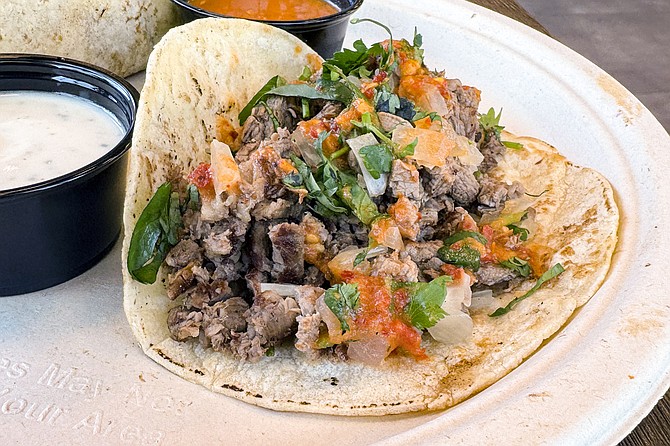
A carne asada taco made with halal beef
There was pickled okra on my taco. And turnips. And tahini. These delicacies were draped and drizzled across the falafel patties folded into my corn tortilla. I hadn't exactly been dreaming of the day I would encounter a falafel taco. But as I took my first bite, I realized that this mash-up was inevitable, given the unique demographic makeup of El Cajon.
While around 30 percent of the city's 100,000 residents identify as Hispanic, an estimated 40 percent hail from the Middle East or North Africa. In other words, the place is fast food heaven, whether you prefer tacos or shawarma wraps.
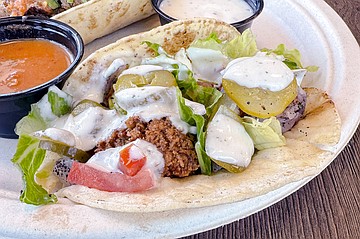
A falafel taco, topped with pickled okra, turnip, and tahini
And in at least one location, you can find both. The El Cajon counter shop Mr. Shawarma Mediterranean Grill, a local chain with several locations, now doubles as Habibi Taqueria. And despite my thoughts on inevitability, putting falafel on a taco is not the point here. It's more about the meat. Habibi Taqueria claims to be "the first halal taco shop in San Diego."
The number of practicing Muslims in El Cajon is hard to pinpoint, though efforts to improve census counts have reportedly been ongoing. But back-of-the-napkin math suggests that there may be around 20,000 who might wish to eat halal. With regard to meat, that means the animal has been ritually (and humanely) slaughtered according to Islamic law.
I can only imagine what it's like to keep a halal diet while also being surrounded by taco shops, but I would guess it's maddening. Habibi — named for an Arabic term of endearment — appears set up to serve these suffering souls. It offers beef birria, lengua (beef tongue) and carne asada tacos, as well as shrimp, fish, and chicken. All halal.
Significantly, there's no pork. Which may seem ironic to taco fans, who know that the pork-based tacos adobada, also known as tacos al pastor, were inspired by Middle Eastern spit-roast cooking. But pork is forbidden in the Muslim faith, and the rotisseries you see behind the counter here aren't part of the taco prep — they cook beef/lamb and chicken shawarma for items on the Mr. Shawarma menu.
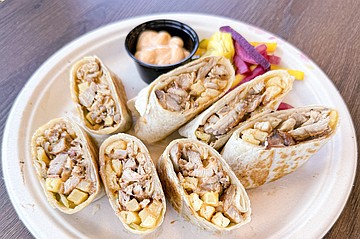
The chipotle chicken shawarma wrap, a bit of fusion offered by Mr. Shawarma
Not that the Mr. Shawarma menu hasn't been influenced by the cultural fusion taking place here — I added a chipotle chicken shawarma wrap ($12) to my taco order. Given the rolled flatbread and french fries insde, there was barely a degree of separation between it and the California burrito found on the Habibi menu ($14.50).
I would never call the falafel taco ($4) must-try, but it did make me think the flavor combination of corn masa and fried chickpea warrants further exploration. More important to me was the relatively straightforward carne asada taco ($4.70), which boasted "grilled prime steak" and guacamole. I was a bit disappointed that the minced steak I was served was fairly bland for a carne asada, and also lacking guac. However, the taco was loaded with onion, cilantro, and a quick-ground salsa that offered some real spice — a bright, citric heat that saved the overall taco experience.
In restaurants, most of the fusion I've seen has been to some degree calculated, as if a chef had an idea to mash-up the palates of two distinct cultures, and set about to make it work. What's happening at Mr. Shawarma and Habibi Taqueria feels more organic. The restaurant is serving a need created by the emergence of a distinct geographic community. Nothing here blew me away, but I remain enchanted by the cultural moment. Here's hoping we see halal taco shops become a thing in El Cajon.
Here's something you might be interested in.
Habibi Taqueria adds halal tacos to a shawarma shop
Mr. Shawarma in El Cajon serves Mexican food practicing Muslims may appreciate

Habibi Taqueria adds halal tacos to a shawarma shop
Mr. Shawarma in El Cajon serves Mexican food practicing Muslims may appreciate
A carne asada taco made with halal beef
There was pickled okra on my taco. And turnips. And tahini. These delicacies were draped and drizzled across the falafel patties folded into my corn tortilla. I hadn't exactly been dreaming of the day I would encounter a falafel taco. But as I took my first bite, I realized that this mash-up was inevitable, given the unique demographic makeup of El Cajon.
While around 30 percent of the city's 100,000 residents identify as Hispanic, an estimated 40 percent hail from the Middle East or North Africa. In other words, the place is fast food heaven, whether you prefer tacos or shawarma wraps.
A falafel taco, topped with pickled okra, turnip, and tahini
And in at least one location, you can find both. The El Cajon counter shop Mr. Shawarma Mediterranean Grill, a local chain with several locations, now doubles as Habibi Taqueria. And despite my thoughts on inevitability, putting falafel on a taco is not the point here. It's more about the meat. Habibi Taqueria claims to be "the first halal taco shop in San Diego."
The number of practicing Muslims in El Cajon is hard to pinpoint, though efforts to improve census counts have reportedly been ongoing. But back-of-the-napkin math suggests that there may be around 20,000 who might wish to eat halal. With regard to meat, that means the animal has been ritually (and humanely) slaughtered according to Islamic law.
I can only imagine what it's like to keep a halal diet while also being surrounded by taco shops, but I would guess it's maddening. Habibi — named for an Arabic term of endearment — appears set up to serve these suffering souls. It offers beef birria, lengua (beef tongue) and carne asada tacos, as well as shrimp, fish, and chicken. All halal.
Significantly, there's no pork. Which may seem ironic to taco fans, who know that the pork-based tacos adobada, also known as tacos al pastor, were inspired by Middle Eastern spit-roast cooking. But pork is forbidden in the Muslim faith, and the rotisseries you see behind the counter here aren't part of the taco prep — they cook beef/lamb and chicken shawarma for items on the Mr. Shawarma menu.
The chipotle chicken shawarma wrap, a bit of fusion offered by Mr. Shawarma
Not that the Mr. Shawarma menu hasn't been influenced by the cultural fusion taking place here — I added a chipotle chicken shawarma wrap ($12) to my taco order. Given the rolled flatbread and french fries insde, there was barely a degree of separation between it and the California burrito found on the Habibi menu ($14.50).
I would never call the falafel taco ($4) must-try, but it did make me think the flavor combination of corn masa and fried chickpea warrants further exploration. More important to me was the relatively straightforward carne asada taco ($4.70), which boasted "grilled prime steak" and guacamole. I was a bit disappointed that the minced steak I was served was fairly bland for a carne asada, and also lacking guac. However, the taco was loaded with onion, cilantro, and a quick-ground salsa that offered some real spice — a bright, citric heat that saved the overall taco experience.
In restaurants, most of the fusion I've seen has been to some degree calculated, as if a chef had an idea to mash-up the palates of two distinct cultures, and set about to make it work. What's happening at Mr. Shawarma and Habibi Taqueria feels more organic. The restaurant is serving a need created by the emergence of a distinct geographic community. Nothing here blew me away, but I remain enchanted by the cultural moment. Here's hoping we see halal taco shops become a thing in El Cajon.