

Here's something you might be interested in.
Ask a Hipster — Advice you didn't know you needed
Big Screen — Movie commentary
Blurt — Music's inside track
Booze News — San Diego spirits
Classical Music — Immortal beauty
Classifieds — Free and easy
Close to Home — What it’s like on the street where you live
Cover Stories — Front-page features
Drinks All Around — Bartenders' drink recipes
Excerpts — Literary and spiritual excerpts
Feast! — Food & drink reviews
Feature Stories — Local news & stories
Fishing Report — What’s getting hooked from ship and shore
From the Archives — Spotlight on the past
Golden Dreams — Talk of the town
The Gonzo Report — Making the musical scene, or at least reporting from it
Letters — Our inbox
Movies@Home — Local movie buffs share favorites
Movie Reviews — Our critics' picks and pans
Musician Interviews — Up close with local artists
Neighborhood News from Stringers — Hyperlocal news
News Ticker — News & politics
Obermeyer — San Diego politics illustrated
Outdoors — Weekly changes in flora and fauna
Overheard in San Diego — Eavesdropping illustrated
Poetry — The old and the new
Reader Travel — Travel section built by travelers
Reading — The hunt for intellectuals
Roam-O-Rama — SoCal's best hiking/biking trails
San Diego Beer — Inside San Diego suds
SD on the QT — Almost factual news
Sheep and Goats — Places of worship
Special Issues — The best of
Street Style — San Diego streets have style
Surf Diego — Real stories from those braving the waves
Theater — On stage in San Diego this week
Tin Fork — Silver spoon alternative
Under the Radar — Matt Potter's undercover work
Unforgettable — Long-ago San Diego
Unreal Estate — San Diego's priciest pads
Your Week — Daily event picks
Physical Media Rules: H.P. Mendoza's FRUIT FLY (2009)
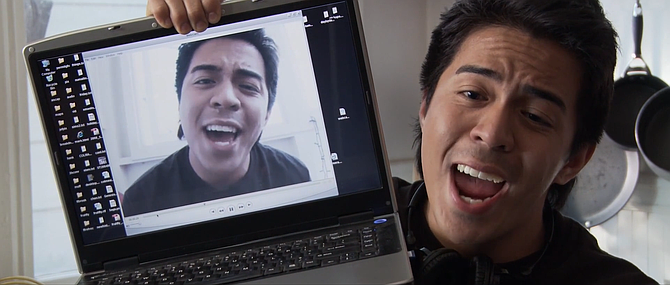
Aaron Zaragoza performs an imaginatively staged duet with himself.
FRUIT FLY (2009) Written, Produced, Directed, Music & Lyrics, Edited, Casting, Sound, and Acted by (Phew!) H.P. Mendoza / Cinematographer: Richard Wong (2.35:1) / Design: Amy Y. Chan / Cast: L.A. Renigen, Mike Curtis, Theresa Navarro, Aaron Zaragoza, E.S. Park, Christian Cagigal, Don Wood, Michelle Talgarow, and Christina Augello / Distributor: Level 33 Entertainment (TLA Releasing) / Not Rated / 94 mins.
You must offer props to any first-time writer-director who chooses as their subject a genre that is deader than disco. Name an original live-action movie musical produced in the past 20 years that owed nothing to Broadway, Disney, and/or Mattel. I’ll spot you La La Land (2016) and In the Heights (2021) and raise you Colma: The Musical (2006), H. P. Mendoza’s first feature screenplay, which he co-wrote with director Richard Wong.
A regular visitor to the San Diego Asian Film Festival, we first met when he and Wong picked up the 2006 jury award for Colma, and again when Mendoza’s directorial debut, Fruit Fly, graced Festival ‘09. We once again crossed paths a few weeks ago when I wrote about the one-night revival of I Am Ghost. Lucky for me he’s on Bluesky. When I asked if there was anything new I should beware of, he tipped me to the April release of a spiffed up Blu-ray pressing of Fruit Fly.
Video:
Trailer: FRUIT FLY
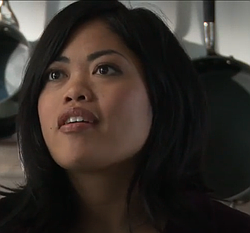
Think of it as a variation on Gregory LaCava’s Stage Door (1937), a comedy/drama that follows the lives of several aspiring actresses who live in a New York boarding house. Almost 90 years later, Tracy (Don Wood) plays “house father” to a handful of diverse San Francisco artisans looking to crack the big time. Though not exactly central to the plot, Tracy neatly unpacks character baggage as he shows potential lessee Bethesda (L.A. Renigen) — a performance artist doing a dance piece on adoption — the lay of the flat. He’s also the first to rise and brew a pot of coffee come rent day. Tracy may not sound like a sage, but there’s a wealth of knowledge hidden inside his deadpan asides.
Adoption is central to understanding Bethesda’s character. She finds a candid picture of a young Filipino woman and her daughter in an antique store and could swear that it's her birth mother — just look at the scars on the young baby's face. Every performance she’s created since has been a public airing of her feelings of abandonment, set to music.
What do all these characters have in common? Aside from a devotion to their various artistic endeavors and a passion for clubbing the night away, all of them are as interesting to watch as Mendoza's film fleshes them out. Even the most insignificant characters display a genuineness, something unique to say or show for themselves. One of the roomers is a big fan of Bethesda’s work. She's eager to share her adoration, but she might have considered waiting until after Bethesda finished painting the bowl with the liquor she drank over the past few hours. Then there’s the persnickety theater owner: too cheap to spring for air conditioning, she limits the length of performances to two hours.
But none compare to Dirty Judy (Christina Augello), a rent control whore paying pennies on the dollar for her patch of prime real estate. The only way she’ll move is when the wrecking ball takes out the right side of her unit. Gritty, urban, and possibly unhinged, Judy is also an authority on the perils of urban gentrification, Mendoza's mouthpiece bemoaning the presence of impersonal skyscrapers that rob her city of its view of the Bay Area. Like Tracy, there’s more to Judy than her crackpot demeanor suggests.
The presentation of the musical numbers — and they are numerous — is as thoughtful and balanced as the widescreen compositions. We Have So Much In Common, a paean to versatile bottoms, could be the sweetest song ever written about anal sex. (Only Mendoza, the Cole Porter of Castro Street, would dare rhyme “fat cocks” with “romantic walks.) And I dare you to keep from singing the zippy Fag Hag on the ride home. Well, it's a Blu-ray, so you're already home, but you take my point.
Did I mention this was Mendoza’s first time behind the camera? He’s forgotten more than most of his contemporaries have learned. It’s always fair weather with Mendoza, no matter how dark the subject matter might get. It’s rare that I use the term “feel-good picture” without a hint of sarcasm or scorn, but hell fire, when it ended, my grin barely made it through the exit doors. ****
Here's something you might be interested in.
Physical Media Rules: H.P. Mendoza's FRUIT FLY (2009)

Physical Media Rules: H.P. Mendoza's FRUIT FLY (2009)
Aaron Zaragoza performs an imaginatively staged duet with himself.
FRUIT FLY (2009) Written, Produced, Directed, Music & Lyrics, Edited, Casting, Sound, and Acted by (Phew!) H.P. Mendoza / Cinematographer: Richard Wong (2.35:1) / Design: Amy Y. Chan / Cast: L.A. Renigen, Mike Curtis, Theresa Navarro, Aaron Zaragoza, E.S. Park, Christian Cagigal, Don Wood, Michelle Talgarow, and Christina Augello / Distributor: Level 33 Entertainment (TLA Releasing) / Not Rated / 94 mins.
You must offer props to any first-time writer-director who chooses as their subject a genre that is deader than disco. Name an original live-action movie musical produced in the past 20 years that owed nothing to Broadway, Disney, and/or Mattel. I’ll spot you La La Land (2016) and In the Heights (2021) and raise you Colma: The Musical (2006), H. P. Mendoza’s first feature screenplay, which he co-wrote with director Richard Wong.
A regular visitor to the San Diego Asian Film Festival, we first met when he and Wong picked up the 2006 jury award for Colma, and again when Mendoza’s directorial debut, Fruit Fly, graced Festival ‘09. We once again crossed paths a few weeks ago when I wrote about the one-night revival of I Am Ghost. Lucky for me he’s on Bluesky. When I asked if there was anything new I should beware of, he tipped me to the April release of a spiffed up Blu-ray pressing of Fruit Fly.
Video:
Trailer: FRUIT FLY
Think of it as a variation on Gregory LaCava’s Stage Door (1937), a comedy/drama that follows the lives of several aspiring actresses who live in a New York boarding house. Almost 90 years later, Tracy (Don Wood) plays “house father” to a handful of diverse San Francisco artisans looking to crack the big time. Though not exactly central to the plot, Tracy neatly unpacks character baggage as he shows potential lessee Bethesda (L.A. Renigen) — a performance artist doing a dance piece on adoption — the lay of the flat. He’s also the first to rise and brew a pot of coffee come rent day. Tracy may not sound like a sage, but there’s a wealth of knowledge hidden inside his deadpan asides.
Adoption is central to understanding Bethesda’s character. She finds a candid picture of a young Filipino woman and her daughter in an antique store and could swear that it's her birth mother — just look at the scars on the young baby's face. Every performance she’s created since has been a public airing of her feelings of abandonment, set to music.
What do all these characters have in common? Aside from a devotion to their various artistic endeavors and a passion for clubbing the night away, all of them are as interesting to watch as Mendoza's film fleshes them out. Even the most insignificant characters display a genuineness, something unique to say or show for themselves. One of the roomers is a big fan of Bethesda’s work. She's eager to share her adoration, but she might have considered waiting until after Bethesda finished painting the bowl with the liquor she drank over the past few hours. Then there’s the persnickety theater owner: too cheap to spring for air conditioning, she limits the length of performances to two hours.
But none compare to Dirty Judy (Christina Augello), a rent control whore paying pennies on the dollar for her patch of prime real estate. The only way she’ll move is when the wrecking ball takes out the right side of her unit. Gritty, urban, and possibly unhinged, Judy is also an authority on the perils of urban gentrification, Mendoza's mouthpiece bemoaning the presence of impersonal skyscrapers that rob her city of its view of the Bay Area. Like Tracy, there’s more to Judy than her crackpot demeanor suggests.
The presentation of the musical numbers — and they are numerous — is as thoughtful and balanced as the widescreen compositions. We Have So Much In Common, a paean to versatile bottoms, could be the sweetest song ever written about anal sex. (Only Mendoza, the Cole Porter of Castro Street, would dare rhyme “fat cocks” with “romantic walks.) And I dare you to keep from singing the zippy Fag Hag on the ride home. Well, it's a Blu-ray, so you're already home, but you take my point.
Did I mention this was Mendoza’s first time behind the camera? He’s forgotten more than most of his contemporaries have learned. It’s always fair weather with Mendoza, no matter how dark the subject matter might get. It’s rare that I use the term “feel-good picture” without a hint of sarcasm or scorn, but hell fire, when it ended, my grin barely made it through the exit doors. ****