

Here's something you might be interested in.
Ask a Hipster — Advice you didn't know you needed
Big Screen — Movie commentary
Blurt — Music's inside track
Booze News — San Diego spirits
Classical Music — Immortal beauty
Classifieds — Free and easy
Close to Home — What it’s like on the street where you live
Cover Stories — Front-page features
Drinks All Around — Bartenders' drink recipes
Excerpts — Literary and spiritual excerpts
Feast! — Food & drink reviews
Feature Stories — Local news & stories
Fishing Report — What’s getting hooked from ship and shore
From the Archives — Spotlight on the past
Golden Dreams — Talk of the town
The Gonzo Report — Making the musical scene, or at least reporting from it
Letters — Our inbox
Movies@Home — Local movie buffs share favorites
Movie Reviews — Our critics' picks and pans
Musician Interviews — Up close with local artists
Neighborhood News from Stringers — Hyperlocal news
News Ticker — News & politics
Obermeyer — San Diego politics illustrated
Outdoors — Weekly changes in flora and fauna
Overheard in San Diego — Eavesdropping illustrated
Poetry — The old and the new
Reader Travel — Travel section built by travelers
Reading — The hunt for intellectuals
Roam-O-Rama — SoCal's best hiking/biking trails
San Diego Beer — Inside San Diego suds
SD on the QT — Almost factual news
Sheep and Goats — Places of worship
Special Issues — The best of
Street Style — San Diego streets have style
Surf Diego — Real stories from those braving the waves
Theater — On stage in San Diego this week
Tin Fork — Silver spoon alternative
Under the Radar — Matt Potter's undercover work
Unforgettable — Long-ago San Diego
Unreal Estate — San Diego's priciest pads
Your Week — Daily event picks
Travel Report: Iruya, the mountain town in a valley
The journey is exciting; the destination is chill
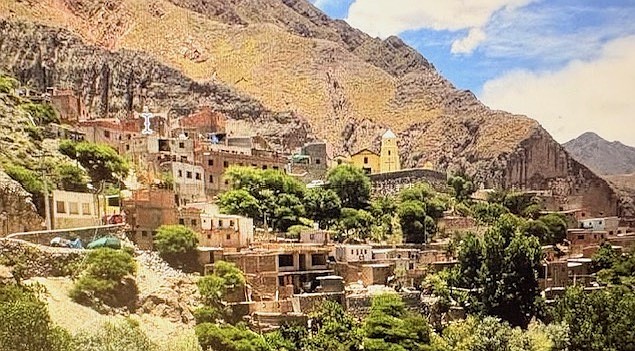
Iruya proper: perched at the base of the Andes, and miles from nowhere.
I journeyed to Humahuaca, a village in the vast quebrada of the same name, mostly so I could reach my real objective: the otherworldly settlement of Iruya. Humahuaca is situated at an altitude of 1100 feet, much like its closest neighbors, Tilcara and Purmamarca. Tourists come here beacause of the sheer scale of the landscape: the giant salt flats to the west, the celebrated multicolored hills throughout this immense gorge. The town itself has a historic center with narrow cobblestone streets, a clean traditional plaza with lots of shade trees, and all sorts of monuments. The views are splendid, and it’s obvious a lot of work was devoted to this site. Colonial-style street lamps lend a lovely light, making this is a worthwhile place from which to witness dusk settle over the big valley.
As in many of these isolated towns, there are a number of renowned old cathedrals and cultural centers, along with open air markets, a clock tower, and souvenir shops galore. There are also more eateries and grocery stores here than in most of the neighboring villages, making it a practical base for exploring the region. Several outfitters are happy to transport travelers to curious sites outside of town, and there are ample opportunities for biking, hiking, and long distance trekking.
I stayed two nights en route to a planned circuit of southern Bolivia, but as I say, my main purpose here was to get to Iruya. A couple of notable wanderers had told me simply, "Don't miss it." The turnoff to Iruya is 19 km north of Humahuaca on Hwy. 9, and from there, it’s 54 km of dusty, bumpy, serpentine and steep pitches into the valley. The village sits perched on a mountain shelf at 2800 meters — even a mountain dweller can feel the altitude here, which is strange, as you are in the bottom of a valley. But then, the surrounding peaks are 5000 meters high.
While the destination is quite the payoff, the actual road there is an engineering marvel that makes the journey its own reward. It begins by climbing steadily through a number of tiny settlements and past grazing animals until it reaches the crest of a high ridge. Then the landscape becomes more dramatic and steep until the road falls off that high ridge into a series of switchbacks with edges marked by large white rocks. I was grateful to see them, as fog or rain could render visibility near zero here, and even a competent driver in a solid four-wheel-drive might feel compelled to crawl along at 5 mph, white-knuckling the entire stretch. Our driver, piloting a creaky old 40-passenger bus, handled it all like a maestro, no doubt due to his extensive experience.
There was a religious shrine tucked into the big rocks at the top of the pass, and a crowd of locals were congregated to mark some holy moment. After that, it was downhill all the way to the bottom of the broad valley bordered by vertical cliffs and sheer bluffs. Finally my destination came into view: a postcard pueblo perched at the bottom of a precipitous peak. I had never seen a place quite like it, and although some of the desert on the way in was stark and daunting, the living beauty of Iruya was something else altogether. I complimented the driver on his road skill as I getting off the bus, and he told me would be departing at 2:30. That gave me three hours in town.
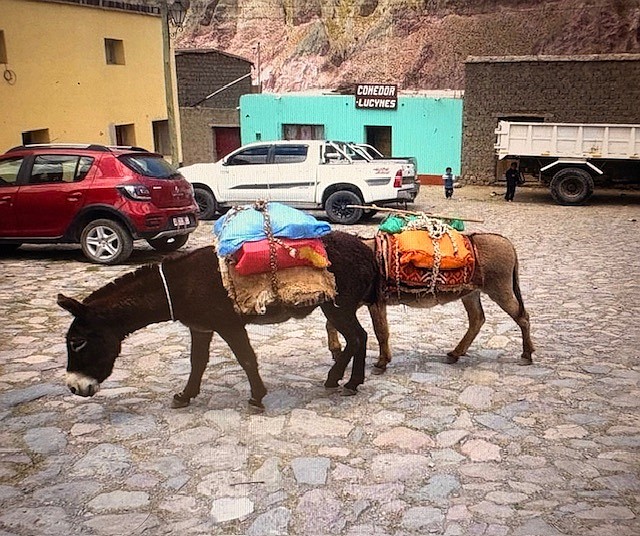
Burritos are the Iruya mountain bikes.
My ramble commenced with a search for something to eat. I wandered narrow stone streets that led up through the mostly adobe buildings. It was Sunday, and there was a crowd of folks in and around the striking yellow church, with the sermon broadcast via loudspeakers outside. Built in 1690, this structure is the most prominent in the village, and has held up quite well.
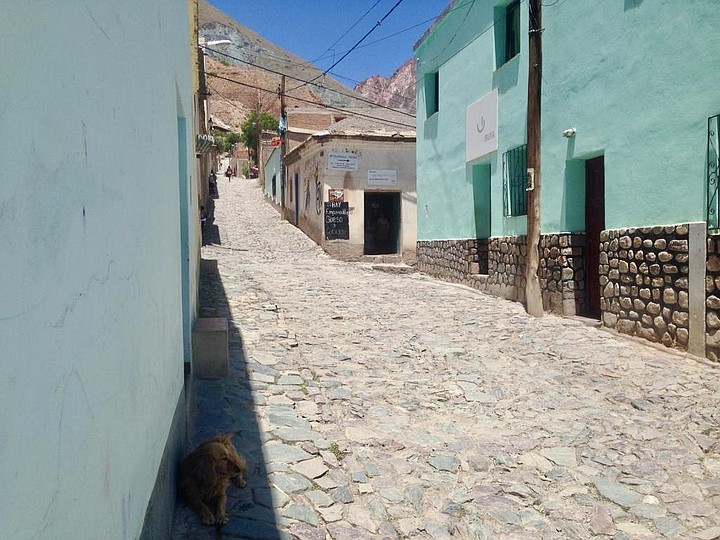
The streets are steep.
I stopped into a store with a sign advertising empanadas and such, and asked about food. A crusty old guy answered my query with, "No quedan nada, hippie" — "there’s nothing left" — which cracked me up. I was sporting a daypack, and no doubt I looked like a vagrant of sorts, but hippie? Still, I imagine that some of the locals do get weary of the tourist day trippers, if only because this place is so isolated that everybody is an "us or them" to some degree — and as many resist the changes as embrace them. And I'm sure change used to come more slowly here than it does now.
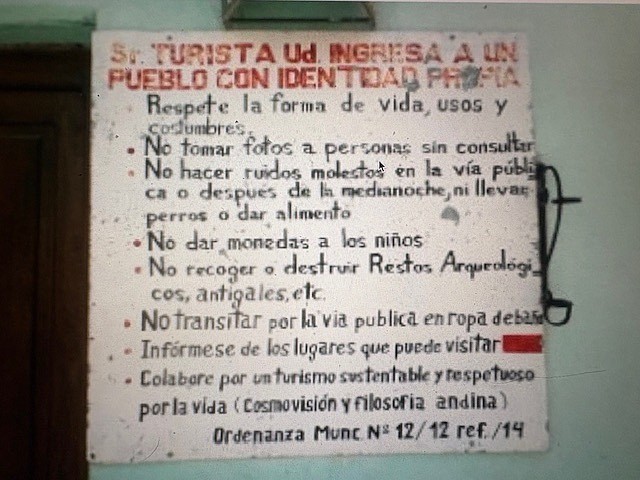
Read them, know them, live them: the rules are different in Iruya.
Continuing my climb up to the limits of the center, I arrived at a locked-up cemetery with million-dollar views. Looping back down a lane — steep enough that I could have skied it if there had been snow — I arrived back at the church, and found someone willing to sell me three small empanadas of carne and goat cheese. This was enough to fuel my trek across the relatively new and thoroughly solid pedestrian bridge over the broad (and usually dry) Iruya river-bed.
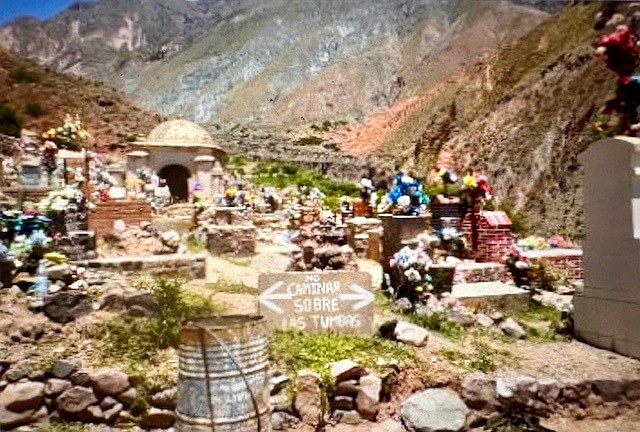
The cemetery, at the top of the town, is a fine place for the big dirt nap.
A leisurely stroll delivered me to the most commercial block in town: a few hostels, cafes, and small stores surrounding a tiny covered plaza. The pace of life is slow in Iruya, sporadically interrupted by the tourist bus arrivals, and I killed the rest of my allotted time before returning to the idling bus at 2:15. My early arrival was fortuitous: after I paid my 150 for the return fare, we took off at 2:19, instead of the scheduled 2:30. There were just a few of us on board, and nobody I could recall from the ride in.
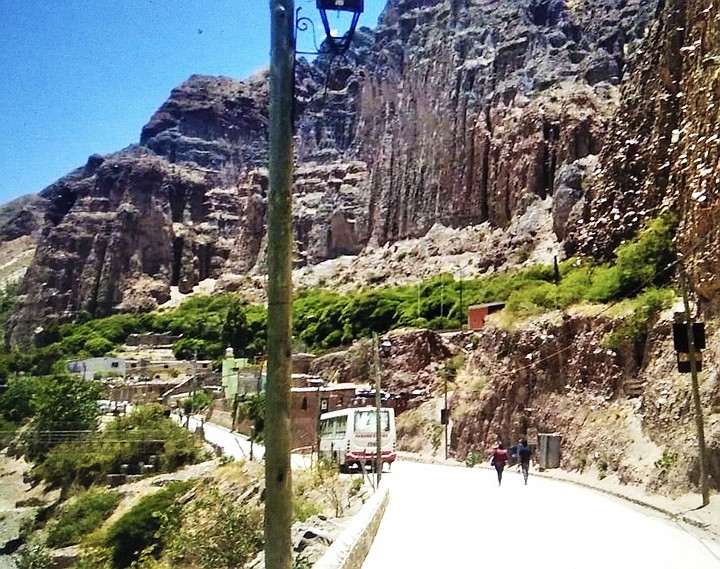
You don't want to miss that last bus leaving town.
The 73 kms between Humahuaca and Iruya takes almost three hours in good conditions, so a visit definitely uses up a day. But it is an amazing destination and worth the time, and plenty of peeps would surely enjoy an overnight stay to further absorb the glacial pace of the place. There are trails heading out in all directions, most going straight up, and mountain biking is likewise an option for big fun.
Here's something you might be interested in.
Travel Report: Iruya, the mountain town in a valley
The journey is exciting; the destination is chill

Travel Report: Iruya, the mountain town in a valley
The journey is exciting; the destination is chill
Iruya proper: perched at the base of the Andes, and miles from nowhere.
I journeyed to Humahuaca, a village in the vast quebrada of the same name, mostly so I could reach my real objective: the otherworldly settlement of Iruya. Humahuaca is situated at an altitude of 1100 feet, much like its closest neighbors, Tilcara and Purmamarca. Tourists come here beacause of the sheer scale of the landscape: the giant salt flats to the west, the celebrated multicolored hills throughout this immense gorge. The town itself has a historic center with narrow cobblestone streets, a clean traditional plaza with lots of shade trees, and all sorts of monuments. The views are splendid, and it’s obvious a lot of work was devoted to this site. Colonial-style street lamps lend a lovely light, making this is a worthwhile place from which to witness dusk settle over the big valley.
As in many of these isolated towns, there are a number of renowned old cathedrals and cultural centers, along with open air markets, a clock tower, and souvenir shops galore. There are also more eateries and grocery stores here than in most of the neighboring villages, making it a practical base for exploring the region. Several outfitters are happy to transport travelers to curious sites outside of town, and there are ample opportunities for biking, hiking, and long distance trekking.
I stayed two nights en route to a planned circuit of southern Bolivia, but as I say, my main purpose here was to get to Iruya. A couple of notable wanderers had told me simply, "Don't miss it." The turnoff to Iruya is 19 km north of Humahuaca on Hwy. 9, and from there, it’s 54 km of dusty, bumpy, serpentine and steep pitches into the valley. The village sits perched on a mountain shelf at 2800 meters — even a mountain dweller can feel the altitude here, which is strange, as you are in the bottom of a valley. But then, the surrounding peaks are 5000 meters high.
While the destination is quite the payoff, the actual road there is an engineering marvel that makes the journey its own reward. It begins by climbing steadily through a number of tiny settlements and past grazing animals until it reaches the crest of a high ridge. Then the landscape becomes more dramatic and steep until the road falls off that high ridge into a series of switchbacks with edges marked by large white rocks. I was grateful to see them, as fog or rain could render visibility near zero here, and even a competent driver in a solid four-wheel-drive might feel compelled to crawl along at 5 mph, white-knuckling the entire stretch. Our driver, piloting a creaky old 40-passenger bus, handled it all like a maestro, no doubt due to his extensive experience.
There was a religious shrine tucked into the big rocks at the top of the pass, and a crowd of locals were congregated to mark some holy moment. After that, it was downhill all the way to the bottom of the broad valley bordered by vertical cliffs and sheer bluffs. Finally my destination came into view: a postcard pueblo perched at the bottom of a precipitous peak. I had never seen a place quite like it, and although some of the desert on the way in was stark and daunting, the living beauty of Iruya was something else altogether. I complimented the driver on his road skill as I getting off the bus, and he told me would be departing at 2:30. That gave me three hours in town.
Burritos are the Iruya mountain bikes.
My ramble commenced with a search for something to eat. I wandered narrow stone streets that led up through the mostly adobe buildings. It was Sunday, and there was a crowd of folks in and around the striking yellow church, with the sermon broadcast via loudspeakers outside. Built in 1690, this structure is the most prominent in the village, and has held up quite well.
The streets are steep.
I stopped into a store with a sign advertising empanadas and such, and asked about food. A crusty old guy answered my query with, "No quedan nada, hippie" — "there’s nothing left" — which cracked me up. I was sporting a daypack, and no doubt I looked like a vagrant of sorts, but hippie? Still, I imagine that some of the locals do get weary of the tourist day trippers, if only because this place is so isolated that everybody is an "us or them" to some degree — and as many resist the changes as embrace them. And I'm sure change used to come more slowly here than it does now.
Read them, know them, live them: the rules are different in Iruya.
Continuing my climb up to the limits of the center, I arrived at a locked-up cemetery with million-dollar views. Looping back down a lane — steep enough that I could have skied it if there had been snow — I arrived back at the church, and found someone willing to sell me three small empanadas of carne and goat cheese. This was enough to fuel my trek across the relatively new and thoroughly solid pedestrian bridge over the broad (and usually dry) Iruya river-bed.
The cemetery, at the top of the town, is a fine place for the big dirt nap.
A leisurely stroll delivered me to the most commercial block in town: a few hostels, cafes, and small stores surrounding a tiny covered plaza. The pace of life is slow in Iruya, sporadically interrupted by the tourist bus arrivals, and I killed the rest of my allotted time before returning to the idling bus at 2:15. My early arrival was fortuitous: after I paid my 150 for the return fare, we took off at 2:19, instead of the scheduled 2:30. There were just a few of us on board, and nobody I could recall from the ride in.
You don't want to miss that last bus leaving town.
The 73 kms between Humahuaca and Iruya takes almost three hours in good conditions, so a visit definitely uses up a day. But it is an amazing destination and worth the time, and plenty of peeps would surely enjoy an overnight stay to further absorb the glacial pace of the place. There are trails heading out in all directions, most going straight up, and mountain biking is likewise an option for big fun.
Comments