

Here's something you might be interested in.
Ask a Hipster — Advice you didn't know you needed
Big Screen — Movie commentary
Blurt — Music's inside track
Booze News — San Diego spirits
Classical Music — Immortal beauty
Classifieds — Free and easy
Close to Home — What it’s like on the street where you live
Cover Stories — Front-page features
Drinks All Around — Bartenders' drink recipes
Excerpts — Literary and spiritual excerpts
Feast! — Food & drink reviews
Feature Stories — Local news & stories
Fishing Report — What’s getting hooked from ship and shore
From the Archives — Spotlight on the past
Golden Dreams — Talk of the town
The Gonzo Report — Making the musical scene, or at least reporting from it
Letters — Our inbox
Movies@Home — Local movie buffs share favorites
Movie Reviews — Our critics' picks and pans
Musician Interviews — Up close with local artists
Neighborhood News from Stringers — Hyperlocal news
News Ticker — News & politics
Obermeyer — San Diego politics illustrated
Outdoors — Weekly changes in flora and fauna
Overheard in San Diego — Eavesdropping illustrated
Poetry — The old and the new
Reader Travel — Travel section built by travelers
Reading — The hunt for intellectuals
Roam-O-Rama — SoCal's best hiking/biking trails
San Diego Beer — Inside San Diego suds
SD on the QT — Almost factual news
Sheep and Goats — Places of worship
Special Issues — The best of
Street Style — San Diego streets have style
Surf Diego — Real stories from those braving the waves
Theater — On stage in San Diego this week
Tin Fork — Silver spoon alternative
Under the Radar — Matt Potter's undercover work
Unforgettable — Long-ago San Diego
Unreal Estate — San Diego's priciest pads
Your Week — Daily event picks
Movie review: BONJOUR, TRISTESSE (2024)
For this film to qualify as a success, everyone who sees it must go home and stream the original.
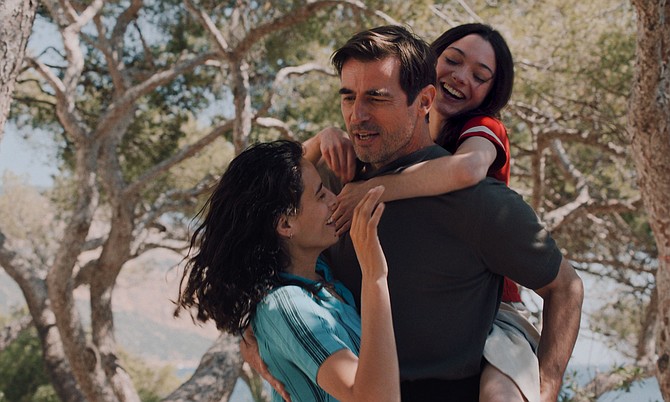
Nailia Harzoune, Claes Bang and Lily McInerny add but little distress to this remake.
BONJOUR, TRISTESSE (2024) Writer & Director: Durga Chew-Bose / From the novel by Françoise Sagan / Cinematographer: Maximilian Pittner / Design: François-Renaud Labarthe / Editor: Amélie Labrèche / Composer: Lesley Barber / Acted by: Lily McInerny, Claes Bang, Chloë Sevigny, Nailia Harzoune, and Aliocha Schneider / Distributor: Greenwich Entertainment / Rated R / Length: 110.
For better or worse, remakes have always been as much a part of the moviegoing experience as sticky auditorium floors and the couple two rows behind you providing play-by-play commentary. But please: if you must remake a movie, make it a bad one. From where I sit, there is nothing wrong with Otto Preminger’s Bonjour, Tristesse (1958).
I must confess to approaching the remake with equal degrees of loyalty and agita. Not since Gus Van Sant traced Psycho have I taken a remake so personally. I knew it would be impossible to approach this without the brilliance of the original blinding me from my rear view mirror.
Video:
Trailer: BONJOUR, TRISTESSE

It’s like I always say: Preminger is colder than an igloo filled with Kubricks. There’s not a likable character in the original, while many in the Durga Chew-Bose adaptation are quite agreeable — starting with David Niven substitute Claes Bang as Cécile’s father, Raymond. Bang is a handsome, soft-spoken James Mason soundalike, and the basic decency inherent in his performance eschews any hint of the incest that Preminger’s screenwriter Arthur Laurents managed to smuggle into the 1958 Hollywood release.
And in this, her second feature, Lily McInerny doesn’t bring to the role the spark and manipulative temperament needed to flesh out Cécile’s dark side. Without giving anything away, suffice it to say that it was her actions that contributed to the film’s tragic ending.
The only way for this film to qualify as a success would be if everyone who sees it goes home and streams the original. *
Video:
Film: BONJOUR, TRISTESSE (1958)

Here's something you might be interested in.
Movie review: BONJOUR, TRISTESSE (2024)
For this film to qualify as a success, everyone who sees it must go home and stream the original.

Movie review: BONJOUR, TRISTESSE (2024)
For this film to qualify as a success, everyone who sees it must go home and stream the original.
Nailia Harzoune, Claes Bang and Lily McInerny add but little distress to this remake.
BONJOUR, TRISTESSE (2024) Writer & Director: Durga Chew-Bose / From the novel by Françoise Sagan / Cinematographer: Maximilian Pittner / Design: François-Renaud Labarthe / Editor: Amélie Labrèche / Composer: Lesley Barber / Acted by: Lily McInerny, Claes Bang, Chloë Sevigny, Nailia Harzoune, and Aliocha Schneider / Distributor: Greenwich Entertainment / Rated R / Length: 110.
For better or worse, remakes have always been as much a part of the moviegoing experience as sticky auditorium floors and the couple two rows behind you providing play-by-play commentary. But please: if you must remake a movie, make it a bad one. From where I sit, there is nothing wrong with Otto Preminger’s Bonjour, Tristesse (1958).
I must confess to approaching the remake with equal degrees of loyalty and agita. Not since Gus Van Sant traced Psycho have I taken a remake so personally. I knew it would be impossible to approach this without the brilliance of the original blinding me from my rear view mirror.
Video:
Trailer: BONJOUR, TRISTESSE
It’s like I always say: Preminger is colder than an igloo filled with Kubricks. There’s not a likable character in the original, while many in the Durga Chew-Bose adaptation are quite agreeable — starting with David Niven substitute Claes Bang as Cécile’s father, Raymond. Bang is a handsome, soft-spoken James Mason soundalike, and the basic decency inherent in his performance eschews any hint of the incest that Preminger’s screenwriter Arthur Laurents managed to smuggle into the 1958 Hollywood release.
And in this, her second feature, Lily McInerny doesn’t bring to the role the spark and manipulative temperament needed to flesh out Cécile’s dark side. Without giving anything away, suffice it to say that it was her actions that contributed to the film’s tragic ending.
The only way for this film to qualify as a success would be if everyone who sees it goes home and streams the original. *
Video:
Film: BONJOUR, TRISTESSE (1958)