

Here's something you might be interested in.
Ask a Hipster — Advice you didn't know you needed
Big Screen — Movie commentary
Blurt — Music's inside track
Booze News — San Diego spirits
Classical Music — Immortal beauty
Classifieds — Free and easy
Close to Home — What it’s like on the street where you live
Cover Stories — Front-page features
Drinks All Around — Bartenders' drink recipes
Excerpts — Literary and spiritual excerpts
Feast! — Food & drink reviews
Feature Stories — Local news & stories
Fishing Report — What’s getting hooked from ship and shore
From the Archives — Spotlight on the past
Golden Dreams — Talk of the town
The Gonzo Report — Making the musical scene, or at least reporting from it
Letters — Our inbox
Movies@Home — Local movie buffs share favorites
Movie Reviews — Our critics' picks and pans
Musician Interviews — Up close with local artists
Neighborhood News from Stringers — Hyperlocal news
News Ticker — News & politics
Obermeyer — San Diego politics illustrated
Outdoors — Weekly changes in flora and fauna
Overheard in San Diego — Eavesdropping illustrated
Poetry — The old and the new
Reader Travel — Travel section built by travelers
Reading — The hunt for intellectuals
Roam-O-Rama — SoCal's best hiking/biking trails
San Diego Beer — Inside San Diego suds
SD on the QT — Almost factual news
Sheep and Goats — Places of worship
Special Issues — The best of
Street Style — San Diego streets have style
Surf Diego — Real stories from those braving the waves
Theater — On stage in San Diego this week
Tin Fork — Silver spoon alternative
Under the Radar — Matt Potter's undercover work
Unforgettable — Long-ago San Diego
Unreal Estate — San Diego's priciest pads
Your Week — Daily event picks
Pizza Kaiju makes strange monster pizzas
Fusion pizzeria opens in Barrio Logan, but don't skip its Japanese dishes
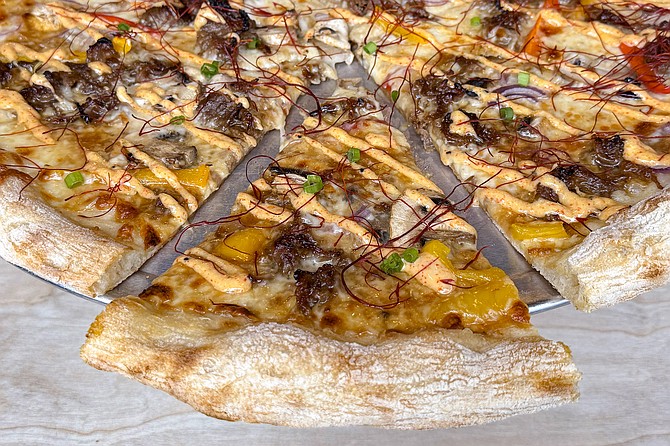
A Bulgogi Supreme pizza, topped with chili threads
"Strange creature" is the literal translation of the Japanese word Kaiju, a term most often applied to monsters in movies featuring the likes of Gamera, Mothra, and mightiest of them all, Godzilla. So when you walk into new Barrio Logan eatery Pizza Kaiju, it's fair to expect strange pizza. Abominations even.
I took note of Pizza Kaiju when it occupied one of the food stalls inside National City co-op, Market on 8th, and told myself I would go back to try it. I mean, what could be more intriguing than Japanese-style pizza?
It proved intriguing enough that the business has struck out on its own, taking over an abandoned brewery space a block from Chicano Park. Well, sort of on its own. In the spirit of strange creatures, Pizza Kaiju here is cobranded with the so-called Yoshuku Diner and Ultra Donuts. They all serve from the same counter.
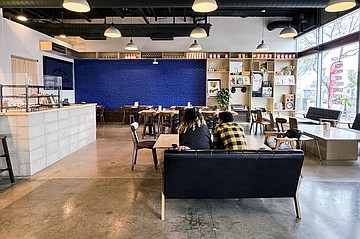
A lounge-like fusion pizza bar and Japanese eatery
The space is ample enough to feature a small, sequestered art gallery, plus a coffee and bar area that weren't yet up and running when I dropped by. The main service and loungey dining room has the look of a listening bar, with vintage hi-fi equipment, vinyl records, and even an old reel-to-reel tape machine.
I showed up intending to focus on the pizza, because that seems to be the driving narrative. First, you get a choice of crusts: thin New York-style or thick Detroit-style. A sampling of the shop's signature pizzas (as well as plain cheese and pepperoni) are available by the slice for $3.50-$5 apiece. I whetted my appetite with a thick slice of the "Wonton Don," which takes a fairly standard pie and applies sweet chili sauce, cream cheese, and wonton strips. In theory, the wonton strips add crunch and flare, but I honestly found the cream cheese to be a bit much, the tomato sauce to be a tad sweet, and the wonton strips to add little to nothing. And perhaps because it was early in the day, my crust could have used more time in the oven.
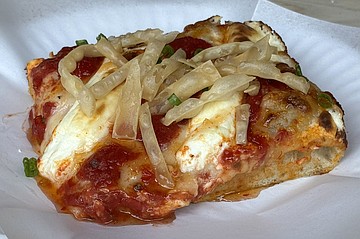
A deep dish pizza topped by cream cheese and wonton strips
So I moved on. The pies I really wanted to try weren't available by the slice, so I resolved to order a whole one for $27. But which one? The Filipino-inspired Sisig pizza, topped by calamansi (citrus) cream, garlic, and pork belly? Or the decidedly Japanese Mentaiko Cream pizza, which adapts a pasta dish of the same name and features bacon, corn, nori, and cod roe? (Obviously, a lot of these choices take pizza creativity to a new level —even the shop's Hawaiian pizza includes taro leaves and kalua pork with its pineapple.)
In the end, I had to go for the Bulgogi Supreme, which takes the Korean marinated beef dish and dresses it with bell peppers, onions, chives, and mushrooms. But I was mostly in it for the "shredded chili," also known as Sil-gochu — those red chili threads that sometimes garnish Korean dishes. It made a visual statement for sure, all these little red threads tossed across the top of a large, 18-inch pizza.
My trouble here came from an unexpected topping: a sweetened, creamy ketchup drizzled across the pizza. Bulgogi's already a little sweet, and this sauce pushed it over the top, as if the pizza had been candied. To the kitchen's credit, they offered to bake me a whole new pie when I asked about it. I was so glad they did: without the ketchup I could appreciated both the beef and the well-made, well-cooked crust beneath.
But as much as I enjoyed the pizza, the moment left me feeling a little past-it. Like I couldn't hope to keep up with all the high-speed food evolution taking place in Japan, or even closer to home. Elsewhere on the menu, I found a hot dog and spaghetti sandwich ($13) and Japanese-styled spaghetti Bolognese topped with a fried egg ($18). All of it was starting to feel like none of my business. Like, Take a hike, boomer food writer. (I'm not a boomer, but GenZ seems to have turned it into a blanket term for anyone older than themselves.)
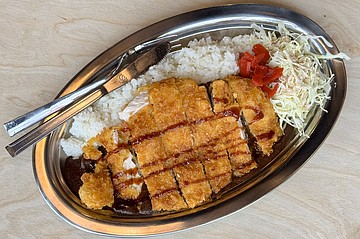
Katsu chicken curry
For comfort, I dug in to one dish that will forever appeal to the kid in me: chicken katsu curry ($16.50). it was one of my go-to favorite meals when I lived in Japan as a teenager, and I still sneak it into the rotation every few months. And here's the thing: this was the best chicken katsu I've eaten anywhere, in 30 years of culinary exploration. It was a thin — yet not so thin that it couldn't be juicy — chicken breast, wearing an exceptional panko crust so crisp it held up to a soak in the dish's sweet, yet spicy and complex curry.
I might not be ready for these strange creatures' pizza experimentations, but this traditional Japanese dish was on point. And I have to admit, for every curious choice on the menu, there's another, more intriguing one: I've yet to try the Detroit style pizza with potato slices and slices of kurabata sausage, for example, or some of that Japanese curry.
Pizza Kaiju might benefit from refinement. Or perhaps to be what it is, it has to make choices I disagree with. And also choices you disagree with. It's what monsters do, and this one seems primed to trample eating conventions like they're a model of downtown Tokyo.
Here's something you might be interested in.
Pizza Kaiju makes strange monster pizzas
Fusion pizzeria opens in Barrio Logan, but don't skip its Japanese dishes

Pizza Kaiju makes strange monster pizzas
Fusion pizzeria opens in Barrio Logan, but don't skip its Japanese dishes
A Bulgogi Supreme pizza, topped with chili threads
"Strange creature" is the literal translation of the Japanese word Kaiju, a term most often applied to monsters in movies featuring the likes of Gamera, Mothra, and mightiest of them all, Godzilla. So when you walk into new Barrio Logan eatery Pizza Kaiju, it's fair to expect strange pizza. Abominations even.
I took note of Pizza Kaiju when it occupied one of the food stalls inside National City co-op, Market on 8th, and told myself I would go back to try it. I mean, what could be more intriguing than Japanese-style pizza?
It proved intriguing enough that the business has struck out on its own, taking over an abandoned brewery space a block from Chicano Park. Well, sort of on its own. In the spirit of strange creatures, Pizza Kaiju here is cobranded with the so-called Yoshuku Diner and Ultra Donuts. They all serve from the same counter.
A lounge-like fusion pizza bar and Japanese eatery
The space is ample enough to feature a small, sequestered art gallery, plus a coffee and bar area that weren't yet up and running when I dropped by. The main service and loungey dining room has the look of a listening bar, with vintage hi-fi equipment, vinyl records, and even an old reel-to-reel tape machine.
I showed up intending to focus on the pizza, because that seems to be the driving narrative. First, you get a choice of crusts: thin New York-style or thick Detroit-style. A sampling of the shop's signature pizzas (as well as plain cheese and pepperoni) are available by the slice for $3.50-$5 apiece. I whetted my appetite with a thick slice of the "Wonton Don," which takes a fairly standard pie and applies sweet chili sauce, cream cheese, and wonton strips. In theory, the wonton strips add crunch and flare, but I honestly found the cream cheese to be a bit much, the tomato sauce to be a tad sweet, and the wonton strips to add little to nothing. And perhaps because it was early in the day, my crust could have used more time in the oven.
A deep dish pizza topped by cream cheese and wonton strips
So I moved on. The pies I really wanted to try weren't available by the slice, so I resolved to order a whole one for $27. But which one? The Filipino-inspired Sisig pizza, topped by calamansi (citrus) cream, garlic, and pork belly? Or the decidedly Japanese Mentaiko Cream pizza, which adapts a pasta dish of the same name and features bacon, corn, nori, and cod roe? (Obviously, a lot of these choices take pizza creativity to a new level —even the shop's Hawaiian pizza includes taro leaves and kalua pork with its pineapple.)
In the end, I had to go for the Bulgogi Supreme, which takes the Korean marinated beef dish and dresses it with bell peppers, onions, chives, and mushrooms. But I was mostly in it for the "shredded chili," also known as Sil-gochu — those red chili threads that sometimes garnish Korean dishes. It made a visual statement for sure, all these little red threads tossed across the top of a large, 18-inch pizza.
My trouble here came from an unexpected topping: a sweetened, creamy ketchup drizzled across the pizza. Bulgogi's already a little sweet, and this sauce pushed it over the top, as if the pizza had been candied. To the kitchen's credit, they offered to bake me a whole new pie when I asked about it. I was so glad they did: without the ketchup I could appreciated both the beef and the well-made, well-cooked crust beneath.
But as much as I enjoyed the pizza, the moment left me feeling a little past-it. Like I couldn't hope to keep up with all the high-speed food evolution taking place in Japan, or even closer to home. Elsewhere on the menu, I found a hot dog and spaghetti sandwich ($13) and Japanese-styled spaghetti Bolognese topped with a fried egg ($18). All of it was starting to feel like none of my business. Like, Take a hike, boomer food writer. (I'm not a boomer, but GenZ seems to have turned it into a blanket term for anyone older than themselves.)
Katsu chicken curry
For comfort, I dug in to one dish that will forever appeal to the kid in me: chicken katsu curry ($16.50). it was one of my go-to favorite meals when I lived in Japan as a teenager, and I still sneak it into the rotation every few months. And here's the thing: this was the best chicken katsu I've eaten anywhere, in 30 years of culinary exploration. It was a thin — yet not so thin that it couldn't be juicy — chicken breast, wearing an exceptional panko crust so crisp it held up to a soak in the dish's sweet, yet spicy and complex curry.
I might not be ready for these strange creatures' pizza experimentations, but this traditional Japanese dish was on point. And I have to admit, for every curious choice on the menu, there's another, more intriguing one: I've yet to try the Detroit style pizza with potato slices and slices of kurabata sausage, for example, or some of that Japanese curry.
Pizza Kaiju might benefit from refinement. Or perhaps to be what it is, it has to make choices I disagree with. And also choices you disagree with. It's what monsters do, and this one seems primed to trample eating conventions like they're a model of downtown Tokyo.