

Here's something you might be interested in.
Ask a Hipster — Advice you didn't know you needed
Big Screen — Movie commentary
Blurt — Music's inside track
Booze News — San Diego spirits
Classical Music — Immortal beauty
Classifieds — Free and easy
Close to Home — What it’s like on the street where you live
Cover Stories — Front-page features
Drinks All Around — Bartenders' drink recipes
Excerpts — Literary and spiritual excerpts
Feast! — Food & drink reviews
Feature Stories — Local news & stories
Fishing Report — What’s getting hooked from ship and shore
From the Archives — Spotlight on the past
Golden Dreams — Talk of the town
The Gonzo Report — Making the musical scene, or at least reporting from it
Letters — Our inbox
Movies@Home — Local movie buffs share favorites
Movie Reviews — Our critics' picks and pans
Musician Interviews — Up close with local artists
Neighborhood News from Stringers — Hyperlocal news
News Ticker — News & politics
Obermeyer — San Diego politics illustrated
Outdoors — Weekly changes in flora and fauna
Overheard in San Diego — Eavesdropping illustrated
Poetry — The old and the new
Reader Travel — Travel section built by travelers
Reading — The hunt for intellectuals
Roam-O-Rama — SoCal's best hiking/biking trails
San Diego Beer — Inside San Diego suds
SD on the QT — Almost factual news
Sheep and Goats — Places of worship
Special Issues — The best of
Street Style — San Diego streets have style
Surf Diego — Real stories from those braving the waves
Theater — On stage in San Diego this week
Tin Fork — Silver spoon alternative
Under the Radar — Matt Potter's undercover work
Unforgettable — Long-ago San Diego
Unreal Estate — San Diego's priciest pads
Your Week — Daily event picks
Now Streaming: THE TUNDRA WITHIN ME (2023)
At the time of the collision Máhtte was bringing the animals to slaughter, so I guess we can call it “meat cute.”
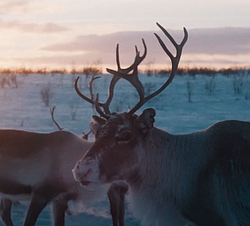
Who's up for joining in some reindeer games?
THE TUNDRA WITHIN ME (2023) Written & Directed by Sara Margrethe Oskal / Cinematographer: Anders Hoft (2.35:1) / Editor: Anna Løvlund / Costume Designer: Anne Margaretha Oskal / Sound Designer: Håkon Lammetun / Acted by: Risten Anine Kvernmo Gaup, Nils Ailu Kemi, Elias Ánte Pilutaq Gaup Lennert, Anitta Suikkari, Berit Anne O. Kemi and Anders Isak Oskal / Country of Origin: Norway (In Saami & Norwegian with English Subtitles) / Production Company: Freedom From Fear / Not Rated / 95 mins.
Sara Margrethe Oskal’s director’s statement reads, in part, “I want to dig into the feeling of not belonging in a traditional society where the collective mindset and its expectations have a strong influence on every individual.” Have you heard the one about the reindeer herder and the single mother/gender artist destined to meet and heat up a frigid Norwegian winter together? The nippy critic within me defrosts at the very thought of first-time writer/director Sara Margrethe Oskal’s The Tundra Within Me, for nothing quickens my cinematic pulse faster than a melodramatic tale of two ordinary people falling in and out of love under extraordinary circumstances.
Máhtte (Nils Ailu Kemi) must not have been on top of his game the afternoon of the accident: one of his herd broke from the pack and collided with a bus carrying, among others, traveling artist Lena (Risten Anine Kvernmo Gaup) and her young son Jonas (Elias Ánte Pilutaq Gaup Lennert), relocating from Oslo back to mom’s birthplace in Sápmi. (At the time of the collision, Máhtte was bringing the animals to slaughter, so I guess we can call it “meat cute.”)
There must have been something more than just a sudden urge within Oskal to write and direct a picture about female reindeer herders. Art imitates life: our director started off as a professional reindeer herder who, thinking a career change was in order, sold her subarctic deer before turning to artistic expression as a way of making a living. She must have transfused a great deal of her experience into Lena’s blood: only someone with an intense appreciation of reindeer-herding would respond positively to the pick-up line, “I'm taking the heifer back to the herd. Do you want to come along?”
The danger here is not from wildlife, but the domestic sort: Máhtte’s widowed mother Gáren (Berit Anne O. Kemi) rules her full-grown baby boy’s life with a clenched heart. She wants her son to think of the future — going so far as to suggest he marry their competitor so the two might put their herds together. If not, a start-up grant for the business is theirs for the asking, yet the old bruja takes more sadistic satisfaction in seeing Máhtte suffer than in seeing her son succeed. Prior to an eleventh hour change of character, Gáren's only act of kind-heartedness is directed at a wounded cow about to be put down. She rights it with a single, swift joint-readjusting twist of its hind leg.
Video:
Trailer: THE TUNDRA WITHIN ME
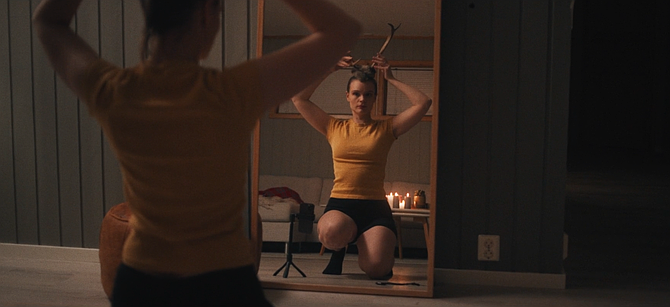
Máhtte isn’t the only one with mother trouble. To Lena’s credit, her homecoming is not an admission of defeat. She’s back in town looking for female herding managers who will consent to be interviewed for an art project. But seldom is heard an encouraging word from mother Biera (Anitta Suikkari). She wants her daughter to paint “nice” pictures, not a bald woman with a great set of antlers and a black abyss where a vagina should be. Pressed for a reaction, Biera's only response is, “You should paint reindeer."
And Biera isn’t alone when it comes to under-appreciating Lena’s artistic vision. Thumbing through her portfolio, the local art commissioner — she of the frozen-faced, fixed grin — has a glint in her eye that pleads, “How much longer do I have to keep grinning at this garbage?” Besides, she's more interested in getting a celebrity photo of Lena for her Facebook page than she is in exploring her art. And the commish is not the only local to act strangely whenever Lena is near. Townsfolk recognize her as a back-biter and question why she is returning after so long an absence — especially when it was her decision to skip town in the first place.
The force of Lena and Máhtte’s relationship lies in Oskal’s restraint; she has the patience to forbear pushing things together to suggest a union that just isn’t there. (Máhtte knows how to read the room: it isn’t until he’s confident that it would be the right time for both of them that he makes his first move.) Oskal also brings with her an innate understanding of how to best to use an anamorphic lens. The interiors are cramped and uncomfortable, but once the four walls disappear and mounted snowmobiles replace humans on horseback, the thrilling herding sequences act as a literal reminder of just how big, wide, and wonderful is the planet we inhabit. ****
The Tundra Within Me makes its exclusive North American debut June 6 on IndiePix Unlimited.
Here's something you might be interested in.
Now Streaming: THE TUNDRA WITHIN ME (2023)
At the time of the collision Máhtte was bringing the animals to slaughter, so I guess we can call it “meat cute.”

Now Streaming: THE TUNDRA WITHIN ME (2023)
At the time of the collision Máhtte was bringing the animals to slaughter, so I guess we can call it “meat cute.”
Who's up for joining in some reindeer games?
THE TUNDRA WITHIN ME (2023) Written & Directed by Sara Margrethe Oskal / Cinematographer: Anders Hoft (2.35:1) / Editor: Anna Løvlund / Costume Designer: Anne Margaretha Oskal / Sound Designer: Håkon Lammetun / Acted by: Risten Anine Kvernmo Gaup, Nils Ailu Kemi, Elias Ánte Pilutaq Gaup Lennert, Anitta Suikkari, Berit Anne O. Kemi and Anders Isak Oskal / Country of Origin: Norway (In Saami & Norwegian with English Subtitles) / Production Company: Freedom From Fear / Not Rated / 95 mins.
Sara Margrethe Oskal’s director’s statement reads, in part, “I want to dig into the feeling of not belonging in a traditional society where the collective mindset and its expectations have a strong influence on every individual.” Have you heard the one about the reindeer herder and the single mother/gender artist destined to meet and heat up a frigid Norwegian winter together? The nippy critic within me defrosts at the very thought of first-time writer/director Sara Margrethe Oskal’s The Tundra Within Me, for nothing quickens my cinematic pulse faster than a melodramatic tale of two ordinary people falling in and out of love under extraordinary circumstances.
Máhtte (Nils Ailu Kemi) must not have been on top of his game the afternoon of the accident: one of his herd broke from the pack and collided with a bus carrying, among others, traveling artist Lena (Risten Anine Kvernmo Gaup) and her young son Jonas (Elias Ánte Pilutaq Gaup Lennert), relocating from Oslo back to mom’s birthplace in Sápmi. (At the time of the collision, Máhtte was bringing the animals to slaughter, so I guess we can call it “meat cute.”)
There must have been something more than just a sudden urge within Oskal to write and direct a picture about female reindeer herders. Art imitates life: our director started off as a professional reindeer herder who, thinking a career change was in order, sold her subarctic deer before turning to artistic expression as a way of making a living. She must have transfused a great deal of her experience into Lena’s blood: only someone with an intense appreciation of reindeer-herding would respond positively to the pick-up line, “I'm taking the heifer back to the herd. Do you want to come along?”
The danger here is not from wildlife, but the domestic sort: Máhtte’s widowed mother Gáren (Berit Anne O. Kemi) rules her full-grown baby boy’s life with a clenched heart. She wants her son to think of the future — going so far as to suggest he marry their competitor so the two might put their herds together. If not, a start-up grant for the business is theirs for the asking, yet the old bruja takes more sadistic satisfaction in seeing Máhtte suffer than in seeing her son succeed. Prior to an eleventh hour change of character, Gáren's only act of kind-heartedness is directed at a wounded cow about to be put down. She rights it with a single, swift joint-readjusting twist of its hind leg.
Video:
Trailer: THE TUNDRA WITHIN ME
Máhtte isn’t the only one with mother trouble. To Lena’s credit, her homecoming is not an admission of defeat. She’s back in town looking for female herding managers who will consent to be interviewed for an art project. But seldom is heard an encouraging word from mother Biera (Anitta Suikkari). She wants her daughter to paint “nice” pictures, not a bald woman with a great set of antlers and a black abyss where a vagina should be. Pressed for a reaction, Biera's only response is, “You should paint reindeer."
And Biera isn’t alone when it comes to under-appreciating Lena’s artistic vision. Thumbing through her portfolio, the local art commissioner — she of the frozen-faced, fixed grin — has a glint in her eye that pleads, “How much longer do I have to keep grinning at this garbage?” Besides, she's more interested in getting a celebrity photo of Lena for her Facebook page than she is in exploring her art. And the commish is not the only local to act strangely whenever Lena is near. Townsfolk recognize her as a back-biter and question why she is returning after so long an absence — especially when it was her decision to skip town in the first place.
The force of Lena and Máhtte’s relationship lies in Oskal’s restraint; she has the patience to forbear pushing things together to suggest a union that just isn’t there. (Máhtte knows how to read the room: it isn’t until he’s confident that it would be the right time for both of them that he makes his first move.) Oskal also brings with her an innate understanding of how to best to use an anamorphic lens. The interiors are cramped and uncomfortable, but once the four walls disappear and mounted snowmobiles replace humans on horseback, the thrilling herding sequences act as a literal reminder of just how big, wide, and wonderful is the planet we inhabit. ****
The Tundra Within Me makes its exclusive North American debut June 6 on IndiePix Unlimited.