

Here's something you might be interested in.
Ask a Hipster — Advice you didn't know you needed
Big Screen — Movie commentary
Blurt — Music's inside track
Booze News — San Diego spirits
Classical Music — Immortal beauty
Classifieds — Free and easy
Close to Home — What it’s like on the street where you live
Cover Stories — Front-page features
Drinks All Around — Bartenders' drink recipes
Excerpts — Literary and spiritual excerpts
Feast! — Food & drink reviews
Feature Stories — Local news & stories
Fishing Report — What’s getting hooked from ship and shore
From the Archives — Spotlight on the past
Golden Dreams — Talk of the town
The Gonzo Report — Making the musical scene, or at least reporting from it
Letters — Our inbox
Movies@Home — Local movie buffs share favorites
Movie Reviews — Our critics' picks and pans
Musician Interviews — Up close with local artists
Neighborhood News from Stringers — Hyperlocal news
News Ticker — News & politics
Obermeyer — San Diego politics illustrated
Outdoors — Weekly changes in flora and fauna
Overheard in San Diego — Eavesdropping illustrated
Poetry — The old and the new
Reader Travel — Travel section built by travelers
Reading — The hunt for intellectuals
Roam-O-Rama — SoCal's best hiking/biking trails
San Diego Beer — Inside San Diego suds
SD on the QT — Almost factual news
Sheep and Goats — Places of worship
Special Issues — The best of
Street Style — San Diego streets have style
Surf Diego — Real stories from those braving the waves
Theater — On stage in San Diego this week
Tin Fork — Silver spoon alternative
Under the Radar — Matt Potter's undercover work
Unforgettable — Long-ago San Diego
Unreal Estate — San Diego's priciest pads
Your Week — Daily event picks
Travel Story: Meandering through Motovun
Local wines and dragon lines in a Croatian hilltop town
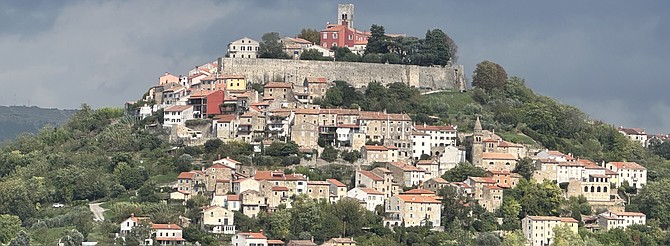
The Croatian town of Motovun rests high atop a hill on the Istria Peninsula. It’s a two-hour drive from Trieste, and three hours from Venice — or you could just take a ferry across the Adriatic and rent a car. My suggestion is to fly into Pula at the country’s southern tip and then take the toll road north. (Do be extra cautious when driving on the two-lane roads, because there are many cyclists, and they have the right of way.) Most people park in a well-lit parking lot at the bottom of the switchback road that goes up to the town, then take a shuttle bus up to the top and walk into town, where the cobblestone streets are mostly pedestrian. It’s also possible to make arrangements for your host to come and get you at the bottom of the hill, whether you are staying in the Boutique Hotel Kaštel, a B&B, or an apartment.
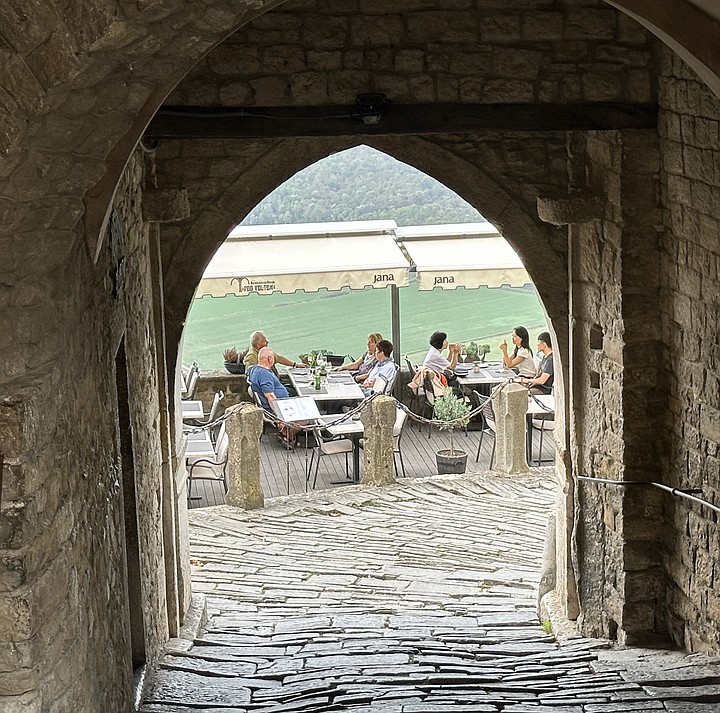
The town's main gate
My wife and I wanted the freedom and amenities offered by The Boutique Hotel Kaštel; a B&B or apartment might have meant a more rigid schedule and the need to stock up on supplies. The hotel has only thirty-three rooms, but it houses a restaurant, spa services, and even an indoor pool. We especially enjoyed the secret garden, where we played a game of Pendulum Bowling, swinging a hard ball at the end of a rope to knock over the pins. A perfect spot to chill out and unwind, which was our objective. You can “do” Motovun in half a day — maybe even an hour — but to take in the full laid-back ambiance, you need a few days.
There is no shortage of restaurants; the town seems to be a destination for foodies. But despite the crowds at both lunch and dinner, we always seemed to get a nice quiet table, usually outside. The hotel’s Restaurant Kaštel features terrace seating, and we were impressed with their gnocchi. (Nota bene: Croatians, and visitors to Croatia, like to smoke, so try and get a table upwind if possible.) The specialty is anything made with local white truffles. And if you don’t like Croatian olive oil, you’re in trouble, because it’s a both a staple and very flavorful. Most main dishes are served with white truffles and an olive oil-based sauce; we preferred it with grilled fish fresh from the Adriatic. As for dessert, it is best to share here, because the portions are large. Oh, a host of liquors are served throughout Croatia; Motovun offered a local apple brandy that was perfect for topping off an evening.
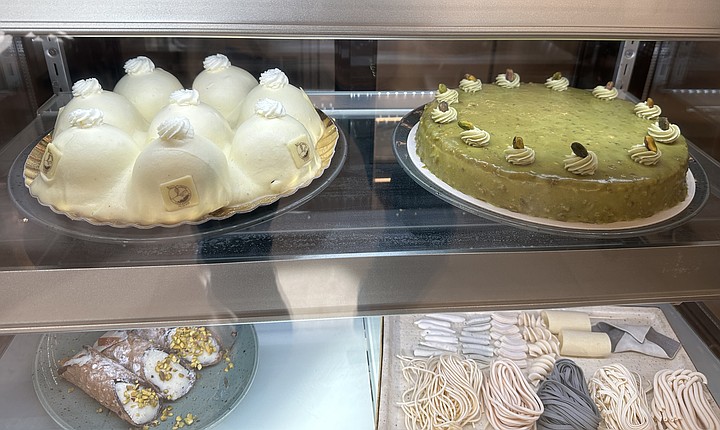
Pastries and pastas
The beer in Croatia is good, but it’s Croatian wines that are spectacular — and very reasonably priced. We tended to split a bottle of white Malvazija at lunch and a local red made with teran grapes at dinner. The day we left we made a point of stopping at the Fakin Winery just a few miles from town for a tasting. There are any number of organized tours for wine and olive oil tasting, truffle hunting, or simply visiting nearby hill towns or coastal communities. You can get information from the Tourist Board Motovun office in the main square, just a few steps from the Boutique Hotel Kaštel. But we came to Motovun to chill out and take in the vibes of this picturesque and tranquil place, so that’s what we did. We spent our days taking slow and careful walks through the cobblestone streets, taking in the medieval Venetian Renaissance architecture of Motovun and views of the surrounding Miran valley. Day visitors don’t arrive until late morning, and they are all gone by late afternoon, so during the mornings and evenings, it felt like we had the town to ourselves.
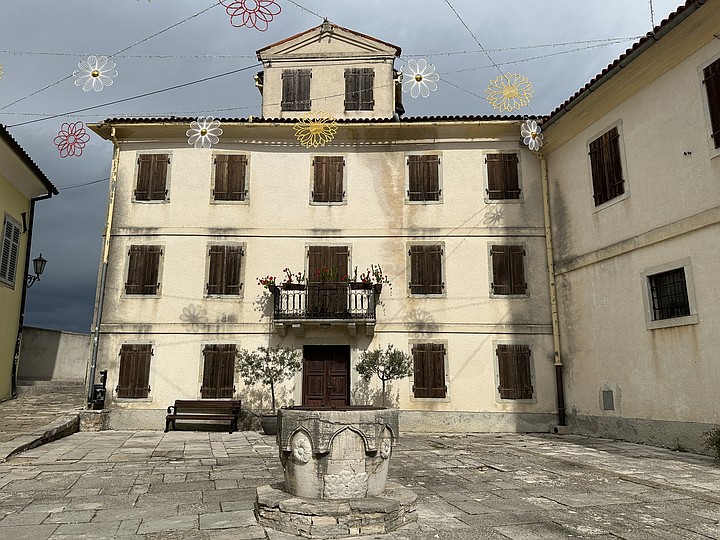
The town square with its ancient well
The best views are from the top of the town’s bell tower — just over 1000 steps to the top. Take it slow and easy and you will be in for a magnificent and well earned reward. Saint Stephen’s church — designed by Venetian architect Andrea Palladio in the 14th century — stands next to the bell tower, and provides a quiet, cool sanctuary after your ascent. After a rest, you can take a short walk on the city wall for more great views of the valleys below, or peruse some of the mostly local art in the town’s private galleries.
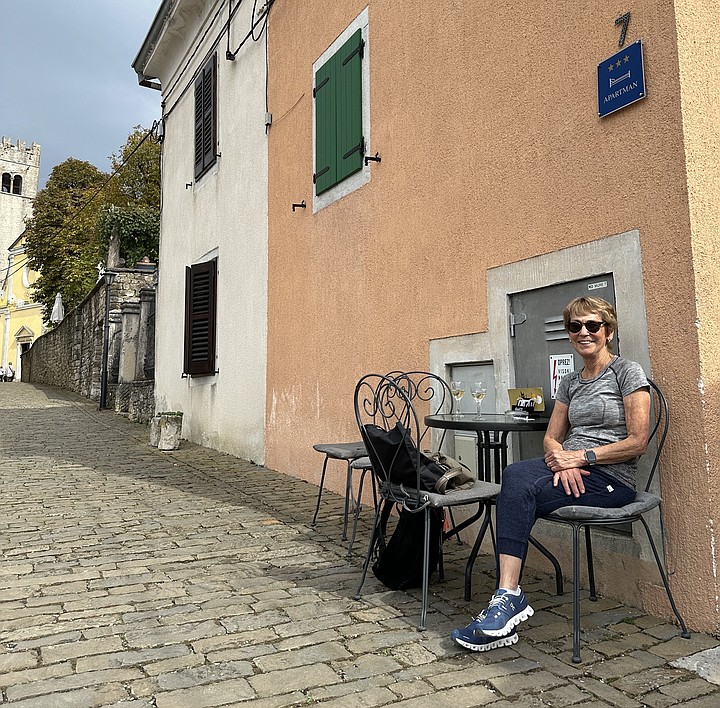
Taking a break before tackling the bell tower in the distance
As you explore, you do get the feeling that a lot has happened here; some good things and some not so good things. We were not surprised to learn that many people believe that Motovun sits on geographic ley lines (also called dragon lines) which are thought to be a positive force for health and wellbeing. Stonehenge and other monolithic sites around the world are also considered to be located on ley lines. My wife and I don’t closely follow this metaphysical way of thinking, but the town definitely imparted a feeling of positive energy. The day we left, we had a feeling of renewed vigor, insight, and a positive perspective, and we could already feel the pull to return.
Here's something you might be interested in.
Travel Story: Meandering through Motovun
Local wines and dragon lines in a Croatian hilltop town

Travel Story: Meandering through Motovun
Local wines and dragon lines in a Croatian hilltop town
The Croatian town of Motovun rests high atop a hill on the Istria Peninsula. It’s a two-hour drive from Trieste, and three hours from Venice — or you could just take a ferry across the Adriatic and rent a car. My suggestion is to fly into Pula at the country’s southern tip and then take the toll road north. (Do be extra cautious when driving on the two-lane roads, because there are many cyclists, and they have the right of way.) Most people park in a well-lit parking lot at the bottom of the switchback road that goes up to the town, then take a shuttle bus up to the top and walk into town, where the cobblestone streets are mostly pedestrian. It’s also possible to make arrangements for your host to come and get you at the bottom of the hill, whether you are staying in the Boutique Hotel Kaštel, a B&B, or an apartment.
The town's main gate
My wife and I wanted the freedom and amenities offered by The Boutique Hotel Kaštel; a B&B or apartment might have meant a more rigid schedule and the need to stock up on supplies. The hotel has only thirty-three rooms, but it houses a restaurant, spa services, and even an indoor pool. We especially enjoyed the secret garden, where we played a game of Pendulum Bowling, swinging a hard ball at the end of a rope to knock over the pins. A perfect spot to chill out and unwind, which was our objective. You can “do” Motovun in half a day — maybe even an hour — but to take in the full laid-back ambiance, you need a few days.
There is no shortage of restaurants; the town seems to be a destination for foodies. But despite the crowds at both lunch and dinner, we always seemed to get a nice quiet table, usually outside. The hotel’s Restaurant Kaštel features terrace seating, and we were impressed with their gnocchi. (Nota bene: Croatians, and visitors to Croatia, like to smoke, so try and get a table upwind if possible.) The specialty is anything made with local white truffles. And if you don’t like Croatian olive oil, you’re in trouble, because it’s a both a staple and very flavorful. Most main dishes are served with white truffles and an olive oil-based sauce; we preferred it with grilled fish fresh from the Adriatic. As for dessert, it is best to share here, because the portions are large. Oh, a host of liquors are served throughout Croatia; Motovun offered a local apple brandy that was perfect for topping off an evening.
Pastries and pastas
The beer in Croatia is good, but it’s Croatian wines that are spectacular — and very reasonably priced. We tended to split a bottle of white Malvazija at lunch and a local red made with teran grapes at dinner. The day we left we made a point of stopping at the Fakin Winery just a few miles from town for a tasting. There are any number of organized tours for wine and olive oil tasting, truffle hunting, or simply visiting nearby hill towns or coastal communities. You can get information from the Tourist Board Motovun office in the main square, just a few steps from the Boutique Hotel Kaštel. But we came to Motovun to chill out and take in the vibes of this picturesque and tranquil place, so that’s what we did. We spent our days taking slow and careful walks through the cobblestone streets, taking in the medieval Venetian Renaissance architecture of Motovun and views of the surrounding Miran valley. Day visitors don’t arrive until late morning, and they are all gone by late afternoon, so during the mornings and evenings, it felt like we had the town to ourselves.
The town square with its ancient well
The best views are from the top of the town’s bell tower — just over 1000 steps to the top. Take it slow and easy and you will be in for a magnificent and well earned reward. Saint Stephen’s church — designed by Venetian architect Andrea Palladio in the 14th century — stands next to the bell tower, and provides a quiet, cool sanctuary after your ascent. After a rest, you can take a short walk on the city wall for more great views of the valleys below, or peruse some of the mostly local art in the town’s private galleries.
Taking a break before tackling the bell tower in the distance
As you explore, you do get the feeling that a lot has happened here; some good things and some not so good things. We were not surprised to learn that many people believe that Motovun sits on geographic ley lines (also called dragon lines) which are thought to be a positive force for health and wellbeing. Stonehenge and other monolithic sites around the world are also considered to be located on ley lines. My wife and I don’t closely follow this metaphysical way of thinking, but the town definitely imparted a feeling of positive energy. The day we left, we had a feeling of renewed vigor, insight, and a positive perspective, and we could already feel the pull to return.
Comments