

Here's something you might be interested in.
Ask a Hipster — Advice you didn't know you needed
Big Screen — Movie commentary
Blurt — Music's inside track
Booze News — San Diego spirits
Classical Music — Immortal beauty
Classifieds — Free and easy
Close to Home — What it’s like on the street where you live
Cover Stories — Front-page features
Drinks All Around — Bartenders' drink recipes
Excerpts — Literary and spiritual excerpts
Feast! — Food & drink reviews
Feature Stories — Local news & stories
Fishing Report — What’s getting hooked from ship and shore
From the Archives — Spotlight on the past
Golden Dreams — Talk of the town
The Gonzo Report — Making the musical scene, or at least reporting from it
Letters — Our inbox
Movies@Home — Local movie buffs share favorites
Movie Reviews — Our critics' picks and pans
Musician Interviews — Up close with local artists
Neighborhood News from Stringers — Hyperlocal news
News Ticker — News & politics
Obermeyer — San Diego politics illustrated
Outdoors — Weekly changes in flora and fauna
Overheard in San Diego — Eavesdropping illustrated
Poetry — The old and the new
Reader Travel — Travel section built by travelers
Reading — The hunt for intellectuals
Roam-O-Rama — SoCal's best hiking/biking trails
San Diego Beer — Inside San Diego suds
SD on the QT — Almost factual news
Sheep and Goats — Places of worship
Special Issues — The best of
Street Style — San Diego streets have style
Surf Diego — Real stories from those braving the waves
Theater — On stage in San Diego this week
Tin Fork — Silver spoon alternative
Under the Radar — Matt Potter's undercover work
Unforgettable — Long-ago San Diego
Unreal Estate — San Diego's priciest pads
Your Week — Daily event picks
The playfully cruel world of backgammon
Things get dicey on that ancient board of elongated triangular spears and stones.
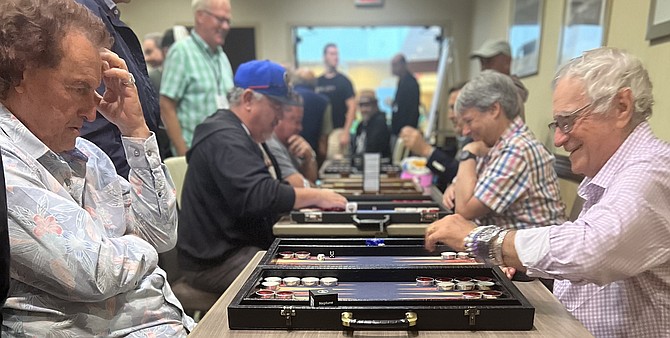
It’s a rarity to be able to walk into a room as a relative newbie and beat a world champion in their respective sport. But therein lies the playful cruelty of backgrammon: anybody is welcome, and on any given day, anybody can taste victory or learn from defeat.
Every Wednesday night at Hilton Embassy Suites hotel in La Jolla, a diverse group of competitors come together to play one of the world’s oldest games: backgammon. The San Diego Backgammon Club has been intellectually stimulating the San Diego community since its 2023 re-inception, and these weekly events have attracted attorneys, a retired Russian jet pilot, and a jovial truck driver, among many others. The appeal of the game is that it involves both strategy and luck. All games are anybody’s game, so to say.
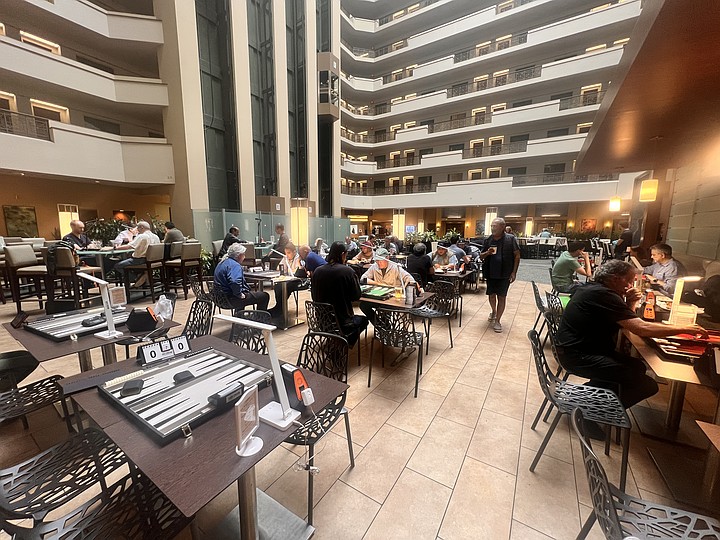
La Jolla's backgammon battleground
On a recent Saturday, the Club hosted a charity event for the Helen Woodward Animal Center. The event brought in some of the backgammon world’s top dogs. On hand were two-time World Champion (1994, 2023) Frank Frigo, Harvey Mudd “mathemagician” Art Benjamin (aka The Human Calculator), and the current ranked number one player in the world, Masayuki “Mochy” Mochizuki. These event pros gave a series of lectures before playing against anybody who was willing to step into their gauntlets. Meanwhile, a tournament for eventgoers was going down simultaneously.
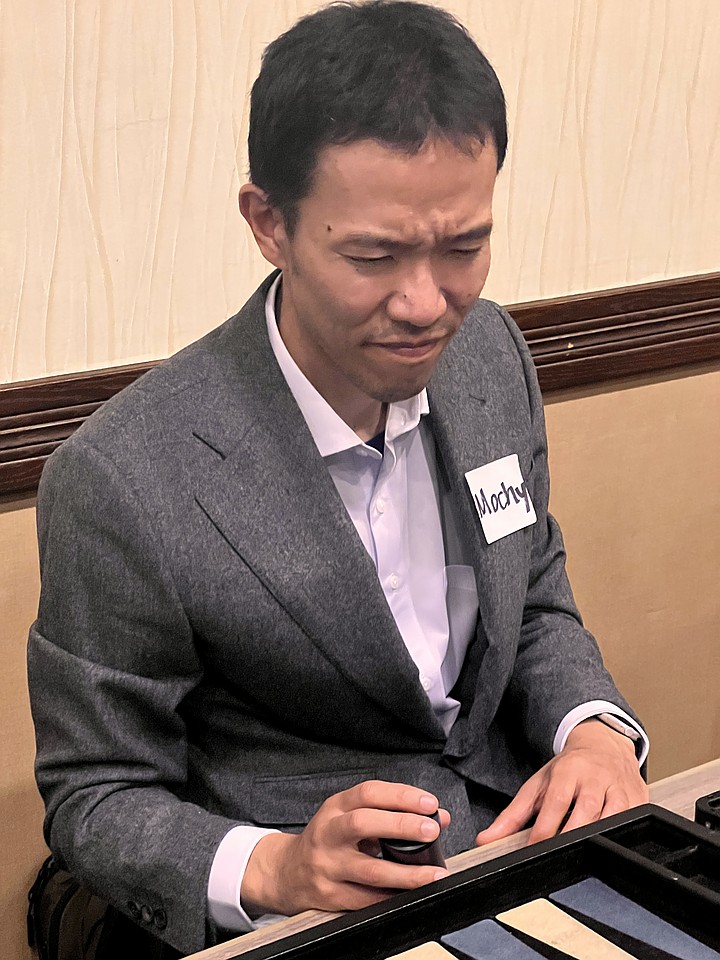
Top-ranked player in the world Masayuki “Mochy” Mochizuki visited San Diego from Japan.
Besides the fundraiser, another incentive for the event was to shine a light on the game for the younger generation. A backgammon renaissance — we had one 50 years ago in the ‘70s — would be welcome, but there’s a concern that the youth may not take to the game. Although it's simple to learn the basics, it does take some time and dedication to hone strategies. (Some even go so far as filming their matches and studying it later.)
One quote dropped over and over: “A four-year-old can learn this game.” And maybe that's when you need to get 'em hooked. An Iranian fellow named Medhi opened a board, started moving the checkers around in no particular order, and said that it’s about planting a seed from the get-go. “The kids just need to have a vision of the board,” he said. “They need to see the dice and the checkers. When they turn four or five, then you teach them some strategy. If you start to teach them at ten or eleven, they won’t take to it.”
One woman argued, “In the heyday of backgammon, it was social. People were talking, laughing, drinking, and having fun. It’s got to be social. You’ve got to get that entry-level social player in the door and playing. The only way to do that is to bring back social backgammon, even if it drives you insane.”
Beyond the social aspect, global backgammon ambassador Phil Simberg stated, “You’ve got to be tough mentally. You’ve got to have the guts to make the right plays. You’ve got to be awake and with it.” Other performance tips from Simberg included sleeping and eating well, forgetting about luck and focusing on what you can control, and forgetting about winning and losing. Rather, he said, think about what the right play is. “When you start thinking about being scared or being excited, it’s going to totally stop your logic. Your emotions are going to screw your logic, and you won’t play well.”
One competitor who did play well that day was Matt Schoonmaker, who came out on top of the 112-person tournament. An actuary by profession, backgammon came naturally to the weekly Club member. “I think it’s the best game in the world,” he proudly stated. “I just got into backgammon a few years ago. It has a lot in common with poker with the strategy and the numbers. Poker is huge, but I think backgammon is more fun. It’s a wonderful game because it’s a nice blend of skill where your decisions matter, and luck where anyone can win. Then there’s a tremendous amount of volatility.”
According to Frank Frigo, the lessons learned in backgammon extend past the board. “It teaches us a lot about good decision making in life,” the world champion said. “Good decisions aren’t necessary based on outcomes. They’re based on taking the information that’s available and giving yourself the highest probably for the desired outcome. Getting too hung up on what’s already transpired or what bad things might happen just pollutes your thinking. It’s a good way to train yourself how to navigate decision making.”
Here's something you might be interested in.
The playfully cruel world of backgammon
Things get dicey on that ancient board of elongated triangular spears and stones.

The playfully cruel world of backgammon
Things get dicey on that ancient board of elongated triangular spears and stones.
It’s a rarity to be able to walk into a room as a relative newbie and beat a world champion in their respective sport. But therein lies the playful cruelty of backgrammon: anybody is welcome, and on any given day, anybody can taste victory or learn from defeat.
Every Wednesday night at Hilton Embassy Suites hotel in La Jolla, a diverse group of competitors come together to play one of the world’s oldest games: backgammon. The San Diego Backgammon Club has been intellectually stimulating the San Diego community since its 2023 re-inception, and these weekly events have attracted attorneys, a retired Russian jet pilot, and a jovial truck driver, among many others. The appeal of the game is that it involves both strategy and luck. All games are anybody’s game, so to say.
La Jolla's backgammon battleground
On a recent Saturday, the Club hosted a charity event for the Helen Woodward Animal Center. The event brought in some of the backgammon world’s top dogs. On hand were two-time World Champion (1994, 2023) Frank Frigo, Harvey Mudd “mathemagician” Art Benjamin (aka The Human Calculator), and the current ranked number one player in the world, Masayuki “Mochy” Mochizuki. These event pros gave a series of lectures before playing against anybody who was willing to step into their gauntlets. Meanwhile, a tournament for eventgoers was going down simultaneously.
Top-ranked player in the world Masayuki “Mochy” Mochizuki visited San Diego from Japan.
Besides the fundraiser, another incentive for the event was to shine a light on the game for the younger generation. A backgammon renaissance — we had one 50 years ago in the ‘70s — would be welcome, but there’s a concern that the youth may not take to the game. Although it's simple to learn the basics, it does take some time and dedication to hone strategies. (Some even go so far as filming their matches and studying it later.)
One quote dropped over and over: “A four-year-old can learn this game.” And maybe that's when you need to get 'em hooked. An Iranian fellow named Medhi opened a board, started moving the checkers around in no particular order, and said that it’s about planting a seed from the get-go. “The kids just need to have a vision of the board,” he said. “They need to see the dice and the checkers. When they turn four or five, then you teach them some strategy. If you start to teach them at ten or eleven, they won’t take to it.”
One woman argued, “In the heyday of backgammon, it was social. People were talking, laughing, drinking, and having fun. It’s got to be social. You’ve got to get that entry-level social player in the door and playing. The only way to do that is to bring back social backgammon, even if it drives you insane.”
Beyond the social aspect, global backgammon ambassador Phil Simberg stated, “You’ve got to be tough mentally. You’ve got to have the guts to make the right plays. You’ve got to be awake and with it.” Other performance tips from Simberg included sleeping and eating well, forgetting about luck and focusing on what you can control, and forgetting about winning and losing. Rather, he said, think about what the right play is. “When you start thinking about being scared or being excited, it’s going to totally stop your logic. Your emotions are going to screw your logic, and you won’t play well.”
One competitor who did play well that day was Matt Schoonmaker, who came out on top of the 112-person tournament. An actuary by profession, backgammon came naturally to the weekly Club member. “I think it’s the best game in the world,” he proudly stated. “I just got into backgammon a few years ago. It has a lot in common with poker with the strategy and the numbers. Poker is huge, but I think backgammon is more fun. It’s a wonderful game because it’s a nice blend of skill where your decisions matter, and luck where anyone can win. Then there’s a tremendous amount of volatility.”
According to Frank Frigo, the lessons learned in backgammon extend past the board. “It teaches us a lot about good decision making in life,” the world champion said. “Good decisions aren’t necessary based on outcomes. They’re based on taking the information that’s available and giving yourself the highest probably for the desired outcome. Getting too hung up on what’s already transpired or what bad things might happen just pollutes your thinking. It’s a good way to train yourself how to navigate decision making.”
Comments