

Here's something you might be interested in.
Ask a Hipster — Advice you didn't know you needed
Big Screen — Movie commentary
Blurt — Music's inside track
Booze News — San Diego spirits
Classical Music — Immortal beauty
Classifieds — Free and easy
Close to Home — What it’s like on the street where you live
Cover Stories — Front-page features
Drinks All Around — Bartenders' drink recipes
Excerpts — Literary and spiritual excerpts
Feast! — Food & drink reviews
Feature Stories — Local news & stories
Fishing Report — What’s getting hooked from ship and shore
From the Archives — Spotlight on the past
Golden Dreams — Talk of the town
The Gonzo Report — Making the musical scene, or at least reporting from it
Letters — Our inbox
Movies@Home — Local movie buffs share favorites
Movie Reviews — Our critics' picks and pans
Musician Interviews — Up close with local artists
Neighborhood News from Stringers — Hyperlocal news
News Ticker — News & politics
Obermeyer — San Diego politics illustrated
Outdoors — Weekly changes in flora and fauna
Overheard in San Diego — Eavesdropping illustrated
Poetry — The old and the new
Reader Travel — Travel section built by travelers
Reading — The hunt for intellectuals
Roam-O-Rama — SoCal's best hiking/biking trails
San Diego Beer — Inside San Diego suds
SD on the QT — Almost factual news
Sheep and Goats — Places of worship
Special Issues — The best of
Street Style — San Diego streets have style
Surf Diego — Real stories from those braving the waves
Theater — On stage in San Diego this week
Tin Fork — Silver spoon alternative
Under the Radar — Matt Potter's undercover work
Unforgettable — Long-ago San Diego
Unreal Estate — San Diego's priciest pads
Your Week — Daily event picks
Now Streaming: THE CONQUEROR: HOLLYWOOD FALLOUT (2023)
Come for the unintentional laughs, stay for the awful truth.
Check out the killer show!
THE CONQUEROR: HOLLYWOOD FALLOUT (2023) / Written & Directed by William Nunez / Cinematographer: Samuel Painter / Art Department: Douglas Ingram / Editor: Justin Weinstein / Composer: Hugo de Chaire / Talking Heads: Patrick Wayne, Michael Medved, John William Law, Andy Kirk, Russell Fjeldsted, James D'Arc, Ellen Levine, Claudia Peterson, & Mark Wannamaker / Distributor: Blue Fox Entertainment / Britain / Not Rated / Length: 116 mins.
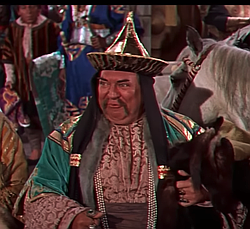
Howard Hughes wanted to bring the life of Genghis Khan to the screen in the worst way — and that’s precisely how he did it. The Conqueror is best remembered for two things: John Wayne in yellowface as the Mongolian warlord, spouting the type of florid dialogue that all the coaching in the world couldn’t get plain-speaking Duke to deliver the way the screenwriter had intended, and a radioactive location shoot that may have contributed to the death of every major player, including director Dick Powell. The Conqueror: Hollywood Fallout is that rarity of rarities: a making-of documentary that far outclasses its subject.
Video:
Trailer: THE CONQUEROR: HOLLYWOOD FALLOUT
It would have been safer — albeit much less cost-effective — had The Conqueror been shot in the Gobi Desert (where the action was originally set), rather than in the community of St. George, Utah — located a breezy 137 miles away down the road from an atomic test site. What Hughes intended to serve as his final masterpiece instead lives on as both one of Hollywood’s most dizzyingly entertaining flops and a production forever shrouded in infamy. The cast and crew was unwittingly placed on “the front-line of atomic warfare," but the government proved remarkably hesitant to admit any wrongdoing.
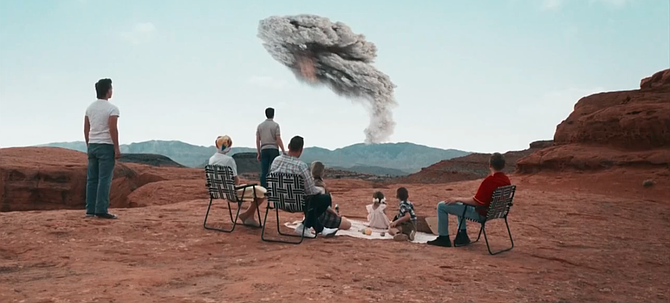
RKO turned the entire town into a movie set, and all the locals giddily pitched in. All went well until one day, a voice on the radio interrupted programming and announced that the wind had shifted in the town’s direction. “There is no danger,” the voice assured listeners. “This is simply routine safety procedure," given that there might be the possibility of some modest exposure to additional radiation. With personal safety not an issue, Mom and Dad could pack a picnic basket and drive the family within miles of the test site for dinner and an A-bomb. The mushroom cloud that formed could reach as high as 40,000 feet. For comparison, the Empire State Building is 1250 feet.
Believe it or don’t, John Wayne wasn’t Powell's first choice for the lead. But after reading the script, Marlon Brando decided he couldn't believe the dialogue and quickly declined. (Even screenwriter Oscar Millard called the film nothing more than a “tarted up Western.”) In Wayne’s defense, he did suggest getting together with Millard and a voice coach to work on massaging the dialogue into something that could roll off his monotone tongue. But at their first meeting, Wayne was so drunk he dozed off about 20 pages in, and he never again mentioned working on the dialogue. Dancer Sylvia Lewis came right out and accused Wayne of drinking his way through the picture. But can you blame him? Wayne’s showing was the most re-goddamn-diculous example of Hollywood miscasting this side of Tony Bennett’s million laughs “performance” in The Oscar. (As if to remind us all of what a great movie star John Wayne could be in the right circumstances, when it comes time to discuss his death, filmmaker William Nunez includes the sobering final shot from The Searchers.)
Hughes was his leading man’s mirror opposite: obsessed with minutiae, hammering away at every point with tent-pole precision. Never one to work businessman hours, and armed with a paranoiacs’ zeal for complete privacy, Hughes would ring Powell in the middle of the night with instructions to meet him in a 24-hour parking garage. There, the two would huddle in the back of Hughes’s car for an hour or so, talking over the production.
This wasn’t Dick Powell’s first time behind the camera. He had just come off of a pair of well-received films noir for RKO. But Michael Medved suggests it wasn't Powell’s prowess, but rather his ability to repeat, “Yes, Howard,” ad infinitum that caught Hughes’s attention. (A producer’s credit and all the zeros it added to his pay stub was more likely his true inspiration. It is suggested that Powell's earnings from the film went into purchasing a home in Mandeville Canyon, a small, affluent community in the Brentwood neighborhood of Los Angeles.)
There was a stretch in the 1950s when spectacle became the industry's go-to gimmick, the thing best-suited for showing off its new widescreen wares. Television was taking a spiked boot to Hollywood's artistic arteries, and the studios responded with the one major advantage they had over a luminescent piece of living room furniture: size. The decade that followed the birth of Cinerama, 3-D, and CinemaScope heralded the dawn of cinema as an immersive visual experience. And on that front, as ludicrous as much of The Conqueror is, the film has a lot going for it. It's simply sumptuous to look at, and small wonder: the action sequences were filmed by four career cinematographers (Joseph LaShelle, William Snyder, Leo Tover, and Harry J. Wild). It sounded great, too: Victor Young’s score mixes trademark rousing action mixed with stringed romanticism. Even the stunt work is spectacular, particularly if you have a keen interest in watching horses repeatedly fall to their knees on cue.
But none of that was enough to make it a real hit, even if Wayne did at one point imply that it was a "massive success." The film's worldwide take doubled its $6 million budget, but the documentary's narration hedges notes that the additional $2 million Hughes spent promoting and marketing the picture “erased any profits." Not long after its release, Hughes had it yanked from distribution. The Conqueror vanished from sight quicker than one could say Porgy and Bess. For 21 years, the film remained out of circulation, until Universal bought the rights in 1979 with the intention of a wide-scale re-release that never materialized.
Legend has it that in his waning years, Hughes would sit alone and naked (give or take a Kleenex tissue) in his penthouse suite at the Desert Inn with a 16 mm projector and a pull-down screen, watching The Conqueror on a loop. It was either that or Ice Station Zebra, an overpriced, underperforming grepse from the dying breaths of the studio system that Hughes had taken a liking to. Either way, it gave good cause to question his sanity.
He eventually dropped $12 million in an effort to buy back every print of both Jet Pilot — his previous collaboration with Wayne — and The Conqueror. (Though in the late '70s, Chicago’s Film Center at the School of the Arts Institute screened a private collector’s flat, 16mm Technicolor print that was letterboxed: 1.85:1. In the '50s, the size of an average television tube was 14 to 17 inches. On a screen that size, letterboxing reduced a CinemaScope image to a band-aid stretched across an already puny screen. That’s how pan-and-scan was born. Back then, even a cropped print of an anamorphic film was a luxury. Today, it’s called business as usual at HBO.) Did Hughes reclaim the prints out of a sense of guilt? Did he feel some responsibility for the lives that were extinguished because of a film that he produced? In his quest for exactitude, Hughes had 60 tons of on-location sand shipped back to the studio. The sand was radioactive. When asked about The Conqueror years later, he said that he felt “guilty as hell” about the whole thing.
The documentary moves at a brisk pace, employing many imaginative new tricks that pleased this old dog. Bridging sequences meant to visualize the narrative were brought to life through storyboards designed for the movie — much better this than constant actor recreations or cheap animation. And those looking for artists' renderings can rejoice in the closing credits, which play over the pages of the original Dell comic book timed to coincide with the film’s release.
Still, there were a couple of easily detectable factual errors that should have been caught prior to the documentary’s release. RKO was not the King of the Bs, as Nunez states. The studio joined MGM, Warner Bros., Paramount, and 20th Century Fox as one of Hollywood's five major studios. Together with the "Little Three" (Universal, Columbia, and United Artists), they made up the Hollywood studio system. And while Hughes did share a producer credit with director Howard Hawks, Scarface was independently produced and distributed by United Artists, not RKO.
When checking the running time, I initially questioned how a “making of” documentary could be longer than the film it covered. But then, there’s much more here than a sniggering excuse to gleefully tear into the film’s awfulness, however plentiful. The Conqueror’s true horrors are derived from the government cover up of circumstances that contributed to numerous subsequent fatalities. After an hour or so, the film's mood and tone shifts, and the absurdity of the situation that got us to this point is replaced by urgent testimonials from both survivors and their descendants.
By the time the fallout cleared, of the 221 cast and crew members that participated in the two-month location shoot, 91 were lost to cancer. Star Wayne was quick to pin the blame not on the government, but on the three to five packs of unfiltered Camels he sucked down each day. And June Allyson, wife of Dick Powell, pinned her husband’s death on cigarettes as well. But the numbers don't lie.
A last word of critical counsel: watch the Hughes original in advance of the documentary. ****
Here's something you might be interested in.
Now Streaming: THE CONQUEROR: HOLLYWOOD FALLOUT (2023)
Come for the unintentional laughs, stay for the awful truth.

Now Streaming: THE CONQUEROR: HOLLYWOOD FALLOUT (2023)
Come for the unintentional laughs, stay for the awful truth.
Check out the killer show!
THE CONQUEROR: HOLLYWOOD FALLOUT (2023) / Written & Directed by William Nunez / Cinematographer: Samuel Painter / Art Department: Douglas Ingram / Editor: Justin Weinstein / Composer: Hugo de Chaire / Talking Heads: Patrick Wayne, Michael Medved, John William Law, Andy Kirk, Russell Fjeldsted, James D'Arc, Ellen Levine, Claudia Peterson, & Mark Wannamaker / Distributor: Blue Fox Entertainment / Britain / Not Rated / Length: 116 mins.
Howard Hughes wanted to bring the life of Genghis Khan to the screen in the worst way — and that’s precisely how he did it. The Conqueror is best remembered for two things: John Wayne in yellowface as the Mongolian warlord, spouting the type of florid dialogue that all the coaching in the world couldn’t get plain-speaking Duke to deliver the way the screenwriter had intended, and a radioactive location shoot that may have contributed to the death of every major player, including director Dick Powell. The Conqueror: Hollywood Fallout is that rarity of rarities: a making-of documentary that far outclasses its subject.
Video:
Trailer: THE CONQUEROR: HOLLYWOOD FALLOUT
It would have been safer — albeit much less cost-effective — had The Conqueror been shot in the Gobi Desert (where the action was originally set), rather than in the community of St. George, Utah — located a breezy 137 miles away down the road from an atomic test site. What Hughes intended to serve as his final masterpiece instead lives on as both one of Hollywood’s most dizzyingly entertaining flops and a production forever shrouded in infamy. The cast and crew was unwittingly placed on “the front-line of atomic warfare," but the government proved remarkably hesitant to admit any wrongdoing.
RKO turned the entire town into a movie set, and all the locals giddily pitched in. All went well until one day, a voice on the radio interrupted programming and announced that the wind had shifted in the town’s direction. “There is no danger,” the voice assured listeners. “This is simply routine safety procedure," given that there might be the possibility of some modest exposure to additional radiation. With personal safety not an issue, Mom and Dad could pack a picnic basket and drive the family within miles of the test site for dinner and an A-bomb. The mushroom cloud that formed could reach as high as 40,000 feet. For comparison, the Empire State Building is 1250 feet.
Believe it or don’t, John Wayne wasn’t Powell's first choice for the lead. But after reading the script, Marlon Brando decided he couldn't believe the dialogue and quickly declined. (Even screenwriter Oscar Millard called the film nothing more than a “tarted up Western.”) In Wayne’s defense, he did suggest getting together with Millard and a voice coach to work on massaging the dialogue into something that could roll off his monotone tongue. But at their first meeting, Wayne was so drunk he dozed off about 20 pages in, and he never again mentioned working on the dialogue. Dancer Sylvia Lewis came right out and accused Wayne of drinking his way through the picture. But can you blame him? Wayne’s showing was the most re-goddamn-diculous example of Hollywood miscasting this side of Tony Bennett’s million laughs “performance” in The Oscar. (As if to remind us all of what a great movie star John Wayne could be in the right circumstances, when it comes time to discuss his death, filmmaker William Nunez includes the sobering final shot from The Searchers.)
Hughes was his leading man’s mirror opposite: obsessed with minutiae, hammering away at every point with tent-pole precision. Never one to work businessman hours, and armed with a paranoiacs’ zeal for complete privacy, Hughes would ring Powell in the middle of the night with instructions to meet him in a 24-hour parking garage. There, the two would huddle in the back of Hughes’s car for an hour or so, talking over the production.
This wasn’t Dick Powell’s first time behind the camera. He had just come off of a pair of well-received films noir for RKO. But Michael Medved suggests it wasn't Powell’s prowess, but rather his ability to repeat, “Yes, Howard,” ad infinitum that caught Hughes’s attention. (A producer’s credit and all the zeros it added to his pay stub was more likely his true inspiration. It is suggested that Powell's earnings from the film went into purchasing a home in Mandeville Canyon, a small, affluent community in the Brentwood neighborhood of Los Angeles.)
There was a stretch in the 1950s when spectacle became the industry's go-to gimmick, the thing best-suited for showing off its new widescreen wares. Television was taking a spiked boot to Hollywood's artistic arteries, and the studios responded with the one major advantage they had over a luminescent piece of living room furniture: size. The decade that followed the birth of Cinerama, 3-D, and CinemaScope heralded the dawn of cinema as an immersive visual experience. And on that front, as ludicrous as much of The Conqueror is, the film has a lot going for it. It's simply sumptuous to look at, and small wonder: the action sequences were filmed by four career cinematographers (Joseph LaShelle, William Snyder, Leo Tover, and Harry J. Wild). It sounded great, too: Victor Young’s score mixes trademark rousing action mixed with stringed romanticism. Even the stunt work is spectacular, particularly if you have a keen interest in watching horses repeatedly fall to their knees on cue.
But none of that was enough to make it a real hit, even if Wayne did at one point imply that it was a "massive success." The film's worldwide take doubled its $6 million budget, but the documentary's narration hedges notes that the additional $2 million Hughes spent promoting and marketing the picture “erased any profits." Not long after its release, Hughes had it yanked from distribution. The Conqueror vanished from sight quicker than one could say Porgy and Bess. For 21 years, the film remained out of circulation, until Universal bought the rights in 1979 with the intention of a wide-scale re-release that never materialized.
Legend has it that in his waning years, Hughes would sit alone and naked (give or take a Kleenex tissue) in his penthouse suite at the Desert Inn with a 16 mm projector and a pull-down screen, watching The Conqueror on a loop. It was either that or Ice Station Zebra, an overpriced, underperforming grepse from the dying breaths of the studio system that Hughes had taken a liking to. Either way, it gave good cause to question his sanity.
He eventually dropped $12 million in an effort to buy back every print of both Jet Pilot — his previous collaboration with Wayne — and The Conqueror. (Though in the late '70s, Chicago’s Film Center at the School of the Arts Institute screened a private collector’s flat, 16mm Technicolor print that was letterboxed: 1.85:1. In the '50s, the size of an average television tube was 14 to 17 inches. On a screen that size, letterboxing reduced a CinemaScope image to a band-aid stretched across an already puny screen. That’s how pan-and-scan was born. Back then, even a cropped print of an anamorphic film was a luxury. Today, it’s called business as usual at HBO.) Did Hughes reclaim the prints out of a sense of guilt? Did he feel some responsibility for the lives that were extinguished because of a film that he produced? In his quest for exactitude, Hughes had 60 tons of on-location sand shipped back to the studio. The sand was radioactive. When asked about The Conqueror years later, he said that he felt “guilty as hell” about the whole thing.
The documentary moves at a brisk pace, employing many imaginative new tricks that pleased this old dog. Bridging sequences meant to visualize the narrative were brought to life through storyboards designed for the movie — much better this than constant actor recreations or cheap animation. And those looking for artists' renderings can rejoice in the closing credits, which play over the pages of the original Dell comic book timed to coincide with the film’s release.
Still, there were a couple of easily detectable factual errors that should have been caught prior to the documentary’s release. RKO was not the King of the Bs, as Nunez states. The studio joined MGM, Warner Bros., Paramount, and 20th Century Fox as one of Hollywood's five major studios. Together with the "Little Three" (Universal, Columbia, and United Artists), they made up the Hollywood studio system. And while Hughes did share a producer credit with director Howard Hawks, Scarface was independently produced and distributed by United Artists, not RKO.
When checking the running time, I initially questioned how a “making of” documentary could be longer than the film it covered. But then, there’s much more here than a sniggering excuse to gleefully tear into the film’s awfulness, however plentiful. The Conqueror’s true horrors are derived from the government cover up of circumstances that contributed to numerous subsequent fatalities. After an hour or so, the film's mood and tone shifts, and the absurdity of the situation that got us to this point is replaced by urgent testimonials from both survivors and their descendants.
By the time the fallout cleared, of the 221 cast and crew members that participated in the two-month location shoot, 91 were lost to cancer. Star Wayne was quick to pin the blame not on the government, but on the three to five packs of unfiltered Camels he sucked down each day. And June Allyson, wife of Dick Powell, pinned her husband’s death on cigarettes as well. But the numbers don't lie.
A last word of critical counsel: watch the Hughes original in advance of the documentary. ****
Comments