

Here's something you might be interested in.
Ask a Hipster — Advice you didn't know you needed
Big Screen — Movie commentary
Blurt — Music's inside track
Booze News — San Diego spirits
Classical Music — Immortal beauty
Classifieds — Free and easy
Close to Home — What it’s like on the street where you live
Cover Stories — Front-page features
Drinks All Around — Bartenders' drink recipes
Excerpts — Literary and spiritual excerpts
Feast! — Food & drink reviews
Feature Stories — Local news & stories
Fishing Report — What’s getting hooked from ship and shore
From the Archives — Spotlight on the past
Golden Dreams — Talk of the town
The Gonzo Report — Making the musical scene, or at least reporting from it
Letters — Our inbox
Movies@Home — Local movie buffs share favorites
Movie Reviews — Our critics' picks and pans
Musician Interviews — Up close with local artists
Neighborhood News from Stringers — Hyperlocal news
News Ticker — News & politics
Obermeyer — San Diego politics illustrated
Outdoors — Weekly changes in flora and fauna
Overheard in San Diego — Eavesdropping illustrated
Poetry — The old and the new
Reader Travel — Travel section built by travelers
Reading — The hunt for intellectuals
Roam-O-Rama — SoCal's best hiking/biking trails
San Diego Beer — Inside San Diego suds
SD on the QT — Almost factual news
Sheep and Goats — Places of worship
Special Issues — The best of
Street Style — San Diego streets have style
Surf Diego — Real stories from those braving the waves
Theater — On stage in San Diego this week
Tin Fork — Silver spoon alternative
Under the Radar — Matt Potter's undercover work
Unforgettable — Long-ago San Diego
Unreal Estate — San Diego's priciest pads
Your Week — Daily event picks
Del Mar wants the views – but also the Torrey Pines and Monterey Cypresses
Greenery diminished by disease, bad pruning
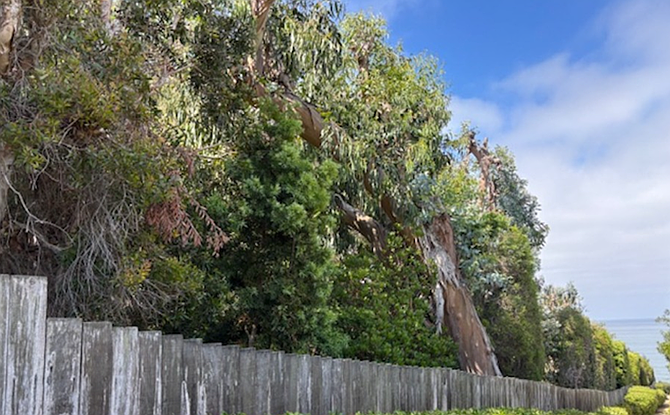
110 Stratford Court: Dense wall of Eucalyptus trees, about 200ft or more in length; difficult access for first responders. (From July 7 city council agenda)
Del Mar’s embattled tree ordinance — which aims to save not only trees, but also scenic views and sunlight — is finally getting an overhaul.
The Trees, Scenic Views, and Sunlight ordinance hasn’t been revised in over 20 years, and while locals have been calling for changes almost since it was first passed, some are now saying the proposed revisions could harm the urban forest.
Often, the concerns expressed are more about lost views than saving mature trees. The ordinance gives neighbors a process for resolving disputes when a neighbor’s greenery — "neighbor" here meaning "within 300 feet" — grows so as to obscure an ocean view.
Because trees are relatively slow growers, residents have ten years from the time when their view is blocked or when they purchase or occupy a property — whichever is shorter — to take action. “Staff spends large amounts of time trying to figure out if a picture is ten years old or not,” said city planner Matt Bator at a previous meeting.
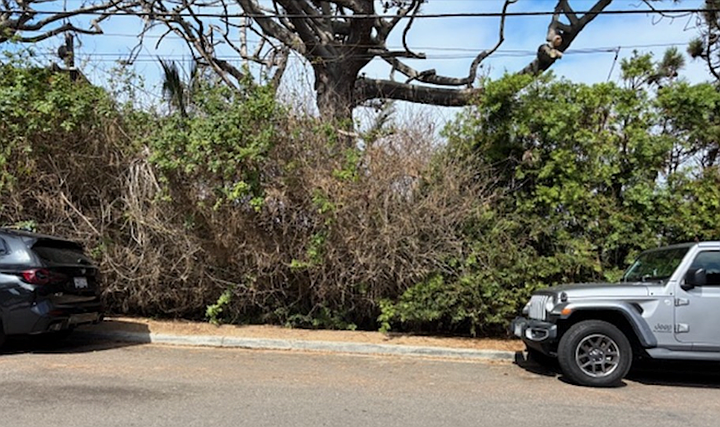
Stratford Court: High, dry hedge, moderate first responder access. (From July 7 city council agenda)
To save city resources, one of the “big ticket” items in the amended ordinance would create a much larger window of time for disputing a foliage curtain. Of the 27 cities with view ordinances, Del Mar’s timeline stands out. In keeping with the others, city planners suggest making it when the ordinance was first adopted — meaning people can try to restore a view from decades ago.
Other issues in the amendments are how to prove unreasonable view and sunlight obstruction; the costs of filing an application and who’s responsible; claims against city trees; and for the first time, possible hedge height limits, a wildly unpopular idea.
The city tries to balance an applicant’s right to view restoration with the goals of the climate action plan, the design review process and the city’s tree regulations.
But public feedback at earlier meetings left the planning commission unable to agree on some proposals, such as the species, size, and location of a replacement tree when one is removed to restore a view. Should the commission consider whether the offending tree is on the city’s discouraged tree list? An up-to-date list of encouraged and discouraged trees has yet to be developed. And when city trees obstruct private views or sunlight, who should pay? Is an application needed? Finally, the commission recommended there be no maximum hedge height, which many were against.
More than sixty residents signed a letter in opposition to several of the changes. Doubling of the time in which to file an application will mean more trees removed, and a shrinking canopy “at a time when our trees have been under vigorous assault from beetles, fungal diseases” and botched pruning, especially involving Torrey Pines and Monterey Cypress, Del Mar’s two protected species – protected unless they are found to be diseased or dying.
Torrey Pines, Monterey Cypress and Aleppo pines were among the city’s encouraged trees in 2005 but many were in poor health, prompting replanting efforts along Camino del Mar, Pine Bluff Preserve, Sea Cliff Park, Jimmy Durante Boulevard, 9th Street, and Cuchara Drive.
“Many trees have been cut down over the last decade, but we are not replenishing our urban forest,” the letter said. Applicants “should be required to replace any mature tree that is removed for view restoration.”
The group’s record request found that Del Mar has approximately 1400 public trees (not counting those in medians), many of which are in front of homes.
They urged the council to preserve mature trees that sequester large amounts of carbon, and not to target any species for removal based on the city’s “outdated undesirable tree list.”
Here's something you might be interested in.
Del Mar wants the views – but also the Torrey Pines and Monterey Cypresses
Greenery diminished by disease, bad pruning

Del Mar wants the views – but also the Torrey Pines and Monterey Cypresses
Greenery diminished by disease, bad pruning
110 Stratford Court: Dense wall of Eucalyptus trees, about 200ft or more in length; difficult access for first responders. (From July 7 city council agenda)
Del Mar’s embattled tree ordinance — which aims to save not only trees, but also scenic views and sunlight — is finally getting an overhaul.
The Trees, Scenic Views, and Sunlight ordinance hasn’t been revised in over 20 years, and while locals have been calling for changes almost since it was first passed, some are now saying the proposed revisions could harm the urban forest.
Often, the concerns expressed are more about lost views than saving mature trees. The ordinance gives neighbors a process for resolving disputes when a neighbor’s greenery — "neighbor" here meaning "within 300 feet" — grows so as to obscure an ocean view.
Because trees are relatively slow growers, residents have ten years from the time when their view is blocked or when they purchase or occupy a property — whichever is shorter — to take action. “Staff spends large amounts of time trying to figure out if a picture is ten years old or not,” said city planner Matt Bator at a previous meeting.
Stratford Court: High, dry hedge, moderate first responder access. (From July 7 city council agenda)
To save city resources, one of the “big ticket” items in the amended ordinance would create a much larger window of time for disputing a foliage curtain. Of the 27 cities with view ordinances, Del Mar’s timeline stands out. In keeping with the others, city planners suggest making it when the ordinance was first adopted — meaning people can try to restore a view from decades ago.
Other issues in the amendments are how to prove unreasonable view and sunlight obstruction; the costs of filing an application and who’s responsible; claims against city trees; and for the first time, possible hedge height limits, a wildly unpopular idea.
The city tries to balance an applicant’s right to view restoration with the goals of the climate action plan, the design review process and the city’s tree regulations.
But public feedback at earlier meetings left the planning commission unable to agree on some proposals, such as the species, size, and location of a replacement tree when one is removed to restore a view. Should the commission consider whether the offending tree is on the city’s discouraged tree list? An up-to-date list of encouraged and discouraged trees has yet to be developed. And when city trees obstruct private views or sunlight, who should pay? Is an application needed? Finally, the commission recommended there be no maximum hedge height, which many were against.
More than sixty residents signed a letter in opposition to several of the changes. Doubling of the time in which to file an application will mean more trees removed, and a shrinking canopy “at a time when our trees have been under vigorous assault from beetles, fungal diseases” and botched pruning, especially involving Torrey Pines and Monterey Cypress, Del Mar’s two protected species – protected unless they are found to be diseased or dying.
Torrey Pines, Monterey Cypress and Aleppo pines were among the city’s encouraged trees in 2005 but many were in poor health, prompting replanting efforts along Camino del Mar, Pine Bluff Preserve, Sea Cliff Park, Jimmy Durante Boulevard, 9th Street, and Cuchara Drive.
“Many trees have been cut down over the last decade, but we are not replenishing our urban forest,” the letter said. Applicants “should be required to replace any mature tree that is removed for view restoration.”
The group’s record request found that Del Mar has approximately 1400 public trees (not counting those in medians), many of which are in front of homes.
They urged the council to preserve mature trees that sequester large amounts of carbon, and not to target any species for removal based on the city’s “outdated undesirable tree list.”
Comments