

Here's something you might be interested in.
Ask a Hipster — Advice you didn't know you needed
Big Screen — Movie commentary
Blurt — Music's inside track
Booze News — San Diego spirits
Classical Music — Immortal beauty
Classifieds — Free and easy
Close to Home — What it’s like on the street where you live
Cover Stories — Front-page features
Drinks All Around — Bartenders' drink recipes
Excerpts — Literary and spiritual excerpts
Feast! — Food & drink reviews
Feature Stories — Local news & stories
Fishing Report — What’s getting hooked from ship and shore
From the Archives — Spotlight on the past
Golden Dreams — Talk of the town
The Gonzo Report — Making the musical scene, or at least reporting from it
Letters — Our inbox
Movies@Home — Local movie buffs share favorites
Movie Reviews — Our critics' picks and pans
Musician Interviews — Up close with local artists
Neighborhood News from Stringers — Hyperlocal news
News Ticker — News & politics
Obermeyer — San Diego politics illustrated
Outdoors — Weekly changes in flora and fauna
Overheard in San Diego — Eavesdropping illustrated
Poetry — The old and the new
Reader Travel — Travel section built by travelers
Reading — The hunt for intellectuals
Roam-O-Rama — SoCal's best hiking/biking trails
San Diego Beer — Inside San Diego suds
SD on the QT — Almost factual news
Sheep and Goats — Places of worship
Special Issues — The best of
Street Style — San Diego streets have style
Surf Diego — Real stories from those braving the waves
Theater — On stage in San Diego this week
Tin Fork — Silver spoon alternative
Under the Radar — Matt Potter's undercover work
Unforgettable — Long-ago San Diego
Unreal Estate — San Diego's priciest pads
Your Week — Daily event picks
Judith Moore's favorite winter writing
Robert Frost, Lord Byron, Wallace Stevens, Charles Dickens, Barry Lope, Peter Matthiesen, John Irving, Ole Rolvaag
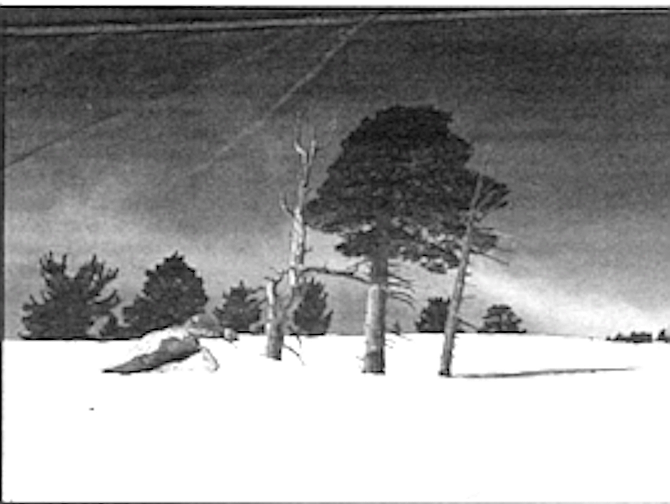
Snowfalls, snowstorms, blizzards, icicles, sleigh rides, ice-skating
The Reader has started this series of its best stories from the past 52 years — 2600 cover stories and some remarkable interior features — to help make up for the loss of its physical edition, which was once large enough to hold whole oceans of print. These stories will feature all the original illustrations and photos (plus easy-to-read typography).
^^^^^^^^^^^
What I don't like about where I live is that it doesn’t snow. The other day. I saw one of those glass balls that has a snowman in it; you shake the globe up and down, and "snow’’ falls. It is a piece of kitschy junk. It cost $13.95. I bought it. I brought it home and put it in my bedroom. I get up in the morning and shake the globe and watch the snow drift and swirl down onto the rim of the snowman’s little black top hat. I do miss snow. And now that it’s December. I go to my bookshelves and search — in poems, novels, essays, short stories — for snowfalls, snowstorms, blizzards, icicles, sleigh rides, ice-skating.
The poem with snow in it that we all learned in school is Robert Frost's "Stopping by Woods on a Snowy Evening." Even the title stirs memory.
- Whose woods these are I think I know.
- His house is in the village though;
- He will not see me stopping here
- To watch his woods fill up with snow.
It is the poem that ends with that grim quatrain to which teachers resorted to introduce the enigmatic element in poetry.
- The woods are lovely, dark and deep.
- But I have promises to keep.
- And miles to go before I sleep.
- And miles to go before I sleep
The teacher always asked. “What do you suppose the poet intended with his mention of promises to keep'?'' I didn’t care then and don’t now what Frost intended and am satisfied to say out loud merely the title, “Stopping by Woods on a Snowy Evening." Those seven words start snow sifting through cold air. sticking on bare, black boughs.
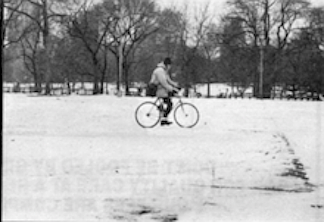
Frost’s poem "The Onset," less well known, offers a more closely observed snow that
- ... lets down as white
- As may be in dark woods, and with a song
- It shall not make again all winter long
- Of hissing on the yet uncovered ground.
Easily as wonderful a Frost snow poem is his eight-line “Dust of Snow." whose first quatrain so quickly establishes its presence that words vanish and nothing remains but
- The way a crow
- Shook down on me
- The dust of snow
- From a hemlock tree.
Basho's On Love and Barley contains three haiku, the first of which "works" in much of the way of the Frost four lines — the words disappear, the world to which the words point remains.
- Snowy morning -
- one crow
- after another.
- Come, let’s go
- snow-viewing
- till we're buried.
- Snow-whisk sweeping
- this path,
- forgets the snow.
This bit of snow writing is not a poem, but it’s written by a poet. Lord Byron, on January 5, 1821, wrote in his journal:
- Rose late — dull and drooping — the weather dripping and dense. Snow on the ground, and sirocco above in the sky. like yesterday. Roads up to the horse's belly, so that riding (at least for pleasure) is not very feasible. Read the conclusion, for the fiftieth time (I have read all W. Scott’s novels at least fifty times), of the third series of Tales of my Landlord - grand work — Scotch.
- Clock strikes — going out to make love.
- Somewhat perilous, but not disagreeable.
Wallace Stevens's "The Snow Man” is one of those poems that stalks you for years and finally one day hits you in the heart. Were I to give the poem a title based upon the effect it has. I’d title it "Exit Wound"
- One must have a mind of winter
- To regard the frost and the boughs
- Of the Pine-trees crusted with snow;
- And have been cold a long time
- To behold the lumpers shagged with ice.
- The spruces rough in the distant glitter
- Of the January sun; and not to think
- Of any misery in the sound of the wind.
- In the sound of a few leaves.
- Which is the sound of the land
- Full of the same wind
- That is blowing in the same bare place
- For the listener, who listens in the snow.
- And. nothing himself, beholds
- Nothing that is not there and the nothing that is.
Back when I lived where snow fell every winter, a friend and I, on the occasion of the year’s first snow, would stand on the street comer under lamplight and read out loud together Robert Penn Warren’s "Function of Blizzard."
- God's goose, neck neatly wrung, is being plucked.
- And night is blacker for the plethora
- Of white feathers except when, in an air-tower beam.
- Black feathers turn white as snow. Which is what they are.
- And in the blind trajectory travelers scream toward silence.
- Black ruins of arson in the Bronx are whitely
- Redeemed. Poverty does not necessarily
- Mean unhappiness. Can't you hear the creak of bed-slats
- Or ghostly echo of childish laughter? Bless
- Needle plunging into pinched vein. Bless
- coverings-over,
- forgettings.
- Bless snow! Bless God. Who must work under the hand of
- Fate, who has no name. God does the best
- He can. and sometimes lets snow whiten the world
- As a promise — as now of mystic comfort to
- The old physicist, a Jew. faith long since dead, who
- is getting
- High-lonesome drunk by the frosted window of
- The Oak Room bar in the Plaza And bless me even
- With no glass in my hand, and far from New York,
- as I rise
- From bed. feet bare, heart freezing, to stare out at
- The whitening fields and forest, and wonder what
- Item of the past I'd most like God to let
- Snow tall on. keep falling on. and never
- Melt, for I. like you. am only a man. after all.
It's difficult to know, after that, which so nearly says all there is to say about man and God and love and snow, what can follow.
Joseph Wood Krutch in The Twelve Seasons suggests: "The snow itself is lonely or. if you prefer, self-sufficient. There is no other time when the whole world seems composed of one thing and one thing only."
Gaston Bachelard, in The Poetics of Space. meditates upon what he calk "praiseworthy space” — the closets, comers, cellars, garrets that attract the poetic imagination. In chapter two. “House and Universe." Bachelard “reads" houses and rooms “written" by writers.
Although at heart a city man, Baudelaire sensed the increased intimacy of a house when it is besieged by winter. In Les paradis artificiels he speaks of Thomas de Quincey's joy when, a prisoner of winter, he read Kant with the help of the idealism furnished by opium. The scene takes place in a cottage in Wales. "Isn’t it true that a pleasant house makes winter more poetic, and doesn’t winter add to the poetry of a house? The white cottage at the end of a little valley, shut in by rather high mountains; and it seemed to be swathed in shrubs." Reading Baudelaire’s passage, Bachelard suggests that we too are “ ‘swathed’ in the blanket of winter."
And we feel warm because it is cold out of doors. Further on in this deep-winter "artificial paradise," Baudelaire declares that dreamers like a severe winter. “Every year they ask the sky to send down as much snow, hail and frost as it can contain. What they really need are Canadian and Russian winters. Their own nests will be all the warmer, all the downier, all the better beloved."
Russians, of course, dependably produce paragraph after paragraph of snow description. Chekhov's "Heartache" opens thus:
- Evening twilight. Large flakes of wet snow are circling lazily about the street lamps which have just been lighted, settling in a thin soft layer on roofs, horses' backs, peoples' shoulders, caps. Iona Potapov, the cabby, all white like a ghost.
As hunched as a living body can be. he sits on the box without stirring. If a whole snowdrift were to fall on him. even then, perhaps he would not find it necessary to shake it off. His nag. loo. is while and motionless.
One of the oddest snow scenes occurs in Tolstoy’s War and Peace. Natasha.,Sonya, and Nikolai costume themselves in clothes of the opposite gender — Natasha as a hussar, Sonya a Circassian with burnt cork eyebrows and a mustache. Nikolai as an old lady in a farthingale. The group gathers in Nikolai’s troika, which is draped with harness bells:
- Nikolai, in his old lady's dress over which he had belled his hussar's cloak, stood in the middle of the sledge, reins in hand. It was so light that he could see the moonlight reflected in the metal of the harness and in the eyes of the startled horses ...
- Nikolai set off after the first troika; the other two noisily followed, their runners whining.... As they drove by the garden the shadows cast by the bare trees fell across the road obscuring the bright moonlight, but as soon as they had passed the fence, the still, snowy plain, all bathed in the radiance of the moon, sparkling like diamonds and with a bluish sheen, opened out before them....
- Nikolai glanced at Sonya and bent down to look more closely into her face. A quite new. sweet face with black eyebrows and mustache — so near yet so remote in the moonlight — peeped up to him from her sable furs.
- One of the classic cold-weather novels is Thomas Mann’s Magic Mountain that suggests Hans Castrop’s confinement in a tuberculosis sanitarium as analogy to Europe's post-World War I crisis:
- The winter came mildly on, at first no different from many a day they had seen in the height of summer. The wind had been two days in the south, the sun bore down, the valley seemed shrunken, the sidewalk at its mouth looked near and bald. Clouds came up. behind Piz Michel and Tinzenhorn. and drove north-eastwards. It rained heavily. Then the rain turned foul, a whitish-grey, mingled with snow-flakes — soon it was all snow, the valley was full of flurry; it kept on and on, the temperature fell appreciably, so that the fallen snow could not quite melt but lay covering the valley with a wet and threadbare while garment, against which showed black the pines on the slopes.
For seven days snow fell across Mann's valley. And then, this:
- The world, this narrow, lofty, isolated world up here, looked now well wadded and upholstered indeed: no pillar or post but wore its whitecap; the steps up to the entrance of the Berghof had turned into an inclined plane: heavy cushions, in the drollest shapes, weighed down the branches of the Scotch firs — now and then one slid off and raised up a cloud of powdery white dust in its fall.
American author Cynthia Ozick in chapter four of The Messiah of Stockholm places Lars Andemening at night on foot in Stockholm.
- There was a bitter wind now. lording it over the black one o'dock. The blackness went on throwing the snow into Lars's face, and he packed tus scad over hk nose and mouth — how-warm his breath was in the little cave this made! ... The spiraling flakes stuttered around him like Morse code. A smell of something roasting, what was that? Chimneys...
- Under the screen of revolving flakes the steeples had the look of whirling Merlin hats.
A few years ago I ran across Yasunari Kawabata's novel Snow Country. The author's descriptions of snow on the west coast of Japan, which sometimes falls 15 feet deep, are some of the most satisfying I know. I look forward to leaning against the bookcase and reading them aloud to myself until I fed the cold he writes climb up on me.
- The earth lay white under the night sky.
- The brightness of the snow was more intense,
- it seemed to be burning icily.
- Presently, as the mountain chasms were far and
- near, high and low, the shadows in them began
- to deepen, and the sky was red over the snowy
- mountains, bathed now in but a wan light.
- The snow on the distant mountains was soft
- and creamy, as if veiled in a faint smoke.
- From the gray sky. framed by the window, the
- snow floated toward them in great flakes, like
- white peonies.
- The cedars, under a thin coating of snow, rose
- sheer from the white ground to the sky. each cut
- off sharply from the rest.
When I want North American snow, I turn first to books set in the Midwest and then to my childhood books, to the Laura Ingalls Wilder's "Little House” books. A section from Wilder’s Long Winter furnished me with material for what must have been my earliest childhood snow nightmares. Laura follows her father out into a late-fall snowstorm:
- Outdoors the sun-glitter hurt her eyes. She breathed a deep breath of the tingling cold and squinted her eyes to look around her. The sky was hugely blue and all the land was blowing white. The straight, strong wind did not lift the snow, but drove it scudding across the prairie...
- The cattle were standing in sunshine and shadow by the haystacks — red and brown and spotted cattle and one thin black one. They stood perfectly still, every head bowed down to the ground. The hairy red necks and brown necks all stretched down from bony-gaunt shoulders to monstrous, swollen while heads...
- They did not seem like real cattle. They stood so terrible still In the whole herd there was not the least movement. Only their breathing sucked their hairy sides in between the rib bones and pushed them out again ... Their legs were braced out. stiff and still And where their heads should be. swollen while lumps seemed fast to the ground under the blowing snow.
For Midwestern winters. I like Willa Cather's My Antonia, which has as its landscape the author's childhood home in Nebraska.
The first snowfall came early in December. I remember how the world looked from our sitting-room window as I dressed behind the stove that morning: the low sky was like a sheet of metal: the blond cornfields had faded out into ghostliness at last....
The sky was brilliantly blue, and the sunlight on the glittering white stretches of prairie was almost blinding. As Antonia said, the whole world was changed by snow; we kept looking in vain for familiar landmarks. The deep arroyo through which Squaw Creek wound was now only a cleft between snowdnfts — very blue when one looked down into it ... The cold stung and at the same lime delighted one. My horse's breath rose like steam, and whenever we stopped he smoked all over....
In the morning when I was fighting my way to school against the wind. I couldn't see anything but the road in front of me; but in the late afternoon, when I was coming home, the town looked bleak and desolate to me. The pale, cold light of the winter sunset did not beautify — it was like the light of truth itself. When the smoky clouds hung low in the west and the red sun went down behind them, leaving a pink flush on the snowy roofs and the bluedrifts. then the wind sprang up afresh, with a kind of bitter song, as if it said: "This is reality, whether you like it or not. All those frivolities ol summer, the light and shadow, the living mask of green that trembled over everything, they were lies, and this is what was underneath. This is the truth.""
For contemporary, no-nonsense New England snow, nobody beats Russell Banks, whose Affliction tells the story of Wade Whitehouse. a part-time policeman in a New Hampshire mill town, who goes on a violent rampage. Banks writes the dirty Rust Belt snow that has driven south more than one New Englander.
- Wade liked the way the river looked in the new snow and milky early morning light. That is a tourist's idea of New Hampshire, he thought, with pine trees drooping over the water and snarls of lode-laden birches clumped at the edges of eddies and pools, with large snow-covered boulders in the middle of the stream and dark-green water churning, swirling and splashing past and over them, raising a thick while crust of ice at the crest marks ...
- When the snows do come, it is as natural and as inescapable and in some sense as welcome as gravity.... The first scattered flakes drift almost accidentally down, as if spilled while carted by a high wind to somewhere east of here, to the Man times or New Brunswick: a single hard dry flake, then several more, then a hundred, a thousand, too many to be seen as separate from one another anymore: until at last the snow is falling over the valley and the hills and lakes like a lacy soft eiderdown billowing out and settling over the entire region, covering the trees, the rocks and ridges. the old stone walk, the fields and meadows behind the houses in town and out along Route 29. the roofs of the houses, barns and trailers, the tops of cars and trucks the roads, lanes, driveways and parking lots: covering and transforming everything in the last few moments of the night, so that when at dawn the day and the month truly begin, winter too will have arrived, returned, seeming never to have left...
- The snow was coming down with fury, in while fists, and as he drove slowly through the stuff. Wade thought, I can't stand it anymore.
Mark Helprin’s stories' and novels' surfaces glitter and shimmer and shine with snow and ice. Perhaps no living writer, in English, does as well with plays of light over snow. In the prologue to Winter's Tale, he describes snow falling on New York City.
- But the city is now obscured, as it often is. by the whitened mass in which it rests — rushing by us at unfathomable speed, crackling like wind in the mist, cold to the touch, glistening and unfolding, tumbling over itself like the steam of an engine or cotton spilling born a bale. Through the blinding white web of ceaseless sound flows past mercilessly, the curtain is breaking ... it reveals amid the clouds a lake of air as smooth and dear as a minor, the deep round eye of a white hurricane.
- No Renaissance engine belching fire or hurtling stone could keep pace with even one while dap of a New York winter, and winter there dapped as endlessly as a paddlewheel on one of the big whiteboats slapping across the lake in seasons gone by. Battalions of arctic clouds droned down from the north to bomb the stale with snow, to bleach it as while as young ivory, to mortar it with frost that would last from September to May.
An excerpt from Joe Bemardini's Singapore: A Novel of the Bronx is an example of non-romanticized urban snow:
- In all fairness to the Bronx, snow is greeted with great cheers of delight.... The snowball fights we used to have in the lot constituted the happiest moments of my youth.... I recall throwing a snowball that landed wide of the mark. It struck the window of a recluse who was forever sitting with his nose pressed against the pane. He appeared to be staring straight at me. there was no way possible for him to overlook the snowball, and yet as the snowball approached and then struck his window he didn't budge an inch. Frightened out of my wits. I ran all the way up to Bainbridge and returned hours later when it was dark.
- The light from the street lamp illumined his window and I saw that a piece of cardboard had been wedged against the opening and above the cardboard I was even able to make out the man's forehead and a few wisps of hair. He was sitting there with his nose pressed against the cardboard Do you understand? Snow was falling on the Bronx. For several hours a dean, white blanket would cover the grime. Then dogs would yellow it with their pee and boots would riddle it with holes and soot belched from the incinerators would settle on its surface and it would turn to slush, and in contrast to the few white patches that remained, the Bronx would appear even grimier than before. So snow meant nothing to him. It was still the Bronx.
Snow passages in fiction and poetry are splendid opportunities for writers to set up dazzling pictorial contrasts. Peter Handke's Afternoon of a Writer offers this:
- He switched off all the lights. Because of the snow and the reflection of the city in the clouds, il was light in all the rooms, a nocturnal light that made the objects in the rooms all the darker In another example of this use of snow for effects of visual contrast, there is in Kawabata's novel a paragraph in which his emotionally frozen male character watches a geisha as she looks at herself in a mirror that reflects both her face and the snow outside the window: "The white in the depths of the mirror was the snow, and floating in the middle of it were the woman's bright red cheeks."
An early scene in Banks’s Affliction, a deer hunt, is another passage in which snow's whiteness and purity are used as a graphic contrast medium.
- Slugs, pellets, balls made of aluminum lead, steel, rip into the body of the deer, crash through bone, penetrate and smash organs, rend muscle and sinew. Blood splashes into the air. across tree bark, stone, onto smooth while blankets of snow, where scarlet fades swiftly to pink. Black tongue lolls over blooded teeth, as if the mouth were a carnivore's; huge brown eyes roll back, glassed over, opaque and dry; blood trickles from carbon-black nostrils, shit spits steaming into the snow; urine, entrails, blood, mucus spill from the animal's body: as heavy-booted hunters rush across the frozen snow-covered ground to claim the kill.
Perhaps precisely because snow offers such a canvas on which to draw contrasts, mystery, suspense, thriller and honor writers show a fondness for wintry settings. Martin Cruz Smith's Gorky Park provides particularly vivid examples of the use of snow as a backdrop for violence. As bits of ice glimmer in the air, a chief investigator for the People's Militia, Arkady Renko, strides through snow "to the telltale humps" in the center of a clearing.
There were three bodies ... They lay peacefully, even artfully, under their thawing crust of ice. the center one on its back, hands folded as if for a religious funeral, the other two turned, arms out under the ice like flanking emblems on embossed writing paper. They were wearing ice skates.
In The Snows of Kilimanjaro. Hemingway's Harry, a writer, is in Africa, suffering a gangrenous leg. Lying on a canvas cot at the edge of the bush. Harry looks across “the heat shimmer of the plain." He knows he’s going to die. "Now he would never write the things that he had saved to write until he knew enough to write them well."
Snow was one of the things he'd saved to write, and Hemingway gives Harry a seven-paragraph riff that’s about the best snow anybody's written. Paragraph three:
- In Schrunz, on Christmas day. the snow was so bright it hurt your eyes when you looked out from the weinstube and saw every one coming home from church. That was where they walked up the sleigh-smoothed urine-yellowed road along the river with the steep pine hilts, skis heavy on the shoulder, and where they ran that great run down the glacier above the Madlener-haus. the snow as smooth to see as cake frosting and as light as powder and he remembered the noiseless rush the speed made as you dropped down like a bud.
When I ask people what in literature they remember for its snow scenes. Dickens's Christmas Carol is spoken of. and Barry Lope's Arctic Dreams. Peter Matthiesen's Snow Leopard. John Irving’s Owen Meany, O.E. Rolvaag’s Giants in the Earth, and always Jack London. Not a few readers are reminded of Conrad Aiken's haunting story “Silent Snow. Secret Snow." in which the snow is imaginary, the vision of a young boy's disturbed mind. But almost no one fails to mention the conclusion of "The Dead," the final story in James Joyce’s Dubliners.
- Yes, the newspapers were right: snow was general all over Ireland. It was falling on every part of the dark central plain, on the treeless hills, falling softly upon the Bog of Allen and. farther westward, softly falling into the dark mutinous Shannon waves. It was falling, too. upon every part of the lonely churchyard on the hill where Michael Furey lay buried. It lay thickly drifted on the crooked crosses and headstones, on the spears of the little gale, on the barren thorns. His soul swooned slowly as he heard the snow falling faintly through the universe and faintly falling, like the descent of their last end. upon ail the living and all the dead.
This story first appeared in the Reader on December 21, 1989.
Here's something you might be interested in.
Judith Moore's favorite winter writing
Robert Frost, Lord Byron, Wallace Stevens, Charles Dickens, Barry Lope, Peter Matthiesen, John Irving, Ole Rolvaag

Judith Moore's favorite winter writing
Robert Frost, Lord Byron, Wallace Stevens, Charles Dickens, Barry Lope, Peter Matthiesen, John Irving, Ole Rolvaag
Snowfalls, snowstorms, blizzards, icicles, sleigh rides, ice-skating
The Reader has started this series of its best stories from the past 52 years — 2600 cover stories and some remarkable interior features — to help make up for the loss of its physical edition, which was once large enough to hold whole oceans of print. These stories will feature all the original illustrations and photos (plus easy-to-read typography).
^^^^^^^^^^^
What I don't like about where I live is that it doesn’t snow. The other day. I saw one of those glass balls that has a snowman in it; you shake the globe up and down, and "snow’’ falls. It is a piece of kitschy junk. It cost $13.95. I bought it. I brought it home and put it in my bedroom. I get up in the morning and shake the globe and watch the snow drift and swirl down onto the rim of the snowman’s little black top hat. I do miss snow. And now that it’s December. I go to my bookshelves and search — in poems, novels, essays, short stories — for snowfalls, snowstorms, blizzards, icicles, sleigh rides, ice-skating.
The poem with snow in it that we all learned in school is Robert Frost's "Stopping by Woods on a Snowy Evening." Even the title stirs memory.
- Whose woods these are I think I know.
- His house is in the village though;
- He will not see me stopping here
- To watch his woods fill up with snow.
It is the poem that ends with that grim quatrain to which teachers resorted to introduce the enigmatic element in poetry.
- The woods are lovely, dark and deep.
- But I have promises to keep.
- And miles to go before I sleep.
- And miles to go before I sleep
The teacher always asked. “What do you suppose the poet intended with his mention of promises to keep'?'' I didn’t care then and don’t now what Frost intended and am satisfied to say out loud merely the title, “Stopping by Woods on a Snowy Evening." Those seven words start snow sifting through cold air. sticking on bare, black boughs.
Frost’s poem "The Onset," less well known, offers a more closely observed snow that
- ... lets down as white
- As may be in dark woods, and with a song
- It shall not make again all winter long
- Of hissing on the yet uncovered ground.
Easily as wonderful a Frost snow poem is his eight-line “Dust of Snow." whose first quatrain so quickly establishes its presence that words vanish and nothing remains but
- The way a crow
- Shook down on me
- The dust of snow
- From a hemlock tree.
Basho's On Love and Barley contains three haiku, the first of which "works" in much of the way of the Frost four lines — the words disappear, the world to which the words point remains.
- Snowy morning -
- one crow
- after another.
- Come, let’s go
- snow-viewing
- till we're buried.
- Snow-whisk sweeping
- this path,
- forgets the snow.
This bit of snow writing is not a poem, but it’s written by a poet. Lord Byron, on January 5, 1821, wrote in his journal:
- Rose late — dull and drooping — the weather dripping and dense. Snow on the ground, and sirocco above in the sky. like yesterday. Roads up to the horse's belly, so that riding (at least for pleasure) is not very feasible. Read the conclusion, for the fiftieth time (I have read all W. Scott’s novels at least fifty times), of the third series of Tales of my Landlord - grand work — Scotch.
- Clock strikes — going out to make love.
- Somewhat perilous, but not disagreeable.
Wallace Stevens's "The Snow Man” is one of those poems that stalks you for years and finally one day hits you in the heart. Were I to give the poem a title based upon the effect it has. I’d title it "Exit Wound"
- One must have a mind of winter
- To regard the frost and the boughs
- Of the Pine-trees crusted with snow;
- And have been cold a long time
- To behold the lumpers shagged with ice.
- The spruces rough in the distant glitter
- Of the January sun; and not to think
- Of any misery in the sound of the wind.
- In the sound of a few leaves.
- Which is the sound of the land
- Full of the same wind
- That is blowing in the same bare place
- For the listener, who listens in the snow.
- And. nothing himself, beholds
- Nothing that is not there and the nothing that is.
Back when I lived where snow fell every winter, a friend and I, on the occasion of the year’s first snow, would stand on the street comer under lamplight and read out loud together Robert Penn Warren’s "Function of Blizzard."
- God's goose, neck neatly wrung, is being plucked.
- And night is blacker for the plethora
- Of white feathers except when, in an air-tower beam.
- Black feathers turn white as snow. Which is what they are.
- And in the blind trajectory travelers scream toward silence.
- Black ruins of arson in the Bronx are whitely
- Redeemed. Poverty does not necessarily
- Mean unhappiness. Can't you hear the creak of bed-slats
- Or ghostly echo of childish laughter? Bless
- Needle plunging into pinched vein. Bless
- coverings-over,
- forgettings.
- Bless snow! Bless God. Who must work under the hand of
- Fate, who has no name. God does the best
- He can. and sometimes lets snow whiten the world
- As a promise — as now of mystic comfort to
- The old physicist, a Jew. faith long since dead, who
- is getting
- High-lonesome drunk by the frosted window of
- The Oak Room bar in the Plaza And bless me even
- With no glass in my hand, and far from New York,
- as I rise
- From bed. feet bare, heart freezing, to stare out at
- The whitening fields and forest, and wonder what
- Item of the past I'd most like God to let
- Snow tall on. keep falling on. and never
- Melt, for I. like you. am only a man. after all.
It's difficult to know, after that, which so nearly says all there is to say about man and God and love and snow, what can follow.
Joseph Wood Krutch in The Twelve Seasons suggests: "The snow itself is lonely or. if you prefer, self-sufficient. There is no other time when the whole world seems composed of one thing and one thing only."
Gaston Bachelard, in The Poetics of Space. meditates upon what he calk "praiseworthy space” — the closets, comers, cellars, garrets that attract the poetic imagination. In chapter two. “House and Universe." Bachelard “reads" houses and rooms “written" by writers.
Although at heart a city man, Baudelaire sensed the increased intimacy of a house when it is besieged by winter. In Les paradis artificiels he speaks of Thomas de Quincey's joy when, a prisoner of winter, he read Kant with the help of the idealism furnished by opium. The scene takes place in a cottage in Wales. "Isn’t it true that a pleasant house makes winter more poetic, and doesn’t winter add to the poetry of a house? The white cottage at the end of a little valley, shut in by rather high mountains; and it seemed to be swathed in shrubs." Reading Baudelaire’s passage, Bachelard suggests that we too are “ ‘swathed’ in the blanket of winter."
And we feel warm because it is cold out of doors. Further on in this deep-winter "artificial paradise," Baudelaire declares that dreamers like a severe winter. “Every year they ask the sky to send down as much snow, hail and frost as it can contain. What they really need are Canadian and Russian winters. Their own nests will be all the warmer, all the downier, all the better beloved."
Russians, of course, dependably produce paragraph after paragraph of snow description. Chekhov's "Heartache" opens thus:
- Evening twilight. Large flakes of wet snow are circling lazily about the street lamps which have just been lighted, settling in a thin soft layer on roofs, horses' backs, peoples' shoulders, caps. Iona Potapov, the cabby, all white like a ghost.
As hunched as a living body can be. he sits on the box without stirring. If a whole snowdrift were to fall on him. even then, perhaps he would not find it necessary to shake it off. His nag. loo. is while and motionless.
One of the oddest snow scenes occurs in Tolstoy’s War and Peace. Natasha.,Sonya, and Nikolai costume themselves in clothes of the opposite gender — Natasha as a hussar, Sonya a Circassian with burnt cork eyebrows and a mustache. Nikolai as an old lady in a farthingale. The group gathers in Nikolai’s troika, which is draped with harness bells:
- Nikolai, in his old lady's dress over which he had belled his hussar's cloak, stood in the middle of the sledge, reins in hand. It was so light that he could see the moonlight reflected in the metal of the harness and in the eyes of the startled horses ...
- Nikolai set off after the first troika; the other two noisily followed, their runners whining.... As they drove by the garden the shadows cast by the bare trees fell across the road obscuring the bright moonlight, but as soon as they had passed the fence, the still, snowy plain, all bathed in the radiance of the moon, sparkling like diamonds and with a bluish sheen, opened out before them....
- Nikolai glanced at Sonya and bent down to look more closely into her face. A quite new. sweet face with black eyebrows and mustache — so near yet so remote in the moonlight — peeped up to him from her sable furs.
- One of the classic cold-weather novels is Thomas Mann’s Magic Mountain that suggests Hans Castrop’s confinement in a tuberculosis sanitarium as analogy to Europe's post-World War I crisis:
- The winter came mildly on, at first no different from many a day they had seen in the height of summer. The wind had been two days in the south, the sun bore down, the valley seemed shrunken, the sidewalk at its mouth looked near and bald. Clouds came up. behind Piz Michel and Tinzenhorn. and drove north-eastwards. It rained heavily. Then the rain turned foul, a whitish-grey, mingled with snow-flakes — soon it was all snow, the valley was full of flurry; it kept on and on, the temperature fell appreciably, so that the fallen snow could not quite melt but lay covering the valley with a wet and threadbare while garment, against which showed black the pines on the slopes.
For seven days snow fell across Mann's valley. And then, this:
- The world, this narrow, lofty, isolated world up here, looked now well wadded and upholstered indeed: no pillar or post but wore its whitecap; the steps up to the entrance of the Berghof had turned into an inclined plane: heavy cushions, in the drollest shapes, weighed down the branches of the Scotch firs — now and then one slid off and raised up a cloud of powdery white dust in its fall.
American author Cynthia Ozick in chapter four of The Messiah of Stockholm places Lars Andemening at night on foot in Stockholm.
- There was a bitter wind now. lording it over the black one o'dock. The blackness went on throwing the snow into Lars's face, and he packed tus scad over hk nose and mouth — how-warm his breath was in the little cave this made! ... The spiraling flakes stuttered around him like Morse code. A smell of something roasting, what was that? Chimneys...
- Under the screen of revolving flakes the steeples had the look of whirling Merlin hats.
A few years ago I ran across Yasunari Kawabata's novel Snow Country. The author's descriptions of snow on the west coast of Japan, which sometimes falls 15 feet deep, are some of the most satisfying I know. I look forward to leaning against the bookcase and reading them aloud to myself until I fed the cold he writes climb up on me.
- The earth lay white under the night sky.
- The brightness of the snow was more intense,
- it seemed to be burning icily.
- Presently, as the mountain chasms were far and
- near, high and low, the shadows in them began
- to deepen, and the sky was red over the snowy
- mountains, bathed now in but a wan light.
- The snow on the distant mountains was soft
- and creamy, as if veiled in a faint smoke.
- From the gray sky. framed by the window, the
- snow floated toward them in great flakes, like
- white peonies.
- The cedars, under a thin coating of snow, rose
- sheer from the white ground to the sky. each cut
- off sharply from the rest.
When I want North American snow, I turn first to books set in the Midwest and then to my childhood books, to the Laura Ingalls Wilder's "Little House” books. A section from Wilder’s Long Winter furnished me with material for what must have been my earliest childhood snow nightmares. Laura follows her father out into a late-fall snowstorm:
- Outdoors the sun-glitter hurt her eyes. She breathed a deep breath of the tingling cold and squinted her eyes to look around her. The sky was hugely blue and all the land was blowing white. The straight, strong wind did not lift the snow, but drove it scudding across the prairie...
- The cattle were standing in sunshine and shadow by the haystacks — red and brown and spotted cattle and one thin black one. They stood perfectly still, every head bowed down to the ground. The hairy red necks and brown necks all stretched down from bony-gaunt shoulders to monstrous, swollen while heads...
- They did not seem like real cattle. They stood so terrible still In the whole herd there was not the least movement. Only their breathing sucked their hairy sides in between the rib bones and pushed them out again ... Their legs were braced out. stiff and still And where their heads should be. swollen while lumps seemed fast to the ground under the blowing snow.
For Midwestern winters. I like Willa Cather's My Antonia, which has as its landscape the author's childhood home in Nebraska.
The first snowfall came early in December. I remember how the world looked from our sitting-room window as I dressed behind the stove that morning: the low sky was like a sheet of metal: the blond cornfields had faded out into ghostliness at last....
The sky was brilliantly blue, and the sunlight on the glittering white stretches of prairie was almost blinding. As Antonia said, the whole world was changed by snow; we kept looking in vain for familiar landmarks. The deep arroyo through which Squaw Creek wound was now only a cleft between snowdnfts — very blue when one looked down into it ... The cold stung and at the same lime delighted one. My horse's breath rose like steam, and whenever we stopped he smoked all over....
In the morning when I was fighting my way to school against the wind. I couldn't see anything but the road in front of me; but in the late afternoon, when I was coming home, the town looked bleak and desolate to me. The pale, cold light of the winter sunset did not beautify — it was like the light of truth itself. When the smoky clouds hung low in the west and the red sun went down behind them, leaving a pink flush on the snowy roofs and the bluedrifts. then the wind sprang up afresh, with a kind of bitter song, as if it said: "This is reality, whether you like it or not. All those frivolities ol summer, the light and shadow, the living mask of green that trembled over everything, they were lies, and this is what was underneath. This is the truth.""
For contemporary, no-nonsense New England snow, nobody beats Russell Banks, whose Affliction tells the story of Wade Whitehouse. a part-time policeman in a New Hampshire mill town, who goes on a violent rampage. Banks writes the dirty Rust Belt snow that has driven south more than one New Englander.
- Wade liked the way the river looked in the new snow and milky early morning light. That is a tourist's idea of New Hampshire, he thought, with pine trees drooping over the water and snarls of lode-laden birches clumped at the edges of eddies and pools, with large snow-covered boulders in the middle of the stream and dark-green water churning, swirling and splashing past and over them, raising a thick while crust of ice at the crest marks ...
- When the snows do come, it is as natural and as inescapable and in some sense as welcome as gravity.... The first scattered flakes drift almost accidentally down, as if spilled while carted by a high wind to somewhere east of here, to the Man times or New Brunswick: a single hard dry flake, then several more, then a hundred, a thousand, too many to be seen as separate from one another anymore: until at last the snow is falling over the valley and the hills and lakes like a lacy soft eiderdown billowing out and settling over the entire region, covering the trees, the rocks and ridges. the old stone walk, the fields and meadows behind the houses in town and out along Route 29. the roofs of the houses, barns and trailers, the tops of cars and trucks the roads, lanes, driveways and parking lots: covering and transforming everything in the last few moments of the night, so that when at dawn the day and the month truly begin, winter too will have arrived, returned, seeming never to have left...
- The snow was coming down with fury, in while fists, and as he drove slowly through the stuff. Wade thought, I can't stand it anymore.
Mark Helprin’s stories' and novels' surfaces glitter and shimmer and shine with snow and ice. Perhaps no living writer, in English, does as well with plays of light over snow. In the prologue to Winter's Tale, he describes snow falling on New York City.
- But the city is now obscured, as it often is. by the whitened mass in which it rests — rushing by us at unfathomable speed, crackling like wind in the mist, cold to the touch, glistening and unfolding, tumbling over itself like the steam of an engine or cotton spilling born a bale. Through the blinding white web of ceaseless sound flows past mercilessly, the curtain is breaking ... it reveals amid the clouds a lake of air as smooth and dear as a minor, the deep round eye of a white hurricane.
- No Renaissance engine belching fire or hurtling stone could keep pace with even one while dap of a New York winter, and winter there dapped as endlessly as a paddlewheel on one of the big whiteboats slapping across the lake in seasons gone by. Battalions of arctic clouds droned down from the north to bomb the stale with snow, to bleach it as while as young ivory, to mortar it with frost that would last from September to May.
An excerpt from Joe Bemardini's Singapore: A Novel of the Bronx is an example of non-romanticized urban snow:
- In all fairness to the Bronx, snow is greeted with great cheers of delight.... The snowball fights we used to have in the lot constituted the happiest moments of my youth.... I recall throwing a snowball that landed wide of the mark. It struck the window of a recluse who was forever sitting with his nose pressed against the pane. He appeared to be staring straight at me. there was no way possible for him to overlook the snowball, and yet as the snowball approached and then struck his window he didn't budge an inch. Frightened out of my wits. I ran all the way up to Bainbridge and returned hours later when it was dark.
- The light from the street lamp illumined his window and I saw that a piece of cardboard had been wedged against the opening and above the cardboard I was even able to make out the man's forehead and a few wisps of hair. He was sitting there with his nose pressed against the cardboard Do you understand? Snow was falling on the Bronx. For several hours a dean, white blanket would cover the grime. Then dogs would yellow it with their pee and boots would riddle it with holes and soot belched from the incinerators would settle on its surface and it would turn to slush, and in contrast to the few white patches that remained, the Bronx would appear even grimier than before. So snow meant nothing to him. It was still the Bronx.
Snow passages in fiction and poetry are splendid opportunities for writers to set up dazzling pictorial contrasts. Peter Handke's Afternoon of a Writer offers this:
- He switched off all the lights. Because of the snow and the reflection of the city in the clouds, il was light in all the rooms, a nocturnal light that made the objects in the rooms all the darker In another example of this use of snow for effects of visual contrast, there is in Kawabata's novel a paragraph in which his emotionally frozen male character watches a geisha as she looks at herself in a mirror that reflects both her face and the snow outside the window: "The white in the depths of the mirror was the snow, and floating in the middle of it were the woman's bright red cheeks."
An early scene in Banks’s Affliction, a deer hunt, is another passage in which snow's whiteness and purity are used as a graphic contrast medium.
- Slugs, pellets, balls made of aluminum lead, steel, rip into the body of the deer, crash through bone, penetrate and smash organs, rend muscle and sinew. Blood splashes into the air. across tree bark, stone, onto smooth while blankets of snow, where scarlet fades swiftly to pink. Black tongue lolls over blooded teeth, as if the mouth were a carnivore's; huge brown eyes roll back, glassed over, opaque and dry; blood trickles from carbon-black nostrils, shit spits steaming into the snow; urine, entrails, blood, mucus spill from the animal's body: as heavy-booted hunters rush across the frozen snow-covered ground to claim the kill.
Perhaps precisely because snow offers such a canvas on which to draw contrasts, mystery, suspense, thriller and honor writers show a fondness for wintry settings. Martin Cruz Smith's Gorky Park provides particularly vivid examples of the use of snow as a backdrop for violence. As bits of ice glimmer in the air, a chief investigator for the People's Militia, Arkady Renko, strides through snow "to the telltale humps" in the center of a clearing.
There were three bodies ... They lay peacefully, even artfully, under their thawing crust of ice. the center one on its back, hands folded as if for a religious funeral, the other two turned, arms out under the ice like flanking emblems on embossed writing paper. They were wearing ice skates.
In The Snows of Kilimanjaro. Hemingway's Harry, a writer, is in Africa, suffering a gangrenous leg. Lying on a canvas cot at the edge of the bush. Harry looks across “the heat shimmer of the plain." He knows he’s going to die. "Now he would never write the things that he had saved to write until he knew enough to write them well."
Snow was one of the things he'd saved to write, and Hemingway gives Harry a seven-paragraph riff that’s about the best snow anybody's written. Paragraph three:
- In Schrunz, on Christmas day. the snow was so bright it hurt your eyes when you looked out from the weinstube and saw every one coming home from church. That was where they walked up the sleigh-smoothed urine-yellowed road along the river with the steep pine hilts, skis heavy on the shoulder, and where they ran that great run down the glacier above the Madlener-haus. the snow as smooth to see as cake frosting and as light as powder and he remembered the noiseless rush the speed made as you dropped down like a bud.
When I ask people what in literature they remember for its snow scenes. Dickens's Christmas Carol is spoken of. and Barry Lope's Arctic Dreams. Peter Matthiesen's Snow Leopard. John Irving’s Owen Meany, O.E. Rolvaag’s Giants in the Earth, and always Jack London. Not a few readers are reminded of Conrad Aiken's haunting story “Silent Snow. Secret Snow." in which the snow is imaginary, the vision of a young boy's disturbed mind. But almost no one fails to mention the conclusion of "The Dead," the final story in James Joyce’s Dubliners.
- Yes, the newspapers were right: snow was general all over Ireland. It was falling on every part of the dark central plain, on the treeless hills, falling softly upon the Bog of Allen and. farther westward, softly falling into the dark mutinous Shannon waves. It was falling, too. upon every part of the lonely churchyard on the hill where Michael Furey lay buried. It lay thickly drifted on the crooked crosses and headstones, on the spears of the little gale, on the barren thorns. His soul swooned slowly as he heard the snow falling faintly through the universe and faintly falling, like the descent of their last end. upon ail the living and all the dead.
This story first appeared in the Reader on December 21, 1989.
Comments