

Here's something you might be interested in.
Ask a Hipster — Advice you didn't know you needed
Big Screen — Movie commentary
Blurt — Music's inside track
Booze News — San Diego spirits
Classical Music — Immortal beauty
Classifieds — Free and easy
Close to Home — What it’s like on the street where you live
Cover Stories — Front-page features
Drinks All Around — Bartenders' drink recipes
Excerpts — Literary and spiritual excerpts
Feast! — Food & drink reviews
Feature Stories — Local news & stories
Fishing Report — What’s getting hooked from ship and shore
From the Archives — Spotlight on the past
Golden Dreams — Talk of the town
The Gonzo Report — Making the musical scene, or at least reporting from it
Letters — Our inbox
Movies@Home — Local movie buffs share favorites
Movie Reviews — Our critics' picks and pans
Musician Interviews — Up close with local artists
Neighborhood News from Stringers — Hyperlocal news
News Ticker — News & politics
Obermeyer — San Diego politics illustrated
Outdoors — Weekly changes in flora and fauna
Overheard in San Diego — Eavesdropping illustrated
Poetry — The old and the new
Reader Travel — Travel section built by travelers
Reading — The hunt for intellectuals
Roam-O-Rama — SoCal's best hiking/biking trails
San Diego Beer — Inside San Diego suds
SD on the QT — Almost factual news
Sheep and Goats — Places of worship
Special Issues — The best of
Street Style — San Diego streets have style
Surf Diego — Real stories from those braving the waves
Theater — On stage in San Diego this week
Tin Fork — Silver spoon alternative
Under the Radar — Matt Potter's undercover work
Unforgettable — Long-ago San Diego
Unreal Estate — San Diego's priciest pads
Your Week — Daily event picks
San Diego's Prince and Pauper bookstore – the minds behind it
Nancy Drew and the stolen missile parts
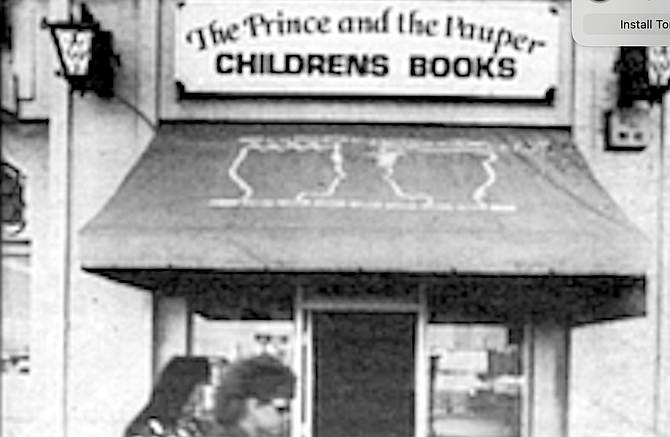
The former location on Adams Avenue
The Reader has started this series of its best stories from the past 52 years — 2600 cover stories and some remarkable interior features — to help make up for the loss of its physical edition, which was once large enough to hold whole oceans of print. These stories will feature all the original illustrations and photos (plus easy-to-read typography).
^^^^^^^^^^^
The first time I went into the Prince and the Pauper, a tiny storefront on Adams Avenue's book row (so called for the presence along that avenue of Safari Out of Print Books, Normal Heights Bookstore, Adams Avenue Bookstore. Writer's Bookstore & Haven). I went in hope of finding a book my grandmother bought for me when I was in second grade.
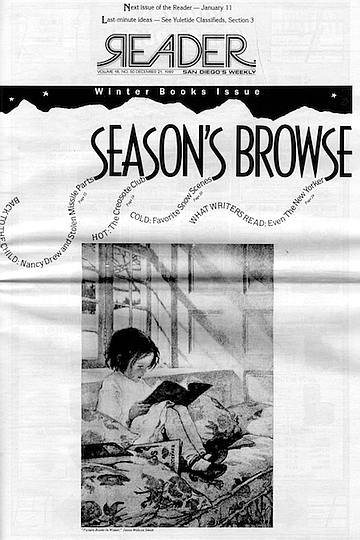 1989 Winter books issue cover illustration Picture-Books in Winter by Jessie Willcox Smith
Other people were browsing that day — an older man. a middle-aged woman, a woman in her 20s — and in the small space we brushed hips and arms and shoulders as we made our way along the shelves. The store, which specializes in used, out-of-print, and collectible children’s books, had been open only several months, but even then, the floor-to-oeiling shelves, which wrap around all four walls, and the mare of free-standing bookcases in the middle of the store's 500 square feet were stacked double deep.
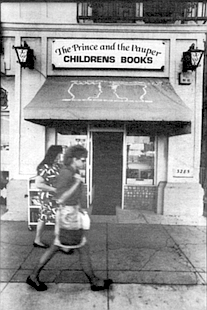 The Prince and the Pauper in 1989
Of course, there were copies of The Prince and the Pauper, the Mark Twain classic from which the store takes its name. Also The Wizard of Oz. The House at Pooh Comer. At the Back of the North Wind. Curious George, Billy Goats Gruff. Peter Rabbit. Little Pig Robinson. Dr. Doolittle. Tom Swift. Nancy Drew. Pippi Longstocking. Little Women. Little Men. Madeline in London: collected here were the books that lit imaginations of generations of children.
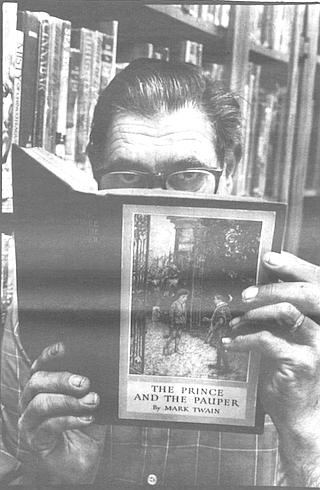 Store owner Jack Hastings: "By the time I was 16. I had bummed my way about the United States. My mother gave me a note to carry that said I had permission to be wherever I was."
The book I wanted was about wild animals in North America. So I searched the nature section. Leafed through The Adventures of Buster Bear and then Thorton Burgess's Mother West Wind stories with Harrison Cady's happy illustrations. I stopped at a drawing titled "Grandfather Frog Gets a Ride," which shows the frog — dressed in formal coat and red polka-dotted bow tie — waving his red top hat. I looked at horse stories by Marguerite Henry, dog stories by Albert Payson Terhune.
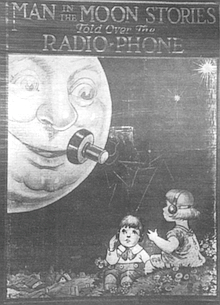
I found myself then next to the woman in her 20s as she slid one of the Little Bear series from the shelf. She turned pages slowly. Her breath quickened. She stroked illustrator Maurice Sendaks round-eyed, fat-bellied, stippled-hairy little bear. "I still love that bear!" she said.
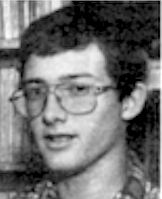 James Keeline: "I have one of the better Tom Swift collections in the country."
Meanwhile, the man filled his arms with Scribner’s Illustrated Classics — Kidnapped. illustrated by N.C. Wyeth; Lugene Field's Poems of Childhood, illustrated by Maxfield Parrish; and The Children of Dickens, illustrated by Jesse Wilcox Smith. Humming, he carried his swag to the counter, above which, in a wooden cage as wide as a playpen, a green parrot said, “Hello, hello.”
Sunlight streamed in from a window and through the store's front door, which was ajar.
But as I shifted through the maze of bookcases, from shelf to shelf, and touched cloth and leather binding, variously trimmed and stamped and embossed and gilded, the light in the store seemed to take on that submarine gloom that I picture as the light always turned on above thrumming turbines in the engine room of the unconscious mind. I ran fingertips down spines whose titles summoned beanstalks that grew to heaven and turreted castles and secret rooms, deep forests and the sharp-toothed wolves and foxes who plotted how to make meals of vulnerable piggies and hapless bunnies. I opened books that reminded me how easily I’d believed quicksilver transformations and solved-at-the-last minute riddles. These books' pages were the property room from which I have drawn a lifetimes dream images, lo stand close to these books evoked equal portions of comfort and terror.
I moved to the back of the store. From among tier after tier of Hardy Boys and Boxcar Children and Nancy Drews and other series books. I chose The Clue of the Tapping Heels. in which Nancy signals for help by tap dancing in Morse code.
But I hadn't found the book for which I was looking. "It was a big book. It had a brown and beige cover." I told store co-founder and co-owner Jack Hastings, a dark-haired, dark-bearded man in his mid- 50s. Hastings, who speaks in a scratchy gravel bass straight out of Goldilocks and the Three Bears, asked what I remembered about the book.
The title, I believed, was Home and Habitats of Wild Animals, and it had line drawings and color illustrations. I said, and added, all in a rush, feeling as if I were speaking some detail too intimate to be confided in a stranger, “and in one of those illustrations. I remember a white snowshoe rabbit.”
No book by that title or description was on the store's shelves, nor could Hastings recall ever having had it in the store. He helped me fill out a card — name, telephone number, book's title, and anything about the book I could remember. Feeling the same half-hearted hope I feel when I dole out for a lottery ticket. I scribbled answers and said good-bye and forgot it.
Six months later, the telephone rings. The Prince and the Pauper. The gravelly “Who's been eating my porridge?" voice. He thought he had the book I wanted.
So I go in. There's a black cat I didn’t recall from my last visit. The cat is asleep atop a glass front bookcase. The parrot calls out in the cat's direction. “Kitty, kitty, kitty." and then "meeow. meeow.” Jack Hastings offers me a stool by the counter. The parrot — "His name's Prince," says Hastings — looks down at me and screeches. Hastings picks up a plastic spray bottle, lightly sprays Prince with water. Prince retreats to his swing. From a ledge behind the counter,
Hastings draws out a book I have not seen in 30 years. Its dust cover is intact. Its title is not Homes and Habitats of Wild Animals but Homes and Habits of Wild Animals. I turn past the glossy, sharp-clawed wolverene, past the spotted faun, past beavers busy repairing their dam. There he is, my white showshoe rabbit. I swallow hard.
I thank Hastings and write a check for $15 and ask if he is as often this successful in finding books for which people asked.
He gets, he says, from 10 to 40 requests per day, most by telephone. ’The call may come from New York or Los Angeles or La Mesa.
Sometimes we can say, ‘Yes, we have it.’ We've probably found 50 percent of what people are looking for.
“It’s not always easy. People come in. and they won't remember the author or the title. But they remember the story or some detail in the story. Like, ‘On the last page of the book, there is a lion rolling in the daisies.’ Sometimes a person will describe the illustrations. So one thing we do is get out books and show the person examples from various illustrators — like showing mug shots.
“We've found books people have been looking for for 20 years. When we first opened, a woman, probably 80 years old. came in. She wanted the original Little Engine That Could, published by Platt and Munk. At that moment we had two copies. I put them down in front of her. right here where your book is. and I thought I was going to have to make it around the other side of that counter because she looked as if she would faint.
"The whole key in anything with an out-of-print bookstore, and especially a children’s out-of-print bookstore, is that we can only rely on the books that people actually bought, kept, and then later on sold to a bookstore. Also, you have to remember, books have a lot of enemies, not the least of which are silverfish. Or water, dampness of any kind, heat, fire.
"Children’s books have become among the most collectible of all books, and they are the scarcest because the books children enjoyed the most tend to be the most worn. Children practice their handwriting on books’ pages, color in black-and-white illustrations with crayons. They play Frisbee with books, and when the dog catches a book, he may chew it up.
"Dust jackets are especially difficult to come by with children's books. We can use a laser copier and make jackets, of course. But a children's book with an original dust jacket can be very, very pricey. You can go all the way up and down the coast of California, and I don't think you would see more than a half a dozen Tom Swift original dust jackets.
"We get books in every possible way. We subscribe to Antiquarian Bookman Weekly and both place and answer ads in that. Collectors bring in books for trade. We correspond with book salesmen. We go to garage sales, flea markets, auctions. In Orange County, there’s a place where thrift stores offer stock for sale before that stock is distributed to stores. There are always huge bins of books there and book dealers going through those books."
Hastings shows me a copy of Antiquarian Bookman Weekly, which is published weekly in New Jersey and mailed first class from the East Coast on Monday. “If you’re lucky, it gets here by Thursday. If we don’t get it until Monday, however, and there’s a book advertised that we want, we don’t even bother to call. It’s a forlorn hope. The book will be gone. Even if it comes on Thursday and you see something you want — like this," Hastings reads, “ ‘Shirley Temple in Wee Willie Winkie. 1937, $25. Square, small. 32 pages, profusely illustrated’ — well, you don’t even finish reading the ad. you just start dialing. Once in a while you get lucky."
I ask what sort of prices a much-desired collectible children’s title can bring. Hastings answers that early this year the first edition of Tarzan and the Apes, in fine condition, in dust jacket, sold for $50,000. Later this year, two other early Edgar Rice Burroughs titles sold for $20,000 and $30,000, respectively.
Across the country, says Hastings, there are some 50 dealers who buy and sell only collectible children’s books. Few of these dealers, perhaps no more than half a dozen, have open shops in which people can actually come into the store and browse.
Hastings has never done a count but estimates that the Prince and the Pauper has on its shelves some 20,000 titles. "We have books for collectors and books for readers. We have books for several thousand dollars and books for 50 cents. You can buy a copy of The Swiss Family Robinson here for any sum from $50 to $2.00“
Children’s books of the type Hastings stocks are wanted, he tells me, for many reasons. Collectors tend to want particular authors, titles, or illustrators or titles from specific editions of certain series. There are people who collect anything connected with Alice in Wonderland or first editions of Newbery and Caldecott medal-winning books or all of the Nancy Drew titles. Recently, someone came in and bought every book Hastings had about Peter Pan.
"Some customers,” Hastings says, "simply want reading copies of their own childhood books to read to their children and grandchildren. Then, we also get younger parents who would rather bring their kids here and spend five or ten dollars to pick out four or five of our less expensive books. You go to Crown, and you’d better have more than ten dollars for even, one or two books.
"You get the occasional oddball request. We had a man who wanted everything to do with Dick and Jane. A close friend of his named Dick was marrying a woman named Jane.
"Fun With Dick and Jane, the first-grade reading primer that was used in public schools during the 1940s,” Hastings adds, “is far and away the title most often requested. We simply can’t keep them in the store.
“But often, as in your case, a person just wants a very specific book she remembers.
Certain books that were read to children or that children themselves read become part of their deepest, fondest memories of their childhood or everything that their childhood was for them.
Say the book that person wants is A Child's Garden of Verses. That title comes now in 30 or 40 formats. Peopie don’t want just any copy of that book, they want the book they remember. They are not just looking for the words but the gestalt — and for that, you need the same binding, dust cover, typeface, illustration, frontispiece."
Hastings reaches up to the ledge from which he took down the book that now sits open on my lap (this book. I reflect, when I first had it. must have seemed huge) and takes down Bibliophile in the Nursery, A Bookman's Treasury of Collectors' Lore on Old and Rare Children's Books by William Targ. Hastings says that this book explains children’s-book collecting better than he can. He asks if I mind if he reads to me. and I assure him I don’t.
- Collecting children's books is an activity that can be related to "second childhood." It is a kind of return the first, euphoric childhood of memory, the recalled world of fantasy and adventure, mirrored in the magic of printer ’s ink and paper.
- It is a sentimental journey, if you will, to the best of all possible worlds, that of childhood. And what, after all. is collecting but affectionate appreciation stemming out of early impressions, nostalgia, and new understanding?
Prince squawks. Hastings interrupts his reading, picks up the spray bottle, sprays Prince. Prince's green feathers fluff up. he hops off his swing onto the cage floor. He spreads his wings, showing red and blue feathers. Sunflower seed hulls fly down through the cage's bars, scatter.
Hastings resumes:
- A good children's book strikes a vibration in the soul that lasts a lifetime And when a reader or collector achieves maturity and a special sense of values, he may recognize that the best books are really those that children have loved for many generations of lifetimes.
Closing the book. Hastings says. “So when you reach up in a shelf and take down a book from childhood that someone’s wanted, and you put the book in their hands, it’s a pretty great feeling.”
In the year and a half the store has been open. Hastings has discovered what he calls "the 30-year formula.” He explains: "Thirty years pass between the time a book was initially popular with children and the time that book reaches a nostalgia point. We’re almost to 1990, and we are seeing people in their 40s who come in wanting the white-spine Oz books published in the 1960s. A year ago, we were able to sell those books for $15. and now when I buy them for re-sale. I have to pay $30 or $35 for a copy."
The original Oz were bound in cloth and had an applique picture applied to the face and came in a dust jacket. In the '60s. they used a washable-type material that is white. and the title on the spine was printed directly on the white background.
Hastings’s mother, sister, and aunts read to him as a child. He remembers his sister and himself "sitting in our small house, in front of the stove while our mother read to us from Beatrix Potter, from Grimms' and Anderson’s fairy tales. Hans Brinker. Then one day after I’d started school, my mother brought home one of the Hardy Boys series and read eight or nine chapters to me. Then she closed the book and handed it to me and said. ‘If you want to know how this comes out. you will have to read it yourself.’ Several months later. I had bought all of the Hardy Boys series I could find. Next it was the Tom Swift series. By the time I was 20, I had some 10,000 books. I later sold the collection. I felt like I sold part of myself and have never quite gotten over it."
Hastings himself, it turns out. as a youngster, had something of a boy’s adventure-book life. Born in Pasadena, he began at 12 to wander. "By the time I was 16. I had virtually bummed my way about the United States. My mother finally gave me a note to carry that said I had permission to be wherever I was. She was tired of getting phone calls from the authorities, wondering if I was a runaway. By the time I was 18, I had managed to travel through the majority of the Western nations.
"I read Howard Pease — The Heart of Danger, and Bound for Singapore, and The Tattooed Man — when I was young, and at one point. I came back to California with the idea that I’d get enough money to bum around South America and then turn myself in to the US. consulate as a destitute citizen so they would get me seaman’s papers to get back to San Francisco. Then, I figured, with those seaman’s papers I could travel the world. Unfortunately. I got waylaid by a good job.”
Before Hastings and his wife, a registered nurse, opened the Prince and the Pauper, Hastings worked in sales for Cox Cable and on weekends, with his wife, bought and sold collectibles at antique shows. As sellers, they specialized in Royal Doulton ceramics. As buyers, however, they found themselves acquiring increasing numbers of collectible older children's books. Soon, they had added the books to the ceramics. The books sold so well that they decided to concentrate on children's books. Then, because there wasn’t a store in the area that sold only children’s out-of-print and used books and because the Hastingses had grown weary of traveling weekend after weekend to antique shows, they decided to get a shop. To acquire basic stock, the Hastingses bought out children’s books from seven stores that sell used books.
Adams Avenue Bookstore, now at 35th Street and Adams, had its start at this same address.
But when the Hastingses leased the space, it was being used for storage. "My original idea was that we would haul everything out. scrub, build bookcases, and open for business. But the place was an absolute shambles. We started hauling everything out and discovered the ceiling was falling apart, that we'd have to build a new floor, rebuild the walls for structure. Virtually none of the original surface is here. It was 30 days of hard, hard work before we opened the doors. You’d think we sat down and planned to make it interesting, but the fact is, we just tried to figure out how to get everything in and not have browsers feel crunched.”
"May 1, 1988." Hastings tells me. when I ask when the store opened its doors. "That first day. 240 people came through before I quit counting. People were so amazed — an entire store stocked with used children’s books — that they would go home and get other people.
"We — my wife and I — had intended to do this as an avocation. I would keep my full-time position at Cox. We would do this as a hobby. It quickly became clear that at least one of us would have to work at this full time, so I quit my job. Two of our children help out here, and we have a full-time assistant — James Keeline — a physics major at San Diego State."
At just that moment. Keeline — slight, darkhaired. boyish — comes through the door. Hastings introduces us. and Keeline tells me that it was his attempts to gather Tom Swift titles that brought him to the Prince and the Pauper, first as a customer and later as a worker.
"My father started me off with gadgets and with the books about Tom Swift, boy inventor and lover of gadgets. I read them and enjoyed them and wanted more. So I’d go through the Yellow Pages and call book stores, and maybe if I got lucky. I would get one new title a year. When the Prince and the Pauper opened. I called them."
Hastings had been sure, he says, that they could turn up the Swift titles Keeline wanted.
But in the first weeks of his search, he turned up only one. Keeline came to pick up the book. "I expected a man in his 40s, at least." Hastings said. "Those are the men — in their 40s. 50s, 60s. and even 70s — that are avidly seeking Tom Swift titles. Jim here introduced himself, and after I got my jaw closed, I showed him our pitiful offering, one measly book.”
Blushing. Keeline takes over the story’s thread. "The neat thing about this store was that first there was that one book, then it was 3 books, then it was 9, and then in June. Jack came up with 40 books. Now I have one of the better Tom Swift collections in the country, including some very rare books, one of which is one of 17 known copies to exist anywhere."
“Over the next few months, as James says, we kept turning up books for him and he was always around helping. and then I got that entire set — and it was a very expensive set — but he had shown such an interest that I thought it over and gave it to him. Then he started helping us out on a more regular basis. I said, ’That’s very nice that you come here and pitch in, but I didn’t give the books to you with the expectation that you’d pay for it by working. I simply gave it to you. As a gift. So. tell me when we’ve nan out of credit.’ "
Have they run out of credit? I ask Keeline. who answers in a tone of mock-weariness. “A long time ago."
Keeline plans to get an advanced degree in physics and work for the space program. But for the present, he says. Tom Swift has become a growing interest for me, and I'm writing a book about Tom Swift and the Swift series.
"Officially. I started working here in December 1988. In this last year, I’ve learned a lot about series books other than Tom Swift and have made contact through collectors’ special-interest magazines with series collectors. There are entire magazines devoted to series books. These magazines will have four or five hundred subscribers, people intensely interested in their series — Hardy Boys, Nancy Drew."
About 30 percent of the Prince and the Pauper’s stock is series books — Frank Merriwell, the Rover Boys. Tom Swift, Nancy Drew, Happy Hollisters. Five Little tappers. Honey Bunch, Vicky Ban. the Motor Boys. Penny Marsh. Sue Barton. Cherry Ames, the Bobbsey Twins, the Hardy Boys, the Dana Girls. "We cannot keep these books in stock," says Hastings. "Nancy Drew is the most collected of all the series books."
Why did Hastings think that was so? He thinks a moment, says. "She represented the free spirit"
Series books. Keeline and Hastings explain, were typically written by ghost writers on contract to large syndicates. These books can be particularly tricky for beginning collectors because individual titles have been reprinted, and, over the years, revised.
Keeline goes to the rear of the store, where series books are shelved, and returns with five successive printings of the first Hardy Boys title, The Tower Treasure, first published in 1927. We line the books up on the counter.
The 1927 edition is bound in khaki ckoth and shows, emblazoned in brown, the silhouette of the two Hardy boys. One wears a cap and tie, and both wear the baggy trousers popular in the '20s. The boys appear exceedingly wholesome and not more than 13 or 14 years old. Pictured behind the boys is a Gothic tower. The second edition is quite similar to the first. On the third edition, the tower has transmogrified into ultramodern, and the boys’ caps have disappeared, and the boys themselves have aged, appearing to be 17 or 18. In the fourth edition, put out in the late ’50s, the boys remain much the same, but their clothing is updated to match '50s styles, and the tower is less modern appearing. The fifth and most recent edition uses the same illustration as the fourth, but the book is bound in a glossy, cheap binding. "This is typical." says Hastings, brushing his hand across the line of books, "of changes that have taken place in series books."
During the late 50s, the Bobbsey Twins. Nancy Drew, Hardy Boys, and several other series were also methodically rewritten. These rewrites, explains Keeline. "took into account changes in clothing styles and transportation modes. Racial biases were removed.”
"But in some of these updatings.” says Hastings, “stories are dramatically changed. In the original version of The Clue of the Flickering Torch, the flickering torch was the signal used by highwaymen who robbed cars as they drove by. Now the book offered under this same title is a story about rock bands and stolen uranium, and the flickering torch is the name of a rock band."
"In the original The Clue of the Moss-Covered Mansion, a Nancy Drew title, it was stolen heirlooms and now it is stolen missile parts at Cape Canaveral.”
We walk, then, around the store, while Prince, perhaps intending to keep our attention, begins to duck like a chicken. Then he calls. "Hello! Hello!” Says: "I am a good boy! I am a good boy!"
Keeline and Hastings point out the shelf filled with children’s cookbooks, then the section in which are shelved books that older children, in their teens, would have read — Edgar Rice Burroughs, Gene Stratton Porter, Harold Bell Wright. We stroke spines of Bible stories and fairy tales, books about transportation, natural science, children of other lands.
Hastings laments the shop’s lack of room. Children's books, he points out. tend to be much thinner than adult books. So that while he can get many more titles on shelves than can a store that sells books for adults, "the spines of children's books don't tell much. We would like to be able to show the faces of more of our books. Beautiful, beautiful books and we cannot display them properly."
We arrive before a bookcase in which are arranged the type of book I always think of as "supermarket kiddy book." Hastings explains their presence here. "There is an entire other area of books that people remember, inexpensive books, like Little Golden Books, but not Little Golden Books. There were Tell-a-Tale Books. Wonder Books — hundreds and hundreds of titles that only appeared in this kind of Little Golden Book format. Books with titles like The Rattle Rattle Dump Truck. Somebody is going to remember that.
"We had a lady call from North County who said she wanted a particular book. She had been looking for it for years, asking in various bookstores. The title was Churkendoose. It was about an imaginary beast that was a combination chicken, turkey, duck, goose. James here had been working on putting together a list of books of the Little Golden, Wonder, Tell-a-Tale type.
“I just happened to know we had one. I said, 'Oh. wait a minute, you’re talking about the Wonder Book by that title.’ There was a long pause on the other end of the line. 'You mean you have Churkendoose?' She was so delighted."
For how much do they sell something like Churkendoose? ’Two dollars," says Hastings. "The postage was almost as much as the book."
The mailman is at the door. Until now. Hastings and Keeline have been attentively showing me the store. But as soon as the packet of envelopes is handed over, both men concentrate on the mail. From the customer’s side of the counter, I can see that there are postmarks from Fresno. Chicago, New Jersey, New York, Connecticut, Montana, New Hampshire. Hastings stops for a moment, explains. "Most of what we have here are other book dealers' responses to ads we’ve placed for books for which we're searching in the Antiquarian Bookman."
"Here’s one," Keeline grins, "offering us Howard Pease's Seven League Boots. Here’s someone who’s got Andrew Lang’s Green Fairy Book."
Hastings passes a letter to Keeline. “Here’s a man who wants reading copies of Horatio Alger.”
Keeline takes the proffered letter, hands another across to Hastings. "Here’s someone who wants Alice in Wonderland with color plates."
Prince again is calling. “Kitty, kitty. Meeow. Meeow." Princess, the cat. from her perch atop the nearby bookcase, has begun to study the parrot intently. Hastings bob up from the heap of mail on the counter, gazes at the cat. the parrot, and back again at the cat and says to Keeline: "That cat’s fascination with the parrot may well have overtones of the hunter instinct.”
Which reminded me of why I’d originally sought out Hastings’s store. So I thanked Hastings and Keeline and took home my copy of The Homes and Habits of Wild Animals and read: "The snowshoe rabbit is a different creature from our more familiar Molly Cottontail: and one of the most striking differences is that he changes his brown summer coat to a white one for the winter.... The snowshoe rabbit gets his name from his big feet, which help him to run on the snow.”
This story first appeard in the Reader on CDecember 21, 1989.t
The Prince and he Pauper is now online only.
Here's something you might be interested in.
San Diego's Prince and Pauper bookstore – the minds behind it
Nancy Drew and the stolen missile parts

San Diego's Prince and Pauper bookstore – the minds behind it
Nancy Drew and the stolen missile parts
The former location on Adams Avenue
The Reader has started this series of its best stories from the past 52 years — 2600 cover stories and some remarkable interior features — to help make up for the loss of its physical edition, which was once large enough to hold whole oceans of print. These stories will feature all the original illustrations and photos (plus easy-to-read typography).
^^^^^^^^^^^
The first time I went into the Prince and the Pauper, a tiny storefront on Adams Avenue's book row (so called for the presence along that avenue of Safari Out of Print Books, Normal Heights Bookstore, Adams Avenue Bookstore. Writer's Bookstore & Haven). I went in hope of finding a book my grandmother bought for me when I was in second grade.
1989 Winter books issue cover illustration Picture-Books in Winter by Jessie Willcox SmithOther people were browsing that day — an older man. a middle-aged woman, a woman in her 20s — and in the small space we brushed hips and arms and shoulders as we made our way along the shelves. The store, which specializes in used, out-of-print, and collectible children’s books, had been open only several months, but even then, the floor-to-oeiling shelves, which wrap around all four walls, and the mare of free-standing bookcases in the middle of the store's 500 square feet were stacked double deep.
The Prince and the Pauper in 1989Of course, there were copies of The Prince and the Pauper, the Mark Twain classic from which the store takes its name. Also The Wizard of Oz. The House at Pooh Comer. At the Back of the North Wind. Curious George, Billy Goats Gruff. Peter Rabbit. Little Pig Robinson. Dr. Doolittle. Tom Swift. Nancy Drew. Pippi Longstocking. Little Women. Little Men. Madeline in London: collected here were the books that lit imaginations of generations of children.
Store owner Jack Hastings: "By the time I was 16. I had bummed my way about the United States. My mother gave me a note to carry that said I had permission to be wherever I was."The book I wanted was about wild animals in North America. So I searched the nature section. Leafed through The Adventures of Buster Bear and then Thorton Burgess's Mother West Wind stories with Harrison Cady's happy illustrations. I stopped at a drawing titled "Grandfather Frog Gets a Ride," which shows the frog — dressed in formal coat and red polka-dotted bow tie — waving his red top hat. I looked at horse stories by Marguerite Henry, dog stories by Albert Payson Terhune.
I found myself then next to the woman in her 20s as she slid one of the Little Bear series from the shelf. She turned pages slowly. Her breath quickened. She stroked illustrator Maurice Sendaks round-eyed, fat-bellied, stippled-hairy little bear. "I still love that bear!" she said.
James Keeline: "I have one of the better Tom Swift collections in the country."Meanwhile, the man filled his arms with Scribner’s Illustrated Classics — Kidnapped. illustrated by N.C. Wyeth; Lugene Field's Poems of Childhood, illustrated by Maxfield Parrish; and The Children of Dickens, illustrated by Jesse Wilcox Smith. Humming, he carried his swag to the counter, above which, in a wooden cage as wide as a playpen, a green parrot said, “Hello, hello.”
Sunlight streamed in from a window and through the store's front door, which was ajar.
But as I shifted through the maze of bookcases, from shelf to shelf, and touched cloth and leather binding, variously trimmed and stamped and embossed and gilded, the light in the store seemed to take on that submarine gloom that I picture as the light always turned on above thrumming turbines in the engine room of the unconscious mind. I ran fingertips down spines whose titles summoned beanstalks that grew to heaven and turreted castles and secret rooms, deep forests and the sharp-toothed wolves and foxes who plotted how to make meals of vulnerable piggies and hapless bunnies. I opened books that reminded me how easily I’d believed quicksilver transformations and solved-at-the-last minute riddles. These books' pages were the property room from which I have drawn a lifetimes dream images, lo stand close to these books evoked equal portions of comfort and terror.
I moved to the back of the store. From among tier after tier of Hardy Boys and Boxcar Children and Nancy Drews and other series books. I chose The Clue of the Tapping Heels. in which Nancy signals for help by tap dancing in Morse code.
But I hadn't found the book for which I was looking. "It was a big book. It had a brown and beige cover." I told store co-founder and co-owner Jack Hastings, a dark-haired, dark-bearded man in his mid- 50s. Hastings, who speaks in a scratchy gravel bass straight out of Goldilocks and the Three Bears, asked what I remembered about the book.
The title, I believed, was Home and Habitats of Wild Animals, and it had line drawings and color illustrations. I said, and added, all in a rush, feeling as if I were speaking some detail too intimate to be confided in a stranger, “and in one of those illustrations. I remember a white snowshoe rabbit.”
No book by that title or description was on the store's shelves, nor could Hastings recall ever having had it in the store. He helped me fill out a card — name, telephone number, book's title, and anything about the book I could remember. Feeling the same half-hearted hope I feel when I dole out for a lottery ticket. I scribbled answers and said good-bye and forgot it.
Six months later, the telephone rings. The Prince and the Pauper. The gravelly “Who's been eating my porridge?" voice. He thought he had the book I wanted.
So I go in. There's a black cat I didn’t recall from my last visit. The cat is asleep atop a glass front bookcase. The parrot calls out in the cat's direction. “Kitty, kitty, kitty." and then "meeow. meeow.” Jack Hastings offers me a stool by the counter. The parrot — "His name's Prince," says Hastings — looks down at me and screeches. Hastings picks up a plastic spray bottle, lightly sprays Prince with water. Prince retreats to his swing. From a ledge behind the counter,
Hastings draws out a book I have not seen in 30 years. Its dust cover is intact. Its title is not Homes and Habitats of Wild Animals but Homes and Habits of Wild Animals. I turn past the glossy, sharp-clawed wolverene, past the spotted faun, past beavers busy repairing their dam. There he is, my white showshoe rabbit. I swallow hard.
I thank Hastings and write a check for $15 and ask if he is as often this successful in finding books for which people asked.
He gets, he says, from 10 to 40 requests per day, most by telephone. ’The call may come from New York or Los Angeles or La Mesa.
Sometimes we can say, ‘Yes, we have it.’ We've probably found 50 percent of what people are looking for.
“It’s not always easy. People come in. and they won't remember the author or the title. But they remember the story or some detail in the story. Like, ‘On the last page of the book, there is a lion rolling in the daisies.’ Sometimes a person will describe the illustrations. So one thing we do is get out books and show the person examples from various illustrators — like showing mug shots.
“We've found books people have been looking for for 20 years. When we first opened, a woman, probably 80 years old. came in. She wanted the original Little Engine That Could, published by Platt and Munk. At that moment we had two copies. I put them down in front of her. right here where your book is. and I thought I was going to have to make it around the other side of that counter because she looked as if she would faint.
"The whole key in anything with an out-of-print bookstore, and especially a children’s out-of-print bookstore, is that we can only rely on the books that people actually bought, kept, and then later on sold to a bookstore. Also, you have to remember, books have a lot of enemies, not the least of which are silverfish. Or water, dampness of any kind, heat, fire.
"Children’s books have become among the most collectible of all books, and they are the scarcest because the books children enjoyed the most tend to be the most worn. Children practice their handwriting on books’ pages, color in black-and-white illustrations with crayons. They play Frisbee with books, and when the dog catches a book, he may chew it up.
"Dust jackets are especially difficult to come by with children's books. We can use a laser copier and make jackets, of course. But a children's book with an original dust jacket can be very, very pricey. You can go all the way up and down the coast of California, and I don't think you would see more than a half a dozen Tom Swift original dust jackets.
"We get books in every possible way. We subscribe to Antiquarian Bookman Weekly and both place and answer ads in that. Collectors bring in books for trade. We correspond with book salesmen. We go to garage sales, flea markets, auctions. In Orange County, there’s a place where thrift stores offer stock for sale before that stock is distributed to stores. There are always huge bins of books there and book dealers going through those books."
Hastings shows me a copy of Antiquarian Bookman Weekly, which is published weekly in New Jersey and mailed first class from the East Coast on Monday. “If you’re lucky, it gets here by Thursday. If we don’t get it until Monday, however, and there’s a book advertised that we want, we don’t even bother to call. It’s a forlorn hope. The book will be gone. Even if it comes on Thursday and you see something you want — like this," Hastings reads, “ ‘Shirley Temple in Wee Willie Winkie. 1937, $25. Square, small. 32 pages, profusely illustrated’ — well, you don’t even finish reading the ad. you just start dialing. Once in a while you get lucky."
I ask what sort of prices a much-desired collectible children’s title can bring. Hastings answers that early this year the first edition of Tarzan and the Apes, in fine condition, in dust jacket, sold for $50,000. Later this year, two other early Edgar Rice Burroughs titles sold for $20,000 and $30,000, respectively.
Across the country, says Hastings, there are some 50 dealers who buy and sell only collectible children’s books. Few of these dealers, perhaps no more than half a dozen, have open shops in which people can actually come into the store and browse.
Hastings has never done a count but estimates that the Prince and the Pauper has on its shelves some 20,000 titles. "We have books for collectors and books for readers. We have books for several thousand dollars and books for 50 cents. You can buy a copy of The Swiss Family Robinson here for any sum from $50 to $2.00“
Children’s books of the type Hastings stocks are wanted, he tells me, for many reasons. Collectors tend to want particular authors, titles, or illustrators or titles from specific editions of certain series. There are people who collect anything connected with Alice in Wonderland or first editions of Newbery and Caldecott medal-winning books or all of the Nancy Drew titles. Recently, someone came in and bought every book Hastings had about Peter Pan.
"Some customers,” Hastings says, "simply want reading copies of their own childhood books to read to their children and grandchildren. Then, we also get younger parents who would rather bring their kids here and spend five or ten dollars to pick out four or five of our less expensive books. You go to Crown, and you’d better have more than ten dollars for even, one or two books.
"You get the occasional oddball request. We had a man who wanted everything to do with Dick and Jane. A close friend of his named Dick was marrying a woman named Jane.
"Fun With Dick and Jane, the first-grade reading primer that was used in public schools during the 1940s,” Hastings adds, “is far and away the title most often requested. We simply can’t keep them in the store.
“But often, as in your case, a person just wants a very specific book she remembers.
Certain books that were read to children or that children themselves read become part of their deepest, fondest memories of their childhood or everything that their childhood was for them.
Say the book that person wants is A Child's Garden of Verses. That title comes now in 30 or 40 formats. Peopie don’t want just any copy of that book, they want the book they remember. They are not just looking for the words but the gestalt — and for that, you need the same binding, dust cover, typeface, illustration, frontispiece."
Hastings reaches up to the ledge from which he took down the book that now sits open on my lap (this book. I reflect, when I first had it. must have seemed huge) and takes down Bibliophile in the Nursery, A Bookman's Treasury of Collectors' Lore on Old and Rare Children's Books by William Targ. Hastings says that this book explains children’s-book collecting better than he can. He asks if I mind if he reads to me. and I assure him I don’t.
- Collecting children's books is an activity that can be related to "second childhood." It is a kind of return the first, euphoric childhood of memory, the recalled world of fantasy and adventure, mirrored in the magic of printer ’s ink and paper.
- It is a sentimental journey, if you will, to the best of all possible worlds, that of childhood. And what, after all. is collecting but affectionate appreciation stemming out of early impressions, nostalgia, and new understanding?
Prince squawks. Hastings interrupts his reading, picks up the spray bottle, sprays Prince. Prince's green feathers fluff up. he hops off his swing onto the cage floor. He spreads his wings, showing red and blue feathers. Sunflower seed hulls fly down through the cage's bars, scatter.
Hastings resumes:
- A good children's book strikes a vibration in the soul that lasts a lifetime And when a reader or collector achieves maturity and a special sense of values, he may recognize that the best books are really those that children have loved for many generations of lifetimes.
Closing the book. Hastings says. “So when you reach up in a shelf and take down a book from childhood that someone’s wanted, and you put the book in their hands, it’s a pretty great feeling.”
In the year and a half the store has been open. Hastings has discovered what he calls "the 30-year formula.” He explains: "Thirty years pass between the time a book was initially popular with children and the time that book reaches a nostalgia point. We’re almost to 1990, and we are seeing people in their 40s who come in wanting the white-spine Oz books published in the 1960s. A year ago, we were able to sell those books for $15. and now when I buy them for re-sale. I have to pay $30 or $35 for a copy."
The original Oz were bound in cloth and had an applique picture applied to the face and came in a dust jacket. In the '60s. they used a washable-type material that is white. and the title on the spine was printed directly on the white background.
Hastings’s mother, sister, and aunts read to him as a child. He remembers his sister and himself "sitting in our small house, in front of the stove while our mother read to us from Beatrix Potter, from Grimms' and Anderson’s fairy tales. Hans Brinker. Then one day after I’d started school, my mother brought home one of the Hardy Boys series and read eight or nine chapters to me. Then she closed the book and handed it to me and said. ‘If you want to know how this comes out. you will have to read it yourself.’ Several months later. I had bought all of the Hardy Boys series I could find. Next it was the Tom Swift series. By the time I was 20, I had some 10,000 books. I later sold the collection. I felt like I sold part of myself and have never quite gotten over it."
Hastings himself, it turns out. as a youngster, had something of a boy’s adventure-book life. Born in Pasadena, he began at 12 to wander. "By the time I was 16. I had virtually bummed my way about the United States. My mother finally gave me a note to carry that said I had permission to be wherever I was. She was tired of getting phone calls from the authorities, wondering if I was a runaway. By the time I was 18, I had managed to travel through the majority of the Western nations.
"I read Howard Pease — The Heart of Danger, and Bound for Singapore, and The Tattooed Man — when I was young, and at one point. I came back to California with the idea that I’d get enough money to bum around South America and then turn myself in to the US. consulate as a destitute citizen so they would get me seaman’s papers to get back to San Francisco. Then, I figured, with those seaman’s papers I could travel the world. Unfortunately. I got waylaid by a good job.”
Before Hastings and his wife, a registered nurse, opened the Prince and the Pauper, Hastings worked in sales for Cox Cable and on weekends, with his wife, bought and sold collectibles at antique shows. As sellers, they specialized in Royal Doulton ceramics. As buyers, however, they found themselves acquiring increasing numbers of collectible older children's books. Soon, they had added the books to the ceramics. The books sold so well that they decided to concentrate on children's books. Then, because there wasn’t a store in the area that sold only children’s out-of-print and used books and because the Hastingses had grown weary of traveling weekend after weekend to antique shows, they decided to get a shop. To acquire basic stock, the Hastingses bought out children’s books from seven stores that sell used books.
Adams Avenue Bookstore, now at 35th Street and Adams, had its start at this same address.
But when the Hastingses leased the space, it was being used for storage. "My original idea was that we would haul everything out. scrub, build bookcases, and open for business. But the place was an absolute shambles. We started hauling everything out and discovered the ceiling was falling apart, that we'd have to build a new floor, rebuild the walls for structure. Virtually none of the original surface is here. It was 30 days of hard, hard work before we opened the doors. You’d think we sat down and planned to make it interesting, but the fact is, we just tried to figure out how to get everything in and not have browsers feel crunched.”
"May 1, 1988." Hastings tells me. when I ask when the store opened its doors. "That first day. 240 people came through before I quit counting. People were so amazed — an entire store stocked with used children’s books — that they would go home and get other people.
"We — my wife and I — had intended to do this as an avocation. I would keep my full-time position at Cox. We would do this as a hobby. It quickly became clear that at least one of us would have to work at this full time, so I quit my job. Two of our children help out here, and we have a full-time assistant — James Keeline — a physics major at San Diego State."
At just that moment. Keeline — slight, darkhaired. boyish — comes through the door. Hastings introduces us. and Keeline tells me that it was his attempts to gather Tom Swift titles that brought him to the Prince and the Pauper, first as a customer and later as a worker.
"My father started me off with gadgets and with the books about Tom Swift, boy inventor and lover of gadgets. I read them and enjoyed them and wanted more. So I’d go through the Yellow Pages and call book stores, and maybe if I got lucky. I would get one new title a year. When the Prince and the Pauper opened. I called them."
Hastings had been sure, he says, that they could turn up the Swift titles Keeline wanted.
But in the first weeks of his search, he turned up only one. Keeline came to pick up the book. "I expected a man in his 40s, at least." Hastings said. "Those are the men — in their 40s. 50s, 60s. and even 70s — that are avidly seeking Tom Swift titles. Jim here introduced himself, and after I got my jaw closed, I showed him our pitiful offering, one measly book.”
Blushing. Keeline takes over the story’s thread. "The neat thing about this store was that first there was that one book, then it was 3 books, then it was 9, and then in June. Jack came up with 40 books. Now I have one of the better Tom Swift collections in the country, including some very rare books, one of which is one of 17 known copies to exist anywhere."
“Over the next few months, as James says, we kept turning up books for him and he was always around helping. and then I got that entire set — and it was a very expensive set — but he had shown such an interest that I thought it over and gave it to him. Then he started helping us out on a more regular basis. I said, ’That’s very nice that you come here and pitch in, but I didn’t give the books to you with the expectation that you’d pay for it by working. I simply gave it to you. As a gift. So. tell me when we’ve nan out of credit.’ "
Have they run out of credit? I ask Keeline. who answers in a tone of mock-weariness. “A long time ago."
Keeline plans to get an advanced degree in physics and work for the space program. But for the present, he says. Tom Swift has become a growing interest for me, and I'm writing a book about Tom Swift and the Swift series.
"Officially. I started working here in December 1988. In this last year, I’ve learned a lot about series books other than Tom Swift and have made contact through collectors’ special-interest magazines with series collectors. There are entire magazines devoted to series books. These magazines will have four or five hundred subscribers, people intensely interested in their series — Hardy Boys, Nancy Drew."
About 30 percent of the Prince and the Pauper’s stock is series books — Frank Merriwell, the Rover Boys. Tom Swift, Nancy Drew, Happy Hollisters. Five Little tappers. Honey Bunch, Vicky Ban. the Motor Boys. Penny Marsh. Sue Barton. Cherry Ames, the Bobbsey Twins, the Hardy Boys, the Dana Girls. "We cannot keep these books in stock," says Hastings. "Nancy Drew is the most collected of all the series books."
Why did Hastings think that was so? He thinks a moment, says. "She represented the free spirit"
Series books. Keeline and Hastings explain, were typically written by ghost writers on contract to large syndicates. These books can be particularly tricky for beginning collectors because individual titles have been reprinted, and, over the years, revised.
Keeline goes to the rear of the store, where series books are shelved, and returns with five successive printings of the first Hardy Boys title, The Tower Treasure, first published in 1927. We line the books up on the counter.
The 1927 edition is bound in khaki ckoth and shows, emblazoned in brown, the silhouette of the two Hardy boys. One wears a cap and tie, and both wear the baggy trousers popular in the '20s. The boys appear exceedingly wholesome and not more than 13 or 14 years old. Pictured behind the boys is a Gothic tower. The second edition is quite similar to the first. On the third edition, the tower has transmogrified into ultramodern, and the boys’ caps have disappeared, and the boys themselves have aged, appearing to be 17 or 18. In the fourth edition, put out in the late ’50s, the boys remain much the same, but their clothing is updated to match '50s styles, and the tower is less modern appearing. The fifth and most recent edition uses the same illustration as the fourth, but the book is bound in a glossy, cheap binding. "This is typical." says Hastings, brushing his hand across the line of books, "of changes that have taken place in series books."
During the late 50s, the Bobbsey Twins. Nancy Drew, Hardy Boys, and several other series were also methodically rewritten. These rewrites, explains Keeline. "took into account changes in clothing styles and transportation modes. Racial biases were removed.”
"But in some of these updatings.” says Hastings, “stories are dramatically changed. In the original version of The Clue of the Flickering Torch, the flickering torch was the signal used by highwaymen who robbed cars as they drove by. Now the book offered under this same title is a story about rock bands and stolen uranium, and the flickering torch is the name of a rock band."
"In the original The Clue of the Moss-Covered Mansion, a Nancy Drew title, it was stolen heirlooms and now it is stolen missile parts at Cape Canaveral.”
We walk, then, around the store, while Prince, perhaps intending to keep our attention, begins to duck like a chicken. Then he calls. "Hello! Hello!” Says: "I am a good boy! I am a good boy!"
Keeline and Hastings point out the shelf filled with children’s cookbooks, then the section in which are shelved books that older children, in their teens, would have read — Edgar Rice Burroughs, Gene Stratton Porter, Harold Bell Wright. We stroke spines of Bible stories and fairy tales, books about transportation, natural science, children of other lands.
Hastings laments the shop’s lack of room. Children's books, he points out. tend to be much thinner than adult books. So that while he can get many more titles on shelves than can a store that sells books for adults, "the spines of children's books don't tell much. We would like to be able to show the faces of more of our books. Beautiful, beautiful books and we cannot display them properly."
We arrive before a bookcase in which are arranged the type of book I always think of as "supermarket kiddy book." Hastings explains their presence here. "There is an entire other area of books that people remember, inexpensive books, like Little Golden Books, but not Little Golden Books. There were Tell-a-Tale Books. Wonder Books — hundreds and hundreds of titles that only appeared in this kind of Little Golden Book format. Books with titles like The Rattle Rattle Dump Truck. Somebody is going to remember that.
"We had a lady call from North County who said she wanted a particular book. She had been looking for it for years, asking in various bookstores. The title was Churkendoose. It was about an imaginary beast that was a combination chicken, turkey, duck, goose. James here had been working on putting together a list of books of the Little Golden, Wonder, Tell-a-Tale type.
“I just happened to know we had one. I said, 'Oh. wait a minute, you’re talking about the Wonder Book by that title.’ There was a long pause on the other end of the line. 'You mean you have Churkendoose?' She was so delighted."
For how much do they sell something like Churkendoose? ’Two dollars," says Hastings. "The postage was almost as much as the book."
The mailman is at the door. Until now. Hastings and Keeline have been attentively showing me the store. But as soon as the packet of envelopes is handed over, both men concentrate on the mail. From the customer’s side of the counter, I can see that there are postmarks from Fresno. Chicago, New Jersey, New York, Connecticut, Montana, New Hampshire. Hastings stops for a moment, explains. "Most of what we have here are other book dealers' responses to ads we’ve placed for books for which we're searching in the Antiquarian Bookman."
"Here’s one," Keeline grins, "offering us Howard Pease's Seven League Boots. Here’s someone who’s got Andrew Lang’s Green Fairy Book."
Hastings passes a letter to Keeline. “Here’s a man who wants reading copies of Horatio Alger.”
Keeline takes the proffered letter, hands another across to Hastings. "Here’s someone who wants Alice in Wonderland with color plates."
Prince again is calling. “Kitty, kitty. Meeow. Meeow." Princess, the cat. from her perch atop the nearby bookcase, has begun to study the parrot intently. Hastings bob up from the heap of mail on the counter, gazes at the cat. the parrot, and back again at the cat and says to Keeline: "That cat’s fascination with the parrot may well have overtones of the hunter instinct.”
Which reminded me of why I’d originally sought out Hastings’s store. So I thanked Hastings and Keeline and took home my copy of The Homes and Habits of Wild Animals and read: "The snowshoe rabbit is a different creature from our more familiar Molly Cottontail: and one of the most striking differences is that he changes his brown summer coat to a white one for the winter.... The snowshoe rabbit gets his name from his big feet, which help him to run on the snow.”
This story first appeard in the Reader on CDecember 21, 1989.t
The Prince and he Pauper is now online only.